Ukraine drops NATO bid: Will Kyiv get security guarantees from the West?

Ukrainian President Volodymyr Zelenskyy has said he is prepared to abandon Ukraine’s pursuit of NATO membership in exchange for tighter Western security guarantees. His comments came as he has been holding talks with United States and European envoys aimed at ending Ukraine’s war with Russia.

US President Donald Trump, who has opposed NATO membership for Ukraine, has been pressuring Kyiv to sign a deal with Russia on terms that experts say favour Moscow.

Recommended Stories

list of 4 itemsend of list

The move marks a big shift for Ukraine. Zelenskyy described the latest proposal as a concession by Kyiv, after years of pressing for NATO membership as the strongest deterrent against future Russian attacks.

So will Kyiv be able to get security guarantees from its Western allies? And what would be the parameter of the security deal?

What did Zelenskyy actually say?

In audio messages shared with journalists via a WhatsApp group ahead of the meeting, Zelenskyy said that Kyiv now expects alternative security guarantees comparable to those enjoyed by NATO alliance members.

“From the very beginning, Ukraine’s desire was to join NATO; these are real security guarantees. Some partners from the US and Europe did not support this direction,” Zelenskyy said.

“Bilateral security guarantees between Ukraine and the US, Article 5-like guarantees for us from the US, and security guarantees from European colleagues, as well as other countries – Canada, Japan – are an opportunity to prevent another Russian invasion,” he said.

“These security guarantees are an opportunity to prevent another wave of Russian aggression,” he said.

Russian President Vladimir Putin has long said that Ukraine’s NATO aspirations are a threat to Russian security.

Zelenskyy said that Ukraine, the European Union and the US were reviewing a 28-point plan that could culminate in a ceasefire, though he reiterated that Kyiv was not holding direct talks with Russia.

Trump’s special envoy Steve Witkoff said “a lot of progress was made” as he and the US president’s son-in-law, Jared Kushner, met with Zelenskyy in the German capital city of Berlin on Sunday.

The Ukrainian president also stressed that new security guarantees must be legally binding and endorsed by the US government. Looking ahead, he said he was expecting feedback following talks between Ukrainian and American officials in Germany.

For their part, however, many Ukrainians remain sceptical of this latest round of talks. Reporting from Kyiv, Al Jazeera’s Audrey MacAlpine said that “it’s been months and months of false hope when it comes to diplomatic discussions. Many of them have historically fizzled out. So … the reality of peace still seems far away.”

On Monday, Kremlin spokesman Dmitry Peskov told reporters that “this [NATO] issue is one of the cornerstones and requires special discussion”, and that Moscow is now waiting for Washington “provide us with the concept that is being discussed in Berlin”.

What will be the likely contours of a new security guarantee?

The security guarantees now under discussion would fall short of NATO’s Article 5 – meaning an attack on one is an attack on all. Instead of joining NATO, Ukraine would receive bespoke guarantees from the US and key European powers – set out in bilateral or plurilateral treaties.

These guarantees would likely commit partners to swift and tangible support if Ukraine were attacked again, including military assistance, intelligence sharing, arms supplies, sanctions and financial aid.

Unlike in Article 5, however, the guarantees would not trigger automatic collective defence. Each guarantor’s obligations would be defined separately, potentially with conditions, and without NATO’s integrated command structures.

The final version of the deal, however, would only be known after Kyiv’s Western allies agree on it. It is still unclear how much progress has been made on the issue.

What obstacles still remain?

For months, Washington has tried to balance the competing demands of Russia and Ukraine. Trump has been pushing hard for a conclusion to the war, and is said to be growing increasingly frustrated with delays.

Efforts to find common ground have faced significant hurdles, including the future of Ukraine’s eastern Donetsk region, much of which is under Russian occupation.

Putin has made it a central condition for peace that Ukraine withdraw its forces from the remaining areas of Donetsk under Kyiv’s control – a demand Ukraine has consistently rejected.

Zelenskyy said the US had proposed that Ukraine pull out of Donetsk and turn the area into a demilitarised free economic zone, an idea he dismissed as impractical. “I do not consider this fair, because who will manage this economic zone?” he said.

“If we are talking about some buffer zone along the line of contact … only a police mission should be there, and troops should withdraw, then the question is very simple. If Ukrainian troops withdraw 5-10 kilometres [3-6 miles], for example, then why do Russian troops not withdraw deeper into the occupied territories by the same distance?”

Calling the matter “very sensitive,” Zelenskyy said a freeze along the existing line of contact would be preferable, adding that “today a fair possible option is we stand where we stand”.

On the flip side, Putin’s foreign policy adviser Yuri Ushakov told the business newspaper Kommersant that Russian police and national guard forces would remain in parts of Donetsk even if the region were designated a demilitarised zone under a future peace plan.

Ushakov cautioned that reaching a compromise could take considerable time, arguing that US proposals reflecting Russian demands had been “worsened” by revisions suggested by Ukraine and its European partners.

In remarks broadcast Sunday on Russian state television, Ushakov said that “the contribution of Ukrainians and Europeans to these documents is unlikely to be constructive”, warning that Moscow would have “very strong objections”.

He also said territorial issues were a major topic when Witkoff and Kushner met with Putin earlier this month. “The Americans know and understand our position,” Ushakov said.

Are other discussions also taking place?

On Sunday, Zelenskyy said he spoke with French President Emmanuel Macron shortly before meeting Trump’s envoys, thanking him on X for his support and noting, “We are coordinating closely and working together for the sake of our shared security.”

Macron responded, noting that “France is, and will remain, at Ukraine’s side to build a robust and lasting peace – one that can guarantee Ukraine’s security and sovereignty, and that of Europe, over the long term.”

German Chancellor Friedrich Merz, who has led European support efforts alongside Macron and British Prime Minister Keir Starmer, said on Saturday that “the decades of the ‘Pax Americana’ are largely over for us in Europe and for us in Germany as well.”

However, he warned that Putin’s objective is “a fundamental change to the borders in Europe, the restoration of the old Soviet Union within its borders… If Ukraine falls, he won’t stop,” Merz said at a party conference in Munich on Saturday.

Putin has denied any intention to reestablish the Soviet Union, or to attack European allies.

However, for years, Putin has decried the expansion of NATO around Russia’s borders. On February 24, 2022, the day Russia launched its full-scale invasion, Putin said in a televised address: “Any further expansion of the North Atlantic alliance’s infrastructure or the ongoing efforts to gain a military foothold of the Ukrainian territory are unacceptable for us.”

What’s happening on the battlefront?

Over the weekend, Ukraine’s air force said that Russia had launched ballistic missiles and 138 attack drones overnight. Of those, 110 were intercepted or destroyed, though missile and drone strikes were recorded at six locations.

Zelenskyy said on Sunday that hundreds of thousands of families in the southern, eastern and northeastern regions of Ukraine remain without electricity, and that officials were working to restore power, heat and water after a large-scale attack the previous night.

He added that Russia had fired more than 1,500 strike drones, 900 guided aerial bombs and 46 missiles of various types at Ukraine over the past week. Russia’s Defence Ministry said its air defences shot down 235 Ukrainian drones late Saturday and early Sunday.

In the Krasnodar region, drones struck the town of Afipsky, which houses an oil refinery. Authorities said blasts shattered windows in residential buildings but reported no damage to the refinery.

Stacey Solomon says her under-£20 hand warmers are her ‘best discovery of 2025’

If you’re looking for an instant way to stay warm whilst out and about this winter, Stacey Solomon’s clever hand warmers are under £20 and are her ‘best discovery of 2025’

We’ve all spent enough time outdoors in the winter to know that cold hands may be one of the worst things to tackle. Obviously a good pair of gloves will help keep them toasty, but they can be a little cumbersome in moments when you need your hands free, or sometimes just don’t provide quite enough warmth to do their job.

However, Stacey Solomon has found the perfect solution, as she hails her Ocoopa Hand Warmers her “best discovery of 2025.” She added: “My sister kept telling me to get handwarmers. I should have listened. What a revelation.”

READ MORE: This on-sale beauty box gets you £270 worth of festive staples like Medik8 and Benefit for under £50

READ MORE: Fans race to snap up Stacey Solomon’s £20 cosy fleece shacket that comes in six colours

The ‘revolutionary’ Ocoopa Hand Warmers are ultra affordable at just £19.99, and are fully rechargeable so you can use them time and time again, whether you’re standing pitch-side at your kids football matches or getting some odd jobs done in the garden (like Stacey). They come in four different colours and prints, but Stacey’s floral ones are the only pair priced at under £20 – the other designs are each priced at £22.99.

They have a compact size that fits perfectly in your palms, with a slimline design that means they’re not too bulky or awkward to carry. Their small size also means they’ll fit inside gloves and pockets to keep them warm without holding onto them, and they’ll pop inside your wallet or bag between uses without taking up space.

The Ocoopa Hand Warmers will heat up to 52°C and use intelligent thermal feedback via a built-in smart chip, which senses when they’re touching your skin and adjusts the heat for safety and comfort. You simply charge them up before use, and they’ll gradually heat up once activated with long-lasting warmth that should keep you comfortable most of the day.

For something a little more techy, the LIFESYSTEMS Rechargeable Hand Warmers are £41.49 and have three different heat settings. You’ll get instant warmth for up to nine hours, and you can even use them as a portable power bank to recharge your phone.

If you’re looking to splurge, the Upwell Waterproof Heated Cycle Gloves are £190 at Sealskinz. These might be a bit more than Stacey’s handwarmers, but they have a fully integrated heating system, rechargeable battery, three levels of heat control and a power reserve of six hours – all whilst being made from waterproof goatskin leather treated with signature Aquasealz technology and PrimaLoft Gold insulation.

However, Stacey’s budget-friendly Ocoopa Hand Warmers seem to be doing the job, with shoppers raving about them. One wrote: “Have been using them non stop since buying. Great buy. They last so long!!! Even in the lowest setting, they get quite warm. I work a lot outside with a computer so have been putting them in my gloves and they work perfect, help my fingers type!!! Also whilst walking etc. just holding them for a bit make my whole body warm, super useful tbh for us with cold hands!”

Another said: “Smaller than I thought but that actually makes them better, they fit in my handbag which is small, I can have one in each handbag so I don’t have to think about swapping everything over. They heat up quickly and personally I think level 1 is hot enough and they last longer on level one… really pleased I bought them.”

However some had some complaints about the Ocoopa Hand Warmers , with one adding: “Not sure how others haven’t really mentioned this but only one side gets warm. Which may not be the biggest deal for some, but it feels cold or not very hot to me. I wish both sides got warm.”

Whilst another agreed: “I walk outside every day. Thought these were going to be fantastic. They do not always charge up completely but do get extremely hot. Do not plan to hold them directly on your hands.”

Article continues below

But this wasn’t an issue for many, with one writing: “Really useful on freezing days. Heat up very quickly and you only need the first setting because they do get very hot. Good quality and very pretty design.”

‘Increasingly likely potential’ of Palestine Action hunger strikers dying

London, United Kingdom – Lawyers and loved ones of hunger strikers linked to the protest group Palestine Action are warning the activists could die in prison as they accuse British prison officials of a lack of care and communication and the justice secretary of ignoring their demands for a meeting.

Of 29 Palestine Action-affiliated remand prisoners held over their alleged involvement in break-ins at the UK subsidiary of the Israeli defence firm Elbit Systems in Bristol and a Royal Air Force (RAF) base in Oxfordshire, eight are on hunger strike across five prisons, including two who have refused food for 44 days. Five have been hospitalised.

Recommended Stories

list of 4 itemsend of list

“At any moment now, you could receive a phone call to get the most unfortunate news,” Shahmina Alam, whose 28-year-old brother, Kamran Ahmed, joined the protest 36 days ago, told Al Jazeera.

Ahmed returned to Pentonville prison in London on Thursday after having been hospitalised for a second time.

“When he’s in prison, it’s a bit easier because he’s making daily phone calls,” she said. “But when he goes into hospital, the connection cuts because the prison stops us from communicating at all.”

But Alam’s relief when Ahmed called on Thursday was short-lived.

The doctor who treated Ahmed told him that “he will now start to decline” and expected him to be hospitalised for a third time, Alam said.

Having entered prison at a healthy weight for his height, 74kg (163lb) and 180cm (5ft, 11 inches), Ahmed has lost more than 10kg (22lb) and has dangerously high ketone levels.

“He sounded tired,” Alam said. “He’s got ulcerations in his mouth, so when he’s talking, you can tell it’s quite painful for him to talk. Like his mouth sounds like it’s full.

She added: “We’re at a point where it’s very dangerous territory.”

Ahmed, who worked as a car mechanic, was arrested by counterterrorism police in a dawn raid in November 2024, eight months before Palestine Action was proscribed as a “terrorist organisation“. He is charged with aggravated burglary, criminal damage and violent disorder over his alleged involvement in the break-in at the Elbit site months earlier. He will have spent more than 20 months in prison by his trial, which is set for June 2026.

Palestine Action has accused the UK government of complicity in Israeli war crimes in Gaza and said it is “committed to ending global participation in Israel’s genocidal and apartheid regime”.

On December 9, lawyers of the remand prisoners wrote to David Lammy, the justice secretary, requesting an urgent meeting.

“There is the real and increasingly likely potential that young British citizens will die in prison, having never even been convicted of an offence,” the law firm Imran Khan & Partners wrote in the letter seen by Al Jazeera. “As the Secretary of State for Justice, you are in the unique position of being able to address their concerns … before it becomes too late to avoid the death of one or more of our clients.”

Of Ahmed, the firm wrote: “He feels incredibly dizzy, especially when standing. He has suffered from tightness in his chest and shallow breath.”

Alam accused the Prison Service of failing to update the family on Ahmed’s health condition and is worried that he is not being observed closely enough.

At the time of publication, the Ministry of Justice had not responded to Al Jazeera’s request for comment.

The protest is said to be the largest coordinated hunger strike in UK prisons since 1981 when Irish Republican inmates led by Bobby Sands refused food.

The demands of the pro-Palestine hunger strikers include immediate bail, the right to a fair trial and the de-proscription of Palestine Action. They are also calling for all Elbit sites to be closed.

‘Crisis point for activists’

Qesser Zuhrah, 20, and Amu Gib were the first to go on hunger strike 44 days ago. They are accused of involvement in the Elbit and RAF action, respectively.

Zuhrah, who has lost 13 percent of her body weight, recently lost consciousness and was hospitalised, according to reports. Her friends and advising doctors told Middle East Eye that prison authorities have refused to provide information regarding her condition.

Gib has lost more than 10kg and must lie down most of the day because she suffers from exhaustion. She has been offered a wheelchair, her lawyers said, “due to her inability to walk”.

“Reports that Palestine Action activists on hunger strike have been hospitalised due to seriously deteriorating health send chills down the spine,” Amnesty International UK said. “This is crisis point for these activists – prosecutors must drop the allegations of a ‘terrorism connection’ in these cases and end any excessively lengthy pre-trial detention.”

Lammy has yet to respond to the lawyers’ requests for a meeting.

In parliament last week, Speaker Lindsay Hoyle told Labour MP John McDonnell, who has written to Lammy about the hunger strikers, that it was “totally unacceptable” of ministers to fail to respond to correspondence.

Pressure mounted further on Lammy when several days ago, Alam confronted the justice secretary while he was attending a Christmas event in London. Video footage shared on social media shows her presenting a letter to him and explaining her family’s concerns. He can be seen responding, “I don’t know anything about this,” and later asks, “In the UK?”

Their exchange was “deeply concerning”, Alam said.

Jamie Oliver fears ‘it’s not really healthy’ as he hints at family struggle due to career

Jamie Oliver rose to fame in the late nineties when he released The Naked Chef before going on to write a number of cookbooks and star in other culinary television shows

Jamie Oliver has opened up about an aspect of his life that “isn’t really healthy” as he hinted at a hidden family struggle. The 50-year-old rose to fame with The Naked Chef on BBC Two in 1999.

His 2005 Feed Me Better campaign, which featured on his series Jamie’s School Dinners, was widely credited as being the catalyst behind a major change in the diets of children across the country. It led to junk food being banned in schools.

Since then Jamie is estimated to have sold over 50 million books across the globe and has continued to produce culinary television shows. However on the Radical podcast with Amol Rajan, Jamie appeared to hint that being a public figure had an impact on his private life.

Jamie said: “There’s a lot of currency or want to want to be something in our culture and, good or brilliant or excellent is held up in this world of celebrity and it is a funny old world and I don’t believe it is a very healthy world.

“Getting favours for something you don’t deserve isn’t good and getting grief for something you don’t deserve isn’t good. It isn’t very healthy for your kids, and you have to parent hard to balance, and statistically kids of famous people, it ain’t looking good.

Tracking Sudan’s humanitarian crisis: By the numbers

As fighting continues and access to aid remains restricted, civilians in Sudan are bearing the heaviest cost of a war with no end in sight.

The war between Sudan’s military and the Rapid Support Forces (RSF) paramilitary erupted on April 15, 2023, unleashing a wave of violence that has led to one of the world’s fastest-growing man-made humanitarian crises.

Both sides have been accused of war crimes and crimes against humanity, while the RSF has been implicated in atrocities in Darfur that the United Nations says may amount to genocide.

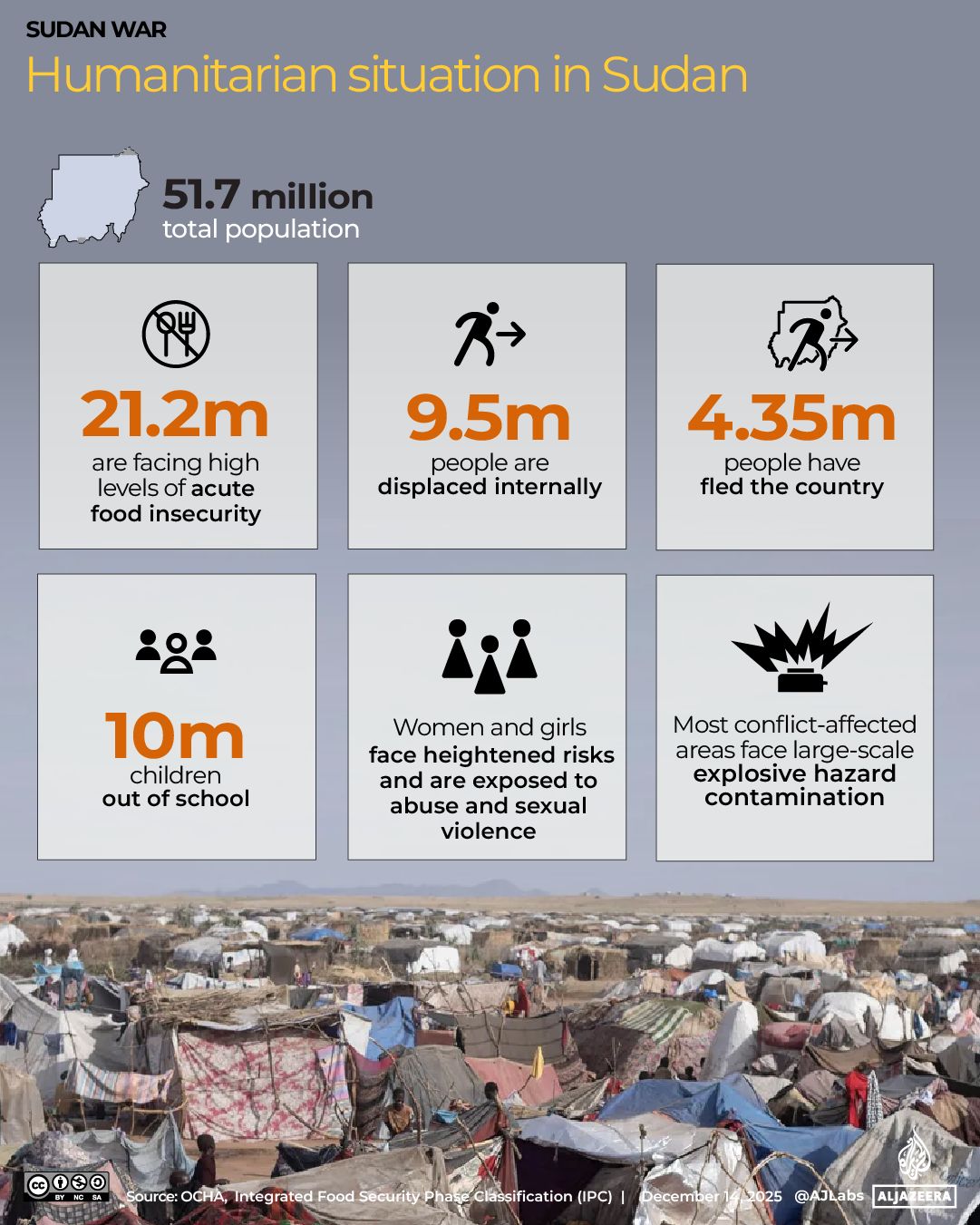
According to the latest figures from the UN, at least 21.2 million people are facing high levels of acute food insecurity, 9.5 million people are displaced internally, 4.35 million people have fled the country, and 10 million children are out of school with classrooms destroyed, occupied, or unsafe to reach.

Women and girls face heightened risks, with survivors reporting mass executions, torture, rape, sexual abuse, and ransom demands by RSF fighters.

(Al Jazeera)

More than 9.5 million people displaced internally

According to the International Organization for Migration (IOM), Sudan is facing the world’s largest humanitarian and displacement crisis, with more than 9.5 million people internally displaced across 10,929 locations in 185 localities, spanning all 18 states of Sudan.

Most of the displaced have sought refuge in South Darfur (1.84 million), North Darfur (1.75 million) and Central Darfur (978,000). More than half, or 51 percent, of those displaced are children.

Even before the current war began, the IOM estimated that more than 2.32 million people had already been displaced in Sudan, mostly in Darfur, due to years of conflict and climate-driven crises.

Since April 2023, an additional 7.25 million people have been displaced within Sudan, including around 2.7 million from Khartoum state, 2 million from South Darfur and a similar number from North Darfur.

INTERACTIVE - Over 9.5 million displaced within Sudan -NOVEMBER 5, 2025-1765797184
(Al Jazeera)

More than 4.3 million refugees

In addition to 9.5 million internally displaced people, an estimated 4.34 million are refugees in neighbouring countries, bringing the total number of displaced across Sudan to about 14 million – more than a quarter of the country’s population of 51 million.

Most have sought refuge in Egypt (1.5 million), South Sudan (1.25 million) and Chad (1.2 million). Of those who fled, about 70 percent are Sudanese nationals, while 30 percent are non-Sudanese.

INTERACTIVE - Cross-border movement from Sudan - NOVEMBER 5, 2025-1765797181

Millions facing emergency levels of hunger

In September 2025, the Integrated Food Security Phase Classification (IPC) estimated that 21.2 million people, 45 percent of Sudan’s population, faced high levels of acute food insecurity. This includes 6.3 million people in Phase 4 or emergency conditions and 375,000 experiencing Phase 5 or famine-levels of hunger.

Famine is the worst level of hunger and occurs when people face severe food shortages, widespread malnutrition and high levels of death due to starvation.

El-Fasher in North Darfur and the besieged town of Kadugli in South Kordofan have been classified as being in famine. Conditions in the besieged nearby town of Dilling are believed to be similarly severe, with supply routes cut off and shortages worsening by the day.

The RSF took the city of el-Fasher, the capital of the state of North Darfur, in October after an 18-month campaign of siege and starvation. The city was the Sudanese army’s last stronghold in the region.

Those who fled el-Fasher, particularly children, are arriving in nearby towns like Tawila in acutely malnourished condition.

The UN Human Rights Office warned that the massacre at the end of the siege forced people to survive on peanut shells and animal feed, while satellite imagery showed bloodstains from mass killings and executions of civilians based on their ethnicity.

INTERACTIVE - SUDAN - FOOD INSECURITY - DEC15, 2025-1765797187
(Al Jazeera)

Healthcare infrastructure devastated

The war has shattered Sudan’s public infrastructure, including its health system. Fewer than 25 percent of hospitals are operational, leaving millions with no access to medical care amid rising disease outbreaks.

The World Health Organization has documented 200 attacks on health facilities and personnel, with 20 ambulances severely damaged or destroyed.

With healthcare access so limited, cholera has spread across Sudan, causing over 123,000 confirmed cases and more than 3,500 deaths.

INTERACTIVE - SUDAN - HEALTHCARE - DEC15, 2025 copy-1765797192
(Al Jazeera)