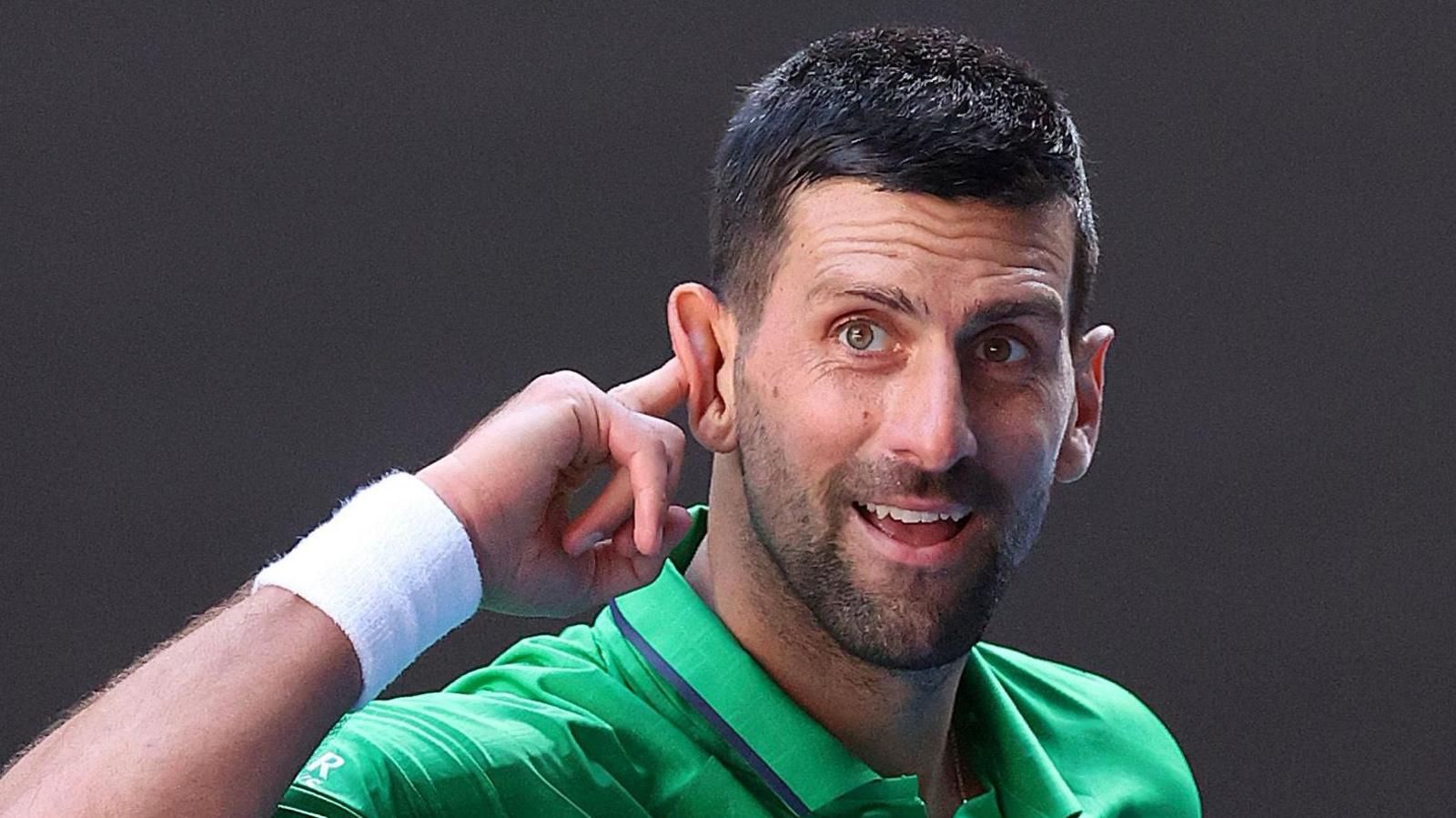
‘It’s not now or never’ – Djokovic targets elusive 25th Slam

Getty Images
  • 105 Comments

Novak Djokovic says he does not think the forthcoming Australian Open is “now or never” for his hopes of winning a standalone all-time record 25th Grand Slam title.

Djokovic, 38, has been tied on 24 major victories with Australia’s Margaret Court since his last triumph at the 2023 US Open.

Unsurprisingly, the Serb has shown signs of decline in recent years, yet still managed to reach the semi-finals of all four Grand Slams last year.

Given he is a record 10-time men’s champion in Melbourne, and has had plenty of recovery time going into the first major of the season, the consensus is that the Australian Open represents his best chance of landing the elusive record-breaking title.

“There has been a lot of talk about the 25th, but I try to focus myself on what I have achieved, not what I’m possibly achieving,” Djokovic, who is seeded fourth at Melbourne Park, said.

“I hope it comes to that [winning 25], but 24 is also not a bad number. I have to appreciate that and remind myself of the amazing career I had.”

Djokovic has never made a secret of his desire to achieve even more history, but is now attempting to release some of the “unnecessary” pressure he places on himself to surpass Court.

He starts his latest bid against Spain’s Pedro Martinez in Monday’s night session on Rod Laver Arena.

“I don’t think it’s needed for me to really go far in terms of make-it-or-break-it or a now-or-never type of mentality,” said Djokovic, who is aiming to become the oldest Grand Slam men’s champion in the Open Era.

    • 3 hours ago
    • 3 hours ago
    • 1 day ago

Djokovic is the last man other than Spain’s Carlos Alcaraz and Italy’s Jannik Sinner – who is bidding for a third straight success in Melbourne – to win a Grand Slam title.

Alcaraz, 22, and Sinner, 24, have swept the past eight majors between them, creating a compelling rivalry which is dominating the men’s game.

Last year, Djokovic reached the Australian Open semi-finals after a memorable quarter-final win over Alcaraz, but injured himself in the process and had to retire from his semi-final against Germany’s Alexander Zverev as a result.

“I know that when I’m healthy, when I’m able to put all the pieces of the puzzle together on a given day, I feel like I can beat anybody,” said Djokovic.

Why Djokovic left players’ union he co-founded

Djokovic also spoke for the first time publicly about his decision to walk away from the Professional Tennis Players’ Association – a union-style body he co-founded in 2020.

Having become disillusioned with its direction, Djokovic announced earlier this month he had “stepped away completely”, citing concerns about “transparency and governance”.

Last year the PTPA launched legal action against tennis’ governing bodies, including the ATP and WTA tours, over what it claimed were “anti-competitive practices and a blatant disregard for player welfare”.

However, it was telling Djokovic was not among the plaintiffs – and he became frustrated with his name being “overused” in PTPA business.

“I still have the opinion that the system is failing us and I think it has to change,” Djokovic said.

“I also didn’t like the way the leadership was taking the direction of the PTPA.

“Does that mean that I’m not supporting PTPA? No, I am. I am still wishing them all the best, because I think there is room and a need for 100% players-only representation organisation existing in our ecosystem.”

Djokovic’s comments came shortly after the PTPA announced it had reached an early stage settlement with Tennis Australia, which runs the Melbourne Grand Slam, in relation to the lawsuit.

The agreement could strengthen the PTPA’s hand against the other defendants – the ATP Tour, WTA Tour, French Tennis Federation, All England Club and US Tennis Association.

Related topics

  • Tennis

More on this story

  • Some tennis balls
    • 16 August 2025
    BBC Sport microphone and phone

Clippers rally past Raptors in OT for fifth straight NBA win

James Harden scored eight of his 31 points in overtime and ‌added 10 assists as the visiting Los Angeles Clippers defeated the Toronto Raptors 121-117.

Ivica Zubac had 16 points and 14 rebounds ‍for the Clippers, who overcame a 14-point ‍deficit to win their fifth game in a row on Friday night. The Clippers finished the game on a 20-8 surge – including Harden scoring the last eight points of regulation.

Recommended Stories

list of 4 itemsend of list

Kawhi Leonard did not play for the Clippers because of a sprained right ankle.

Scottie Barnes scored 24 points for the Raptors, who have lost two of three. Brandon Ingram added 19 points, and Jamal Shead had 15 points and 13 assists.

Nets ⁠112, Bulls 109

Michael Porter Jr scored 26 points, including the go-ahead layup with 5.4 seconds remaining, as host Brooklyn eked out a victory over Chicago after blowing ​a 20-point lead.

Noah Clowney added 23 points and 11 rebounds to help the Nets stop a five-game losing streak and earn ‍their second win over the Bulls this season. Day’Ron Sharpe contributed 14 points, rookie Danny Wolf chipped in 13, and Nic Claxton grabbed a season-best 14 rebounds.

Nikola Vucevic led the Bulls with 19 points and Dosunmu contributed 18 off the bench. Coby White contributed 17 and Matas Buzelis finished with 15 as Chicago lost for the fifth time in seven games.

Cavaliers ‍117, 76ers 115

Jaylon Tyson ⁠scored a career-high 39 points and set up Evan Mobley for the winning bucket as Cleveland posted a victory over Philadelphia to sweep their two-game road series in Philadelphia.

Tyson shot 13 of 17 from the field, 7 of 9 from 3-point range and 6 of 6 from the foul line in a splendid shooting effort. De’Andre Hunter added 16 points while Donovan Mitchell chipped in with 13 points and 12 assists for Cleveland, which played without Darius Garland.

Joel Embiid scored 33 points and Tyrese Maxey had 22 points and nine assists to pace the Sixers, who took their third loss in four games. Cleveland has won three of the past four.

Kings 128, Wizards 115

Russell Westbrook made a season-best six 3-pointers ​and scored 26 points, and Domantas Sabonis energised the Kings in his first appearance since November 16 to help Sacramento ‌beat visiting Washington.

Sabonis, back from a knee injury, made 5 of 6 shots and had 13 points, six rebounds and five assists in 21 minutes off the bench. DeMar DeRozan added 17 points as the Kings extended their season-best winning streak to four games.

Alex Sarr scored 19 points and Tre Johnson had 18 for the Wizards, who lost their fifth consecutive game. ‌Washington has dropped those contests by an average of 17.6 points.

Pacers 127, Pelicans 119

Jay Huff scored 29 points and grabbed nine rebounds, Andrew Nembhard went for a 19-point, 10-assist double-double, and Indiana scored its fourth win in the last ‌five games with a defeat of visiting New Orleans.

Huff set a career scoring high with ⁠13-of-17 shooting from the floor, including 3 of 6 from 3-point range. He was one of five Pacers to knock down multiple 3-point attempts, led by Pascal Siakam’s 4 of 8 effort. Siakam finished with 27 points, six rebounds and five assists.

Zion Williamson, who shot 10 of 12 from the field, led New Orleans with 27 points and seven assists. Trey Murphy III scored 22 points ‌for the Pelicans, but was held to 7-of-21 shooting from the floor.

Rockets 110, Timberwolves 105

Kevin Durant capped a 39-point performance by sinking four free throws in the final minute as Houston sealed a victory over visiting Minnesota.

Durant finished 11 of 18 from the floor and 6 of 8 from 3-point range to ‍lead Houston’s comeback from a 12-point deficit. Alperen Sengun posted 25 points and 14 rebounds before fouling out late. Reed Sheppard and Amen Thompson each added 14 points for the Rockets.

GB snowboarder Bankes wins first World Cup race since injury

Getty Images

Great Britain’s Charlotte Bankes won her first Snowboard Cross World Cup race since breaking her collarbone in April with a dominant display in Dongbeiya.

The 30-year-old showed she is in fine form heading into the Winter Olympics in Milan-Cortina, moving through qualification at the Chinese resort as the fastest athlete, then winning both her quarter and semi-final.

Bankes then triumphed in the Big Final, finishing ahead of Australian Josie Baff and France’s Chloe Trespeuch to seal the second World Cup event of the season.

The win is Bankes’ first podium finish since she took bronze at the Montafon World Cup in March, and is her first victory since the Gudauri World Cup the same month.

Having fully recovered from the injury she sustained at the final World Cup event of last season, the two-time Crystal Globe winner now looks set to challenge for an Olympic medal in Italy.

The then reigning world champion, Bankes was knocked out in the quarter-finals at the 2022 Games in Beijing.

A second set of races will be held in Dongbeiya on Sunday, while the 2026 Winter Olympics open on 6 February.

Meanwhile, Neil Simpson took his third World Cup podium of the week with silver in the Saalbach World Cup Super G races on Friday.

Racing alongside guide Rob Poth, Simpson secured his first ever Super G World Cup podium in the discipline in which he won gold at the 2022 Paralympic Winter Games and the 2023 World Championships.

Related topics

  • Winter Sports
  • Snowboarding

GB snowboarder Bankes wins first World Cup race since breaking collarbone

Images courtesy of Getty

Charlotte Bankes, a British snowboarder, won her first Snowboard Cross World Cup competition in Dongbeiya since breaking her collarbone in April.

The 30-year-old showed promise as she entered the Winter Games in Milan-Cortina, passing the Chinese resort’s qualifying process as the fastest athlete and claiming both her quarter- and semi-final victories.

Then, to cap off the second World Cup competition of the year, Bankes won the Big Final, beating Josie Baff of Australia and Chloe Trespeuch of France.

The victory is Bankes’ first podium appearance since she won the Gudauri World Cup the same month as she took bronze at the Montafon World Cup in March.

The two-time Crystal Globe winner is now looking poised to challenge for an Olympic medal in Italy after fully recovering from the injury she sustained at the end of last year’s World Cup.

Bankes, the then-reigning world champion, was eliminated from the 2022 Beijing Games quarter-finals.

Dongbeiya will host a second race on Sunday as part of the 2026 Winter Olympics, which will begin on February 6.

Neil Simpson also won the Saalbach World Cup Super G races on Friday, earning his third World Cup podium of the week.

Simpson won gold at the 2022 Paralympic Winter Games and the 2023 World Championships while competing with guide Rob Poth for his first Super G World Cup podium in the same category.

related subjects

  • Winter sports
  • Snowboarding

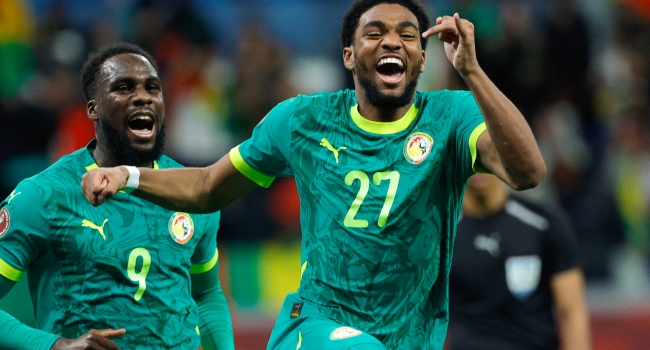
AFCON Final: Senegal Raise Concerns Over Security, Ticketing, Others

The Senegalese national team have raised concerns over security arrangements, ticketing, accommodation, and training facilities ahead of the 2025 Africa Cup of Nations final.

The country’s team will take to the pitch in the AFCON 2025 final following a victory recorded against Egypt in the semi-final on Wednesday.

A statement released on Saturday by the Secretariat of the Teranga Lions of Senegal to the Confederation of African Football and the public, noted that it was compelled to speak out “for the sake of transparency and defence of the interests of the Senegal national team,” following what it described as several malfunctions observed during preparations for the final.

It drew attention to lapses in security during the team’s arrival in Morocco.

“The FSF deplores the clear absence of adequate safety device when the Senegalese delegation arrived at the Rabat railway station,” the communiqué read, warning that the situation exposed players and officials “to a promiscuity and risks incompatible with the standards of a competition of this magnitude and the standing of a continental final.”

Another major source of frustration, according to the federation, is ticketing issues.

“The official endowment is only two VVIP tickets,” the FSF said, lamenting the lack of access to VIP and VVIP tickets for the final, unlike the semi-finals.

While the federation confirmed it had purchased the maximum number of tickets authorised by CAF — 300 Category 1, 850 Category 2, and 1,700 Category 3 — it stressed that “these quantities, although fully acquired, remain insufficient in relation to demand.”

On preparations on the pitch, Senegal rejected the proposed training venue, citing concerns over fairness.

“The FSF has officially notified the Confederation of African Football (CAF) of its categorical refusal to hold its training sessions at the Mohammed VI Complex,” the communiqué stated, explaining that the facility serves as “the base camp of the opposing team, which raises a problem of sporting fairness.”

It further noted that, as of the time of the statement, Senegal had “not yet received notification from the training site of the Senegal national team.”

READ ALSO: ACF Fiorentina President Rocco Commisso Dies At 76

The federation also disclosed challenges surrounding the team’s accommodation, revealing that formal action was required before acceptable arrangements were made.

“Regarding hotel logistics, the FSF informs that an official protest by mail was necessary to win the case,” the statement said, adding that “a 5-star hotel was finally awarded to the Lions, thus guaranteeing the required recovery conditions.”

Sudan: A truce of separation

Since the outbreak of war in Sudan, talk of “humanitarian ceasefires” has become a recurring political refrain, invoked whenever the humanitarian catastrophe reaches its peak. However, the ceasefire being proposed today comes in a different and dangerous context. It follows the committing of genocide and ethnic cleansing by the Rapid Support Forces (RSF) militia in the city of el-Fasher in Darfur – one of the most horrific humanitarian crimes in Sudan’s modern history, and indeed in the history of humanity.

El-Fasher, once a symbol of diversity and coexistence, has been turned into a devastated city emptied of its population. In the aftermath of this major crime, the international community has once again returned to proposing a “humanitarian ceasefire” as an option. This calls for a careful political reading that does not stop at moral slogans, but instead unpacks the motives and potential consequences – especially with regard to Sudan’s geographic, social, and political unity.

A path to peace or a gateway to disintegration?

In popular culture, there is a saying: “If you see a poor man eating chicken, then either the poor man is sick or the chicken is sick.” This proverb captures the essence of the legitimate political suspicion regarding the timing of this ceasefire.

Truces for humanitarian purposes, in principle, are meant to alleviate civilian suffering and may pave the way towards ending conflicts. In the case of Sudan, however, what raises alarm is that this ceasefire was proposed after the catastrophe occurred, not before it – after the RSF categorically rejected any humanitarian commitments, including the protection of hospitals and the securing of safe corridors for civilians to flee.

Humanitarian organisations have been operating in most regions of Sudan, including Darfur, despite security complexities and in the absence of a legal, signed ceasefire. This makes the question unavoidable: Why push for a ceasefire now? And in whose interest is this ceasefire being proposed at this particular moment?

This contradiction opens the door to suspicion that the objective goes beyond humanitarian concerns, extending instead to reshaping the political and geographic reality of the country.

Ceasefires in historical experience

Modern history is full of examples where humanitarian ceasefires transformed from de-escalation tools to preludes to fragmentation and secession. In Western Sahara, Libya, Somalia, Yemen, and South Sudan, ceasefires were not always bridges to peace; more often, they were transitional stages towards the division of states and the erosion of sovereignty.

In the Sudanese context, specifically, Operation Lifeline Sudan launched by the UN in 1989 stands as a stark example of how humanitarian action was employed as a political entry point, eventually culminating in the secession of South Sudan through a referendum that followed a long process of normalising division.

The current situation, however, is far more dangerous and complex. It does not involve a government negotiating with a political movement holding national demands, but rather an unprecedented scenario in which two parties both claim to represent “the government” within a single state: The legitimate government of Sudan, on the one hand, and the RSF, seeking to establish a parallel entity, on the other.

The trap of disguised political recognition

Negotiation between “two governments” within one state is not only unprecedented in Sudan; it represents a grave political trap aimed at extracting recognition of a de facto force under a ceasefire umbrella.

The mere act of joint signing grants the rebel party parity and legitimacy, fundamentally contradicting the immense sacrifices made by the Sudanese people in defence of the state’s unity and sovereignty.

This path constitutes a direct violation of the core principles for which martyrs fell and women were widowed:

First, the principle of unity: The RSF has violated it by importing foreign elements and mercenaries, exploiting external support to impose forced demographic changes, and attempting to reshape Sudan according to agendas that bear no relation to the national will.

Second, the principle of unified government and constitutional legitimacy: The pursuit of a “parallel government” directly undermines this principle. It deals a blow to the foundations upon which the state has stood since independence, and opens the door to political chaos and institutional fragmentation.

Third, the unity of the military institution: The RSF violates it by receiving weapons and combat equipment from foreign states, and relying on looting and self-financing, completely contradicting any talk of security reform or the building of a unified national army. In practice, it lays the groundwork for multiple armies within a single state.

The ambiguity of negotiations and the absence of transparency

Concern deepens with the total lack of transparency surrounding the truce process. Why are negotiations conducted behind closed doors? Why are the Sudanese people excluded from knowing what is being agreed on in their name? How can foreign states negotiate on behalf of a people bleeding under war and displacement? Who has more right to oversee peace efforts than the people themselves? Are there priorities greater than commanding an ongoing war in which everyone is involved?

More alarming still is that the party “holding the pen” in the political process is the same party “holding the gun”, practising killing and ethnic cleansing – an ethical and political paradox that cannot be accepted.

A comprehensive reading of events suggests that this ceasefire is more likely to be an entry point for dismantling the Sudanese state than a bridge to saving it. It may lead to the entrenchment of division: Zones of influence, multiple armies, different currencies, parallel central banks, competing foreign ministries, and conflicting passports – a state without a state, and sovereignty without sovereignty.

This is a contagious disease that, sooner or later, will infect everyone along the coast, the river’s mouth and its source alike.

Between humanitarian duty and national vigilance

No one disputes the priority of improving humanitarian conditions and protecting civilians. Yet the ceasefire being pushed today may carry temporary stability at the cost of a devastating strategic price: The erosion of Sudan’s unity.

National duty demands the highest levels of vigilance and caution, lest the ceasefire turn into a political trap, pushing the project of state disintegration. While we should fully acknowledge that the crisis has deep, accumulated historical roots, we should remember that history does not forgive those who squander their homeland, nor does it absolve those who trade national sovereignty for foreign dictates.

Hope remains pinned on the awareness of the Sudanese people and their ability to unite in confronting this decisive moment, in defence of one homeland, one army, and one state – one that rejects partition and guardianship, accepting only the will of its people through a system and framework that do not involve seizure by force or the imposition of reality at gunpoint.