Shields signs £6m ‘statement’ multi-fight contract

Getty Images
  • 2 Comments

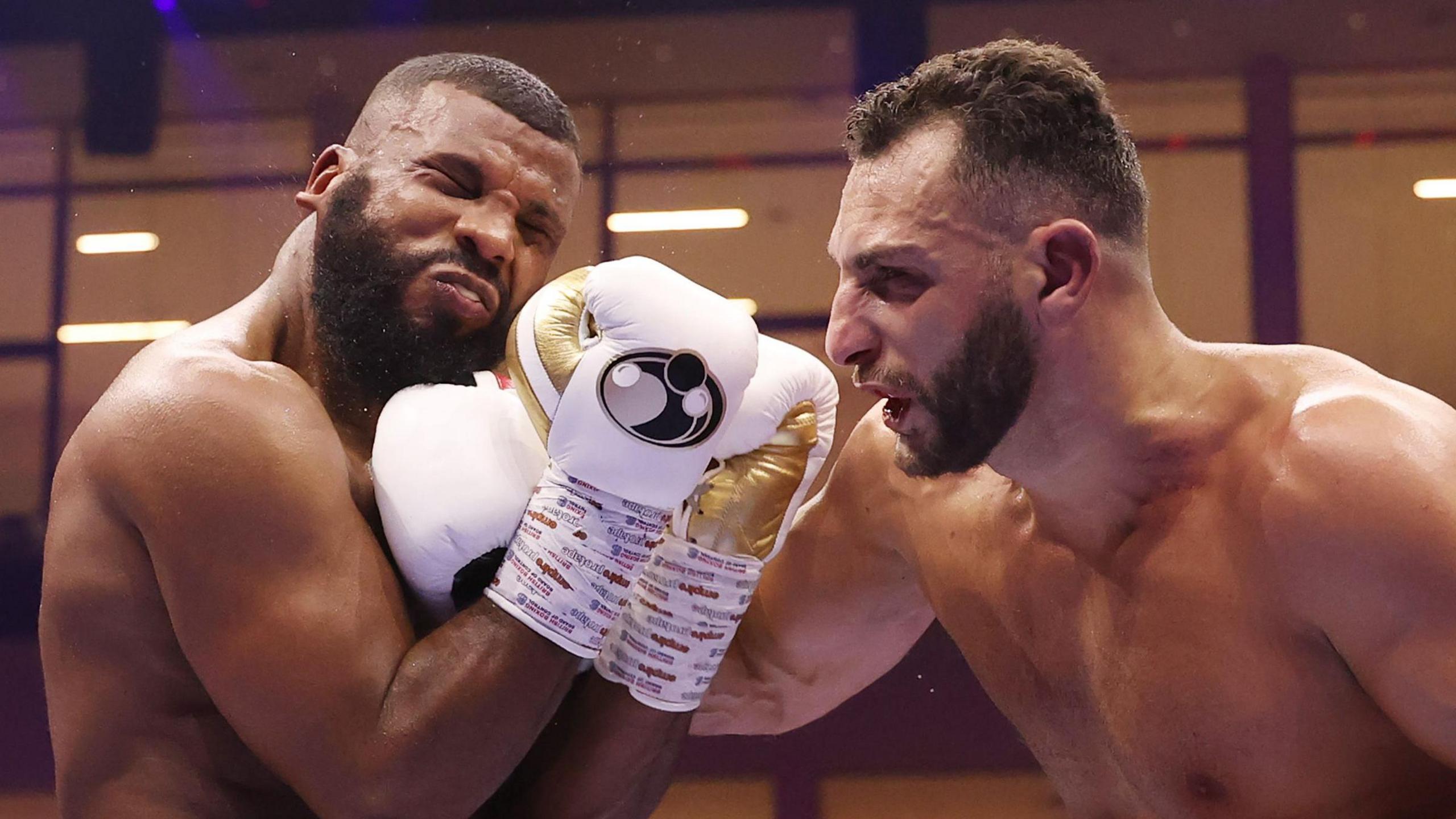
Claressa Shields has signed an $8m (£6.1m) multi-fight contract with Wynn Records and Salita Promotions, which she says will help her “keep breaking barriers inside and outside the ring”.

The American, who has won undisputed titles in three weight classes and is a two-time Olympic gold-medallist, is one of women’s boxing’s biggest stars.

The 30-year-old turned down interest from Jake Paul’s Most Valuable Promotions (MVP), which includes top female talent such as Savannah Marshall and Chantelle Cameron, before signing the deal.

Shields says the contract will give her a bigger platform to continue fighting for equality in the sport.

“This deal represents more than just a contract, it’s a statement. I’ve fought my entire career to prove that women’s boxing deserves equal respect, equal pay, and equal opportunity,” said Shields.

“Partnering with Salita Promotions and Wynn Records gives me the platform to keep breaking barriers inside and outside the ring. Together, we’re building something that’s never been done before.”

Wynn Records describes itself as a leading entertainment and music label, while boxing’s Salita Promotions was set up by former world title challenger Dmitriy Salita in 2010.

Shields’ last fight was a win over Lani Daniels in July when she retained her undisputed heavyweight crown and extended the unbeaten start to her career to 17 bouts.

Related topics

  • Boxing
    • 30 October
    Frazer Clarke faces off with Jeamie TKV
    • 28 April 2024
    Split image of Claressa Shields, Paddy Pimblett and Chris Eubank Jr

More boxing from the BBC

    • 16 August
    BBC Sport microphone and phone

Shields signs £6m ‘statement’ multi-fight contract

Getty Images
  • 2 Comments

Claressa Shields has signed an $8m (£6.1m) multi-fight contract with Wynn Records and Salita Promotions, which she says will help her “keep breaking barriers inside and outside the ring”.

The American, who has won undisputed titles in three weight classes and is a two-time Olympic gold-medallist, is one of women’s boxing’s biggest stars.

The 30-year-old turned down interest from Jake Paul’s Most Valuable Promotions (MVP), which includes top female talent such as Savannah Marshall and Chantelle Cameron, before signing the deal.

Shields says the contract will give her a bigger platform to continue fighting for equality in the sport.

“This deal represents more than just a contract, it’s a statement. I’ve fought my entire career to prove that women’s boxing deserves equal respect, equal pay, and equal opportunity,” said Shields.

“Partnering with Salita Promotions and Wynn Records gives me the platform to keep breaking barriers inside and outside the ring. Together, we’re building something that’s never been done before.”

Wynn Records describes itself as a leading entertainment and music label, while boxing’s Salita Promotions was set up by former world title challenger Dmitriy Salita in 2010.

Shields’ last fight was a win over Lani Daniels in July when she retained her undisputed heavyweight crown and extended the unbeaten start to her career to 17 bouts.

Related topics

  • Boxing
    • 30 October
    Frazer Clarke faces off with Jeamie TKV
    • 28 April 2024
    Split image of Claressa Shields, Paddy Pimblett and Chris Eubank Jr

More boxing from the BBC

    • 16 August
    BBC Sport microphone and phone

Shields signs £6m ‘statement’ multi-fight contract

Getty Images
  • 2 Comments

Claressa Shields has signed an $8m (£6.1m) multi-fight contract with Wynn Records and Salita Promotions, which she says will help her “keep breaking barriers inside and outside the ring”.

The American, who has won undisputed titles in three weight classes and is a two-time Olympic gold-medallist, is one of women’s boxing’s biggest stars.

The 30-year-old turned down interest from Jake Paul’s Most Valuable Promotions (MVP), which includes top female talent such as Savannah Marshall and Chantelle Cameron, before signing the deal.

Shields says the contract will give her a bigger platform to continue fighting for equality in the sport.

“This deal represents more than just a contract, it’s a statement. I’ve fought my entire career to prove that women’s boxing deserves equal respect, equal pay, and equal opportunity,” said Shields.

“Partnering with Salita Promotions and Wynn Records gives me the platform to keep breaking barriers inside and outside the ring. Together, we’re building something that’s never been done before.”

Wynn Records describes itself as a leading entertainment and music label, while boxing’s Salita Promotions was set up by former world title challenger Dmitriy Salita in 2010.

Shields’ last fight was a win over Lani Daniels in July when she retained her undisputed heavyweight crown and extended the unbeaten start to her career to 17 bouts.

Related topics

  • Boxing
    • 30 October
    Frazer Clarke faces off with Jeamie TKV
    • 28 April 2024
    Split image of Claressa Shields, Paddy Pimblett and Chris Eubank Jr

More boxing from the BBC

    • 16 August
    BBC Sport microphone and phone

UN sounds alarm over rising hunger crisis in eastern DR Congo

The number of people facing emergency levels of hunger in the eastern Democratic Republic of Congo has nearly doubled since last year, the United Nations has warned.

The UN’s World Food Programme (WFP) said on Friday a “deepening hunger crisis” was unfolding in the region, but warned it was only able to reach a fraction of those in need due to acute funding shortages and access difficulties.

Recommended Stories

list of 3 itemsend of list

“We’re at historically low levels of funding. We’ve probably received about $150m this year,” said Cynthia Jones, country director of the WFP for the DRC, pointing to a need for $350m to help people in desperate need in the West African country.

“One in three people in DRC’s eastern provinces of North Kivu, South Kivu, Ituri, and Tanganyika are facing crisis levels of hunger or worse. That’s over 10 million people,” Jones said.

“Of that, an alarming three million people are in emergency levels of hunger,” she told a media briefing in Geneva.

She said this higher level meant people were facing extreme gaps in food consumption and very high levels of malnutrition, adding that the numbers of people that are facing emergency levels of hunger is surging.

“It has almost doubled since last year,” said Jones. “People are already dying of hunger.”

Years-long conflict

The area has been rocked by more than a year of fighting. The Rwanda-backed M23 armed group has seized swaths of the eastern DRC since taking up arms again in 2021, compounding a humanitarian crisis and the more than three-decade conflict in the region.

The armed group’s lightning offensive saw it capture the key eastern cities of Goma and Bukavu, near the border with Rwanda. It has set up an administration there parallel to the government in Kinshasa and taken control of nearby mines.

Rwanda has denied supporting the rebels. Both M23 and Congolese forces have been accused of carrying out atrocities.

Jones said the WFP was facing “a complete halt of all emergency food assistance in the eastern provinces” from February or March 2026.

She added that the two airports in the east, Goma and Bukavu, had been shut for months.

WFP wants an air bridge set up between neighbouring Rwanda and the eastern DRC, saying it would be a safer, faster and more effective route than from Kinshasa, on the other side of the vast nation.

In recent years, the WFP had received up to $600m in funding. In 2024, it received about $380m.

What if … the United Nations was disbanded next Friday?

People have been asking “What if …” forever. Over the next few months, Al Jazeera will explore some of the biggest challenges of our time and ask leading experts: “What if …”

Established 80 years ago in October, the United Nations has become a fixture in the lives of people across the globe.

Recommended Stories

list of 4 itemsend of list

Over the last eight decades, as well as playing a vital role in steering the world through global health crises, the organisation has played a central role in shaping international law, diplomacy, humanitarian aid, peacekeeping, and, rightly or wrongly, preserving what most people understand to be the world order.

However, while many still regard its role as vital, the UN has come under increasing criticism for prioritising the agendas of the Western world over the needs of the Global South. It has also faced scrutiny for failing to prevent mass atrocities, including the genocides in the 1990s in Rwanda and Bosnia and Herzegovina, and the brutal violence in Sudan’s Darfur region, despite the presence of UN troops.

Many would argue that the organisation has been entirely sidelined during Israel’s war on Gaza, with its legitimacy contested by Israel and its traditional role in brokering a ceasefire reflective of international law usurped by the United States.

So, why bother with the UN at all? Could individual states not just deal with their own problems? After all, the UN is not even the first attempt at some form of global governance. Its predecessor, the League of Nations, founded in 1920, barely survived the second world war. Why should we expect the UN to continue forever?

Al Jazeera spoke to several experts and asked them to break down what they thought would happen if the UN were disbanded next Friday.

The UN flag flies during the United Nations General Assembly, September 22, 2022 [Ted Shaffrey/AP Photo]

What would happen to migration?

If you disbanded the UN on a Friday, you would be looking for a way to reinvent it by Monday.

So many of the challenges the world faces today are transnational. Take refugees, for example: there are at least 100 million refugees, displaced people and irregular migrants globally. That is not a problem any one state can solve; it needs a transnational response.

We are already seeing aid cuts, particularly from the US, reducing food security in UN-supported camps and driving up malnutrition and social tensions.

As assistance dries up, more refugees are moving from camps to urban areas. There, they can sometimes survive through the informal economy, but their arrival — through no fault of their own — can place new pressures on the resources and services available within those urban areas.

If the UN were to disappear entirely, some refugees would undoubtedly move [from camps] towards the Global North; a process that would probably have an impact on Europe within a year. But others would find themselves trapped in increasingly precarious situations. The poorer the refugees, the less able they are to travel.

Without the UN, states would no longer be held to account for how they treat refugees, and standards would quickly fall. You would see the US model of unilateral action spreading — and groups like the Gaza Humanitarian Foundation (the Israeli-US private aid model that has resulted in more than 600 people being killed trying to access food) stepping into the vacuum.

And of course, there are thousands of jobs — both within the UN and among its partner organisations and suppliers — that would also vanish overnight.

Jeff Crisp, a research associate at the Refugee Studies Centre at the University of Oxford, formerly with the UN High Commissioner for Refugees

Migrant children seeking asylum with their relatives play as they wait inside a shelter in the hope of getting an appointment with the U.S. Customs and Border Protection (CBP One) ahead of U.S. President-elect Donald Trump's inauguration, in Matamoros, Mexico January 18, 2025. REUTERS/Daniel Becerril
Migrant children seeking asylum with their relatives play as they wait inside a shelter [File: Daniel Becerril/Reuters]

What would happen to international law?

For the larger states, especially the US, international law has always come second to sovereignty. The influence of bodies like the International Court of Justice (ICJ) and the International Criminal Court (ICC), which enforce international law under separate statutes, has been shrinking for some time.

So when we talk about the legal implications of disbanding the UN, we are really discussing a process that is already under way. Great institutions have withered before – the League of Nations being the obvious example. The UN has been losing political clout for a while and could disappear altogether, especially since much of its funding comes from the US. If it did, we would likely return to a world of sealed borders and pure Westphalian politics (a system where each state has absolute sovereignty over its own territory) – not exactly ideal.

Even without the UN, international law would not vanish. NGOs and non-state actors can still use national courts to hold actors accountable. For example, (independently of the UN), the Palestinian human rights organisation Al-Haq is pursuing British companies for providing parts to the Israeli military. Following China’s forced organ harvesting case, trade bodies took action against the Chinese medical industry, affecting research publications. Lawyers at the ICC have also pioneered cross-border initiatives, notably investigations into alleged crimes against the Rohingya in Bangladesh and Myanmar, showing how prosecutors can coordinate across jurisdictions to hold perpetrators accountable.

The (international courts) would probably survive, and laws against genocide remain. But enforcement would increasingly fall on states, corporations, and civil society – an unexpected burden, but one someone has to bear.

Geoffrey Nice, UK barrister and former lead prosecutor in the trial of Slobodan Milosevic

ICC
People stand outside the ICC in The Hague, Netherlands, September 22, 2025 [Piroschka van de Wouw/Reuters]

Could individual states take over peacekeeping?

Unilateral peacekeeping is not really peacekeeping – it is occupation. This is why countries tend to avoid it or seek a multilateral mandate, such as from the African Union. But even then, they go back to be ratified by the UN.

That is the UN’s role in peacekeeping: it gives legitimacy, and it will likely retain that until the UN itself loses all legitimacy. Compare it to, say, the G20. The powers there and their hangers-on have the financial and military capacity to do much of the UN’s work, but it would always be seen – correctly – as the big economic powers imposing their will upon poorer ones. The only way to get around that is to have the UN, or something similar.

But that legitimacy is under threat. It cannot, or won’t, enforce any measures against the Security Council’s permanent members (China, France, Russia, the United Kingdom, the US). This really makes a joke of international law. Any law that cannot be enforced is really a legal fiction, and that erodes everything. Look at where we are: the ICJ, the ICC – we have (Russian President Vladimir) Putin and (Israeli Prime Minister Benjamin) Netanyahu flying all over the world without any apparent threat.

Could we do without the UN in its current form? Yes. If we were to design it today, the odds are it would be in a radically different form from the one we have, whose structures were agreed upon in 1945. The world is a very different place now than it was then.

Ramesh Thakur, former assistant UN secretary-general

UNIFIL peacekeeping troops on Lebanon-Israel border
UNIFIL peacekeeping troops patrol the southern Lebanese village of Ramyah near the border with Israel [File: Mahmoud Zayyat/AFP]

What would happen to the World Health Organization?

If we disbanded the WHO on Friday, the world would scramble to recreate it almost immediately. Its strength lies in its structure — every member state has one equal vote, making it a truly global body.

Its absence would be felt most acutely in low-income countries. Many lack the infrastructure to approve medicines or vaccines and rely on the WHO to do that. Without it, people would either go without essential treatments or receive unsafe, unvetted ones – and people would die.

We would also lose vital pandemic preparedness. The WHO’s Global Influenza Surveillance and Response System has operated for 50 years and built deep trust with governments. It does not just track influenza but all major viruses, giving countries early warning for outbreaks. For example, it is currently monitoring the H5N1 virus spreading among animals in North America. Humans have caught it from animals, but human-to-human transmission is only a mutation away – something the WHO is closely watching, even as other agencies face funding cuts.

Vaccine equity is another crucial area. During the COVID-19 pandemic, smaller nations struggled to access vaccines until the WHO intervened. It also helps protect low-income populations from exploitation by commercial interests by setting global health standards and highlighting risk factors.

The WHO is far from perfect – governance and efficiency can certainly improve – but the world cannot function safely without it. Its absence would leave a vacuum that no single government or organisation could fill.

Dr Soumya Swaminathan, paediatrician and former chief scientist at the WHO

A worker arranges UN's World Health Organisation (WHO) humanitian aid in a UAE plane headed to Egypt's El-Arish airport on January 24, 2025 at an airport in Dubai, as part of a humanitarian mission organised by the United Arab Emirates to deliver humanitarian assistance in the Gaza Strip after a ceasefire deal in the war between Israel and Hamas. (Photo by Fadel Senna / AFP)
A worker arranges WHO aid in a UAE plane headed to Egypt’s El Arish airport on January 24, 2025, at an airport in Dubai, as part of a humanitarian mission organised by the United Arab Emirates for Gaza [Fadel Senna/AFP]

Who would manage aid?

If we disbanded the UN, we would be forced to confront how deeply we have come to see such institutions as inevitable.

The UN, WHO, and USAID do enormous good – these are the organisations with the reach, funding, and infrastructure to change millions of lives. Smaller NGOs also make a real difference, but they rarely have the scale or stability to sustain global programmes.

When I managed a USAID health data initiative with a budget of about $1m a week, it seemed like straightforward development work – helping countries collect and use health data to guide policy. But over time, I saw how tightly political priorities in Washington shaped what we could and could not do.

The UN and similar bodies do not just deliver aid; they often reinforce the Global North’s narrative: we are developed, you are not; to progress, you must become like us.

That framing still carries a colonial legacy. Efforts to decolonise aid are under way, but they are uneven and incomplete.

If the UN were suddenly gone, we would scramble to fill the void with smaller, more local organisations. That could make aid more diverse and grounded – but also more fragmented, fragile, and uncertain. The real challenge would be imagining – and building – something genuinely different.

Professor James Thomas, author, But I Meant Well: Unlearning Colonial Ways of Doing Good; professor emeritus, Gillings School of Global Public Health, University of North Carolina at Chapel Hill

UNRWA distributes aid parcels to Palestinians in Gaza amid food crisis
UNRWA distributes aid parcels to Palestinians in Gaza amid food crisis [File: Anadolu]

How would international diplomacy work?

If the UN were abolished, many of the illusions of shared international norms would collapse.

Diplomacy would shift decisively towards bilateral and regional arrangements, making global engagement openly transactional.

In truth, much of, if not all, diplomacy already operates that way – (US President Donald) Trump’s transactional approach merely stripped away the pretence of a rules-based order.

Still, the UN’s framework, however flawed, provides a reference point for international law and moral pressure in crises and conflicts. Without it, even that limited leverage would vanish, and vulnerable populations would bear the brunt.

Many UN-backed treaties that attempt to uphold international norms would lose force or relevance. In fact, we are already seeing this erosion – the UN’s existence no longer guarantees the protection of those norms. Abolishing it would simply accelerate the breakdown, with regional blocs like the European Union or the African Union trying to fill the void, though none could replicate the UN’s global scope or legitimacy.

HA Hellyer, Royal United Services Institute and Center for American Progress

Empty seats as Israeli Prime Minister Benjamin Netanyahu addresses the 80th United Nations General Assembly
Empty seats as Israeli Prime Minister Benjamin Netanyahu addresses the 80th UNGA at the UN headquarters in New York, US, September 26, 2025 [Caitlin Ochs/Reuters]

What would happen to climate goals?

Whatever its faults, the UN remains the only forum where the world can speak with a unified voice on climate change and concrete decisions, such as the Green Climate Fund, the UN Framework Convention on Climate Change and the Paris Agreement, can be made.

The UN embodies the principles of justice and equity in managing the climate crises. That goes some way to explaining how, despite its faults, the UN has done a good job of providing the smaller, developing countries with the resources they need to help make the transition they need.

Without it, I cannot see any chance of the developed countries stepping up. I think we would quickly see the climate crisis be overtaken by market and neoliberal forces, with talk of “mitigation” prominent among richer countries and no help on offer to the poorer, developing countries.

Chukwumerije Okereke, professor of global climate and environmental governance, Bristol University

A man walks amid debris of a damaged house after the passage of Hurricane Melissa in Boca de Dos Rios village, Santiago de Cuba province, Cuba on October 30, 2025.
A man walks amid debris of a damaged house after the passage of Hurricane Melissa in Boca de Dos Rios village, Santiago de Cuba province, Cuba, on October 30, 2025 [AFP]

What else would the world miss?

The UN system is a fantastically complicated set of institutions.

It is much more than the Security Council and the General Assembly. There are a host of technical agencies covering things like telecommunications, intellectual property and so on.

These basically manage the wiring of an interconnected world. If you closed them, you would find that a whole bunch of routine international interactions would grind to a halt.

I think of these as the “wi-fi of multilateralism”: You don’t think about their existence most of the time, because they work OK, but if they went down, you would miss them a lot.

Honda profits tumble as Trump tariffs weigh on the carmaker

Honda profits have tumbled for the first fiscal half of the year through September as United States President Donald Trump’s tariffs weigh on the Japanese car and motorcycle brand.

On Friday, Honda reported that its profit fell by 37 percent.

Recommended Stories

list of 4 itemsend of list

Tokyo-based Honda Motor Co recorded a 311.8 billion yen ($2bn) profit for April-September, down from 494.6 billion yen ($3.2bn) a year before. Sales over the six months totalled 10.6 trillion yen ($69bn), down 1.5 percent from nearly 10.8 trillion yen ($70.5bn).

Honda lowered its profit projection for the fiscal year through March 2026 to 300 billion yen ($2bn), which would be a decline of 64 percent from 835.8 billion yen ($5.4bn) the year before. It had earlier forecast a 420 billion yen ($2.7bn) annual profit.

Honda, which makes the Accord sedan and Odyssey minivan, said an unfavourable currency rate also hurt its bottom line, erasing 116 billion yen ($756m) from its operating profit over the six months.

But Honda achieved record sales in motorcycles, led by strong results in the Asian region, excluding Vietnam. Honda said it sold more than nine million motorcycles in Asia during the first half, up from 8.8 million a year ago.

Honda’s motorcycle sales improved in every global region, except for Europe, at a record 10.7 million units sold.

Honda’s global vehicle sales in the first half totalled 1.68 million vehicles, down from 1.78 million. By region, vehicle sales grew in North America, but fell in Japan, the rest of Asia and Europe.

Although it helps that Honda produces many of its vehicles in the US, tariffs caused a decline of 164 billion yen ($1.1bn) in operating profit over the six-month period, the company said.

Adding to its challenges, Honda has faced a chip shortage after the Dutch government in late September took control of Nexperia, which is based in the Netherlands, but owned by Chinese company Wingtech Technology, citing national security concerns.

In response, China blocked shipments of chips from Nexperia’s plant in the southern Chinese city of Dongguan, though it has now allowed those exports to resume.