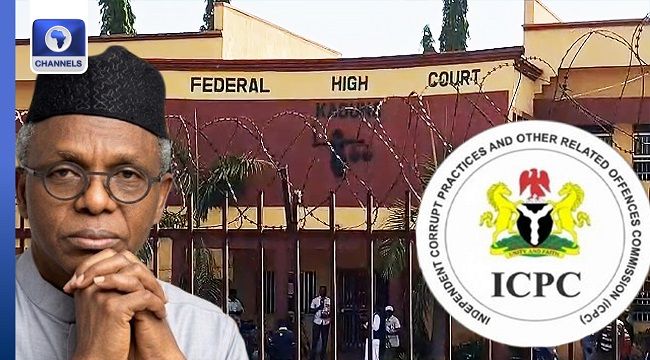
Former Kaduna State Governor, Nasir El-Rufai, has arrived at the Federal High Court sitting in the state capital for his arraignment by the Independent Corrupt Practices and Other Related Offences Commission (ICPC).
El-Rufai is expected to face charges related to alleged corruption and abuse of office.
The ICPC has filed charges against the former governor, accusing him of financial misconduct during his time in office.
Ahead of El-Rufai’s arraignment, security presence in the Kaduna State capital and around the court has been significantly heightened, with armed personnel stationed at key entry points to forestall any breakdown of law and order, as supporters and observers gathered outside the premises.
Proceedings are already underway, with the arraignment marking the first formal step in what could become a high-profile legal battle. Meanwhile, journalists were barred from entering the courtroom to witness the proceedings.
The former governor is being arraigned by the ICPC alongside one Joel Adoga before the Federal High Court.
READ ALSO: ICPC To Arraign El-Rufai Tuesday In Kaduna Over Fraud, Money Laundering Allegations
According to a statement issued on Monday by the Commission’s Head of Media and Public Communications, John Okor Odey, the arraignment follows charges filed under suit number FHC/KD/73/2026. The charges include alleged conversion and possession of public property, as well as money laundering.
In a related development, the ICPC has also filed a separate case against El-Rufai and Amadu Sule before the Kaduna State High Court in the Kaduna Judicial Division. The case, marked KDH/KAD/ICPC/01/26, contains allegations ranging from abuse of office and fraud to intent to commit fraud and conferring undue advantage.
The Commission disclosed that both charges were instituted on March 18, 2026, as part of its ongoing efforts to enforce accountability and combat corruption.
While the arraignment at the Federal High Court is scheduled for Tuesday, the date for the hearing at the State High Court is yet to be announced and will be communicated in due course.
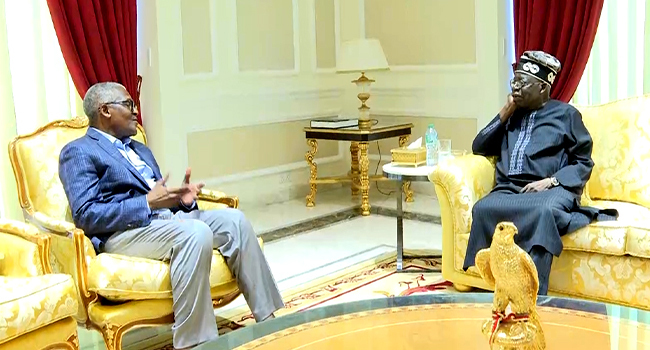
President of Dangote Group, Aliko Dangote, has raised concerns over the growing volatility in the global oil market, warning that the ongoing conflict in the Middle East could worsen economic hardship across Africa if not urgently resolved.
Speaking on the implications of the crisis, Dangote said that although Nigeria is not directly involved, the ripple effects of global oil price fluctuations would inevitably be felt.
READ ALSO: Trump Postpones Iran Power Plant Strikes After ‘Very Good’ Peace Talks
“It means quite a lot. We don’t have much to do with it, but I know the world is a global village. And it definitely will affect us, unfortunately, but we pray this situation will be sorted out,” he said after his visit to President Bola Tinubu in Lagos on Monday.
Dangote warned that a prolonged crisis could further destabilise economies, particularly in Africa, where fiscal buffers are limited, and debt pressures remain high.
“If it doesn’t de-escalate, we’ll end up paying big prices, like what I said earlier on to CNN. Africa is very busy paying debt, and putting this again on top of us is going to add a lot of hardship on people, on the government, on the people, on everybody, for something that we have no involvement in.”
He stressed that energy costs are central to nearly all sectors of the economy, meaning sustained increases would have widespread and cascading effects on livelihoods and production.
“So if this thing doesn’t de-escalate, it is going to keep going up and up and up, and governments cannot really now go and add salaries also. So people will really feel the hinge — barbers, people who are doing bread, people who have industries, who have to fire their own generator,” he said.
Dangote also pointed to possible global adjustments as countries respond to the crisis, including reduced work schedules and remote working arrangements to cut energy consumption.
“I mean, you can see in some countries today what they’ve done; they asked everybody to work from home. I think in Indonesia, they say, ‘No, only go to work four days a week.’ And they will look at the situation.
“If it doesn’t improve, they will ask everybody not to go to work anymore. We will do it like the time of COVID, where people will now go and work from home.
“If they don’t work that day, they won’t eat. So I think really we just need all hands on deck to pray that this thing comes to an end,” said the businessman.
Economic Boost
Meanwhile, Dangote described Tinubu’s recent state visit to the United Kingdom as a major boost for Nigeria’s economic prospects.
“Well, I think it has opened ways. Today, diplomacy without the economic part of it is not complete. So I believe his own visit will open quite a lot of doors,” he said.
Dangote described the major agreement worth about £746 million secured by Nigeria as significant, noting the difficulty often associated with securing such commitments.
“You can see the agreement that was signed for actually improving our infrastructure, especially in the ports and other areas, which is almost £746 million; that’s quite a lot. It’s not that easy dealing with the British, getting this kind of money out of them. They, too, are struggling on their own.”
He stressed that beyond the financial value, the deal represents renewed global confidence in Nigeria’s economy and leadership.
“But I think this is to show confidence. It’s not about the money. It’s about the confidence in Nigeria.
“So the moment that they do that, there will be other countries that will follow suit… Germany will come, others, so they will line up and start coming now,” he added.
Dangote also urged Nigerian investors to take advantage of the opportunities created by the agreements, particularly access to international credit facilities.
Middle East Conflict
Global oil prices have come under sustained pressure in recent weeks following escalating tensions in the Middle East, with fears of supply disruptions pushing crude prices upward.
The instability has contributed to increased costs of petroleum products across international markets, with countries heavily reliant on imports facing immediate consequences.
In Nigeria, the impact has been evident in rising pump prices, as refiners and marketers adjust to higher crude costs.
The Dangote Refinery, alongside other downstream operators, has implemented price increases in recent weeks, reflecting global market realities.
This has compounded the burden on consumers already grappling with inflation and high transportation costs.
Businesses across Nigeria have continued to express concern over rising energy costs, as many depend heavily on petrol and diesel to power generators due to persistent electricity challenges.
Bashir Bayo Ojulari, Group Chief Executive Officer of the Nigerian National Petroleum Company (NNPC) Limited, has said that Nigeria can increase oil production by about 100,000 barrels per day over the next few months.
Bayo Ojulari told Reuters on the sidelines of the CERAWeek by S&P Global conference in Houston, when asked if Nigeria could help make up for the crude shortfall resulting from the U.S.-Israeli war on Iran.
The country averaged about 1.6 million to 1.7 million barrels per day last year and is hoping to average 1.8 million bpd this year,
“We are building that capacity,” he said, though he added, “We are not like Saudi Arabia,” referring to the top OPEC member. “But we can contribute.”
During an onstage interview at the conference, Bayo Ojulari said NNPC completed a full portfolio review of its business last year and is beginning to implement changes this year.
One focus is working to improve execution and ensuring projects are delivered on budget and on time, after previous delays, he said.
His comments followed the country recording a combined crude oil and condensate production shortfall of about 16.6 million barrels in January and February of 2026, according to an analysis of data released by the Nigerian Upstream Petroleum Regulatory Commission (NUPRC).
According to the data, Nigeria produced a total of 50.5 million barrels of crude oil and condensate in January, while output declined notably in February, with total production dropping to approximately 41.6 million barrels, bringing cumulative output for the two months to 92 million barrels.
Based on the government’s benchmark in the 2026 budget, the country was expected to produce about 57 million barrels in January and 51.5 million barrels in February, to reach about 108.6 million barrels for the period.
The daily production averages provided in the NUPRC report further illustrated the extent of the gap. In January, total liquids output, according to the data, averaged about 1.63 million barrels per day, falling short of the 1.84 million barrels per day target by roughly 210,000 barrels per day.
In the same vein, in February, the shortfall widened significantly, with production averaging about 1.48 million barrels per day, leaving a gap of around 360,000 barrels per day.
According to the report, over the course of the two months, the daily deficits accumulated into the overall shortfall of about 16.6 million barrels, reinforcing the scale of Nigeria’s underperformance relative to its fiscal assumptions.
Crude oil production remained the dominant component of Nigeria’s output in the period under review. In January, crude production averaged 1.46 million bpd, before declining to roughly 1.31 million barrels per day in February, dragging down overall output for the month.
On the other hand, condensate production, while significantly smaller in volume, provided some support to total output. It averaged just over 116,000 barrels per day in January and about 122,000 barrels per day in February.
READ ALSO: [VIDEO] What Govt Can Do To Cushion Effects Of Soaring Oil Prices – PETROAN
The production gap is coming at a period when global oil prices have shown signs of strength, offering oil-producing countries an opportunity to boost earnings. Higher prices typically allow producers to maximise revenue, particularly when supported by increased output volumes.
Brent crude oil jumped back above $100 a barrel on Tuesday, a day after plunging more than 10 per cent in reaction to Donald Trump’s decision to delay fresh strikes on Iran as he hailed “very good” talks with Tehran.
Brent rose 2.9 per cent to $102.84, while West Texas Intermediate jumped 3.5 per cent to $91.20.
Trump’s comments sparked a sharp reversal on markets, with crude prices sinking as much as 14 per cent after rising around one per cent earlier on Monday.
Around 1145 GMT, international benchmark Brent North Sea crude was down 6.7 per cent at $104.70 per barrel.
Iran launched a new wave of missiles against Israel Tuesday, hours after US President Donald Trump hailed “very good” talks to end the war despite Tehran denying any dialogue had taken place.
Trump’s surprise disclosure — which prompted a positive response from jittery markets and pushed oil prices down — came ahead of a deadline he imposed for Iran to reopen the Strait of Hormuz shipping lane or see the US “obliterate” its power plants.
Trump said his administration was speaking with an unidentified “top person”, while warning if talks failed in the next five days “we’ll just keep bombing our little hearts out”.
Axios, citing an unnamed Israeli official, identified Trump’s interlocutor as Mohammad Bagher Ghalibaf, Iran’s speaker of parliament and one of its most prominent non-clerical figures.
The outlet reported US negotiators Steve Witkoff and Jared Kushner may meet an Iranian delegation for talks in Pakistan as soon as this week, with Vice President JD Vance possibly joining.
READ ALSO: Trump Postpones Iran Power Plant Strikes After ‘Very Good’ Peace Talks
White House spokeswoman Karoline Leavitt did not deny the reports, saying “speculation about meetings should not be deemed as final until they are formally announced by the White House”.
Pakistan’s Prime Minister Shehbaz Sharif said Monday he spoke with Iran’s President Masoud Pezeshkian, promising Islamabad’s help to bring peace to the region.
But Ghalibaf said on X that “no negotiations” were underway, insisting Trump was seeking “to manipulate the financial and oil markets”.
Iranian foreign ministry spokesman Esmaeil Baqaei said messages were received from “some friendly countries indicating a US request for negotiations aimed at ending the war”, but denied any such talks had taken place, Iran’s official IRNA agency reported.
A resident looks on as Iranian firefighters with the help of an excavator clear rubble from a destroyed residential building in northern Tehran on March 23, 2026. (Photo by AFP) /
Israeli Prime Minister Benjamin Netanyahu said he had spoken to Trump and acknowledged Washington thought a deal was possible, but vowed to continue striking Iran and Lebanon to protect Israel.
“Trump believes there is a chance to leverage the tremendous achievements of the IDF and the US military… in an agreement,” he said.
Early Tuesday, state-run Iranian media reported another round of missiles fired at Israel, and rescue services there showed images of a damaged building in the north but reported no casualties.
Lebanese state media said Israel carried out seven air raids on south Beirut overnight.
‘Trump blinked’
On Monday, Iran’s neighbours breathed a sigh of relief after Trump stepped back from his threat to target the country’s power infrastructure.
Tehran had vowed to deploy naval mines and strike power and water infrastructure across the region in retaliation, threatening to escalate an energy crisis of already historic proportions.
“Trump blinked first — out of a clear understanding that striking Iran’s energy infrastructure would trigger a direct and significant retaliation,” Danny Citrinowicz, a security analyst and former Israeli intelligence Iran expert, wrote on X.
Thousands of US Marines are headed to the Middle East, reinforcing America’s presence following weekend speculation Trump was mulling ground operations either to seize Iranian oil assets or to forcibly reopen the Strait of Hormuz.
‘Major threat’ to economy
Since the war erupted, Tehran has retaliated against US-Israeli attacks by throttling traffic through the Strait, a conduit for one-fifth of global crude, and by hitting Gulf energy sites and US embassies as well as targets in Israel.
International Energy Agency chief Fatih Birol warned if the war is protracted, daily oil losses would pave the way for a crisis worse than the combined impact of both 1970s oil shocks and Russia’s invasion of Ukraine.
Oil prices have been driven above $100 a barrel by the conflict, but they tumbled sharply after Trump’s announcements.
Asian markets were up Tuesday, following rises in Europe and on Wall Street in the wake of Trump’s announcement.
Trump said there were already “major points of agreement” with Iranian negotiators.
US conditions included Iran abandoning any nuclear ambitions and giving up its enriched uranium stockpiles, he said.
Lebanon ground campaign
Trump has offered shifting timelines and objectives for the war, saying Friday he was considering “winding down” the operation — only to later threaten Iran’s power plants, of which it has more than 90.
Netanyahu has spoken of a long-term campaign against Iran’s government, a sponsor of Hamas, which launched the October 7, 2023 attack that triggered the Gaza war.
In Lebanon, Israel has expanded its ground campaign against Iran-backed Hezbollah, warning of “weeks of fighting”, striking southern Beirut again Monday and claiming to capture two Hezbollah fighters.
Israel’s attacks in Lebanon have killed more than 1,000 people and displaced more than a million, Lebanon’s health ministry said.
The war has killed at least 3,230 Iranians, including 1,406 civilians, according to the US-based Human Rights Activists News Agency. AFP cannot access strike sites nor independently verify tolls in Iran.
The National President, Petroleum Products Retail Outlets Owners Association of Nigeria (PETROAN), Billy Gilly-Harry, has provided a couple of solutions following the continuous rise in prices of crude oil in the global market as a result of the Middle East war.
Brent crude oil jumped back above $100 a barrel on Tuesday, a day after plunging more than 10 per cent in reaction to President Donald Trump’s decision to delay fresh strikes on Iran as he hailed “very good” talks with Tehran.
Brent rose 2.9 per cent to $102.84, while West Texas Intermediate jumped 3.5 per cent to $91.20.
Trump’s comments sparked a sharp reversal on markets, with crude prices sinking as much as 14 per cent after rising around one per cent earlier on Monday.
Iran has, however, denied knowledge of any talks with Trump.
In Nigeria, the Dangote Petroleum Refinery announced a fresh increase in the price of Premium Motor Spirit (PMS) from N1,175 to N1,245 per litre.
A notice to marketers by the Refinery on Friday noted that its ex-depot (gantry) price would rise from N1,175 to N1,245 per litre, while the coastal price increased from N1,512,648 to N1,606,518 per metric tonne.
The notice explained that the revision reflected global market realities, including fluctuations in crude oil prices and increased shipping costs, which are beyond the Refinery’s control.
Dangote Warns Of Volatility
Responding to the crisis, Aliko Dangote, President of the Dangote Group, met with President Bola Tinubu on Monday and raised concerns about the growing volatility in the global oil market.
A fuel attendant pumps petrol into a motorcycle at a fuel station in Abuja on March 9, 2026, after transport fares increased following a recent hike in petrol prices. Africa is feeling the impact of rising oil prices and threats to shipping, as the continent again suffers from events largely beyond its control. Pump prices in Nigeria were up around 14 percent this week. (Photo by Light Oriye Tamunotonye / AFP)
Speaking on the implications of the crisis, Dangote said that although Nigeria is not directly involved in the war, the ripple effects of global oil price fluctuations would inevitably be felt.
“It means quite a lot. We don’t have much to do with it, but I know the world is a global village. And it definitely will affect us, unfortunately, but we pray this situation will be sorted out,” he said after his visit to President Bola Tinubu in Lagos on Monday.
NNPCL Group Chief Executive Officer, Bayo Ojulari, and Bayo Ojulari. Photo: Channels TV/Nosa Akhimien
Dangote warned that a prolonged crisis could further destabilise economies, particularly in Africa, where fiscal buffers are limited, and debt pressures remain high.
“If it doesn’t de-escalate, we’ll end up paying big prices, like what I said earlier on CNN. Africa is very busy paying debt, and putting this again on top of us is going to add a lot of hardship on people, on the government, on the people, on everybody, for something that we have no involvement in.”
He stressed that energy costs are central to nearly all sectors of the economy, meaning sustained increases would have widespread and cascading effects on livelihoods and production.
[embedded content]
READ ALSO: Dangote Refinery Increases Fuel Price As Iran War Drives Oil Surge
No Country Will Be Spared — IEA Birol
This is as Fatih Birol, International Energy Agency chief, on Monday, said that the global economy is under “major threat” from the energy crisis caused by the Middle East war, and “no country will be immune” to its effects.
Executive Director of the International Energy Agency (IEA) Fatih Birol delivers opening remarks during the Future of Energy Security Summit, hosted by the International Energy Agency and UK Government at Lancaster House in London, on April 24, 2025. (Photo by JUSTIN TALLIS / POOL / AFP)
Speaking at the National Press Club in Australia’s capital, Birol compared the current energy crisis to those of the 1970s and the impact of Russia’s 2022 invasion of Ukraine.
“This crisis, as things stand, is now two oil crises and one gas crash put all together,” Birol said.
“The global economy is facing a major, major threat today, and I very much hope that this issue will be resolved as soon as possible.
“No country will be immune to the effects of this crisis if it continues to go in this direction. So there is a need for global efforts.”
READ ALSO: ‘No Country Will Be Immune’ To Effects Of Global Energy Crisis: IEA Chief
‘How FG Can Reduce Impact Of High Petrol Prices’
As a follow-up to Dangote’s meeting, Gilly-Harry, while appearing as a guest on Channels Television’s The Morning Brief on Tuesday, listed some of the solutions to the crisis, including the construction of massive gas stations across the country.
“The meeting between Dangote and the president is on point, and if I had an opportunity to meet with the President, I believe I would be talking about those palliatives the government can put in place to cushion the effects of soaring oil prices.
“In this case, he is finally proffering the solution, which is why we are thankful that Dangote Refinery is a very strong structure at this time.
“What we should be looking at today should be solutions and not to cry on the shoulders of this war.
“One of those things will be a total pursuit of one of our gas alternatives, because we have gas, so it’s not like we are going to import gas from anywhere. What you and I are going to do is to make sure we have gas, and make sure we have enough investments.
“If we have enough gas stations on CNGs, introduce EVs, those will definitely help cushion the effects of the war.
“But in the interim, what I will suggest is that, could there be some sort of subsidy to cushion the effects of transportation costs for transport owners, especially commercial transport owners.
“For us in PETROAN, the profit margins are still very meagre at this time.
“The size of what we sell at the pump does not translate to the profit margins we make, because we are still very mindful that we need products in our stations, and we should be able to buy our products and be able to carry them around as fast as possible.”
READ ALSO: Middle East War: Dangote Meets Tinubu, Urges De-escalation Amid Global Oil Market Volatility
He noted that oil marketers are not taking undue advantage of Nigerians following the increase in prices of petrol across the country, adding that PETRON is already in talks with the government on how to get deeply involved in gas penetration across the country.
“We are not taking undue advantage of the situation. We have even come out with the idea of crowd-buying to get as much products as possible to as many outlets.
“So, if I had the opportunity to meet with the president, those are the things I would discuss. We need to have massive gas stations across the country, and we are willing to partner with the government, with the PCNG.
“We are already in talks with them on how PETROAN can be deeply involved in gas penetration across the country.
“In my opinion, I don’t think the government is folding its hands. I am certain the President is very keen on solving the challenges facing Nigerians. But I can’t speak for the government.
A Colombian military plane carrying 125 soldiers and crew members crashed on takeoff early Monday, killing at least 66 people and injuring dozens of others, officials said.
The C-130 Hercules aircraft went down shortly after departure from Puerto Leguizamo, near the southern border with Ecuador and Peru, strewing burning wreckage on the jungle floor.
A military source told AFP that 58 soldiers had died, along with six air force personnel and two police officers.
The updated toll came shortly after the local government secretary Carlos Claros told RCN television that 33 people had died, and that efforts were being made to treat and evacuate dozens of others injured.
He added that investigators were probing the cause of the crash.
Flames and thick black smoke rise from an Air Force Hercules that crashed during takeoff, as a member of the Colombian Police stands nearby, in Puerto Leguizamo, Colombia, near the southern border with Ecuador, on March 23, 2026. (Photo by daniel ortiz / AFP)
READ ALSO: 20 Killed In Cash-Packed Military Plane Crash In Bolivia
The border area where the plane went down has been the scene of heavy military activity in recent weeks, as the Colombian and Ecuadoran militaries try to tackle drug-running cartels and militias.
AFP images from the scene showed civilians clambering around the broken tail of the aircraft, marked FAC 1016, as smoke and flames billowed above the trees.
Defense Minister Pedro Sanchez expressed his “deep sorrow” over the disaster, saying it was too early to determine the cause of the crash.
“It is a deeply painful event for the country. May our prayers bring some measure of comfort,” Sanchez said.
General Carlos Fernando Silva Rueda said that 114 troops were aboard and 11 crew members, travelling from Puerto Leguizamo to an Amazon outpost nearby.
“The airport is small and there are several difficulties” hindering the evacuation of bodies and the injured, Jhon Gabriel Molina, governor of the Putamayo region, said in a Facebook video.
‘Horrific Accident’
Locals in the area recounted hearing a loud bang.
“I felt an explosion in the air and, when I looked up, the plane was flying close to the house on my plot,” said Noe Mota, a farmer.
Colombia’s President Gustavo Petro shared footage showing the aircraft attempting to gain altitude before plummeting down.
He described the crash on X as a “horrific accident” and emphasized a need to modernize Colombia’s military hardware, though he did not specifically link the crash to the plane’s condition.
People and soldiers stand near debris from an Air Force Hercules that crashed during takeoff, in Puerto Leguizamo, Colombia, near the southern border with Ecuador, on March 23, 2026. (Photo by daniel ortiz / AFP)
The crash is the second by a C-130 Hercules, a four-engine turboprop built by Lockheed Martin, in South America in under a month.
A Bolivian military cargo plane carrying banknotes crashed while landing near La Paz on February 27, leaving at least 24 people dead.
Renowned for its ability to operate from makeshift airstrips, it is widely used by militaries around the world.
A handout photo released by the Colombian Armed Forces shows members of the Colombian Aerospace Force lifting injured people on stretchers to be loaded onto an aircraft in Puerto Leguizamo, Colombia, near the southern border with Ecuador, on March 23, 2026. (Photo by Handout / Colombian Armed Forces / AFP)