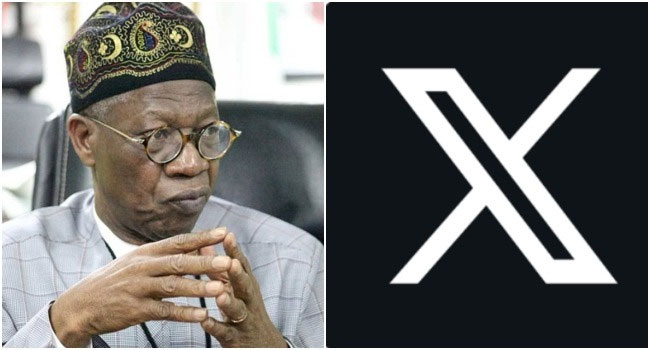

Lai Mohammed, the former minister of information and culture, defended the decision by the Muhammadu Buhari administration to suspend Twitter (now X) in Nigeria.
Mohammed made this statement on Channels Television’s Politics Today on Tuesday during an interview.
The ex-minister claimed that Twitter’s later demands forgoed and supported its position.
He cited his book Headlines and Soundbites: Media Moments That Define an Administration, which documents the correspondence between Nigeria and Twitter prior to the ban’s lifting.
You’ll find all the Twitter correspondence when you read the book. Prior to the signing of the agreement, Twitter was not even registered to conduct business in Nigeria, and neither was it required to pay taxes.
The agreement they signed with us is contained in this book, according to the NCC and other parastatals. Yes, we made the right decision, he said, “and it’s obvious.”
READ ALSO: A Court Orders Lai Mohammed to Inform About a FEMALE Agreement
He claimed that concerns over national cohesion and the dangers posed by unregulated social media activity were the reason the government took action rather than ego or political vendetta.
“It’s because there’s a country called Nigeria, and that’s where all kinds of freedom are available. You must not push that far enough to oppose one side of the nation.
He claimed that social media had reached a point where the gatekeepers were no longer present and that they were dangerous to everyone in contrast to the news media, radio, and television.
Unregulated Social Media
Mohammed began a public campaign against fake news, hate speech, and disinformation in 2017 after becoming aware of the government’s concerns.
He explained that the government initially desired self-regulation rather than legislation after numerous meetings were held with media stakeholders and social media companies.
“I believe the campaign against fake news and disinformation began in 2017.” In my subsequent visits to media outlets, I incorporated that information to help us avoid the risks of fake news, hate speeches, and disinformation.
We pleaded with several of these microblogs to support self-regulation. We didn’t even consider passing a law to stifle the media. However, he said, “Were we concerned about the dangers that a censored social media had on society?”
Despite repeated warnings from the government, the ex-minister added that some platforms eventually turned into tools for individuals who wanted to undermine Nigeria’s unity and stability.
Twitter Suspension Argumentation
Mohammed refuted the claim that Twitter was banned because it offended the political class, arguing that it was done in response to long-standing engagements and unresolved regulatory issues.
He revealed that President Buhari only posed one question when Twitter was set to be suspended in June 2021.
The President, God bless his soul, questioned me on the decision to suspend Twitter’s operations, and I was only given the following: “Do I have the capacity to do so? And I agreed.
I had a discussion with the Communications and Digital Economy Minister, my colleague. However, Mohammed stated that the only reason we suspended Twitter’s operation was because it was becoming reckless.
Following a 222-day suspension, Nigeria and Twitter finally reached an agreement in 2022.
In addition to appointing a country representative and cooperating with the government on content regulation, Twitter also pledged to establish a legal presence in Nigeria and pay any applicable taxes.
The government has argued that the measures were necessary to protect national interests rather than to obstruct free expression, despite the rumor that some conditions took some time to fully materialize.
One of the most contentious digital policy decisions in recent years for Nigeria was the Twitter ban, which came after President Buhari removed a tweet in June 2021.
Source: Channels TV

Leave a Reply