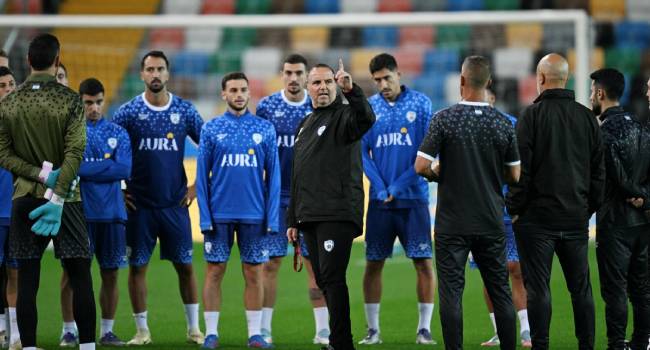
Italy’s 2026 World Cup qualifier with Israel will be prefaced by a major pro-Palestinian demonstration on Tuesday as thousands of people prepare to march through Udine in anger at the hosting of a match they feel should not be played.
The Gaza ceasefire deal signed on Monday and a hostage and prisoner exchange between Israel and Hamas has done nothing to dampen the resolve of around 10,000 protestors who will descend on the small city in Italy’s far north-east amid a massive security operation.
Over 1,000 police officers and army personnel have been deployed while helicopters and drones will fly overhead to keep a watch on a march which was to begin at 5:30pm (1530 GMT) and be kept several kilometres away from the Bluenergy Stadium hosting the Group I fixture later.
The security operation has been designed to stop disorder and ensure no-one gets near the stadium or the Israel team.
Udine was quiet in the hours before the demonstration due to a series of restrictions on bars and restaurants.
READ ALSO: Israel Returns 45 Palestinian Bodies To Gaza —Hospital
Checkpoints have been put up in a ring around the ground, with spectators having to pass concrete barriers and metal detectors in order to watch a match which is key to Italy’s bid to ensure they qualify for a World Cup for the first time since 2014.
“We’re obviously happy that the bombing has stopped,” said Carolina from Udine Committee For Palestine, who said she would not give AFP her surname.
The association is one of five — including Palestinian communities in the regions of Veneto and Fruili-Venezia Giulia — that have organised Tuesday’s march and they will welcome more than 340 activist groups from all over Italy.
“Our message isn’t only about what was going on in Gaza but also that we oppose the politics of occupation and apartheid that affects all Palestinians,” she added.
The association asks that football’s world governing body FIFA exclude Israel from international competition, “as already done with Russia”, in response to the invasion of Ukraine in February 2022.
Match overshadowed
Tuesday’s demonstration comes after a smaller one in Oslo on Saturday, when a few hundred people gathered in the Norwegian capital.
Police used tear gas to disperse activists outside the Ullevaal Stadium which was the scene of a 5-0 win for Norway against Israel.
The head of the Football Association of Norway (NFF), Lise Klaveness, recently said Israel should be sanctioned. Italy’s federation, in contrast, has not made such a call.
“The Norwegian FA has begun taking a position against the presence of Israeli teams, there’s a totally different type of behaviour across the board compared to what you see here (in Italy),” said the activist Carolina.
Tuesday’s protest has overshadowed a match which will go a long way to deciding Italy’s World Cup fate.
Italy sit second in their five-team group, six points behind leaders Norway and three ahead of third-placed Israel with a game in hand on both.
A win would secure Italy at least second place and a spot in the play-offs, with only first place giving direct qualification for next year’s finals in the United States, Canada and Mexico.
However Italy, who have three fixtures left to play, would need Norway to slip up against Estonia next month to have a realistic chance of finishing top, due to the 19-goal gap in goal difference between the two teams.
Human rights organisations say Navarro’s case is part of a growing pattern of violence against protesters since President Javier Milei took office in December 2023.
Shortly after his inauguration, Milei’s administration published a new set of rules for policing protests.
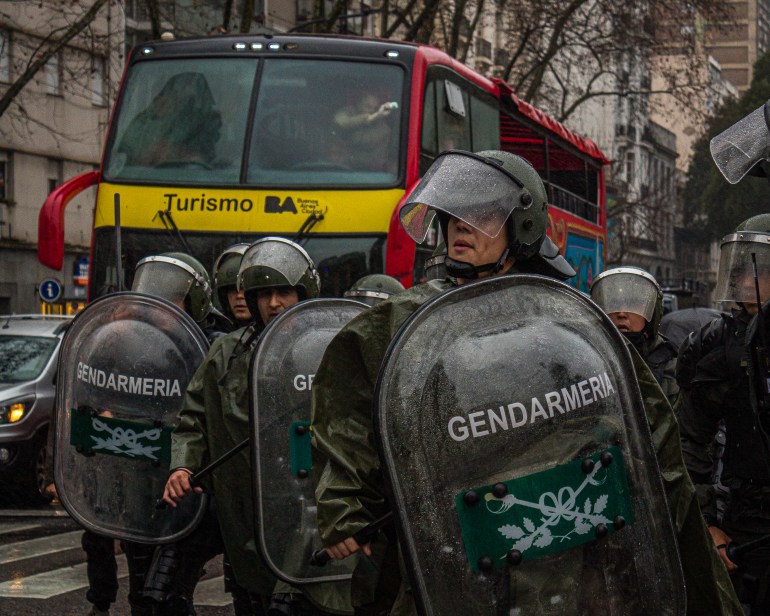
Under the revised protocol, the security forces — including those whose mandate is to protect Argentina’s borders, like the military police — are allowed to use tear gas, water cannon and rubber bullets to prevent people from blocking traffic.
The government claims these “nonlethal methods” are necessary to guarantee people’s right to circulation.
But critics say abuses, including arbitrary arrests, ill-treatment and intimidation, have become the norm, even when protesters are outnumbered by security forces.
Government security forces arrive in riot gear on May 21 in Buenos Aires, Argentina [Patricio A Cabezas/Al Jazeera]
In July, the Provincial Commission for Memory — an autonomous government body that monitors human rights — issued a report that found more cases of protest-related injuries and detentions in the first half of 2025 than in all of 2024.
A total of 1,251 people had been hurt in clashes between police and security forces, and 130 people were arbitrarily arrested, according to the report.
It also accused the police of having “used less-lethal weapons against protesters irrationally and disproportionately, disregarding protocols”.
“Failure to comply with these protocols transforms these weapons into lethal weapons,” the report said.
The protest Navarro participated in was particularly bloody. Healthcare professionals reported treating more than 300 protesters, some of whom had haemorrhages, trauma to the chest and “open facial wounds”, according to the Centre for Legal and Social Studies (CELS), a human rights nonprofit.
Felix Bardone, a doctor, has led a team of volunteers in treating protesters injured during the recent demonstrations [Patricio A Cabezas/Al Jazeera]
Among the injured was photojournalist Pablo Grillo, who was hit on the head with a tear gas canister. Grillo spent weeks in intensive care and is still recovering from his injuries.
“They [the security forces] might be using nonlethal weapons, but even those can cause very serious, life-changing injuries,” said Felix Bardone, a doctor who was among the first to treat Navarro.
Bardone is part of a team of volunteer health professionals who, every week, set up a first aid post near Congress at the Instituto Patria, a think tank founded in 2016 by former President Cristina Fernandez de Kirchner.
The number of patients the first aid post receives varies week to week. But Bardone has cared for protesters whose airways are inflamed by pepper spray and tear gas, and whose bodies have been cut and bruised by projectiles and rubber bullets.
In Navarro’s case, the loss of his eye has meant the loss of more than his vision.
YouTube icons Dan and Phil have opened up over the impact of boundary-pushing fan behaviour after finally confirming a longstanding rumour over their relationship
View 2 Images
Dan and Phil have opened up about their relationship(Image: Dan and Phil/Youtube)
Iconic YouTube duo Dan and Phil have delighted fans everywhere after confirming they were in a secret 16-year relationship. However, the pair also opened up over how their intense fandom had a detrimental effect on their personal lives – leaving many reckoning with the impact of parasocial behaviour.
Dan (34) and Phil (38) were YouTube sensations, snowballing in popularity throughout the 2010s as they posted vlogs, challenges and gaming videos together. They’ve been a little quieter over recent years, but their latest YouTube video has proved to be a bombshell.
In the 47-minute long YouTube video the pair came online to confirm a long-running rumour: they have been dating each other for the past 16 years. The Internet quickly rejoiced, as comment sections flooded with excited fans and some even claimed they were reaching out to friends they hadn’t spoken to in over a decade to share the news.
READ MORE: Jane Austen has audiobook revival as ‘yearning’ becomes the hottest dating trendREAD MORE: Sims 4 fans concerned over future of LGBTQ+ representation after EA buyout
However, segments of Dan and Phil’s video struck a darker chord. The pair admitted that the way a more rabid portion of their predominately young fanbase behaved put a strain on their career and relationship – to the point where it affected their mental health.
During the height of the pair’s popularity, the idea that the two were secretly dating became a popular fan theory. Viewers created a “ship name” for the duo known as “Phan” and drew sexualised artwork, penned lurid fanfics and flooded their comments sections with observations about their supposed relationship.
While Dan and Phil emphasised that they weren’t calling out all of their fans, they said that there were some who took the rumours way too far, leaving them feeling completely objectified. “It’s almost as if people are no longer interested in the real you,” Dan said.
Meanwhile, Phil described how “disheartening” it was to put so much effort into a video only for the comments to be speculating over his and Dan’s relationship.
But despite the intensity of the rumours, the pair kept their romance a secret. Dan explained that this was partly because they didn’t want to become known as the “gay couple show”. Nor did he want their relationship to become something they were selling to their audience.
However, it also ran deeper. Dan admitted that he grew up in a homophobic environment, which made it difficult for him to accept his own sexuality. “In my mid-twenties I felt like I had to hide the relationship because I was still hiding who I was to my friends, family and myself,” he said.
For more stories like this subscribe to our weekly newsletter, The Weekly Gulp, for a curated roundup of trending stories, poignant interviews, and viral lifestyle picks from The Mirror’s Audience U35 team delivered straight to your inbox.
“Which is why all of the digging from people online hit a nerve – because Phil was my safe space,” Dan said. According to Dan, many fans became hostile when he refused to admit to the rumours because he was ruining their “show”.
He said: “Having all of these people try to out us and being so hostile to me when I tried to hide it was so triggering. Honestly, it could have killed me.”
Their transparency over their experience with their crazed fanbase has left many online reflecting over their own parasocial behaviour. Amongst many comments saying “they knew” all along, others have acknowledged that the pair’s relationship really isn’t their business.
“You didn’t ever have to announce this. We aren’t owed anything. But clearly it’s something you’ve done for yourselves and it’s that much more special. Proud of you for taking care of yourselves first and setting a good example of boundaries,” one wrote.
“After all the internet has done to you guys, this was probably really scary to publish. So happy for you. I hope you guys get the peace and love you deserve,” another added.
Help us improve our content by completing the survey below. We’d love to hear from you!
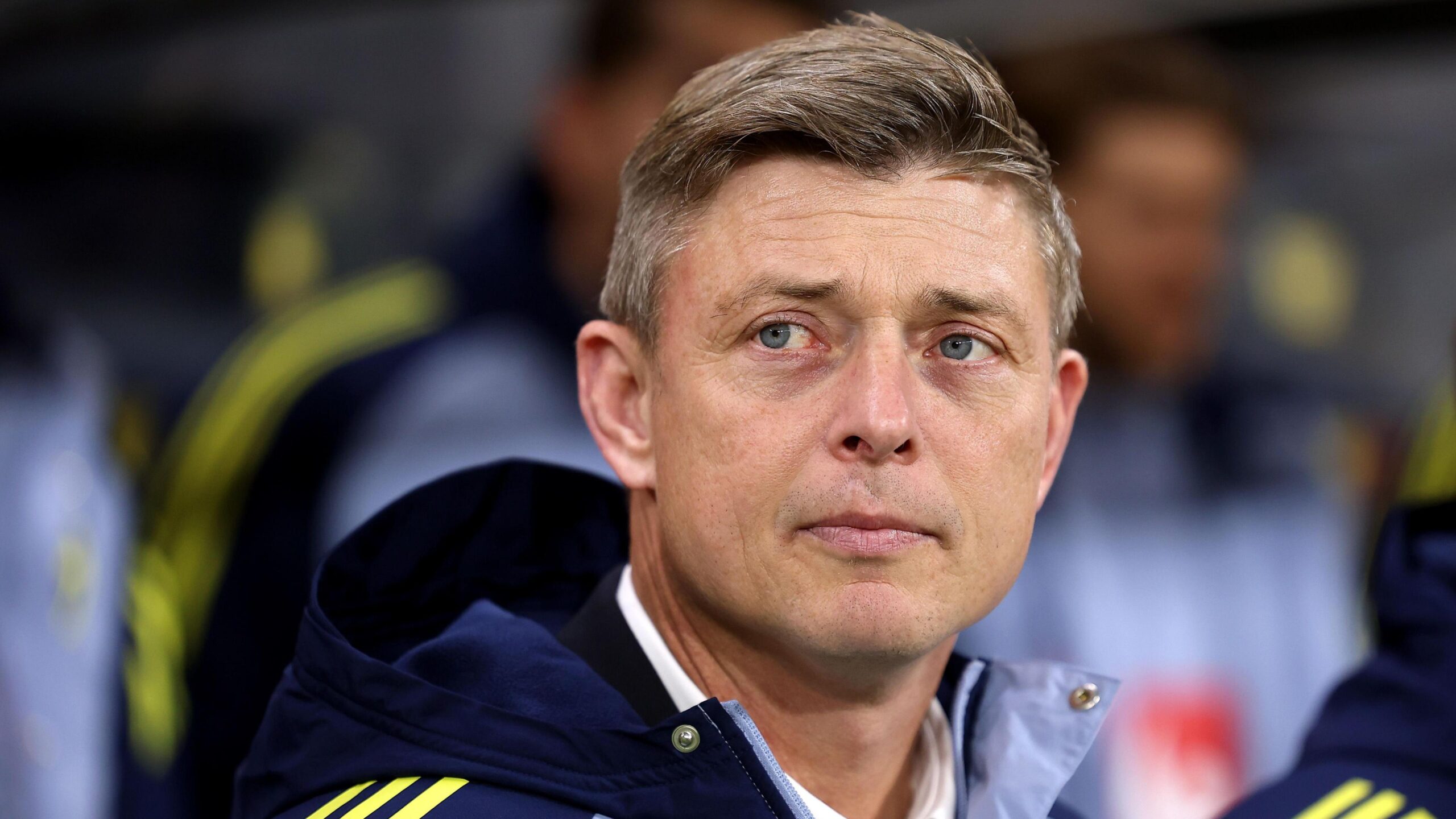
Sweden have sacked manager Jon Dahl Tomasson following a poor start to their 2026 World Cup qualifying campaign.
They are bottom of Group B with one point from four games following a 1-0 defeat against Kosovo on Monday.
Sweden – who have an all-star forward line of Liverpool’s Alexander Isak and Viktor Gyokeres of Arsenal – drew with Slovenia and lost against Kosovo and Switzerland in their opening three group games.
The former Blackburn Rovers manager, who played for Newcastle United during a distinguished career, became Sweden’s first foreign coach when the ex-Denmark striker took over in February 2024.
“The decision is based on the fact the men’s national team has not delivered the results we hoped for,” said Swedish Football Association’s chairman Simon Astrom in a statement.
“There is still a chance of a play-off in March and our responsibility is to ensure we have as optimal conditions as possible to be able to reach a World Cup play-off.
“In this, we assess that a new leadership is required in the form of a new coach.”
‘He forgot what Sweden stands for’ – analysis
Daniel Kristoffersson, football reporter for Swedish newspaper Sportbladet
Everything has gone wrong. He has implemented a system and tactics that we do not have the players for. We have lost to Kosovo twice having not scored a goal – even though we have world-class players like Viktor Gyokeres and Alexander Isak.
He has made players like Lucas Bergvall, Gyokeres and Isak look like Sunday League footballers. We could have expected a lot more from the Swedish national team. He hasn’t got anywhere near what the players are capable of. He was a dead man walking after the Kosovo game.
Before the qualification we were comparing this team to the one that was close to beating the Netherlands in the 2004 Euros quarter-final. Then, we had Zlatan Ibrahimovic, Henrik Larsson, Freddie Ljungberg, Olof Melberg – a fantastic team. If you look at the clubs the players play for and how they have performed, this is one of Sweden’s best teams. But the results are some of the worst. That’s 90% up to the coach.
Cookery writer and TV star Mary Berry is looking back over career ahead of BBC series around her 90th birthday
View 2 Images
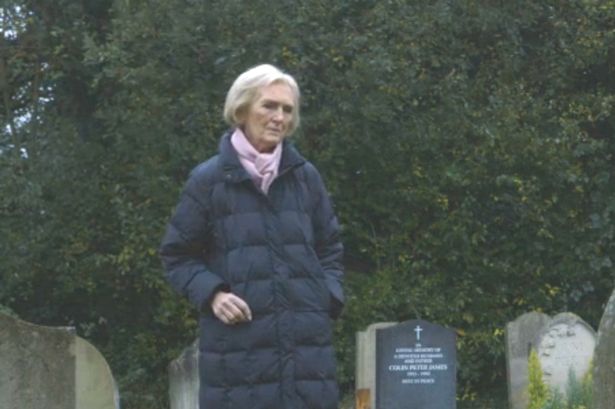
Mary Berry at the grave of her son, William in a BBC documentary in 2013(Image: BBC)
Dame Mary Berry thinks about her late son “every day” but insists she has been very fortunate in life.
The food writer, chef, baker and television presenter has enjoyed an incredible career and will be back on screen later this month in the BBC series Mary at 90: A Lifetime of Cooking. Looking back over her life and career as she promoted the show, the former Bake Off judge was asked about her son William, who was killed aged 19 in a car crash in 1989.
Mary said: “I think of William every day. Of course I do. And if he were to walk through that door over there, I would say, ‘Where the hell have you been?’ I’m still very proud of him. I think of the joy he gave us. He was a lovely child, but you have to step back and think – I had wonderful parents, I’ve got two more children, Annabel and Tom, and my grandchildren. I mean, it would be devastating if you only had one child. I am very fortunate. And I have a husband who is 93.”
Mary has been married to her husband Paul since 1966, and as well as William, they have a son, Thomas, and a daughter, Annabel, whom she remains close to. Annabel works with her mum and is an accomplished chef in her own right. Mary said the secret of her happy marriage was walking away when an argument was on the cards.
READ MORE: Mary Berry’s 5 favourite cake recipes from a red velvet to a classic spongeREAD MORE: Mary Berry’s unexpected ‘secret’ ingredient will make your bolognese so much tastier
She told Radio Times: “Paul always says that the secret to our long marriage is his saying, ‘Yes, dear’ to everything, and then going his own way. But we don’t argue. If any disagreements come up, I open the back door and just go out and maybe pick some flowers or get some apples. It’s amazing if you can walk away.
“Of course, if I was living in a top-floor flat, that would be difficult. But we respect each other. And I’m very lucky. He has mellowed in his old age and he’s become very appreciative of me.
“So I look after him, and it’s a great pleasure. That’s what I promised to do. For better, for worse, for richer, for poorer. And we are very happy in our dotage.”
Mary has been working on screen long enough with food to remember when five spices and fresh ginger were exciting new ingredients to use and tin foil came over to the UK from America for the first time.
She says she has Delia Smith to thank for a pay rise when she was a young writer. “Delia was absolutely brilliant. She came to stay with her husband Michael and we chatted about all sorts of things. I mean, you should never discuss money, sex or religion. But we did discuss money.
“She said, ‘You’re not being paid enough for your writing. I know an agent, Felicity Bryan, and I’ll ring her tonight.’ And the next day I got a postcard from Felicity saying, ‘Can we meet?’ And I’m still with her agency for my books.”
Fast forward a few decades and Mary has more than 70 books and sold more than five million copies. She is also known for her loyalty, staying with the BBC when the Great British Bake Off moved to Channel 4.
Article continues below
She said: “I feel very cherished by the BBC, and it was quite right I stayed with them,”
* Mary at 90: A Lifetime of Cooking will be on BBC2 and BBC iPlayer later this month.
Madagascar’s parliament has voted to impeach embattled President Andry Rajoelina just hours after he confirmed he had fled the country in the wake of an elite army unit appearing to turn against him and seize power, following weeks of deadly “Gen-Z” protests.
The vote on Tuesday afternoon came as Rajoelina moved to dissolve parliament via a decree posted on social media earlier in the day, but which the opposition rejected.
Recommended Stories
list of 4 itemsend of list
“I have decided to dissolve the National Assembly, in accordance with the Constitution,” Rajoelina posted on X on Tuesday. “This choice is necessary to restore order within our Nation and strengthen democracy. The People must be heard again. Make way for the youth.”
The protests, which initially erupted over power and water shortages, have evolved into the most serious crisis the country and Rajoelina’s government has faced in years.
“I was forced to find a safe place to protect my life,” Rajoleina, who did not disclose his location, said in a 26-minute-long live broadcast on Monday after a top army unit, known widely as CAPSAT, reportedly seized the state broadcaster. The same unit announced on Tuesday afternoon that it was “in charge” as parliament concluded the impeachment proceedings.
Opposition parties initiated the impeachment vote on the basis that Rajoelina had “abandoned” his post. In a Facebook message posted on Tuesday evening, Rajoelina condemned the impeachment vote and the army takeover, calling them “unconstitutional”.
There’s no clear leader in the country.
Madagascar has a long history of political crises and uprisings. Rajoelina’s own apparent exit from the country appeared to be an eerie replay of protests in 2009 that led to the collapse of a previous government, and his ascent to power. However, his government has been accused of corruption and of managing a stagnant economy.
Here’s what to know about how the protests unfolded and the army unit that has turned against the president:
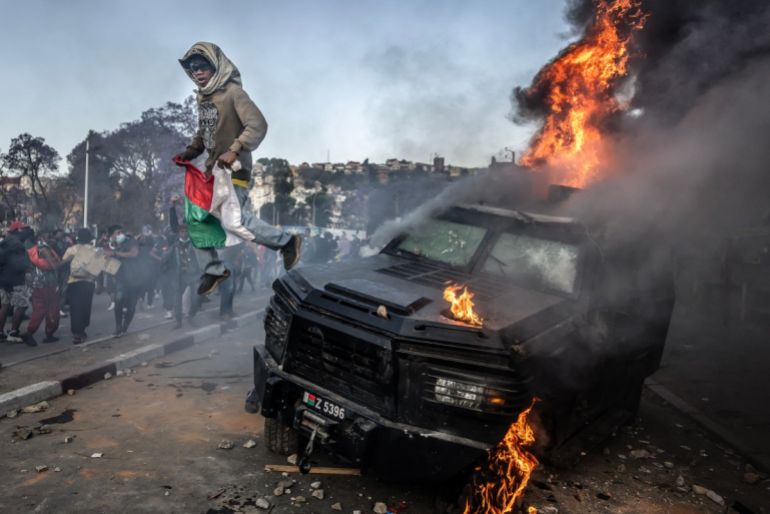
A protester holding a Malagasy flag jumps from a vandalised Gendarmerie armoured vehicle as members of a section of the Malagasy army arrive to take control of the area around Lake Anosy following clashes between demonstrators and security forces during protests in Antananarivo on October 11, 2025 [Luis Tato/AFP]
What led to the protests?
Hundreds of angry protesters, led by a young movement called “Gen Z Madagascar,” began taking to the streets of the capital Antananarivo on September 25, with protests over the weekend recording the largest number of demonstrators in the three weeks of unrest.
What began as anger about persistent water and power cuts that leave businesses and homes without electricity or running water for more than 12 hours quickly escalated into frustrations with general governance.
Protesters decried widespread poverty, high costs of living, and state corruption that they say has seen business elites benefit from close contacts in government. Demonstrators began calling for the end of Rajoelina’s 15-year-old government, and for a “free, egalitarian and united society”.
Although Rajoelina sacked his prime minister and attempted a government reshuffle, protesters were not satisfied, culminating in the CAPSAT backing protesters on Saturday in what the president called an “attempt to seize power”. The unit, in a statement, said it refused “orders to shoot” demonstrators.
Some 80 percent of the country’s 31 million people lived in extreme poverty by 2022, according to the World Bank, largely due to political instability and severe climate disasters affecting food supplies. Only a third of the population has access to electricity, according to the International Monetary Fund, with the state-owned energy company, Jirama, accused of corruption and mismanagement.
Angry demonstrators blocked roads with burning tyres and rocks, and reportedly attacked public buildings, transport infrastructure, and private shops. In response, security officials responded with “violent force” according to the United Nations, with reports noting police fired rubber bullets, stun grenades, and tear gas. At least 22 people have died and dozens of others are injured, the UN said in a statement last week, although the government disputed those figures.
Rajoelina ignored calls for his resignation and accused protesters calling for his exit of wanting to “destroy our country.” His attempts to quell the anger by dissolving the government and appointing army General Ruphin Fortunat Zafisambo as the new prime minister on October 6, as well as inviting protesters for talks, were rejected by the demonstrators, who accused the government of ruling “with weapons”.
Who led the protests?
Young protesters, led by the “Gen Z Madagascar” group, started the demonstrations in late September, following similar youth-led uprisings witnessed in the past year in countries like Nepal, Morocco, Kenya, and Bangladesh.
In Madagascar, protesters say they’re demanding an end to 16 years of “inaction” by Rajoelina’s government, and have promised that they will not be silenced.
“They didn’t want to hear us in the streets,” a statement on the Gen Z Madagascar website reads. “Today, thanks to digital technology and the voice of Generation Z, we will make our voices heard at the table of power on the opposition side. To put an end to 16 years of inaction, let’s demand transparency, accountability, and deep reforms.”
The movement highlighted three demands from the government: the immediate resignation of Rajoelina and his government, the dismantling of the Senate, the electoral commission, and the constitutional court, as well as the prosecution of “the businessman close to the president”, referring to Rajoelina’s adviser and businessman, Maminiaina Ravatomanga.
It warned Rajoelina would be dragged to the International Court of Human Rights on various charges ranging from repression to embezzlement if the demands are not met.
The Gen Z Madagascar’s emblem, a flag featuring a pirate skull and crossbones wearing a distinctive Madagascan hat, is a reference to the Japanese comic series, One Piece, which follows a young pirate banding with others to fight an authoritarian government. The flag has become a hallmark of youth-led protests globally. It was raised by Indonesian protesters to show discontent in the run-up to the nation’s independence day in August, as well as by youth protesters who overthrew the Nepal government in September.
Groups of Madagascar soldiers joined thousands of protester in the capital on October 11, 2025, after announcing they would refuse any orders to shoot demonstrators [Luis Tato/AFP]
Who is President Rajoelina, and where is he?
President Rajoelina’s location is currently unknown. There is speculation that he was flown out of the country on a French military plane, according to French broadcaster RFI, but France has not commented. Madagascar is a former French colony, and Rojoelina is reported to have French citizenship – an issue which has angered some over the years.
In his Facebook statement on Monday evening, the president called for dialogue “to find a way out of this situation” and urged Madagascans to respect the constitution. He did not reveal his location and did not state his resignation.
The move to dissolve the parliament from exile further escalated the crisis and caused confusion, but opposition groups rejected it and voted for the president’s impeachment.
“The legal basis for this is unclear at the moment,” Kenya-based analyst Rose Mumunya told Al Jazeera. “Is he still the president? Legally, he is, but now that the army has announced they are taking over [security institutions], the legality of his decision to dissolve parliament is not really clear,” she said.
The 51-year-old first came to power in 2009 as the leader of a transitional government following a bloodless coup against the former president, Ravalomanana. As an opposition member and mayor of Antananarivo, Rajoelina led weeks of violent protests starting from January 2009 against Ravalomanana, whom he criticised for “restricting freedom” in the country.
Some 130 people died in the crisis. Rabalomanana fled to South Africa in March 2009 following a military coup. Rajoelina’s announcement as leader was ironically backed by CAPSAT. The international community criticised the military intervention and sanctioned Madagascar for years.
Rajoelina was elected in 2019 and re-elected in disputed 2023 polls that were boycotted by the opposition. His government, while popular at first, faced accusations of corruption, increasing repression and rights violations, analysts say. Fired Prime Minister Christian Ntsay and businessman Maminiaina Ravatomanga, were among prominent figures widely criticised in the country. Both arrived in Mauritius on a private flight on Sunday, authorities there said.
What is CAPSAT, the army unit accused of a coup?
CAPSAT, or the Corps d’administration des personnels et des services administratifs et techniques, is an elite unit based in Soanierana district on the outskirts of Antananarivo. While Rajoelina had influential backers in other important army units, analyst Mumunya noted he has not been able to muster such support with CAPSAT.
The group’s leader, Colonel Michael Randrianirina announced in a radio broadcast on Tuesday that the unit was “in charge” and that it was suspending all democratic institutions except the lower parliament house which voted to impeach Rajoelina. According to Reuters, those included the senate, the electoral commission and the constitutional court – appearing to meet some of the protesters’ demands.
CAPSAT will create a ruling commission including army, police and other security leaders, the colonel said, according to the AFP news agency.
“At the same time, after a few days, we will set up a civilian government,” he is quoted as saying.
The unit first appeared to mutiny after members joined thousands of protesters in Antananarivo on Saturday and called for Rajoelina’s resignation. Demonstrators hailed armed CAPSAT members packed in trucks and waving Madagascan flags. There were reports of CAPSAT teams clashing with pro-Rajoelina security forces.
A representative of the contingent said in a video statement on Saturday that “from now on, all orders of the Malagasy army, whether land, air, or navy, will originate from CAPSAT headquarters.” The unit urged all security forces to refuse “orders to shoot” and to stand with protesters.
On the same day, CAPSAT installed a new chief of defense staff, General Demosthene Pikulas, at a ceremony at the army headquarters. Armed Forces Minister Manantsoa Deramasinjaka Rakotoarivelo endorsed the move at the ceremony, saying, “I give him my blessing.”
On Sunday, CAPSAT Colonel Randrianirina told reporters that his unit’s actions did not amount to a coup. “We answered the people’s calls, but it wasn’t a coup d’etat,” he said, speaking at a gathering on Sunday outside the Antananarivo city hall, where large crowds gathered to pray for victims of the violence. One CAPSAT soldier was reportedly killed in a clash with other security units on Saturday.
Madagascar’s military has intervened in politics in several crises since 1960, when the country gained independence from France. Analyst Mumunya said CAPSAT leaders were carefully avoiding an outright coup declaration to avoid international backlash, as in the 2009 revolt. The move by the opposition to impeachment the president would legalise the takeover while the army holds the fort to ensure there’s no counter coup, she said.
“It’s a bit of push and pull between Rajoelina and the army … but the balance of power is not in Rajoelina’s favour,” Mumunya said. There are likely ongoing negotiations between the political opposition, business elite and security forces to install a new civilian government that will appeal to the youth, she added.
“So has (Rajoelina’s) government effectively collapsed? I think we can probably conclude that,” she said.