It’s a bit of a mad one with Wayne this episode that includes Liverpool v Man Utd chat, his birthday weekend, opinions on England and Marcus Rashford, and meet-ups with 50 Cent and Ed Sheeran.
Wayne takes us inside his 40th birthday bash, but who did he dress up as? Which songs did he belt out on karaoke? And who ended up with a nasty injury?
Musician and Liverpool fan Jamie Webster joins Wayne, Kelly and Kae to discuss why their rivalry with Manchester United is the biggest in English football. But who is this match more important for: Arne Slot or Ruben Amorim?
Jamie’s appearance on the show leads to a number of musical revelations from Wayne: how did he end up on stage with 50 Cent? And Why did Coleen have to step in when he tried to change an Ed Sheeran song?
Wayne gives his thoughts on England’s World Cup qualification and explains why he’s pleased the players are less certain of their places under Thomas Tuchel. He also has strong words for Marcus Rashford’s recent comments about the “inconsistent environment” at Old Trafford not helping his form.
Meanwhile, we discover what led Wayne and Jermain Defoe to watch his entire wedding DVD together while they were away at the 2010 World Cup and what was Wayne gutted to find out on the last day at Glastonbury?
You can watch The Wayne Rooney Show on BBC Sport YouTube, iPlayer, as well as listen on BBC Sounds.
It’s a bit of a mad one with Wayne this episode that includes Liverpool v Man Utd chat, his birthday weekend, opinions on England and Marcus Rashford, and meet-ups with 50 Cent and Ed Sheeran.
Wayne takes us inside his 40th birthday bash, but who did he dress up as? Which songs did he belt out on karaoke? And who ended up with a nasty injury?
Musician and Liverpool fan Jamie Webster joins Wayne, Kelly and Kae to discuss why their rivalry with Manchester United is the biggest in English football. But who is this match more important for: Arne Slot or Ruben Amorim?
Jamie’s appearance on the show leads to a number of musical revelations from Wayne: how did he end up on stage with 50 Cent? And Why did Coleen have to step in when he tried to change an Ed Sheeran song?
Wayne gives his thoughts on England’s World Cup qualification and explains why he’s pleased the players are less certain of their places under Thomas Tuchel. He also has strong words for Marcus Rashford’s recent comments about the “inconsistent environment” at Old Trafford not helping his form.
Meanwhile, we discover what led Wayne and Jermain Defoe to watch his entire wedding DVD together while they were away at the 2010 World Cup and what was Wayne gutted to find out on the last day at Glastonbury?
You can watch The Wayne Rooney Show on BBC Sport YouTube, iPlayer, as well as listen on BBC Sounds.
Here is how things stand on Friday, October 17, 2025:
Fighting
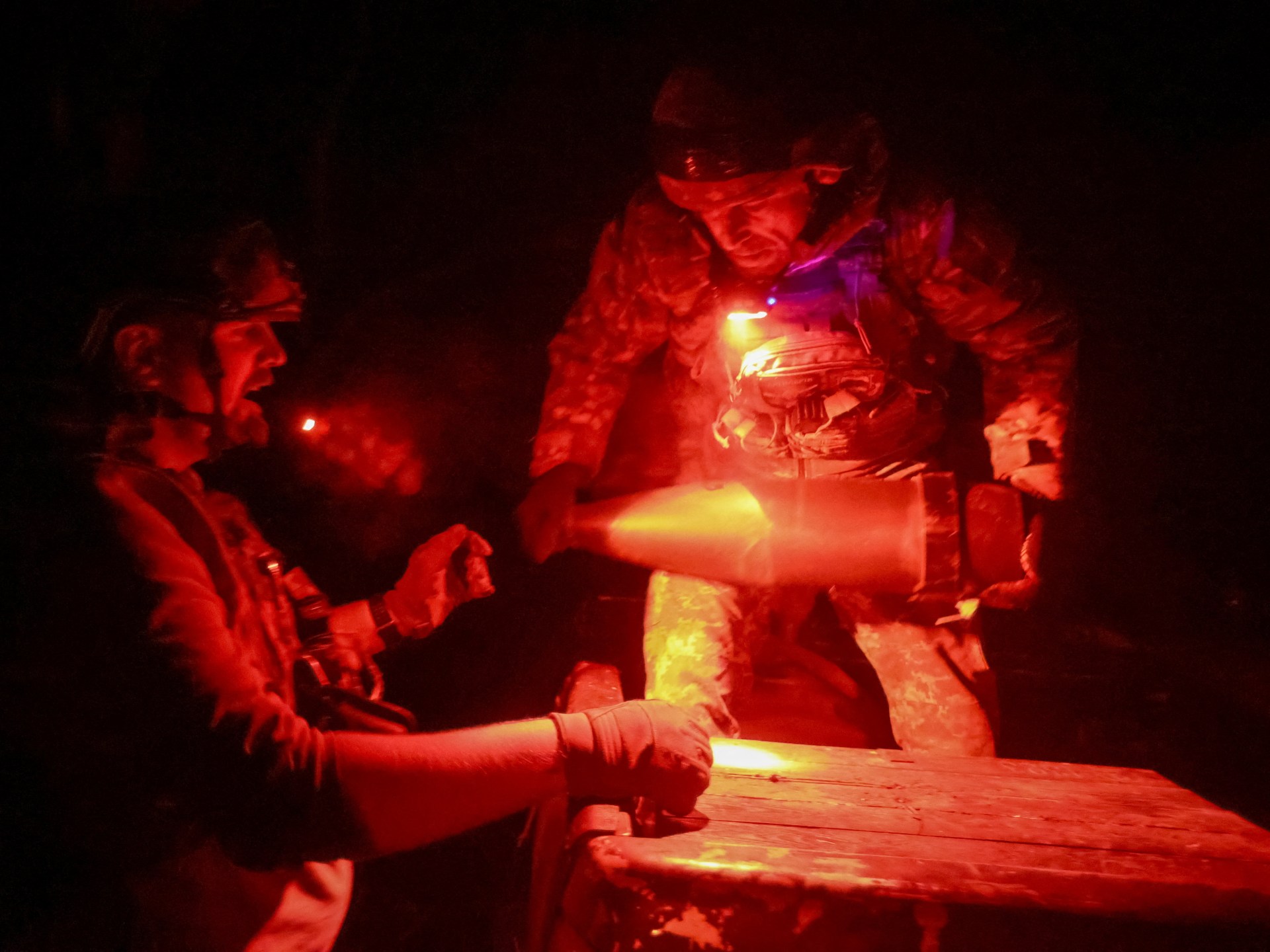
Russia launched a large armoured assault with more than 20 armoured vehicles near the eastern Ukrainian town of Dobropillia, Ukraine’s Azov brigade said, adding that its forces repelled the attack.
Russia’s Defence Ministry said its forces carried out a massive overnight strike on Ukrainian gas infrastructure, which supports Kyiv’s military, in retaliation for what it said were Ukrainian attacks on civilian infrastructure.
Ukrainian President Volodymyr Zelenskyy said Russia launched a barrage of more than 300 drones and 37 missiles in that attack. Ukraine’s state grid operator, Ukrenergo, has also introduced emergency power cuts in every region of the country.
Ukraine struck Russia’s Saratov oil refinery overnight, the Ukrainian military general staff said in a statement on Telegram.
Some 84,000 people are still without power in the Russian-held part of Ukraine’s Kherson region after Ukrainian strikes this week on energy infrastructure, according to Vladimir Saldo, the Russian-appointed governor of the region.
Alexey Likhachev, the head of Russian state nuclear corporation Rosatom, said a decision could be taken as early as Friday on a pause in fighting to enable repairs to power lines at the Russian-held Zaporizhzhia nuclear power station in Ukraine.
North Korean troops based in Russia are operating drones across the border into Ukraine on reconnaissance missions, the Ukrainian military said, the first time Kyiv has reported a battlefield role for North Koreans in months.
Ceasefire talks
In a surprise move, United States President Donald Trump and Russian President Vladimir Putin have agreed to another summit on the war in Ukraine after the leaders held a more than two-hour phone conversation. Trump and Putin may meet within the next two weeks in Budapest, Hungary, Trump said after the conversation, which he called productive.
The Kremlin confirmed plans for the meeting, adding that Putin told Trump on the call that supplying US Tomahawk cruise missiles to Ukraine would harm the peace process and damage ties.
US Secretary of State Marco Rubio and Russian Foreign Minister Sergey Lavrov will speak in the coming days to prepare the summit, Kremlin aide Yuri Ushakov said, adding that the timing would depend on how preparatory work progressed.
The development came as Ukrainian President Volodymyr Zelenskyy was headed to the White House on Friday to push for more military support. Zelenskyy said on the eve of those talks that momentum in the Middle East peace process would help end his country’s more than three-year-old war with Russia.
Europe
The European Commission has proposed four flagship European defence projects, including a counter-drone system and a plan to fortify the eastern border, as part of a drive to get the continent ready to defend itself by 2030.
The proposals, in a defence policy “roadmap”, reflect fears fuelled by the war in Ukraine that Russia may attack a European Union member in the coming years, and calls by President Trump for Europe to do more for its own security.
Sanctions
Britain has targeted Russia’s two largest oil companies, Lukoil and Rosneft, and 44 shadow fleet tankers in what it described as a new bid to tighten energy sanctions and choke off Kremlin revenues. Lukoil and Rosneft were designated under Britain’s Russia sanctions laws for their role in supporting the Russian government. They are subject to an asset freeze, director disqualification, transport restrictions and a ban on British trust services.
German Chancellor Friedrich Merz said he would call for the EU to use Russian assets frozen in the West to provide a large loan to Ukraine to finance its war effort at the upcoming EU summit on October 23.
Canada and Britain have expressed interest in working on the EU idea of a reparations loan for Ukraine based on immobilised Russian assets, European Economic Commissioner Valdis Dombrovskis told the Reuters news agency on the sidelines of the International Monetary Fund meetings in Washington.
Dombrovskis said he presented the idea of the EU loan, which could be up to 185 billion euros ($216.5bn) over two years, to G7 finance ministers.
Ace Frehley’s family announced the rockstar’s tragic death at the age of 74 after he was placed on life support due to a brain bleed after he suffered a fall in his studio earlier this month
View 3 Images
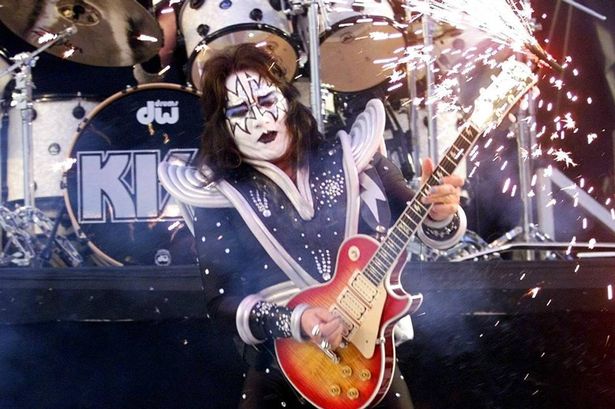
Ace Frehley (front) and Peter Criss (rear) of the rock group Kiss(Image: AFP via Getty Images)
Ace Frehley, the lead guitarist of KISS, has tragically passed away at 74, with his last social media post hinting at the severe health problems he was grappling with.
On Thursday, Oct. 16, Ace’s family confirmed the heartbreaking news of the rockstar’s death after he was put on life support following a brain bleed. The medical crisis happened after he suffered a fall in his studio earlier this month.
Frehley was one of the four original members of the legendary rock band KISS, alongside Gene Simmons, Paul Stanley, and Peter Criss. At the time of his passing, Ace was in Morrisontown, New Jersey, surrounded by his loved ones.
READ MORE: Huge Brit model and TV star set to sign big-money deal for I’m A Celeb
READ MORE: Charlie Puth announces he is expecting his first child with wife Brooke Sansone
In his final post, the Rock N Roll Hall of Fame inductee announced that he had to cancel his upcoming gigs due to his health crisis. His last Instagram post read, “Due to some ongoing medical issues, Ace has made the difficult decision to cancel the remainder of his 2025 dates.”, reports the Mirror US.
Ace was set to perform shows at The Lincoln Theatre in Decatur, Illinois, The Family Arena in St. Charles, Missouri, The Token Lounge in Westland, Michigan, and The Ritz Theatre in Tiffin, Ohio throughout October and November. These performances were intended to promote his 2024 album, 10,000 Volts.
Ace’s family confirmed his passing in an emotional statement that said, “We cherish all of his finest memories, his laughter, and celebrate his strengths and kindness that he bestowed upon others. The magnitude of his passing is of epic proportions, and beyond comprehension. Reflecting on all of his incredible life achievements, Ace’s memory will continue to live on forever!”
Bandmates Paul Stanley and Gene Simmons released their own tribute, writing, “We are devastated by the passing of Ace Frehley. He was an essential and irreplaceable rock soldier during some of the most formative foundational chapters of the band and its history.”
The pair continued, “He is and will always be a part of Kiss’ legacy. Our thoughts are with Jeanette, Monique and all those who loved him, including our fans around the world.”
After news of Ace’s death broke, countless devoted supporters flooded his Instagram with messages of love and remembrance. One admirer wrote, “Rest in peace king Ace. We thank you for so much joy and happiness that you gave us through your music. We love you forever.”
A second follower shared, “I’m at a loss for words! RIP Ace, my heart and deepest condolences go out to your family and loves ones. Thank you for the music, your laughs, and the ‘X rated’ guitar solos, Ace. Fly high and rock on forever in the great gig in the sky, I love you and I hope you knew how much you meant the world to me and many other fans worldwide.”
Another fan shared, “He is the reason I wanted to play guitar! ! Saw him live in Orlando and so happy I got to see him! ! RIP spaceman!”.
One managed Manchester City, just as they were being transformed into the richest club in the world and started scooping up the best footballing talent on the planet.
The other had his first taste of management down the road at phoenix club Macclesfield FC, just a few years after the original club was wound up in the High Court because of £500,000 of unpaid debts.
But, in a classic case of master meets apprentice, former club and country colleagues Mark Hughes and Robbie Savage will meet as managerial equals this Saturday in a setting far removed from their days together at the top.
The pair contest a top-of-the-table tussle in the National League when Hughes’ Carlisle United host Savage’s Forest Green Rovers at Brunton Park.
“To be fair, Mark’s probably the one manager in this league who I can’t say: ‘Did you play in the Premier League 350 times?'” joked Savage, who played 346 top-flight games for Leicester City, Birmingham City, Blackburn Rovers – where he was managed by Hughes – and Derby County.
2 days ago
5 days ago
2 October
From Wales and Premier League to National League
Huw Evans Picture Agency
Savage is right. Hughes’ CV is not too shabby – more than 600 appearances as a player for the likes of Manchester United, Chelsea and Barcelona.
Then as a manager more than 450 top-flight games at Blackburn, Stoke City, Southampton, Fulham and Queens Park Rangers, as well as an 18-month spell at the Etihad Stadium just as City were coming under their transformative Abu Dhabi ownership.
By contrast, Savage’s management career started in the Northern Premier League Premier Division – the seventh tier of the English game – with Macclesfield Town before he moved to fifth-tier Forest Green in the summer
Hughes – known affectionately as ‘Sparky’ from a childhood comic book hero – is managing at non-league level for the first time after joining Carlisle last season following an 18-month spell at Bradford City.
The 61-year-old could not save the Cumbrians from relegation, but he is hoping to get them back into the Football League at the first attempt – with Savage’s Forest Green one of their main promotion rivals.
Rovers are second in the National League and Carlisle are third – both just a point behind leaders Rochdale – going into the reunion between the former Wales and Blackburn colleagues, which falls sweetly on Savage’s 51st birthday.
“Sav was great to work with as a player, he just had that high energy and his teams are very much indicative of how he played,” said Hughes, who managed Savage as Wales boss between 1999 and 2004.
“Sometimes people misinterpret how he is as a personality. He sometimes does things and says things for effect, certainly in his role as a radio presenter and pundit, but first and foremost he’s a very enthusiastic football person.”
Hughes also signed Savage for Blackburn in 2005.
“With some players you never knew what you’d get from one week to the next, but that was never the case with Robbie,” he added.
“When things were going bad, he would grab a game by the scruff of the neck and get a reaction from his team-mates. I always had a lot of respect for Sav in that regard.
Savage ambition… but Hughes underappreciated?
Getty Images
Could Savage emulate his old Wales boss by managing in the Premier League or at international level one day?
Wrexham-born Savage, who won 39 caps as a player, says he is currently “a million miles away” from managing Wales or any Football League side, but would like to take charge of his country at some point.
Savage certainly has a useful mentor at Forest Green – fellow Welshman Mark Bowen, who used to coach him with Wales and Blackburn as Hughes’ number two, and is now director of football at the Gloucestershire club.
“Robbie is a very driven person and a real student of the game,” said Bowen, who played a key role in Savage’s appointment as manager at The New Lawn.
“He hasn’t got a lot of outside interests other than football. He watches it, he reads it, he studies it.
“The chairman [Dale Vince] was convinced at the start Robbie could and should be the man for Forest Green Rovers. We’ve brought in a lot of new players, around 15, and we thought it would take a while for it to settle down.”
WInning eight and drawing five of their first thirteen games before losing for the first time against Rochdale last weekend came as a pleasant surprise.
“We certainly didn’t expect to hit the ground running as we have,” added Bowen.
“I look at people who have had chances at higher leagues and better clubs and ask: ‘Are they any different to a Robbie Savage?’ Ultimately you’ve got to win football matches and he’s doing that.
“There’s nothing stopping him going to a higher level – hopefully with Forest Green Rovers.”
Having spent most of his coaching career working alongside Hughes, Bowen believes the former Wales and Manchester United striker was not given the credit he deserved for managing six top-flight clubs over a period of 14 years.
Hughes was denied his best chance of Premier League and Champions League silverware when City, flush from their initial Middle Eastern buyout, sacked him in 2009 after 18 months in charge and replaced him with Roberto Mancini.
“I always feel that Mark got a bad lot of it. The day Mark got sacked by Man City they were lying sixth in the Premier League and in the semi-finals of the League Cup,” said Bowen.
“We used to compare ourselves to the likes of David Moyes and ‘Big Sam’ [Allardyce]. For a long period, you could arguably look at Mark’s record and it was better than those two.
Desperately trying to beat ‘my hero’
PA Media
While Hughes’ top-flight days may be behind him, he is certainly relishing his current status as Carlisle’s potential saviour, with the ultimate aim of beating Savage’s Forest Green to the one and only automatic promotion spot.
Savage’s only focus this weekend is trying to get the better of his old boss.
“Mark was my hero, you know,” Savage said. “I’m managing at the same level as someone who’s had an unbelievable managerial career.
“He’s got a very, very good side but on the sideline he’s just Mark, he’s not my hero, he’s Mark, manager of Carlisle.
“So I’ll be trying desperately to beat him, as I would be trying desperately to beat Braintree or whoever we’re playing against. I respect him massively, it’s going to be strange, but it’s a big month for us.”
The respect from Hughes is mutual, but he hopes a feverish Brunton Park crowd will make it as hard as possible for Savage’s promotion contenders.
“I think he likes to engage the crowd so we’ll see how that goes with the lads in the Paddock,” said Hughes of the vociferous terraced section behind the dugouts.
Islamabad, Pakistan – The provincial government of Punjab, Pakistan’s most populous province, is seeking federal approval to ban the far-right religious party Tehreek-e-Labbaik Pakistan (TLP) amid a violent crackdown on the group’s protesters this week.
In a meeting chaired by Maryam Nawaz Sharif, the province’s chief minister and niece of Prime Minister Shehbaz Sharif, officials approved what they described as “historic” and “extraordinary” decisions.
Recommended Stories
list of 4 itemsend of list
The chief minister did not name the TLP, but a statement from her office said the ban would be sought against an “extremist” party, and added that those involved in inciting violence, spreading hatred and violating the law would be arrested “immediately”.
“The extremist party’s leadership will be placed in the Fourth Schedule of the Anti-Terrorism Act,” the provincial government statement said. The Fourth Schedule is a list of proscribed individuals suspected of terrorism and sectarianism under Pakistan’s antiterrorism legislation.
The announcement came four days after a large-scale predawn operation by law enforcement agencies on Monday to dismantle a TLP protest camp in Muridke, 60km (37 miles) from the provincial capital, Lahore.
Muridke made headlines earlier this year in May when India launched missiles on the town, targeting what it claimed were sanctuaries for Pakistan-based armed groups responsible for carrying out attacks on Indian territory.
Following the police operation against the TLP – a political party with a controversial and violent history – authorities said they detained more than 2,700 people, while another 2,800 were placed on an exit control list.
The party has led blasphemy-related protests in Pakistan, a highly sensitive topic in the Muslim-majority country, and has been accused of attacks against religious minorities, particularly Christians and Ahmadis.
Why was the TLP protesting?
United States President Donald Trump unveiled a 20-point plan on September 29, with Israeli Prime Minister Benjamin Netanyahu standing beside him, aimed at ending Israel’s two-year war on Gaza.
The plan, subsequently ratified by several countries, including Pakistan, on October 13, stipulated that the war would end immediately, with all captives held by Hamas in Gaza since October 7 – both alive and dead – returned within 72 hours, and Palestinian prisoners released.
The plan also stated that the Gaza Strip would be temporarily governed by a Palestinian technocratic government with no role for Hamas, and Israel would not annex Gaza. “The United States will work with Arab and international partners to develop a temporary International Stabilization Force (ISF) to immediately deploy in Gaza,” the plan added.
But the plan does not explicitly commit to a Palestinian state, something that is a demand of most of the world – and has been a central part of Pakistan’s policy in the Middle East.
Following Trump’s announcement, the TLP declared its intention to march, stating it did not accept the peace agreement. The party called the peace agreement a “conspiracy to subjugate the Palestinian people” that demanded a protest.
According to the TLP and its chief, Saad Hussain Rizvi, the “Al-Aqsa Gaza March” was scheduled to begin from Lahore, the party’s base, on October 10.
The objective was to march on the main national highway from Lahore towards the capital Islamabad, where the party intended to stage a demonstration outside the US embassy.
“The purpose of this march was to express solidarity with the oppressed people of Palestine and the situation in Gaza only,” a TLP spokesperson who was not present at the protest site told Al Jazeera on condition of anonymity due to fear of arrest.
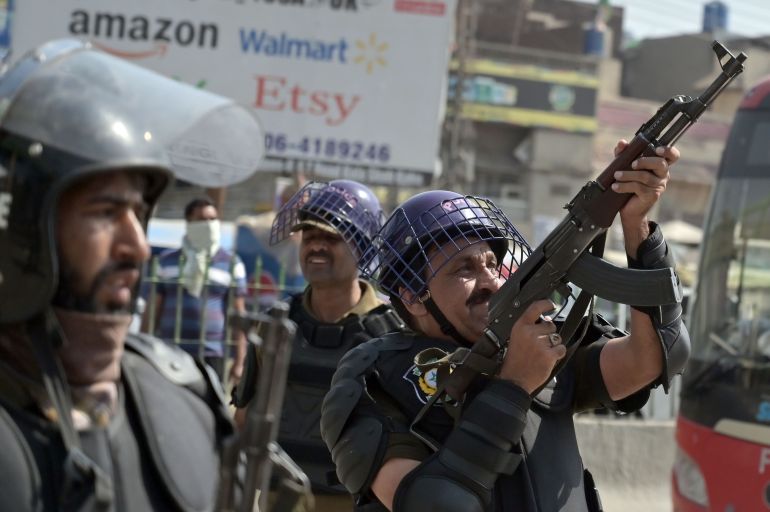
Police fire shots to disperse supporters of the Tehreek-e-Labbaik Pakistan in Muridke, Pakistan, on October 13, 2025 [A Hussain/EPA]
How did the protest unfold?
As TLP workers gathered in Lahore last Friday, Rizvi addressed a large rally of thousands, urging them to break through all obstacles placed by authorities and carry out their march.
Lahore police had placed numerous containers on the main highway and dug trenches to break the party’s momentum.
However, despite clashes with police, TLP workers managed to break free and reach Muridke by Sunday.
Authorities allege that workers from the party injured several dozen police officials in clashes as they made their way towards Islamabad.
Ehtesham Shami, a local journalist covering the TLP march in Muridke, said party workers arrived in the city despite blockades everywhere that made movement extremely difficult.
Looking at the number of law enforcement personnel present in Muridke and surrounding areas, it was evident that an operation would be launched against the party, and this was even conveyed by authorities to TLP leaders, Shami said.
“However, as workers remained present, around 2am the police started its operation, firing the first tear gas shell,” Shami, who was present at the scene, told Al Jazeera.
He said clashes between the two sides continued for several hours until dawn, during which TLP workers also engaged in counterattacks against police personnel, appearing in “small groups, moving swiftly and acting rapidly”.
The TLP official, one of numerous spokespeople for the party, however, denied any such counterattacks, blaming authorities for “wanton violence against peaceful protesters”, saying the party believes in peaceful protest.
Punjab police said in a statement on Monday that at least one police official was killed in the clashes, while dozens of police personnel were injured, some critically.
Disputed casualty figures
Since the operation ended on Monday, TLP-affiliated social media accounts have claimed the police action resulted in hundreds of deaths among their workers.
While the official government statement said only three TLP workers were killed, the TLP official denied the count.
“Hundreds of our workers were killed, and their bodies were removed from the scene by the officials to hide their crimes,” he claimed, without providing evidence.
The claims have been amplified by several leaders of Pakistan Tehreek-e-Insaf (PTI), the largest opposition party in Pakistan, which itself conducted several operations against the TLP during its tenure between 2018 and 2022.
PTI has faced a state-led crackdown since being ousted from power in April 2022. Last November, at least 12 of their workers were killed in a protest in Islamabad.
Amid the dispute over the death toll in the clashes between law enforcement officials and the TLP in Muridke, Fawad Chaudhry, a former federal information minister under the PTI government, also told Al Jazeera he reached out to several local community leaders and politicians in various cities near Lahore from where TLP workers gathered.
“I spoke to more than two dozen community leaders to find out about any deaths in their constituency following the crackdown on TLP, but apart from one confirmation, nobody else had anything to add,” he said.
What is the TLP?
TLP, a group following the Barelvi school of Sunni Islam, was formed in 2015 by Khadim Hussain Rizvi, the wheelchair-bound father of the current leader. The Barelvi school has roots in Bareilly in India’s northern state of Uttar Pradesh.
Supporters of the religio-political party Tehreek-e-Labbaik Pakistan (TLP) march during their protest rally in Lahore, Pakistan, on October 11, 2025 [A Hussain/EPA]
The party made its name as a far-right, populist religio-political movement primarily through controversial and violent protests focusing on blasphemy, demanding immediate death for anybody accused of the offence.
The party came to prominence for its vehement support for Mumtaz Qadri, a police constable who shot Punjab Governor Salmaan Taseer in 2011 for expressing sympathetic sentiments towards Aasia Bibi, a Christian woman accused of blasphemy.
The party has continued to mobilise around issues of religious sanctity, with its first major protest taking place in November 2017.
Subsequently, they carried out similar, often violent, protests in 2020 and 2021 over the publication of perceived blasphemous caricatures, during which several police officials were killed.
The TLP contested both the 2018 and 2024 elections. While they never secured a seat in the national assembly, they managed to win more than two million votes in both elections.
In 2018, the party placed fifth in total votes and won three provincial seats from Sindh. In 2024, it ranked fourth in total votes while winning one provincial seat in Punjab.
The party’s founder, Rizvi, died in November 2020 from natural causes at the age of 54. After his death, the party was headed by Saad Hussain Rizvi, who was later joined by his younger brother, Anas Hussain Rizvi.
Blasphemy is an extremely sensitive topic in Muslim-majority Pakistan, with at least 85 people murdered in relation to the allegations since 1990, according to local media and researchers. As of 2023, at least 53 people are in custody across Pakistan on blasphemy charges, according to the US Commission on International Religious Freedom.
The rise of TLP has seen a drastic increase in violence and blasphemy cases filed across the country.
The TLP has particularly targeted Ahmadis, a religious minority in Pakistan that considers itself Muslim but was officially declared “non-Muslim” in 1974 through a constitutional amendment. The party has often targeted their places of worship and desecrated graveyards.
Where are the Rizvi brothers?
Following the police crackdown on Monday morning, the party’s leaders, brothers Saad and Anas, have been missing.
Saad Hussain Rizvi, chief of TLP, gestures to his supporters after being released from jail in Lahore, Pakistan, November 18, 2021 [Mohsin Raza/Reuters]
While social media was rife with rumours of at least one brother’s death, with both allegedly having been hit by bullets, Punjab police denied any such reports.
Muhammad Faisal Kamran, a senior Lahore police official, told a news channel on October 14 that neither brother was in police custody, though he added that officials had managed to “trace them” and would arrest them soon.
Shami, the journalist, said that while police deny having custody of both brothers, it appears they will declare their formal arrest within a few days.
“Maybe the purpose of not immediately bringing them forward at this time is to reduce the anger among their supporters and ensure that the situation remains under control, as there is also an impression that if both brothers were arrested and immediately presented, their workers could become agitated,” he told Al Jazeera.
Did the TLP miscalculate?
For a party that has singularly focused on blasphemy-related issues for its brand of “agitational politics”, some analysts say the TLP tried to reorient its approach but miscalculated.
Abdul Basit, a scholar at the International Centre for Political Violence and Terrorism Research at Singapore’s S Rajaratnam School of International Studies, has followed the group closely since its emergence.
The analyst says the party has always believed in confrontational politics, but perhaps with this protest, it tried its hand at other issues.
“Being agitational is part of the TLP DNA, and it tried to move away from blasphemy-related activism,” he told Al Jazeera.
Chaudhry, the former federal minister under the PTI tenure, said there was no public display of any resentment against the Gaza peace deal, making it unclear why the party chose to latch onto this topic.
However, the politician endorsed state action against the far-right party.
“TLP chants slogans of ‘separate the head from the body of a blasphemer’. They set fire on property of people and target minorities. Should they be garlanded for these violent actions? Should politics allow space for parties that endorse beheading people?” Chaudhry asked.
Basit, on the other hand, said every political group or social movement has a “democratic, fundamental right to protest”, regardless of their agenda.
“Now the question is whether the TLP’s protest was peaceful or not. The party does not have any credit due to their tainted past of conducting violent protests. Having said that, there are certainly less violent ways to control a crowd and the state, arguably, used excessive violence,” the scholar said.
Police officers and supporters of TLP run amid tear gas fired by police during a solidarity march for Gaza in Lahore, Pakistan, October 10, 2025 [Mohsin Raza/Reuters]
Muhammad Amir Rana, a security analyst and director of the Pak Institute of Peace Studies (PIPS), said that the TLP had never previously been held accountable for violence.
“In the past protests, TLP often perpetrated violence against Punjab police personnel, with several police officers dying during different protests. This time, with the state’s full backing, police had the opportunity to go after the party,” Islamabad-based Rana told Al Jazeera.
Did TLP’s Gaza protest fail to resonate with the public?
Public opposition in Pakistan to Trump’s announced Gaza deal has been largely muted, despite criticism and questions about the deal’s practicality.
Pakistan’s mainstream religious parties, Jamaat-e-Islami and Jamiat Ulema Islam-Fazal, held rallies in early October – but they focused on expressing “solidarity for the people of Gaza”, rather than questioning the deal or its conditions.
“Perhaps, TLP felt that their space and political relevance was reducing, so they wanted to hold a protest to get some public attention,” Rana, the security analyst, said.
Basit, the Singapore-based expert, said that while Palestine is also an emotive issue in Pakistan, the TLP’s attempt to galvanise support around the issue had failed.
“No other political or religious group, so far, has publicly protested against the deal or Pakistan’s involvement. Had there been other groups joining their rally, it could have shown there was public sentiment against the deal, serious enough for people to be on the streets, but that was not the case,” he pointed out.