Richard Madeley has opened up about his and Judy Finnigan’s marriage, as he addressed a difficult time when they were on the cusp of making a huge decision about their relationship
View 3 Images
Richard Madeley and Judy Finnigan
Richard Madeley has opened up about a pressing fear held by his wife, Judy Finnigan, before they moved in together, and how it led to him fleeing the UK to think “deeply”. In a recent episode of the On The Mend podcast with Matt Willis, Richard discussed the early days of his and Judy’s relationship, a time when they were both divorced and on the cusp of making a significant decision: whether to live together.
Judy, who had twin boys, Dan and Tom, from her previous marriage to David Henshaw, explained, according to Richard, that she came in a “three-pack” and felt “concerned” about whether he knew what he was doing in terms of being a stepfather.
To understand how he truly felt about the relationship, Richard jetted off to Greece for a spot of soul-searching. He spent two weeks in the European nation thinking “quite deeply” about his future, but it would all have a happy ending.
Richard said: “So, I went off on my own. I went off to Greece for two weeks on a kind of a solo holiday to think about it, because I didn’t want to rush – well, I wasn’t rushing – but I didn’t want to make that mistake.”
He continued: “I didn’t want to say airily and with super-confidence, ‘ Oh, yeah, it’ll be fine. You know, I’m happy to be a stepfather’. I needed to know that I could deliver and that I meant it”.
He disclosed that he spent two weeks away to think “quite deeply” about the future and how he felt about Judy, ultimately deciding that he “felt very comfortable” and “told her that” upon his return.
Richard described how the four of them took a trip to Cornwall, where they rented a cottage as a “little trial”. Touchingly, it proved “fantastic”, and they had a “great time”; Richard added that this “sealed it”.
Richard and Judy, who tied the knot in 1986, went on to have two kids together, Chloe and Jack, and now have five grandchildren. In other news, the star, who hosts Good Morning Britain (GMB), recently made a “confession” on the ITV show.
Last week (October 16), he and co-host Kate Garraway updated viewers on the latest news. In the episode, colleague Charlotte Hawkins detailed how the amount of motorists landing penalty points had risen over the past year.
Speaking about the topic with commentators Kwasi Kwarteng and Ayesha Hazarika, Richard said: “I’m going to make a confession now, it’s not a big deal, but whatever.”
Continue reading the article.
He then disclosed that he had six points on his driving licence, saying: “Both because of speed cameras. One for doing 34 mph on a dual carriageway at four thirty in the morning when it was a 30 mph [zone], I didn’t realise that.
“And one for traveling at four in the morning at twenty-four mph in a 20 mph zone.” And I have to admit that I don’t mind getting fined because, yes, I accidentally broke the law, but it also seemed a little unfair to receive three points on a license.
When Judy and Rickard Madeley were about to make a major decision about their relationship, Richard Madeley addressed a challenging situation.
3 images to be seen
Judy Finnigan and Richard Madeley
Richard Madeley has opened up about a pressing fear held by his wife, Judy Finnigan, before they moved in together, and how it led to him fleeing the UK to think “deeply”. In a recent episode of the On The Mend podcast with Matt Willis, Richard discussed the early days of his and Judy’s relationship, a time when they were both divorced and on the cusp of making a significant decision: whether to live together.
According to Richard, Judy, who had twin boys Dan and Tom from her previous marriage to David Henshaw, said she was concerned about whether he knew what he was doing as a stepfather.
To understand how he truly felt about the relationship, Richard jetted off to Greece for a spot of soul-searching. He spent two weeks in the European nation thinking “quite deeply” about his future, but it would all have a happy ending.
Richard said: “So, I went off on my own. I went off to Greece for two weeks on a kind of a solo holiday to think about it, because I didn’t want to rush – well, I wasn’t rushing – but I didn’t want to make that mistake.”
He continued, “Oh, yeah, it’ll be fine,” without airing it out loud and confidently. I’m happy to be your stepfather, I assure you. I needed to know I could deliver and that I was right.
He revealed that he spent two weeks away from Judy and that he thought “quite deeply” about the future and his feelings toward her when he ultimately said he “felt very comfortable” and “told her that” when he returned.
Richard described how the four of them took a trip to Cornwall, where they rented a cottage as a “little trial”. Touchingly, it proved “fantastic”, and they had a “great time”; Richard added that this “sealed it”.
Richard and Judy, who tied the knot in 1986, went on to have two kids together, Chloe and Jack, and now have five grandchildren. In other news, the star, who hosts Good Morning Britain (GMB), recently made a “confession” on the ITV show.
Last week (October 16), he and co-host Kate Garraway updated viewers on the latest news. In the episode, colleague Charlotte Hawkins detailed how the amount of motorists landing penalty points had risen over the past year.
Speaking about the topic with commentators Kwasi Kwarteng and Ayesha Hazarika, Richard said: “I’m going to make a confession now, it’s not a big deal, but whatever.”
Continue reading the article.
He then disclosed that he had six points on his driving licence, saying: “Both because of speed cameras. One for doing 34 mph on a dual carriageway at four thirty in the morning when it was a 30 mph [zone], I didn’t realise that.
“And one for traveling at four in the morning at twenty-four mph in a 20 mph zone.” And I have to admit that I don’t mind getting fined because, yes, I accidentally broke the law, but it also seemed a little unfair to receive three points on a license.
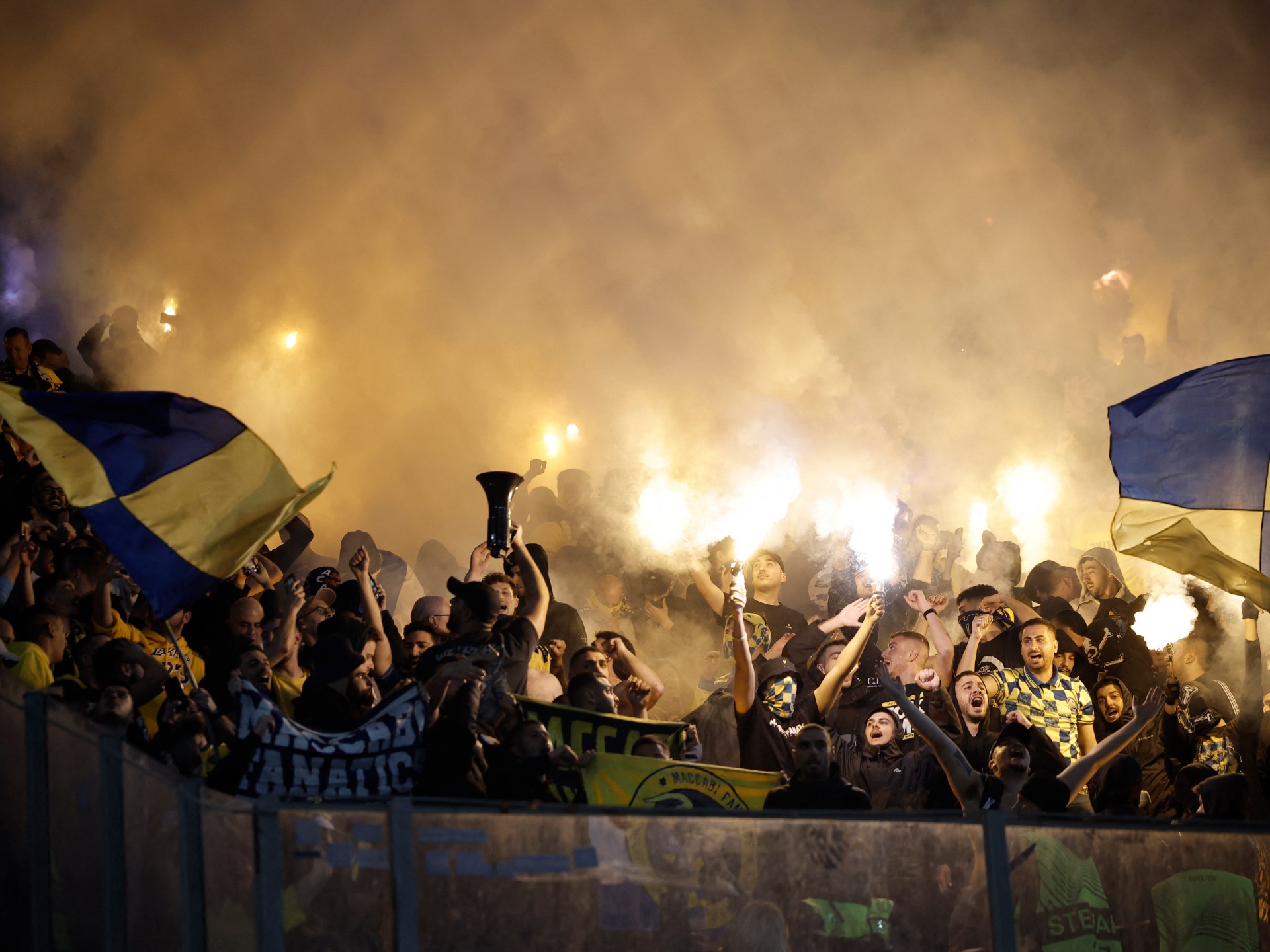
Even if a previous ruling by local officials had barred the team’s supporters from attending, Israeli football team Maccabi Tel Aviv has said it will refuse any tickets to a game in the United Kingdom.
According to Maccabi Tel Aviv, which had “hard lessons learned,” it had decided to turn down any offer of tickets for the Europa League game against Aston Villa on Monday.
Recommended Stories
list of 4 itemsend of list
In a statement posted online, the team stated that “the safety and well-being of our fans is top priority.” In that context, “our decision should be understood.”
The organization added that it has been “working to combat racism” among its “more extreme elements.”
Muslim, Christian, and Jewish players make up our first-team squad, according to the statement. Additionally, our fan base crosses the line between religion and race.
The team’s decision came a day after Israeli police had to cancel a Maccabi game with its rival Tel Aviv team Hapoel before kickoff due to what they termed “public disorder and violent riots.”
The decision by Israeli authorities to halt the game contrasted with criticism from British and Israeli leaders regarding Birmingham City’s decision to outlaw Maccabi supporters from the November 6 game at Villa Park in Birmingham, central England.
Israeli Foreign Affairs Minister Gideon Saar demanded that the city’s Safety Advisory Group (SAG) ban be reversed, while UK Prime Minister Keir Starmer called it the “wrong decision.”
The UK government announced on Friday that it was attempting to overthrow local authorities to permit the presence of Israeli fans.
Some UK politicians questioned the government’s role in Birmingham after Israeli police shut down the match between Tel Aviv teams on Sunday.
“Thanks to Keir Starmer and others who attempted to make this about religion!” More evidence is provided in this example. These fans chose violence despite being in the spotlight, injuring police officers, independent MP Ayoub Khan wrote in a post on X.
Labour MP Richard Burgon sided with his government, claiming that the recent developments supported the club’s decision to forbid fans from watching the game.
He said on X, “This news exposes how ridiculous that campaign has been.” “Birmingham residents have a right to be kept safe,” says the statement.
According to West Midlands Police, the match was deemed high risk based on “current intelligence and previous incidents, including violent clashes and hate crimes, that occurred during the 2024 UEFA Europa League match between Ajax and Maccabi Tel Aviv in Amsterdam,” according to a statement released last week.
According to the police force, “we believe this measure will help reduce risks to public safety,” according to their professional judgment.
Numerous arrests were caused by the clashes between pro-Palestinian supporters and Maccabi Tel Aviv supporters last year in Amsterdam.
Following incidents of Israeli fans raping Palestinians and Arabs, assaulting residents, and destroying Palestinian solidarity symbols, the clashes came as a result of the incidents.
Additionally, there were rumored anti-Semitism-related incidents during the clashes, including a private messaging chat that demanded a “Jew hunt.”
According to a report released by UN investigators that stated that Israel is killing Palestinians, legal experts have also expressed concerns about Israeli teams playing in international sporting events.
More than 30 legal experts wrote to UEFA President Aleksander Ceferin earlier this month to claim that it was “imperative” to outlaw Israel from competitions.
Before services were finally restored, a significant outage at Amazon Web Services (AWS) on Monday severely damaged the internet, downing apps, websites, and online tools used by millions of people all over the world.
The hours-long breakdown revealed how much of modern life depends on cloud infrastructure, from airlines to banking apps to smart home devices and gaming platforms.
Recommended Stories
list of 1 itemend of list
What we know is as follows:
What transpired, and what caused the AWS to go offline?
Amazon’s cloud service experienced a significant failure at around 7:11 GMT, causing numerous well-known apps and websites, including banks, gaming sites, and entertainment services, to stop functioning.
After a technical change to the API, which connects various computer programs, of DynamoDB, a crucial cloud database service that stores user data and other significant data for many online platforms, the issue began in one of AWS’s main data centers in Virginia, its oldest and largest site.
The Domain Name System (DNS), which assists apps in finding the correct server addresses, appears to be the root cause of the error in the update. The DNS process converts website names into the numerical IP addresses that computers use to connect to servers works like the phone book of the internet.
Apps were unable to connect because of the DNS problem and were unable to find the IP address for DynamoDB’s API.
Other AWS services started to fail as DynamoDB did. The outage affected 113 different services overall. By 10:11 GMT, Amazon claimed that all AWS operations had resumed, but there was a “backlog of messages that will be processed over the next few hours.”
Downdetector, a website that monitors internet outages based on user reports, was still reporting issues with platforms like Apple Music, ESPN, and OpenAI at the time of publication.
Updated analysis of the AWS Outage’s overall impact so far! https: //t. pic: co/Bgpm1fFGtf twitter.com/TAAxjagNl6
What exactly is AWS and what is it?
Instead of being physically stored on a computer or other storage device, a cloud allows you to store and use programs or data online.
When people refer to something as “in the cloud,” it means that it is not stored on your personal device, but rather that files, apps, or systems are running on powerful servers hosted by businesses like Amazon (AWS), Google, and Microsoft.
AWS allows businesses to rent storage and computing power in this situation. Behind the scenes, it provides the technology that powers websites, apps, and a lot of online services.
DynamoDB, a database that stores crucial business data, such as customer records, is one of AWS’s core services. Customers were unable to access their DynamoDB data, according to an Amazon report released on Monday.
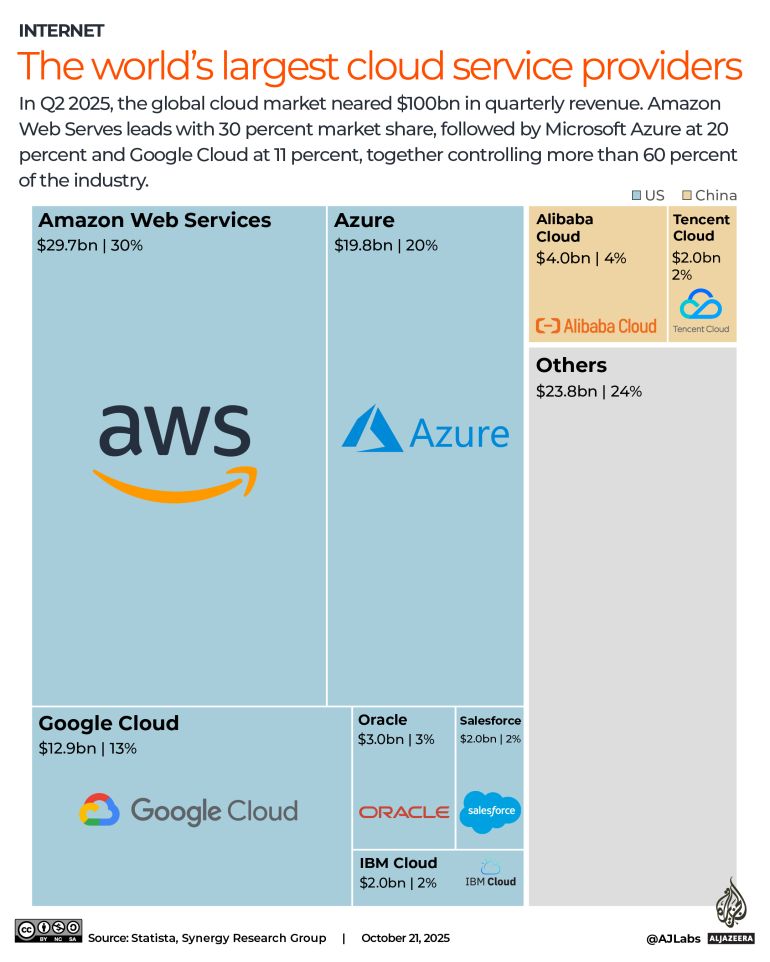
The world’s largest cloud service provider is AWS.
As more businesses rely on cloud services every day, they’ve grown more noticeable than ever before.
According to Joshua Mahony, the chief market analyst at Scope Markets, “the fallout had an impact on people across a number of different spheres.” However, this kind of territory comes with tech companies, and the key is that they can resolve it quickly and affordably.
He claimed that the incident was likely to have a lasting impact on Amazon.
He said, “You’re looking at something that’s a little contained.” Only 30% of the market is owned by Amazon Web Services. Users won’t be jumping ship at once. Their industries are ingrained deeply.
What apps and services were down?
According to Downdetector, the outage affected dozens of websites, including Apple TV, Pinterest, and Snapchat.
Additionally affected were messaging apps like Starbucks, WhatsApp, Signal, Zoom, and Slack, as well as gaming apps like Roblox, Fortnite, and Xbox. Etsy also had issues.
People in the United States were also having issues with Venmo and other financial apps.
Some users reported that their Alexa and Ring doorbells stopped working, while others were unable to download books from their Kindles or access the Amazon website.
Duolingo, the language app, and Canva, the creative tool, reported errors on their websites, as well as The Wall Street Journal, The New York Times, and the Associated Press.
Along with US airlines Delta and United, banks, the cryptocurrency exchange Coinbase, and AI firm Perplexity reported issues.
Why did so many important apps suddenly go offline?
Not just Amazon’s tools were affected when AWS went offline. Other businesses that use AWS for storage, databases, or web hosting also experienced success. These businesses rely on AWS to run significant portions of their systems, including many well-known apps.
The first thing that comes to mind when we see these headlines is, “Is this one of those cyberattacks?” is a phrase that shivers everyone in the face. Is this a military- or intelligence-driven event causing this disruption? And in this situation, Scythe’s CEO, Bryan Bort, told Al Jazeera.
It isn’t, in fact, the majority of the time. Usually, it’s human error.
What was Amazon’s response?
AWS acknowledged the breakdown and stated that engineers were “immediately engaged” in the fix.
AWS claimed to have “many parallel paths to accelerate recovery.” The main issue was fully addressed, according to the report, though some users continued to experience sporadic delays as the recovery process progressed.
Additionally, the business added that it would publish a thorough post-event summary explaining what transpired.
[Jonathan Ernst/Reuters] An aerial view of an Ashburn, Virginia-based Amazon Web Services Data Center.
Lucknow, India – On the evening of September 4, an illuminated signboard lit up a predominantly Muslim neighbourhood in Kanpur, an industrial town in India’s northern state of Uttar Pradesh.
The signboard said: “I love Muhammad” – with a red heart standing in for the word, love.
Recommended Stories
list of 4 itemsend of list
It was the first time the mainly working-class residents in Kanpur’s Syed Nagar had put up such a sign as part of the decorations as they joined millions of Muslims around the world to celebrate Prophet Muhammad’s birthday.
The day, marked as Eid Milad-un-Nabi across South Asia, involves the faithful organising religious gatherings, Quran recitations, and sermons about the prophet’s life and teachings. At some places, the celebrations include mass processions, with people carrying posters to express their love and reverence for the prophet.
In Syed Nagar, however, as soon as the words glowed, a group of Hindu men swooped in, objecting to the celebration. Police were called in, and following a ruckus that lasted hours, the signboard was removed late that night.
Charges related to promoting enmity between different religious groups, as well as deliberate and malicious acts intended to outrage the religious feelings of another community, were filed against nine Muslim men and 15 unidentified people from Syed Nagar. No arrests have been made so far.
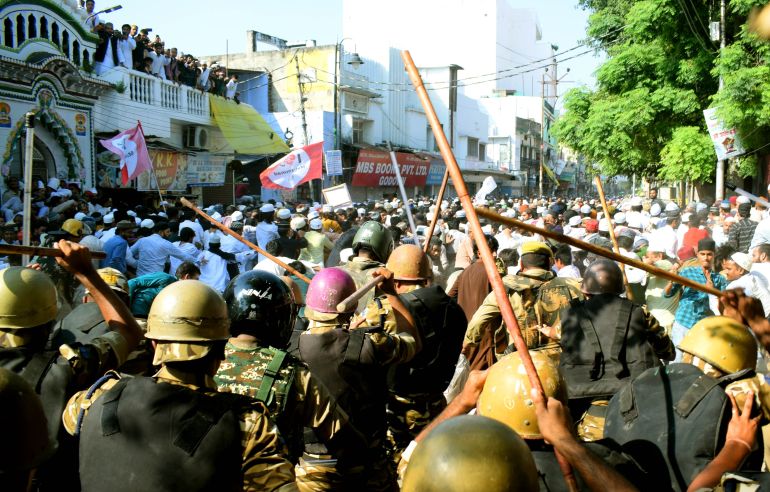
Police attacking Muslim demonstrators in Bareilly, Uttar Pradesh, India [Al Jazeera]
Mohit Bajpayee, a Syed Nagar resident affiliated with a Hindu group named Sri Ramnavmi Samiti, said he had no objection to the text, ‘I love Muhammad’, but to the placement of the signboard at a place used by them for a Hindu festival.
“All religions have equal rights under the constitution,” he told Al Jazeera. “But the sign was put up at a location where our Ram Navami decorations are usually displayed. Everyone has a right to follow their religion, but new traditions should not be started in new locations.”
But the Muslim residents of Syed Nagar say the signboard was put up at a public place they converged at every year for the prophet’s birth anniversary.
“We had official permission for the decorations. Everyone has the right to practise their religion under the constitution,” said a 28-year-old resident who is one of those charged, unwilling to reveal his identity over fears of further action by the government.
MA Khan, the lawyer for the accused in Kanpur, told Al Jazeera that the Muslim men were also accused of tearing a banner of the Hindu community during the Eid Milad-un-Nabi procession on September 5.
“Many of those named were not even present in the procession,” he said.
‘Disturbing communal harmony’
Uttar Pradesh is home to 38 million Muslims – more than the entire population of Saudi Arabia – comprising nearly 20 percent of India’s most populous state. Since 2017, the politically crucial state has been governed by Yogi Adityanath, a hardline Hindu monk known for his anti-Muslim speech and policies, and a prominent politician from Prime Minister Narendra Modi’s Hindu majoritarian Bharatiya Janata Party (BJP).
Days later, the spark from Kanpur ignited a fire some 270km (168 miles) away, in another Uttar Pradesh town called Bareilly – headquarters of the Barelvi sect of Sunni Muslims, who number between 200 million to 300 million across the world.
On September 10, the state police registered a first information report (FIR) against nine Muslims in Bareilly, including a religious scholar, accusing them of “disturbing communal harmony” and starting a “new tradition” that threatened public order.
A Muslim woman protesting in Lucknow, India [Naeem Ansari/Al Jazeera]
On September 21, Maulana Tauqeer Raza Khan, chief of a Muslim group called Ittehad-e-Millat Council (IMC) and descendant of Imam Ahmed Raza Khan, the founder of the Barelvi sect, announced a protest over the FIRs filed in Bareilly and Kanpur, and urged his supporters to gather at a ground after Friday prayers on September 26 to denounce the police action.
The district administration denied Khan permission for the rally.
On September 25, the IMC issued a statement asking people not to gather for the protest. But hours later, Khan’s supporters allegedly circulated a social media message, claiming the IMC statement was fake and aimed at defaming the Muslim body.
The next day, thousands of Muslims assembled near a famous Muslim shrine in Bareilly after the Friday prayers, holding “I love Muhammad” posters and raising slogans against the police for their action in Kanpur.
District authorities alleged that the march was unauthorised and accused some participants of pelting stones at the police and vandalising public property. The police responded with a baton charge, and arrested Khan and dozens of others, as authorities shut down the internet in the town.
Police attacking Muslim demonstrators in Bareilly, Uttar Pradesh, India [Al Jazeera]
In a video message recorded before his arrest, Khan said the crackdown was a targeted suppression of religious expression. “Attempts to suppress our religious sentiments will backfire,” he warned.
A day later, while speaking at an event in the state capital, Lucknow, Chief Minister Adityanath condemned the Bareilly unrest as a “well-orchestrated attempt” to disturb social harmony.
“Sometimes, people are not able to shun their bad habits easily. For that, some denting-painting is required … You saw that in Bareilly yesterday. A maulana [Muslim scholar] forgot who is in power,” he said in Hindi, without naming anyone.
The “denting-painting” soon followed, as has been the pattern with Adityanath’s crackdown on Muslims accused of disrupting public order. A banquet hall belonging to one of the accused was bulldozed by the authorities in Bareilly.
‘Government wants to instil fear’
Demolition of homes and commercial properties belonging to Muslims accused of a range of crimes has become a common practice in Uttar Pradesh and other BJP-ruled states, despite India’s top court recently banning what it called the “bulldozer justice”. Rights groups say such demolitions are a form of extralegal punishment that bypasses judicial processes and devastates families economically.
While the Uttar Pradesh government claimed the demolitions in Bareilly targeted illegally-constructed buildings, the timing and targets suggest a clear strategy of intimidation.
“Police are registering cases against Muslims across the nation to suppress their legitimate protests … The BJP government wants to instil fear so Muslims lose the courage to speak for their religious and fundamental rights,” Sumaiya Rana, daughter of the famous Urdu poet late Munawwar Rana, told Al Jazeera.
Rana herself organised a protest outside the state assembly building in Lucknow, where more than a dozen demonstrators holding “I love Muhammad” placards were briefly detained by the police.
A woman protesting outside the Uttar Pradesh Legislative Assembly building in Lucknow [Naeem Ansari/Al Jazeera]
The Association for Protection of Civil Rights (APCR), a rights group, says at least 22 FIRs have been filed across India in connection with the Muslim campaign, naming more than 2,500 individuals, with at least 89 arrested in Bareilly so far.
“Authorities have treated a slogan expressing love for the prophet as a criminal act and described it as provocative,” APCR secretary Nadeem Khan told Al Jazeera. “In many cases, the administration violated due process in registering cases and demolishing the properties of the accused, which has severe social and economic impacts on Muslim communities.”
SQR Ilyasi, a member of the All India Muslim Personal Law Board, a prominent Muslim body, stressed that peaceful protest is not illegal for any community in India. “Expressing love for the prophet is our right,” he told Al Jazeera.
Activist Vandana Mishra of the People’s Union for Civil Liberties, a rights group, said the authorities frequently allow the Hindu community to “raise religious slogans freely, while the minority faces arrest for expressing love for the prophet”.
“This contravenes the secular and democratic ethos of our constitution,” she told Al Jazeera.
Opposition parties have also criticised the Uttar Pradesh government’s actions.
The Samajwadi Party, one of the state’s biggest political forces, said it attempted to send a delegation to Bareilly to meet the victims of the police crackdown, but claimed its members were prevented. “The government talks of democracy but acts in complete disregard of it,” the leader of the opposition in the Uttar Pradesh Assembly, Mata Prasad Pandey, told reporters in Lucknow.
Lawyer Zia Jillani, who recently visited Bareilly and is representing some of the accused, told Al Jazeera that most of those arrested or facing charges “belong to the marginalised sections of society and earn on a daily wage basis”.
“For them, due to their financial incapability, pursuing and fighting legal cases against the injustices inflicted upon them is an unbearable task,” he said.
On Tuesday, October 21, 2025, how things are going:
Fighting
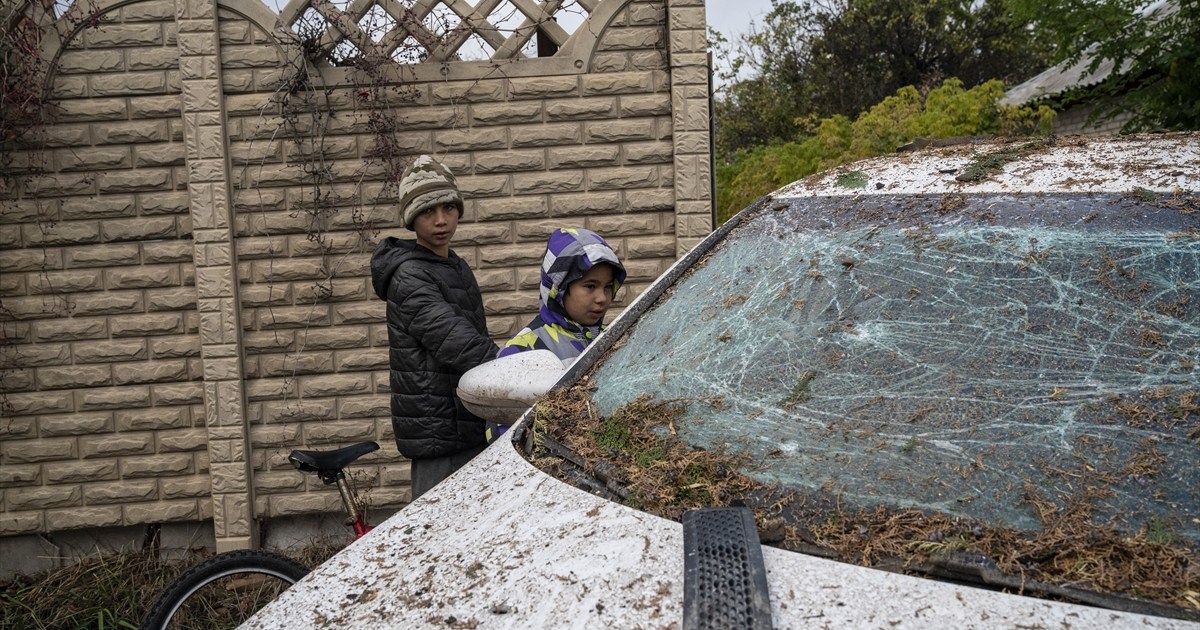
One person was killed and three others were hurt in the Kherson Regional State Administration’s post on Telegram, according to the Kherson Regional State Administration.
Without providing further information about the number of people killed or when the attack took place, the 7th Corps of Ukraine’s Air Assault Forces reported in a Facebook post that a Russian assault group had killed several Ukrainians in recent days while attacking the Ukrainian city of Pokrovsk.
Private Ukrainian energy company DTEK wrote in a post on Telegram that Russian forces attacked a coal enrichment plan in the Dnipropetrovsk region of Ukraine.
In a post on Telegram, Governor Vyacheslav Gladkov reported that two people were killed in a Ukrainian drone attack on the village of Yasnye Zori in the Russian border region of Belgorod.
diplomacy and politics
Donald Trump, the president of the United States, said on Monday that Ukrainians’ chances of winning the war were “questionable.”
According to a summary of the call released by the US State Department, US Secretary of State Marco Rubio and Russian Foreign Affairs Minister Sergey Lavrov discussed “advancing a durable resolution to the Russia-Ukraine war, in line with Trump’s vision.”
In response to rising threats from Ukraine and NATO nations, Russian lawmakers have proposed a law mandating life imprisonment for anyone who engages in sabotage.
Budapest debates
Ukraine and other European nations should be included in upcoming negotiations between Trump and Vladimir Putin, according to French President Emmanuel Macron, who spoke to reporters in Slovenia.
The Ukrainians should be present when they discuss Ukraine’s future. The Europeans should be present when they discuss the security implications for Europeans, Macron said.
Macron added that Volodymyr Zelenskyy, the president of Ukraine, is scheduled to attend their own meeting on Friday in London under the umbrella of “the coalition of the willing.”
Zelenskyy stated to reporters on Monday that he hopes to be invited to Budapest, whether the invitation is “in a format where we meet as three or, as it’s known, shuttle diplomacy.”
Weapons
Zelenskyy claimed that his country is still “working with the United States” to secure “the necessary number of Patriot systems,” that he had spoken with weapons manufacturers in Washington, DC, and that support is needed at “the political level in Washington.”