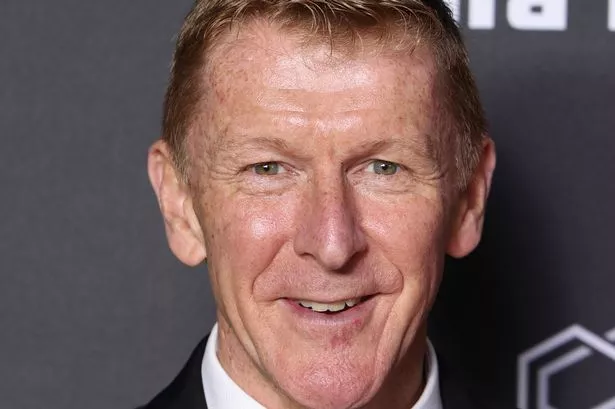
Exactly 10 years since he blasted into space, Tim Peake reveals the lessons he learned in orbit – and what the future holds for public space travel
Performing a clumsy but weightless backwards somersault, astronaut Major Tim Peake declared with undisguised glee that life in orbit was “absolutely spectacular.” The first Brit to visit the International Space Station and complete a spacewalk, through him we could all vicariously live out our dreams of becoming astronauts. A decade later, now 53, he’s lost none of the boyish enthusiasm that won our hearts, telling The Mirror: “The extraordinary view of the planet earth is probably by far the most special thing about being in space. It’s awe inspiring, seeing the Milky Way rise – 200 billion stars of our own galaxy that’s incredibly special as well.”
Next Monday at 11.03am – marking the exact moment 10 years ago on December 15 2015 that Tim blasted into space – a mass paper rocket launch will be staged at London’s Science Museum. Schools across the UK will also be invited to join in a lesson with Tim, broadcast live from the museum, following a day of free activities hosted there by the astronaut on Sunday.
READ MORE: NASA astronaut’s wife claimed to be ‘first crime in space’ victim – but she lied
Tim says: “There will be explosive live shows and kids can learn how to send a rocket up into space.” The first astronaut to run the equivalent of the London Marathon in space, Tim recalls blasting off from the launch site in Kazakhstan as if it was yesterday. Waving to the throngs of people who had gathered for the launch, he walked side by side with Russian commander Yuri Malenchko and American NASA astronaut Tim Kopra, before they stepped inside the Soyuz rocket.
But, as the hatch door closed, they were plunged into silence. “There was a real switch going from all that buzz and activity to going up inside the rocket,” says Tim. “Inside the capsule, when the hatch closes – that’s the moment when everything shifts. It’s just three people crammed in like sardines in a tin waiting for the blue touchpaper to light. That’s the time when you shut everything else out and you just focus on what you’ve been training for, for so many years.”
Inside the Soyuz there’s the descent module for launch and re-entry, and the orbital module – a cramped, bell-shaped capsule, providing tightly seated living space for the crew. It took six hours for the 7 tonne Soyuz to reach the 400 tonne Space Station, arriving at 5.33pm.
But the astronauts didn’t open the hatch until 7.58pm. Only once they were sure the connection between the two crafts was airtight, did they enter the Space Station, which would become Tim’s home for the next six months. Orbiting the earth presented Tim – who lives in Chichester with his wife Rebecca, 51, and their sons Thomas, 16, and Oliver, 14 – with a treasure chest of unearthly delights.
His most memorable was undoubtedly the space walk. “I’ll never forget it,” he says. “It’s one thing to dock in space, which is like a moment out of Moonraker, but it’s another to put on a space suit and go outside. The feeling of danger is palpable. You’re in this environment you’re not supposed to be in – but it’s also incredibly beautiful, peaceful and tranquil being surrounded by the universe. To be out there floating around in space is the most special experience ever. Being in space taught me that this planet is the most beautiful planet I’ve ever seen, and set in the backdrop of the infinite universe it makes you realise we need to look after it.”
Taking part in more than 250 scientific experiments during his mission, he also engaged 2 million schoolchildren across Europe in at least 30 projects. Now retired, but still an ambassador for Science, Technology, Engineering and Mathematic (STEM) he is passionate about inspiring the next generation of explorers, engineers and scientists.
Running the London Marathon strapped to the Space Station’s treadmill by a bungee cord attached to a harness, so he didn’t float away, was another intergalactic feat. He completed the virtual course – in support of The Prince’s Trust (now The King’s Trust) – in 3 hours, 35 minutes and 21 seconds, while watching fellow runners pound the London streets below him via video link.
Low gravity meant Tim’s legs only had to carry 80% of his actual weight. “You could say we’re cheating in a way, but the reality is that if you have all that weight on your collarbone it forces you into this forward position,” he explains. “The treadmill was incredibly narrow, which meant I couldn’t run with my normal gait. It’s a bit like when models walk down the catwalk and they have to put one foot in front of the other – you have to run a bit like that.
“For three and a half hours your blood circulation is cut off by wearing this ridiculous harness and you have to really focus on every foot you place being accurate, so you don’t trip up. After about an hour, I was desperate to get off, so I got faster and faster, because I wanted to finish it as soon as possible. I’d say it is harder to run a marathon in space, but being able to watch the live London marathon at the same time really inspired me.”
His muscles also recovered quicker, because he floated off the treadmill without putting his full body weight on his tired legs. But he failed to beat his earthly time. When he ran the London Marathon in 1999 he finished in 3 hours and 18 minutes. Waxing lyrical about wonders he saw from space – including the Sahara desert, the Amazon rainforest and the Himalayas – Tim says the juxtaposition between the awesome views and the everyday was mindblowing.
Tim, who joined the Army at 19, becoming a pilot in the Army Air Corps and then joining the European Space Agency astronaut corps in 2009, says: “There’s almost this disconnect between normality and awe and wonder. On the one hand you’re working really hard and the next you pass by the window and suddenly see Earth beneath you. “You see this magnificent view of the Aurora at night, or a thunderstorm – and it blows your mind.”
Orbiting around 250 miles above Earth, Tim loved looking down at the planet from the space station’s Cupola – a unique observation deck with seven windows – and shared his images and thoughts on social media. “When you see the Aurora and the small strip of atmosphere that protects us from space, it gives you an appreciation of just what our planet is doing to protect us from a harsh environment.”
The strip of atmosphere, while remarkably thin, technically extends thousands of miles – blending into space and gradually fading. “Back in the Apollo era – they said we came all this way to see what’s on the moon – but what we really discovered was planet Earth,” says Tim, who landed back on terra firma on June 18 2016.
Twenty five this year, the International Space Station will be deorbited in 2031. Advanced technology and high maintenance costs mean it will be replaced by multiple commercial space stations. Tim says: “Space tourists have been spending 10 to 12 days on the ISS for the last 10 years. As it gets easier and cheaper to get to space, we’re seeing more and more people doing it.”
But while singer Katy Perry joined an all female crew to go into space in April this year, it will still be a while before ordinary people can fly to the moon and back, as it currently costs more than £40m. In the meantime, there are still serious space missions in the offing. Artemis II is a NASA-led crewed mission that will send four astronauts on a 10-day flight around the Moon and back, with a launch targeted for early 2026. The lunar flyby will be to test systems for future landings. China also has its own space station now.
Tim continues: “I’m a fan of using space for science and space for the benefit of everybody. I don’t think there’s a huge public appetite for just watching people with high net worth having a quick six minutes of weightlessness in space. Having said that, back in the 1920s and 30s, it was only very wealthy people flying across the Atlantic.
“Today it’s affordable for a much larger percentage of the population. In 100 years time we could be seeing a transportation system that would get you from London to Sydney in 45 minutes [via space] and it could be affordable for a large percentage of people. We might look back at rich people and celebrities going to space and think it was just the start.”
Find out more about how to join in with Tim Peake’s activities at The Science Museum on Sunday 14th and Monday 15th December here
READ MORE: ‘I spent three months living on ISS and discovered space has a distinct smell’
Source: Mirror

Leave a Reply