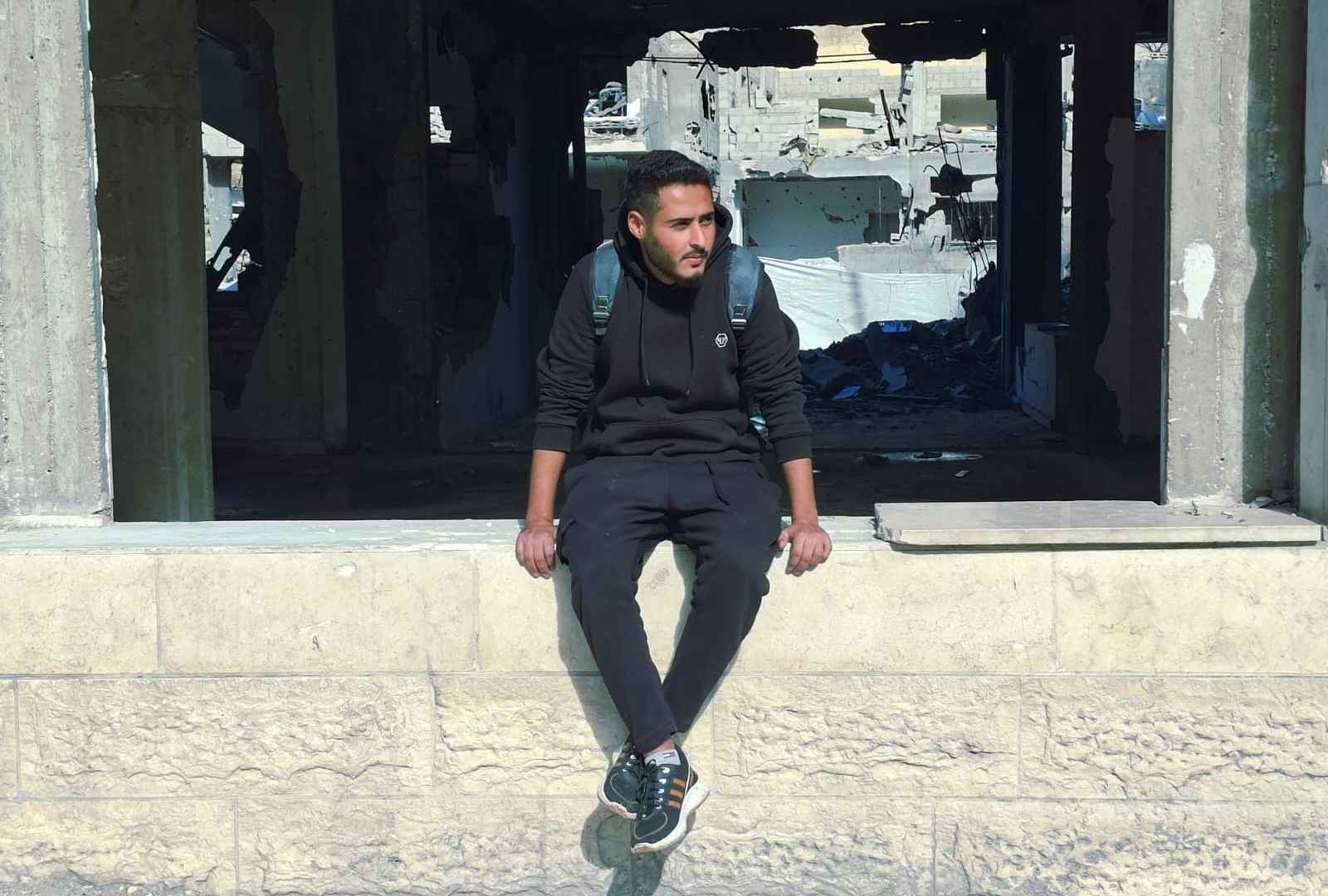
Life in Gaza is still divided between Israel’s killing machine and the world’s growing indifference. Another year has passed. Our unique calendar of death, destruction, and loss has been expanded to this year.
In a March article, I expressed my concern that Israel might pursue its genocide even further than it had already done. And it succeeded. Israel exceeded even my worst fears, achieving unfathomable levels of evil. That evil made our entire year in Gaza special.
I saw a lot of people posting recaps of their favorite 2025 moments, so I thought I’d share my own version. What did this year look like to me?
The brief brief respite from the bombs was insufficient for us to mentally process the 15 months of continuous killing and destruction that had come before it.
I had the opportunity to meet many of the Palestinian prisoners who had been freed as a result of the ceasefire and hear their gruesome accounts of how the Israeli army had forcibly taken them out in February. Antar al-Agha, my high school teacher, was one of them. I was shocked when I first saw him. He couldn’t even stretch his arm to touch me because he was so pale and gaunt.
He described how long he spent in the Israeli detention facility’s “scabies room,” an area that was intended to house scabies. I finally had the opportunity to wash my hands at one dawn, but it didn’t come as a relief. The skin began to peel as though it were a hot boiled potato once the water touched my hand. My hands were covered in blood. He recalled how he could still feel the pain.
More than 400 people were killed in a single blow in the middle of the month as a result of Israel’s continued genocide in March. It obstructed all crossings into the Strip.
The first signs of widespread starvation started to appear in April.
I and my family were forced to leave our home in eastern Khan Younis in May by the Israeli army.
Israel had already arranged a new, inventive form of mass murder and humiliation, cynically dubbed the “Gaza Humanitarian Foundation” by the end of that month. This organization began providing food to afflicted Palestinians through “hunger games,” which was established with the assistance of the United States.
I also went to a GHF point in June because I was extremely hungry. I witnessed my people scurrying for food on the scorching hot sand. A young man hid behind another person to defend himself from bullets, I witnessed. Over a kilogram of flour, I witnessed young men slit each other’s throats.
My house and the entire neighborhood were completely flattened by the Israeli army in July.
The Integrated Food Security Phase Classification (IPC) made the official announcement that Gaza was experiencing a famine in August. Then, not even flour, was left over for us to consume. Red lentils or rice bird feed were being ground to make thin-layered bread. That was my only meal of the day, a portion.
The Israeli army mandated yet another large displacement of Gaza’s northern and southern populations in September, putting hundreds of thousands of people in agony of having to relocate once more.
Another ceasefire agreement was made public in October. I was then unable to feel anything. I already felt depressed for losing my home, my entire city, and many of my close friends and relatives. Due to the oppressive conditions of displacement, I lost both of my freelance content writing contracts.
I was well aware that Israel would not adhere to its side of the truce, and that this would not be the end alligator.
My suspicions were confirmed in November. Israel continued to bomb us. The genocide has just been replaced by a less violent, loud, and intense murder campaign. The so-called “yellow line” was constantly expanding and evicting more and more land, including what was left over in my neighborhood, as the Israeli land-grabbing continued. Governments in that month chose to denounce Israel’s ceasefire violations and instead lavish it with benefits, such as a $35 billion gas deal, making the world’s indifference even more acute.
The brutal winter of December flooded tents and collapsed buildings. Hypothermia began to cause babies’ deaths.
My trip to the GHF site would be the one thing that would make a year of misery disappear from my memory. What I saw there was, in my opinion, the highest level of evil. When I pass by locations I passed on the way to the GHF site and back, I still can’t shake the fear I feel.
As I wander the rain-soaked, confined alleys of my tent camp today, I wonder why all these people continue to cling to life despite having lost their homes, jobs, and loved ones.
It’s not a hope, as far as I’m aware; instead, it’s a mix of surrender and helplessness.
Perhaps it’s because time has slowed down in Gaza. The present, the future, and the past all occur at once in this place.
Time is not flying; it is not an arrow here. There are endless episodes of horrifying agony between beginning and end in a circle that combines beginnings and ends.
The tragedy in Gaza does not differ from the fundamental laws of physics, which make no distinction between the present and the past.
The opposite direction’s movement of a pendulum has the same energy and momentum as its right-to-left movement. The past and future cannot be identified unless we start the process.
In Gaza, where the future influences the past or where the effects are before the causes, I recently started making fun of the idea of retrocausality. I can picture how Israeli planes might bomb buildings when they collapse on their own, but as we watch them crumble, we can see how they will eventually crumble.
Of course, one could argue that in Gaza, buildings are still collapsing because Israeli bombardment had already done so. However, it is also true that Israel continues to bomb Palestinian homes. It is not beyond the imagination to imagine how Palestinian rubble will be destroyed in the future by an Israeli bomb because the same building would be bombed and rebuilt over and over again.
We in Gaza are terrified of what lies ahead as the world prepares for a new year and a better future. We are caught between a future and a past that we don’t dare to imagine.
Because we have no control over our lives, we are unable to even make New Year’s resolutions.
Israel might block all food from entering Gaza again because I want to eat less sugar.
Although I want to learn to swim, Israel might shoot me if I venture into the water.
My back yard needs to be replanned, but I’m not even close to doing so.
Although Israel forbids us from traveling, I want to take my mother to Umrah and to Masjid al-Haram, Mecca’s Great Mosque.
The only New Year’s resolution I can probably make is to get used to the cold showers. Having no gas and firewood might make that wish much simpler.
There is nothing to plan for in Gaza, but everything to aspire to.
Source: Aljazeera

Leave a Reply