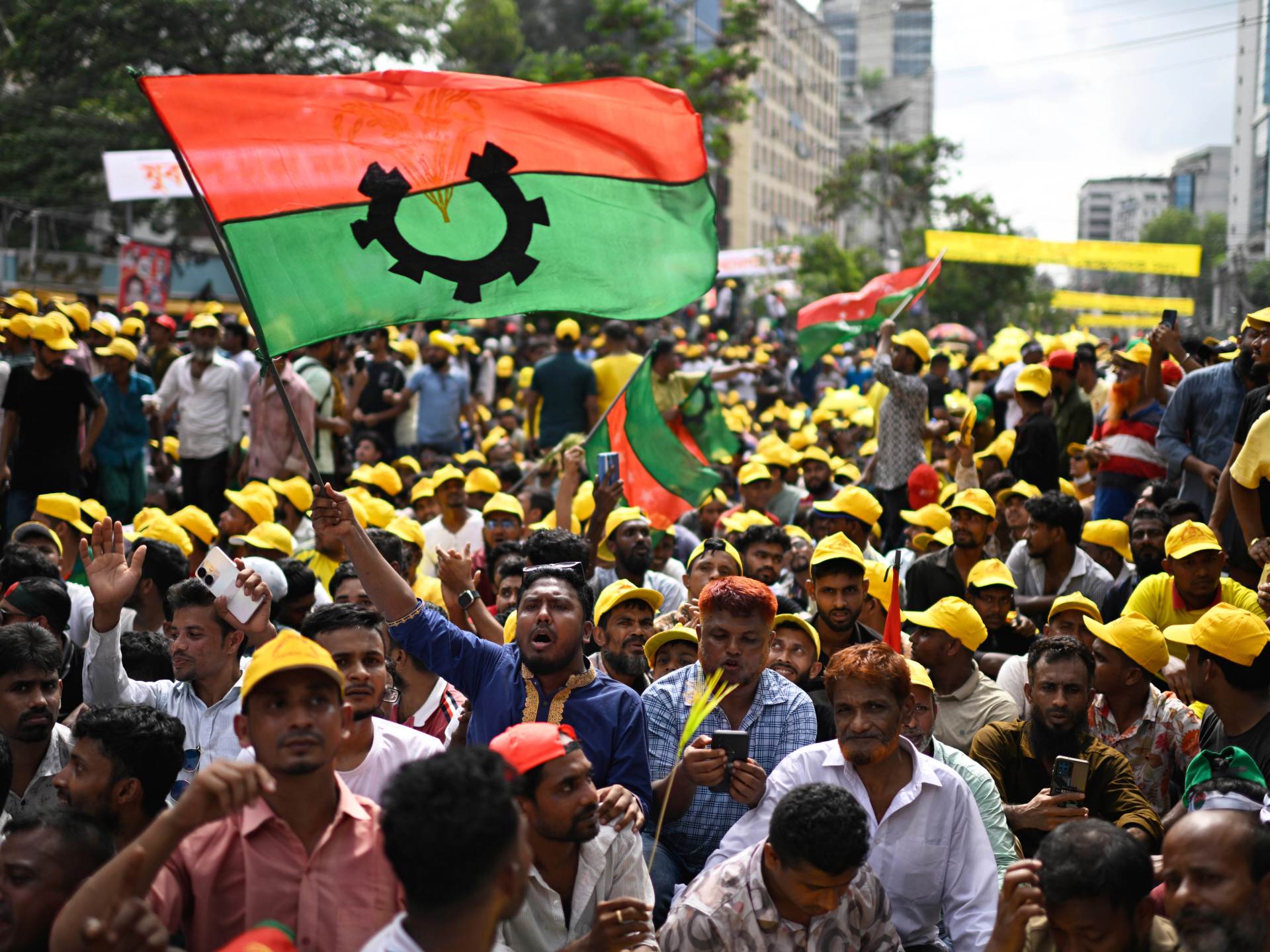
The Bangladesh Nationalist Party (BNP), the country’s largest political party, is decisively breaking its decades-long alliance with the Jamaat-e-Islami, the South Asian nation’s biggest Islamist group, repositioning itself instead as a liberal, democratic force before national elections.
The shift comes 16 months after the toppling of former Prime Minister Sheikh Hasina, following a mass uprising against her decade-and-a-half-long rule marked by widespread human rights excesses, including extrajudicial killings, forced disappearances, arrests of critics and opposition leaders, and a brutal crackdown on protesters in August 2024.
Hasina’s Awami League party, historically the BNP’s principal rival, had over the decades proclaimed the mantle of a secular, liberal pillar in Bangladeshi politics, though critics disputed that assertion.
By contrast, the BNP and Jamaat were pulled together by their shared opposition to the Awami League. But their ideological differences were never hidden: The BNP subscribed to a nationalist worldview, while the Islamic identity of most Bangladeshis is the raison d’etre of the Jamaat.
Now, those differences have erupted into a full-fledged split between the parties that had ruled together in the last non-Hasina government elected in Bangladesh, between 2001 and 2006.
Addressing party supporters this week, BNP Acting Chairman Tarique Rehman invoked the blood-soaked memory of Bangladesh’s 1971 Liberation War against Pakistan, saying “people saw” what happened then. He did not name the Jamaat, but the reference was clearly understood across Bangladesh: The Jamaat had opposed Bangladesh’s independence from Pakistan.
He also accused the Jamaat of misusing religion to seek votes.
In similar comments last month, BNP Secretary-General Mirza Fakhrul Islam Alamgir cautioned against dividing the country “in the name of religion” and stressed that the BNP’s politics ought to rest on national unity, democratic principles, and the foundational spirit of 1971.
So what’s behind this shift?
The BNP’s recent narrative suggests that it wants to appropriate the moral vocabulary of secular nationalism that the Awami League long monopolised through its lopsided historical revisionism of the true spirit of the liberation war. Awami League founder Sheikh Mujibur Rehman led the liberation struggle, but was also responsible for an independent Bnagladesh’s early descent into authoritarianism, when he banned all other political parties to try to set up a one-party system in 1975.
Hasina carried forward that legacy when she was in power between 2009 and 2024, banning the Jamaat and arresting thousands of BNP leaders and workers – including its longtime chief and former Prime Minister Begum Khaleda Zia, who is currently in hospital in what her party and family have described as a “very critical condition”. The Hasina government’s ruthless crackdown on the political opposition and other critics turned the 2014, 2018 and 2024 elections into a sham, with the Awami League winning landslides against a landscape of repression.
To occupy the secular nationalist void left by the Awami League – which itself has now been banned, while Hasina is in exile in India – the BNP needs to sever ties with an Islamist party whose historical baggage could hinder its attempt to appeal to an audience seeking pluralistic politics.
To be sure, the BNP-Jamaat split did not appear overnight. For months, both parties have drifted apart over core questions: Whether broader reforms must precede elections, how to restructure the Constitution, and what political model should define the post-Hasina era.
The Jamaat pushed for sweeping structural changes before polls; the BNP insisted on early elections and minimal constitutional revisions. Their disagreements slowly hardened into open rifts.
But this break is not merely about strategic disagreements. It reflects an ideological recalibration driven by the new political environment.
The centre-left, liberal-secular space that the Awami League once claimed is now vacant.
The BNP sees an opportunity to occupy it, before national elections scheduled for February.
BNP’s calculation is anchored in the shifting mood of the electorate. The youth-led uprising of 2024, the collapse of one-party authoritarianism, and the civic awakening of urban middle-class voters have all produced a renewed demand for democratic governance and political moderation.
Jamaat’s religion-driven leanings, the BNP believes, could clash with that sentiment. By rebranding itself, the BNP believes it can resonate with voters who are disillusioned with both the Awami League’s authoritarianism and the Jamaat’s religious conservatism.
The reorientation also aims to reclaim the moral high ground of 1971. For decades, the Awami League weaponised the Jamaat’s wartime collaboration with Pakistan to delegitimise the BNP by association. Now the BNP is flipping that narrative.
By denouncing the Jamaat’s role in 1971, the party is challenging the ideological monopoly the Awami League exercised for half a century – trying to appeal to younger citizens who view 1971 through narratives of democracy and human rights rather than loyalty to any one party.
This attempted transformation is not without risks. The BNP must overcome scepticism about whether this rebranding is genuine or opportunistic. Elements within the BNP’s own ranks may resist the shift towards a more liberal identity.
Furthermore, the post-Hasina political space is crowded: Youth-driven groups like the National Citizen Party (NCP) and civil society networks are also vying for the liberal-centrist vote. Vote fragmentation could dilute the BNP’s gains unless it manages to unify disparate pro-democracy constituencies.
Yet the strategic logic behind BNP’s recalibration appears compelling for now.
The party is no longer positioning itself as a centre-right force competing with the Awami League; it is attempting to transform into a broad democratic platform that absorbs former Awami League voters, urban liberals, minority communities, and politically awakened youth, all searching for a new political home.
Whether this shift succeeds will depend on how consistently the BNP maintains this new ideological line and whether the public believes that the party’s rupture with Jamaat is a principled decision rather than electoral choreography.
But what is clear already is that the BNP of 2025 is not the BNP of the past decade. Its leaders are speaking a new language – rooted in inclusiveness, anti-sectarianism, and democratic reform.
And they are speaking it loudly.
Source: Aljazeera

Leave a Reply