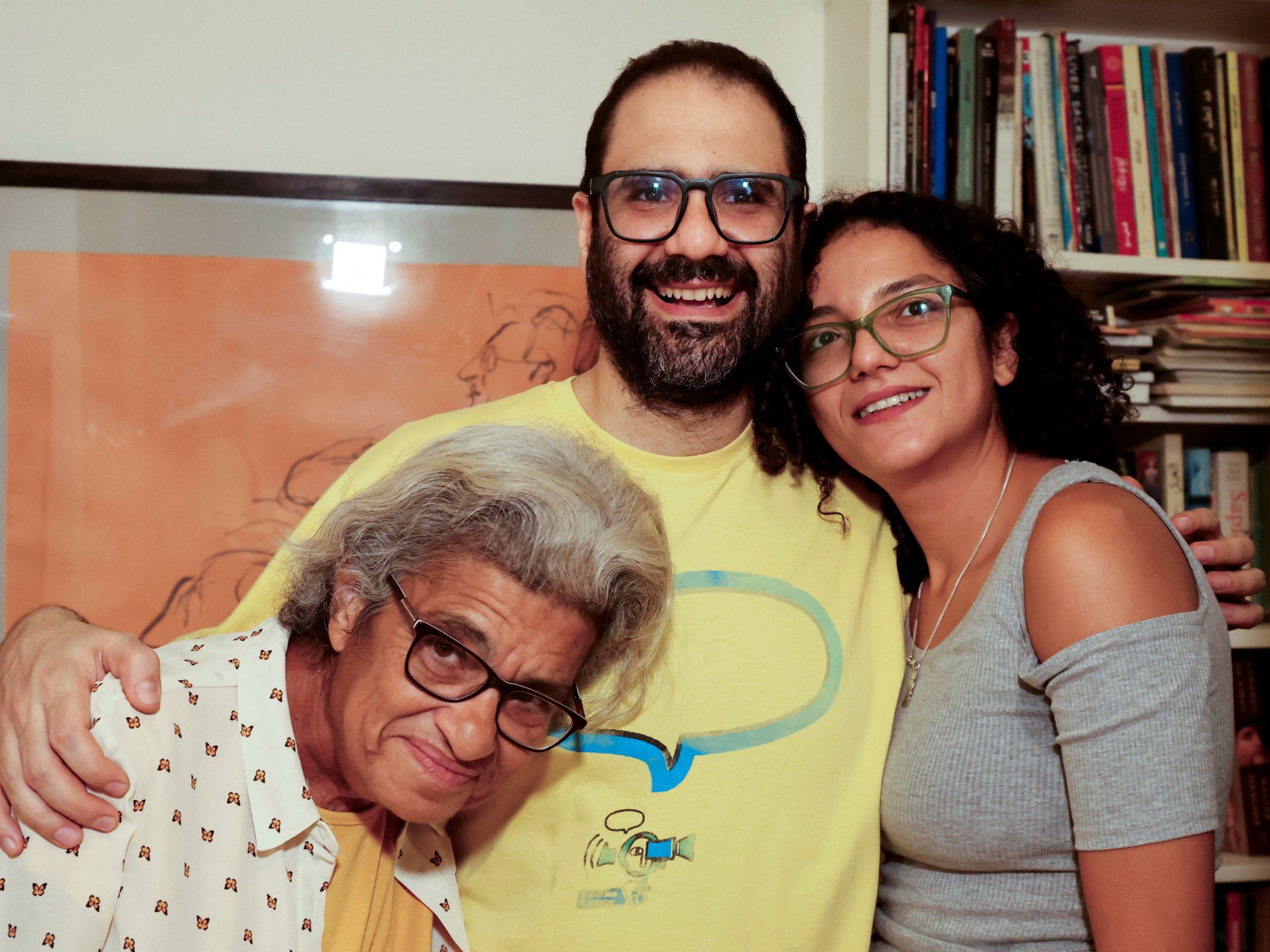
The current backlash against Alaa Abdelfattah in Britain is so intense that it exposes how selectively outrage is used, not because it highlights a renewed concern for justice.
After the uprising that overthrew President Hosni Mubarak in 2011, Alaa, an Egyptian-British writer and activist, spent more than a decade in and out of Egyptian prisons. His detention was marked by protracted hunger strikes, discrimination against fundamental rights, and treatment that human rights organizations described as cruel and degrading. Following a year-long campaign by his mother, sister, and close friends, he was finally free on September 23. He was only permitted to travel in the UK on December 26 and his family was only allowed to travel there this month.
Alaaa fled Cairo after ten years of oppression only to be met with public outbursts, a petition for his removal from the British citizenship, and his deportation. Alaa said he considered “killing any colonialists… heroic,” including Zionists, in a 2010 social media post that caused public hostility.
The tweet has received a lot of negative feedback from politicians calling for tough measures, as well as being subject to scrutiny from the counterterrorism police.
The UK’s response is moving at a much faster pace and intensity than the silence surrounding much more significant statements and actions that it actively encourages.
Selective outrage can be seen in this manner.
The UK continues to host and work with senior Israeli officials who have been accused of participating in and inciting genocide, even though Alaa’s words are dissected and framed as a moral emergency.
For instance, Israel’s air force chief Tomer Bar, who has overseen the carpet bombing of Gaza, the destruction of hospitals, schools, and homes, and the extermination of entire families, was granted special legal immunity to travel to the UK in July. He was protected from arrest for war crimes while he was on British soil, according to reports from Declassified UK.
No comparable outcry has been expressed about this.
In September, Israeli President Isaac Herzog was able to visit the UK and hold high-level meetings. This is the same man who, at the start of the genocide, suggested that “the entire Palestinian] nation” is to blame and that “this rhetoric about civilians not aware, not involved – it’s not true.” Herzog’s statements and those of others have been gathered in a sizable database that currently supports the International Court of Justice (ICJ) genocide case against Israel.
However, Israeli President Keir Starmer welcomed the Israeli prime minister after being accused of inciting genocide and was unharmed when he entered the country. No outrage over the visit of a potential war criminal was displayed by those concerned about Alaa’s tweet.
British nationals who have traveled to Israel have been omitted from the Israeli military, including during Israel’s ongoing genocide in Gaza. Tens of thousands of civilian deaths have been caused by these operations, which have been documented by the UN, Amnesty International, and Human Rights Watch, as well as the destruction of hospitals and universities.
There hasn’t been a comprehensive investigation into whether British citizens have been involved in international law violations despite the extensive documentation of war crimes and crimes against humanity and the ICJ’s warning of the serious risk of genocide.
Again, there isn’t much outrage.
The UK continues to cooperate politically, militarily, and politically with Israel while granting arms export licenses to Israel. Even as international organizations have issued warnings about serious human rights violations and potential violations of international law, these policies continue. All of this occurs relatively unaffected politically.
The UK’s political panic is caused by a decade-old tweet, not a mass massacre, not a siege, not a massive destruction of civilian life, not an incite to genocide.
This contrast is not coincidental. It reveals a hierarchy of outrage where opposing voices are systematically silenced and punished while state violence is not, and where public hostility is directed at the wrongful people rather than the rightward ones. In Alaa’s case, it is apparent how moral language is used sparingly to control discomfort rather than restrain impunity.
The UK claims that the principles it defends are untrue because of this asymmetry. When limited protection of human rights is used, they become convenience tools rather than universal standards. When anger is loud but persistent, it becomes performance-driven. And impunity becomes a policy when powerful allies are denied accountability.
People who support this tactic frequently make use of “quiet diplomacy,” arguing that restraint is more successful than confrontation. There is little evidence that Alaa or other civilians in Gaza have been held accountable by silence, which is lacking. In both cases, discretion served more as a means of achieving goals than as a means of achieving them.
The UK has the resources to take a different course of action: halting arms exports, conducting internal investigations into suspected crimes committed by its citizens, imposing sanctions on cooperation and limiting visits by officials convicted of serious crimes. It is also revealing that these tools are still largely in use.
Without that change, outrage will remain constrained, subject to impunity, and remain limited, widening the gap between the values the UK professes and the violence it continues to support.
Source: Aljazeera

Leave a Reply