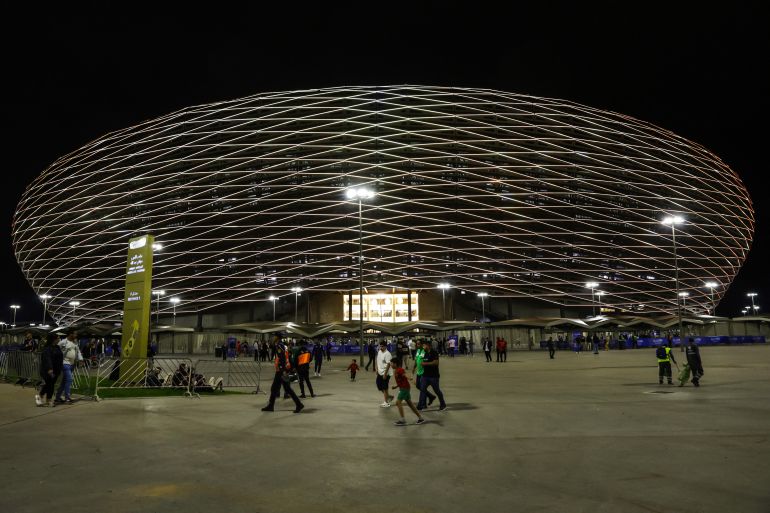
African football’s finest teams and brightest stars will take centre stage in Morocco when the continent’s premier showpiece, the Africa Cup of Nations, kicks off on Sunday.
Ivory Coast will look to defend the title they won in 2023, while Morocco, Egypt and Senegal are also among the pretournament favourites.
With high-profile players such as Mohamed Salah, Achraf Hakimi and Victor Osimhen set to feature, the 2025 edition is expected to deliver top-tier football and storylines that extend well beyond the pitch.
Here’s what you need to know about the upcoming AFCON:
What are the key dates and where will the AFCON final be played?
The CAF Africa Cup of Nations 2025 will begin on Sunday, as host nation Morocco play Comoros in the opening game.
The final will be played on January 18 at the 69,500-capacity Prince Moulay Abdellah Stadium in Rabat, marking the conclusion of the 52-match tournament.
- Group stage: December 21 to 31
- Round of 16: January 3 to 6
- Quarterfinals: January 9 and 10
- Semifinals: January 14
- Third-place playoff: January 17
- Final: January 18
Why is AFCON 2025 starting in December?
The tournament in Morocco was due to be played in June, but that clashed with the expanded 32-team FIFA Club World Cup, which was held in the United States at the time.
It marks the first time AFCON will take place over the Christmas and New Year period.
Where is the tournament being held?
Morocco is hosting the 35th edition of AFCON across nine venues in six cities – the most ever for an AFCON.
Guinea was initially due to host this edition, but the West African country, which is among the poorest on the continent, was stripped of hosting rights due to concerns about its readiness.
The 2025 edition marks the second time Morocco has hosted the African championships, having first done so in 1988.
Here’s a list of the venues and cities:
⚽ Agadir: Adrar Stadium (capacity: 45,480)
⚽ Casablanca: Stade Mohammed V (capacity: 67,000)
⚽ Fez: Fez Stadium (capacity: 45,000)
⚽ Marrakesh: Marrakesh Stadium (capacity: 45,240)
⚽ Rabat: Prince Moulay Abdellah Stadium (capacity: 69,500)
⚽ Rabat: Moulay Hassan Stadium (capacity: 22,000)
⚽ Rabat: Rabat Olympic Stadium (capacity: 21,000)
⚽ Rabat: Al Barid Stadium (capacity: 18,000)
⚽ Tangier: Ibn Batouta Stadium (capacity: 75,600)

How many teams are taking part?
Twenty-four teams from the Confederation of African Football (CAF) will play in the tournament.
Defending champions Ivory Coast, record seven-time winners Egypt, giants Morocco and Nigeria are among the participants.
The nations have been divided into six groups:
⚽ Group A: Morocco, Mali, Zambia, Comoros
⚽ Group B: Egypt, South Africa, Angola, Zimbabwe
⚽ Group C: Nigeria, Tunisia, Uganda, Tanzania
⚽ Group D: Senegal, DR Congo, Benin, Botswana
⚽ Group E: Algeria, Burkina Faso, Equatorial Guinea, Sudan
⚽ Group F: Ivory Coast, Cameroon, Gabon, Mozambique
What is the tournament format?
The teams will play in a round-robin format, with the top two from each group, along with the best four third-placed teams, advancing to the knockout stage, which begins with the round of 16.
That is followed by the quarterfinals, semifinals and the final. There is also a third-place playoff between the two losing semifinalists.
In the knockout stages, if a match is level at the end of normal playing time, it will go to 30 minutes of extra time and, if required, penalties.
A full AFCON 2025 match schedule is available here.

When were the players released for AFCON?
FIFA announced in early December that clubs would only be obliged to release players from December 15 – a week later than the standard international window. The decision left AFCON teams less than a week to prepare once all players were available, posing a logistical challenge for coaches and organisers.
FIFA said the shortened release period, the same approach used for the 2022 World Cup in Qatar, was agreed after consultations with CAF and other stakeholders to “reduce the impact on various parties”, without elaborating.
Mali coach Tom Saintfiet said it showed a lack of respect for African football and that European clubs were given a higher priority by FIFA. “Everyone in Europe thinks African football is not important,” he added. “It shows a lack of respect, and I’m angry.”
The late notification was also criticised by the coaches, given that the dates for the AFCON finals were announced in June last year, giving FIFA ample time to make its ruling.
Who are the previous AFCON champions?
Egypt are the most successful African nation with seven AFCON titles. However, the Pharaohs haven’t won the title since 2010.
Cameroon are the second-most successful team with five titles, followed by Ghana with four, though they will be absent from this year’s edition after failing to qualify.
Nigeria and the Ivory Coast have won three each, with the latter beating the former in the last edition’s final.
As many as 15 countries have won the championship since the tournament started in 1957.

Why is the AFCON important?
The Africa Cup of Nations brings together some of the strongest teams on the continent, including several capable of making deep runs on the global stage at events like the FIFA World Cup.
Seven teams featuring at AFCON 2025 – Algeria, Egypt, Ivory Coast, Morocco, Senegal, South Africa and Tunisia – have also qualified for the 2026 FIFA World Cup, which will be co-hosted by the United States, Mexico and Canada.
“AFCON is special because it reflects the rich cultures of our continent. Every edition has its own identity – from the fans to the rhythm of the matches,” ex-Zambia Christopher Katongo, who led them to the title in 2012, told CAFOnline.
“It’s not just about football; it’s about pride, history, and representing your people. The level of competition keeps growing because African football is constantly improving, and that makes every tournament a fresh challenge.
“AFCON has become a global showcase for African talent,” he added.
For host nation Morocco, this tournament doubles up as an opportunity to identify areas for improvement and a timely warm-up before the 2030 World Cup, which they will co-host with Spain and Portugal.
Who are the favourites to win AFCON 2025?
Host nation Morocco and defending champions Ivory Coast are among the frontrunners for the title.
Morocco, Africa’s highest-ranked nation at 11th in the world, are in great form, having extended their record-breaking run of successive victories to 18 last month.
The North Africans, whose squad is widely regarded as a golden generation and was the surprise package at the 2022 Qatar World Cup with a semifinal achievement, will also enjoy the advantage of playing in front of home crowds as they aim for their first title in 50 years.
After stunning Nigeria in the 2023 final on home soil, title holders Ivory Coast enter the tournament this year in high spirits. The Elephants sealed their ticket to the 2026 World Cup in remarkable fashion, finishing top of their group in the qualifying stage, without conceding a goal in their 10 games.
Egypt, spearheaded by Liverpool legend Mohamed Salah, could also be one to watch. Senegal, Tunisia and Algeria are among the other fancied teams.
What is the prize money for AFCON?
The prize money remains the same as the last edition, with the winner receiving $7m, while the runner-up takes home $4m.
The total prize pot for the tournament is $32m.
Where to buy tickets and watch the tournament?
Tickets went live on CAF’s official platform in mid-October, with the federation saying 298,000 tickets were sold during the first two phases, with buyers in 106 nations worldwide. A third phase was announced in mid-November.
Tickets for the final, starting from about $43, were sold out in the third phase. Overall, the cheapest ticket available for a game is priced at a little over $10.
Regional broadcasters, including Channel 4, beIN Sport, SuperSport and Canal+, will telecast the tournament.
Source: Aljazeera

Leave a Reply