REPORTER’S NOTEBOOK
The town of Hpapun was once a bustling regional hub with banks, regional government offices, and stores that supplied the surrounding valleys.
It even had its own airport, which was particularly useful in this remote corner of eastern Myanmar.
The ruling military government say Hpapun will be part of the second phase of voting when the general election resumes this Sunday, after the first phase at the end of December.
The only problem: Hpapun is actually a ghost town.
On the walls of the police station, a sign asks helpfully, “Can We Help You?” in English. But just inside the gate, a white skull and crossbones on a red background warns of landmines planted inside.
When Al Jazeera visited Hpapun several weeks ago, not a single soul remained in the town, and all the businesses and homes had been either burned, bombed or reclaimed by the jungle.
Some voting will take place inside the Tactical Command post about 10km (6 miles) down the road. But anyone wanting to cast their ballot will have to get past landmines, booby traps and about 800 government soldiers, who have been under siege since 2024.
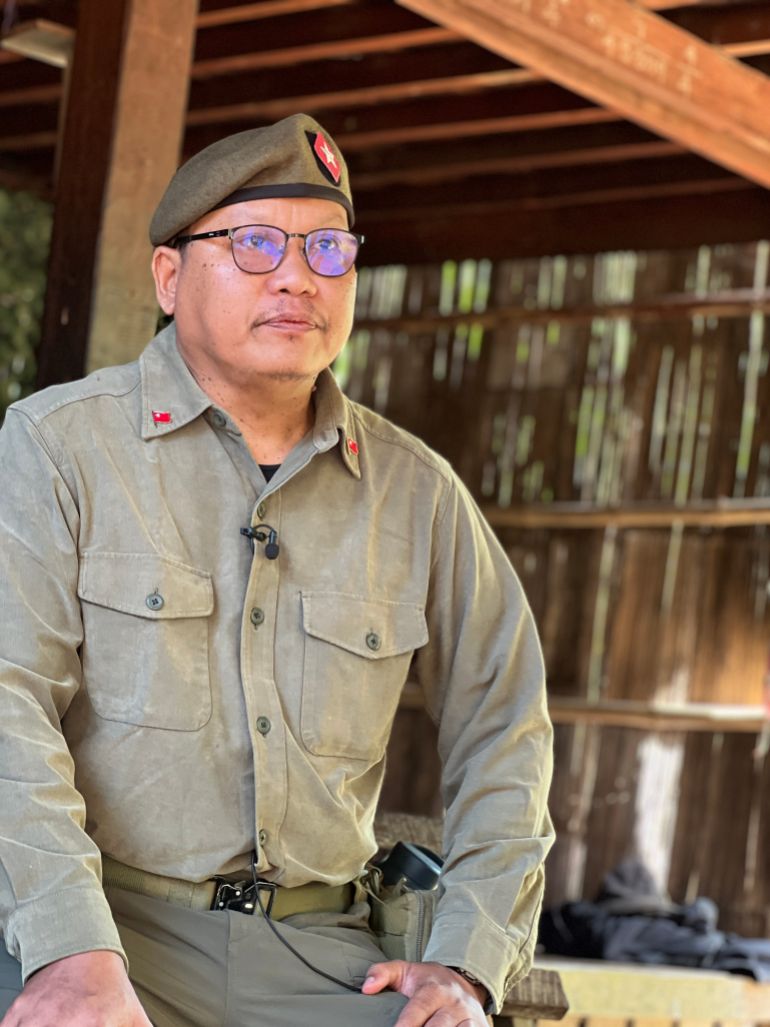
“The military junta’s upcoming election is a sham. It’s a staged, fake election designed to maintain the power they have stolen,” says Tin Oo, commander of the People’s Defence Force, one of the groups of fighters currently trying to clear government forces out of the area.
And at least 3.5 million voters across Myanmar won’t be able to vote because they’ve been forced from their homes by fighting in the civil war.
Aye Thu Zar fled from her village, Pazun Myaung, two months ago after it was hit by air strikes from government fighter jets. Now she and her son Moe live in a community of 150 other displaced people on the banks of the Sittang river, surviving on what she ekes out of the land. There are no relief agencies operating here offering handouts of shelter or food.
“No, I’m not voting,” she told me, sitting in the bamboo hut she now calls home. “I don’t know. I haven’t heard anything about it. We live in a remote area, so we don’t know about the election.”
![Overgrowth outside an office of the National League for Democracy, of Nobel Peace Prize winner Aung San Suu Kyi, who is now under house arrest [Tony Cheng/ Al Jazeera]](https://i0.wp.com/www.aljazeera.com/wp-content/uploads/2026/01/IMG_1234-1768051626.jpg?w=696&ssl=1)
Just two hours’ drive away in Yangon, Myanmar’s most populated city, security is light and the civil war feels far away. Many of the country’s urban areas voted in the first phase of the election on December 28. After the second phase on Sunday, a third phase will take place on January 25 before final results are declared.
But with military-backed parties the only option on the ballot paper, many voters simply didn’t show up in cities like Yangon, and while official figures are yet to be released, local election officials told Al Jazeera that the turnout could be as low as 35 percent.
None of these problems seems to be troubling the pro-military Union Solidarity and Development Party (USDP), however. They’ve already been named as the easy winners in the first phase, with 89 out of 102 lower seats won, and it seems likely they will emerge as the winners when the outcome is announced at the end of the month.
Source: Aljazeera

Leave a Reply