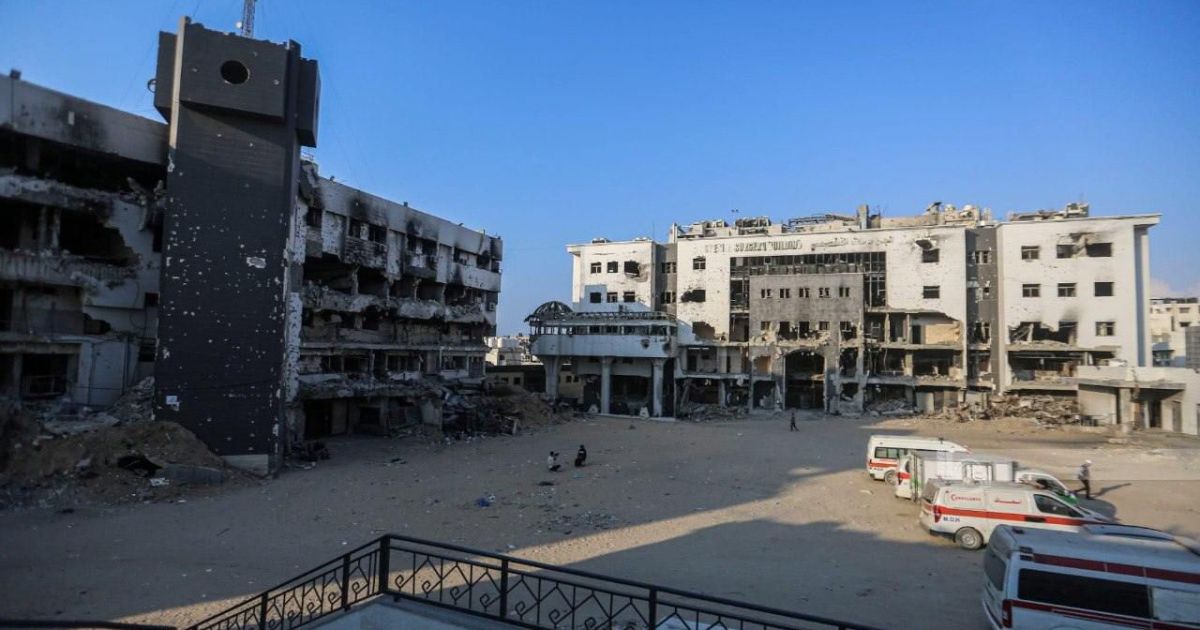
I arrive at al-Shifa Hospital’s emergency room at 7:30 am and spend the entire 24-hour period there. There are constantly more patients coming in from heart attacks, hypothermia, chronic diseases that have suddenlygotten worse as a result of the lack of medical attention for traumatic injuries brought on by Israeli attacks.
Up to three doctors and four to six nurses work a regular shift, which is roughly a third of the emergency room’s staff before the war. I don’t get paid for this work, like many other medical professionals. Although the hospital cannot afford to pay us, some coworkers occasionally receive symbolic pay from organizations that support our efforts. No one is paid in installments.
Only three of the 29 al-Shifa departments are still in full swing. The majority of the structures in the once-sprawling medical complex have been destroyed or burned. Three of them have undergone partial restoration, and we work in them.
When my shift is over, I return to my bombed-out home, which has been replaced with tarpaulins rather than walls. Because I don’t bring any money back, we have no heating, electricity, or running water, and we struggle to get enough food.
Medical professionals in Gaza are confronted with this reality. The Gazan hospitals still resemble battlefronts despite more than two months since the ceasefire was in effect. Only the volunteerism and moral decency of countless medical professionals have allowed the sector to survive. It is barely functioning.
Patients stand in long lines in Gaza as doctors are working under enormous pressure, nurses are performing tasks beyond their capacity, and equipment shortages cause them to have their appointments delayed.
Hospital occupancy rates are at records, and some departments’ capacity has been frequently exceeded.
In a setting where almost everything is lacking, including essential medicines, ventilators, operating rooms, and even beds, medical teams are operating. Even a minor malfunction can halt the treatment of dozens of patients, adding to this a severe shortage of spare parts for malfunctioning medical equipment.
350, 000 people experience chronic illnesses, the majority of whom are unable to receive regular medical care. 42, 000 people in Gaza need long-term rehabilitation and/or multiple surgeries, which are inaccessible. Nearly 1,100 patients have died while awaiting medical clearance to leave for treatment out of the over 16, 000 patients.
In the meantime, Israel continues to bomb civilians and prevent the delivery of crucial and life-saving medications, including those for dialysis, heart medications, antibiotics, insulin, and emergency care IV solutions.
Since the Israeli truce ended on October 10 and injured at least 411 people, there are at least 411. The number of people who have died as a result of Israel’s decision to omit drugs is up for guesswork.
Medical professionals who have already endured hell bear the burden of all these pressures, including the high patient count, the damaged medical infrastructure, and the lack of medicines.
According to Medical Aid for Palestinians, at least 1,722 of our colleagues perished in the genocide. Some people eluded Gaza when they had the chance. Dr. Hussam Abu Safia, the hospital’s director, is one of the at least 80 of our colleagues who are still imprisoned in Israel.
Those of us who are still working are exhausted. We are still haunted by images of the horrors of the genocide: infants and children who have lost multiple limbs, elderly people who have severe internal injuries that cannot be operated on, and young people who have spinal or head injuries who are now entirely dependent on a caregiver and have access to medical supplies or medications.
In my pocket, among the tools and bandages, is where I carry my grief. One of my coworkers at al-Shifa Hospital who lost a child recently remarked, “Sometimes I treat a child who looks like my own son and I have to hide my tears.”
We are fighting against time and death, according to another coworker, and we don’t work in hospitals.
We are not just caregivers or employees in Gaza, as medical professionals. We are soldiers in a different kind of war, heroes without armor, and witnesses to tragedy. Despite putting our own suffering aside, some of us have lost loved ones, while others have lost homes. We can’t afford to let our patients down, but rather because we are fearless. There is an unwavering will despite the exhaustion, fear, and sorrow, and hearts filled with duty and humanity.
We’ll keep going, but we can’t do it alone. We require urgent assistance in order to re-equip operating rooms, re-stock medical supplies, and restore Gaza’s healthcare sector.
Gaza needs medicine, personnel, medical supplies, and a guarantee of the fundamental right to treatment, not more statements.
Let this article serve as a call to action right away, not a call for help. To resurrect Gaza’s healthcare system, lives must be saved. Israelis are important.
Source: Aljazeera

Leave a Reply