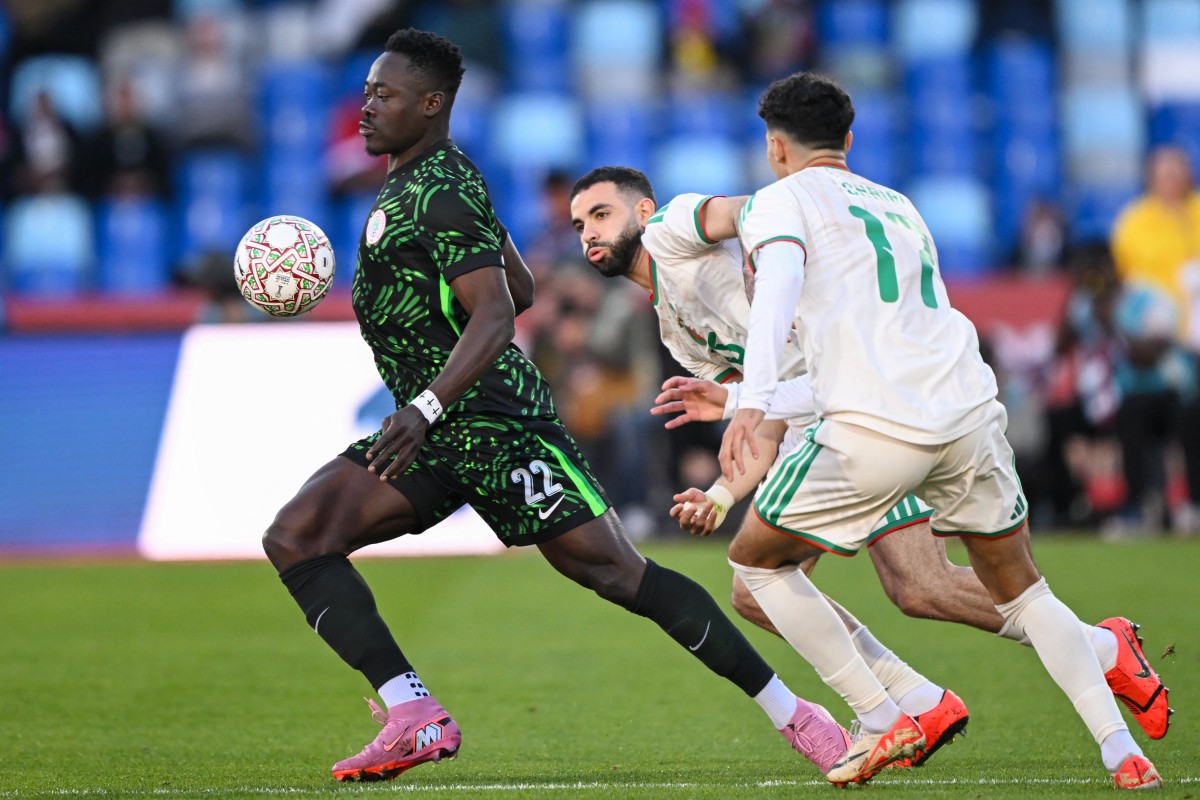
Nigeria secured a well-deserved 2-0 victory over Algeria in their Africa Cup of Nations (AFCON) quarterfinal, with second-half goals from Victor Osimhen and Akor Adams, setting up a semi-final clash against hosts Morocco.
The Super Eagles delivered an impressive performance, especially considering they had missed out on World Cup qualification just two months prior.
READ ALSO: [AFCON] Tinubu Hails Super Eagles Over Quarter-Final Win
From the beginning of the match at the Grand Stade de Marrakesh, they overwhelmed their opponents with determination, speed, and strength in challenges. Remarkably, they denied their rivals any scoring opportunities throughout the game.
Eric Chelle’s men will now look forward to what many will call their toughest test yet, against the hosts, Morocco, on Wednesday
Takeaways from Nigeria vs Algeria Match
But before that game, here are six takeaways from the Nigeria vs Algeria match
Nigeria Dominated Overall Play

Tactical Awareness, Collectiveness Was Key

Yet again, the Super Eagles delivered a disciplined, well-coordinated performance that reflected clear planning and strong in-game understanding across all departments.
At the back, Nigeria’s defenders maintained a compact shape, ensuring minimal space between the lines. The centre-back pairing of Calvin Bassey and Semi Ajayi stayed disciplined rather than stepping out recklessly, while the fullbacks timed their forward runs intelligently.
This balance allowed Nigeria to defend solidly without sacrificing attacking width. Algeria were frequently forced wide or backward, unable to play through Nigeria’s defensive block.
In midfield, Nigeria’s work rate and positional awareness stood out. The midfielders provided constant cover for the defence while also acting as the link between the defence and the attack.
When Nigeria were out of possession, they pressed in coordinated units rather than individually, cutting off passing lanes and slowing Algeria’s build-up. In possession, they moved the ball quickly and efficiently, allowing Nigeria to transition smoothly from defence into attack.
The use of the flanks was a key tactical feature. Nigeria’s fullbacks pushed high at the right moments, stretching Algeria’s defensive line and creating overloads out wide. This width forced Algeria’s defenders to shift laterally, opening spaces centrally for the forwards.
Crosses and cut-backs from wide areas repeatedly put Algeria under pressure, even when clear chances did not immediately materialise.
Nigeria’s Attack Looked More Balanced

For years, Nigeria’s attacking identity has often revolved around Osimhen as the primary source of goals and intensity. While his presence remains central, the emergence of Akor Adams as a genuine scoring option altered the dynamics.
Algeria could no longer afford to focus all their defensive attention on shutting down Osimhen, as doing so created spaces elsewhere, spaces Akor was quick to exploit.
Akor’s willingness to make intelligent off-ball runs complemented Osimhen’s direct, physical style. While the 27-year-old occupied centre-backs with his pressing, aerial duels, and hold-up play, the Sevilla forward found gaps between defenders and timed his movements into the box effectively.
This dual threat made Nigeria’s attack less predictable and more difficult to contain.
The shared scoring responsibility also had a psychological impact. Osimhen was able to play with greater freedom, dropping deeper to link play or drifting wide without the constant burden of being the sole match-winner.
In turn, this improved Nigeria’s fluidity in the final third, as attacks were built through combinations rather than rushed, individual actions.
Iwobi Still Instrumental In Decisive Moments

One person who has been key to Nigeria’s outing at the AFCON is Alex Iwobi. It would be an understatement to say he is enjoying the tournament. The Fulham man has been a ”revelation” to say the least.
In attacking phases, Iwobi provided creative connectivity rather than flashiness. He helped shift play wide, supported overlapping runs, and timed his forward movements to keep Algeria’s midfield occupied.
Even when not directly involved in goals, his movement and passing helped open spaces for forwards like Osimhen and Akor to exploit, particularly as Nigeria increased their dominance in the second half.
Defensively, Iwobi’s work rate stood out. He tracked runners, pressed intelligently rather than recklessly, and contributed to Nigeria’s compact shape when protecting the lead.
Algeria Struggled To Generate Offensive Chances

Meanwhile, Algeria’s difficulty in generating offensive chances was one of the defining features of the match and a direct reflection of Nigeria’s tactical control.
Throughout the game, the Desert Foxes found it hard to progress the ball cleanly into dangerous areas. Nigeria’s midfield of Wilfred Ndidi, Iwobi, and Frank Onyeka pressed aggressively and cut off passing lanes, forcing Algeria to circulate possession sideways or backwards rather than play through the centre.
Whenever Algeria attempted to build from deep, they were quickly met by coordinated pressure that disrupted their timing and limited forward momentum.
In the final third, the North Africans lacked penetration and clarity. Their attacking players were often isolated, with little support arriving from midfield, which made it easy for Nigeria’s defenders to contain one-on-one situations.
The Final Whistle Did Little To End Tensions

Players from both sides converged near the centre of the pitch, with heated exchanges, pushing, and confrontations involving not only players but also members of the technical benches.
Match officials were forced to intervene quickly to prevent the situation from escalating further.
The tension appeared to stem from a mix of frustration and high stakes. For Algeria, the defeat marked an abrupt end to a promising AFCON campaign, and some of their players visibly reacted to decisions made late in the game, including fouls and stoppages that disrupted their attempts to mount a comeback.
Nigeria’s players, meanwhile, were seen defending teammates and responding to perceived provocation as celebrations began.
Security personnel and coaching staff played a key role in restoring order, shepherding players away from flashpoints and toward the dressing rooms.
While the situation eventually de-escalated, the scenes underlined just how emotionally charged knockout football at AFCON can be, especially between two traditional continental heavyweights.
Super Eagles Face Africa’s Best
Source: Channels TV

Leave a Reply