Archive January 28, 2026

Pegula sets up Australian Open semi against Rybakina as Swiatek crashes out

Elena Rybakina and Jessica Pegula will clash in the semifinals of the Australian Open after knocking out pre-tournament favourites Iga Swiatek and Amanda Anisimova, respectively.

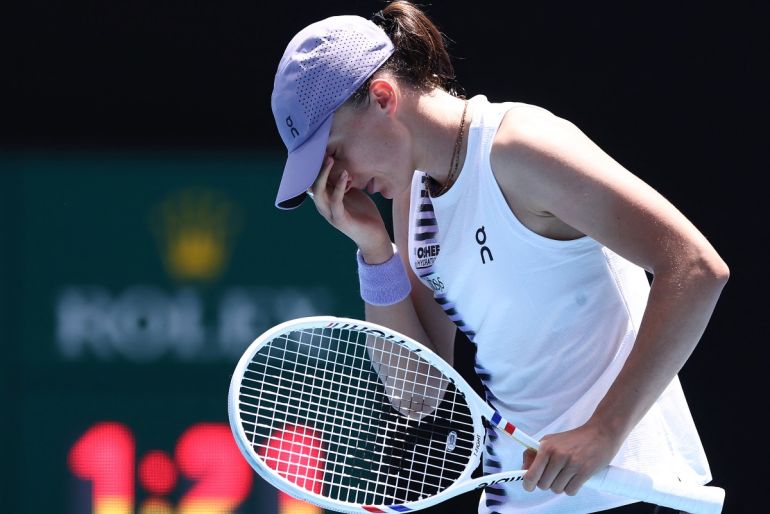
Reigning Wimbledon champion and second-seeded Swiatek, who was seeking a career Grand Slam with a win at Melbourne Park, was stunned by Rybakina in straight sets on Wednesday.

Recommended Stories

list of 3 itemsend of list

The 7-5, 6-2 win for the 2022 Wimbledon champion gives her a chance to win her second Grand Slam, while crushing Swiatek’s dreams of lifting the one Slam trophy that has eluded her despite six major titles.

Rybakina has made the Melbourne final once before, in 2023, when she lost in three tough sets to Aryna Sabalenka.

The 26-year-old fifth seed took her latest victory in her stride, saying a calmer mindset helped in the heat of battle.

“In the beginning, when it’s the first final and you go so far in a tournament, of course you are more emotional,” said Rybakina.

“Now I feel like I’m just doing my job, trying to improve each day. So it’s kind of another day, another match.”

Rybakina fired 11 aces ⁠and 26 winners at Rod Laver Arena, winning eight ​of the last nine games to underline her authority.

“Really pleased with the win,” said ‍Rybakina. “We know each other pretty well and I was just trying to stay aggressive.”

Swiatek struggled with her serve throughout the contest, and the world number two said that was something she needed to ‌improve on in the coming months.

“I didn’t serve as well ⁠as in Cincinnati, for example, against Elena. My serve was kind of normal and sometimes it could have given me a bit more,” Swiatek told reporters.

“There’s some stuff on the serve that I want to change and I already changed that ‌in the preseason. But then matches come and you don’t have that much time to think about this.

“You don’t want to think about these details when you play. So then it comes back to ‍the old patterns… There’s some stuff that I can change to play better, and I’ll try to do that.”

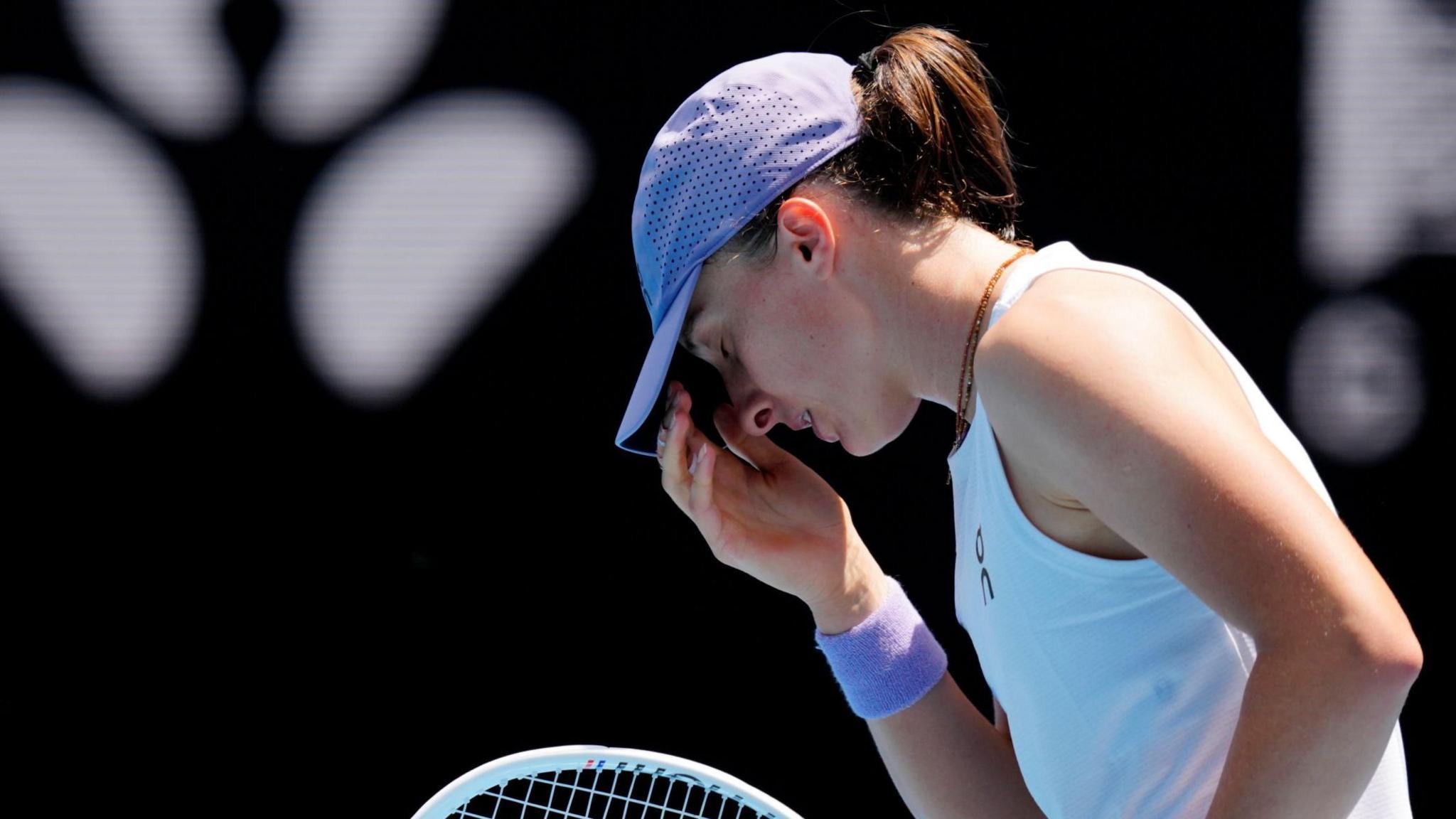
Poland's Iga Swiatek reacts on a point to Kazakhstan's Elena Rybakina during their women's singles quarter-final match on day eleven of the Australian Open tennis tournament in Melbourne on January 28, 2026. (Photo by Izhar Khan / AFP) / -- IMAGE RESTRICTED TO EDITORIAL USE - STRICTLY NO COMMERCIAL USE --
Iga Swiatek’s bid for a career Grand Slam is over for another year [Izhar Khan/AFP]

Pegula revels in ‘awesome win’ over Anisimova

Meanwhile, Pegula – fresh off her win over last year’s champion Madison Keys – emerged victorious in an all-American quarterfinal against Anisimova with a 6-2, 7-6 (7-1) scoreline.

Pegula is yet to drop a set this year in Melbourne and is arrowing in on her first major crown at the age of 31.

“It’s awesome,” Pegula said of reaching her first Australian Open semifinal.

“I’ve been able to go deeper in ‍the US Open ⁠in the last couple of years, but here was the first Slam that I broke through at.

“I feel like I play some good tennis here, I like the conditions and even ​matches I’ve lost here I’ve played well ‌in, so I’ve been waiting for the time when I could break through.”

The sixth seed was helped by an error-riddled display from fourth seed Anisimova, who racked up 44 unforced errors to Pegula’s 21.

Anisimova’s frustrations boiled over at the end as her hopes of reaching a third major title in a row melted away in a blur of mistakes.

Sixth seed Pegula and Rybakina have shared three wins each in their six matches so far.

Two-time champion Sabalenka faces Ukrainian 12th seed Elina Svitolina in the other semifinal.

USA's Amanda Anisimova reacts on a point to compatriot Jessica Pegula during their women's singles quarter-final match on day eleven of the Australian Open tennis tournament in Melbourne on January 28, 2026. (Photo by IZHAR KHAN / AFP) / -- IMAGE RESTRICTED TO EDITORIAL USE - STRICTLY NO COMMERCIAL USE --
Amanda Anisimova was left frustrated after committing a flurry of errors [Izhar Khan/AFP]

Is Trump’s ‘Board of Peace’ an effort to curtail Europe’s middle powers?

Most European countries have either turned down their invitations to join United States President Donald Trump’s “Board of Peace” for overseeing the reconstruction of Gaza – or politely suggested they are “considering” it, citing concerns.

From within the European Union, only Hungary and Bulgaria have accepted. That is a better track record of unity than the one displayed in 2003, when then-US President George W Bush called on member states to join his invasion of Iraq.

Recommended Stories

list of 4 itemsend of list

Spain, Britain, Poland, Hungary, Czechia and Slovakia said “yes”.

France turned the invitation down on the grounds that Trump’s board “goes beyond the framework of Gaza and raises serious questions, in particular with respect to the principles and structure of the United Nations, which cannot be called into question”.

Trump pointedly did not invite Denmark, a close US ally, following a diplomatic fracas in which he had threatened to seize Greenland, a Danish territory, by force.

The US leader signed the charter for his Board of Peace on January 22 at the World Economic Forum in Davos, Switzerland, calling it “one of the most consequential bodies ever created”.

It has come across to many of the countries invited to join it as perhaps too consequential – an attempt to supplant the United Nations, whose mandate the board is meant to be fulfilling.

Although Trump said he believed the UN should continue to exist, his recent threats suggest that he would not respect the UN Charter, which forbids the violation of borders.

That impression was strengthened by the fact that he invited Russia to the board, amid its full-scale invasion of Ukraine.

‘Trump needs a big win ahead of midterms’

“Trump is thinking about the interior of the US. Things aren’t going well. He needs a big win ahead of the November midterms,” said Angelos Syrigos, a professor of international law at Panteion University in Athens.

The US president has spent his first year in office looking for foreign policy triumphs he can sell at home, said Syrigos, citing the abduction of Venezuelan President Nicolas Maduro, the bombing of Iran and his efforts to end the Ukraine war.

Trump has invited board members to contribute $1bn each for a lifetime membership, but has not spelled out how the money will be spent.

His son-in-law, Jared Kushner, is a member of the executive board.

“How will this thing function? Will Trump and his son-in-law administer it?” asked Syrigos.

Catherine Fieschi, a political scientist and fellow at the European University Institute, believed there was a more ambitious geopolitical goal as well.

“It’s as though Trump were gathering very deliberately middle powers … to defang the potential that these powers have of working independently and making deals,” she said.

Much like Bush’s 2003 “coalition of the willing” against Iraq, Trump’s initiative has cobbled together an ensemble of countries whose common traits are difficult to discern, ranging from Vietnam and Mongolia to Turkiye and Belarus.

Fieschi believed Trump was trying to corral middle powers in order to forestall other forms of multilateralism, a pathway to power that Canadian Prime Minister Mark Carney outlined in his speech at Davos, which so offended Trump.

“In a world of great power rivalry, the countries in between have a choice: [to] compete with each other for favour, or to combine to create a third path with impact,” Carney had said, encouraging countries to build “different coalitions for different issues” and to draw on “the power of legitimacy, integrity and rules”.

He decried the “rupture in the world order … and the beginning of a brutal reality where geopolitics among the great powers is not subject to any constraints”.

After the speech, Trump soon rescinded Canada’s invitation.

Countering agglomerations of power and legitimacy was Trump’s goal, Fieschi believed.

“Here you bind them into an organisation that in some ways offers a framework with Trump in it and the US in it, and implies constraints,” said Fieschi. “It’s not so much benign multilateralism as stopping the middle powers getting on with their hedging and with their capacity to have any kind of autonomy, strategic and otherwise.”

At the same time, she said, Trump was suggesting that the Board of Peace “might give them more power than they have right now in the UN”.

“Trump thinks this is like a golf club and therefore he’s going to charge a membership fee,” Fieschi said.

“If it was a reconstruction fee [for Gaza], I don’t think people would necessarily baulk at that,” she noted, adding that the fee smacked of “crass oligarchic motivation”.

The Board of Peace is called into existence by last November’s UN Security Council Resolution 2803 to oversee the reconstruction of Gaza.

It is defined as “a transitional administration” meant to exist only “until such time as the Palestinian Authority (PA) has satisfactorily completed its reform program … and [can] effectively take back control of Gaza.”

Trump’s charter for the board makes no mention of Gaza, nor of the board’s limited lifespan. Instead, it broadens the board’s mandate to “areas affected or threatened by conflict”, and says it “shall dissolve at such time as the Chairman considers necessary or appropriate”.

China, which has presented itself as a harbinger of multipolarity and a challenger of the US-led world order, rejected the invitation.

“No matter how the international landscape may evolve, China will stay firmly committed to safeguarding the international system with the UN at its core,” said Chinese Foreign Ministry spokesman Guo Jiakun last week.

The UN itself appears to be offended by Trump’s scheme.

“The UN Security Council stands alone in its Charter-mandated authority to act on behalf of all Member States on matters of peace and security,” wrote UN Secretary-General Antonio Guterres on social media on Monday, January 26.

“No other body or ad-hoc coalition can legally require all Member States to comply with decisions on peace and security,” he wrote.

Guterres was calling for a reform that would strengthen the legitimacy of the UN Security Council by better reflecting the balance of power in the world as it is, 81 years after the body was formed. But his statement can also be read as a veiled criticism of Trump’s version of the Board of Peace.

Transparency and governance are problematic, too.

Symbolic Doomsday Clock moves closer to midnight amid ‘catastrophic risks’

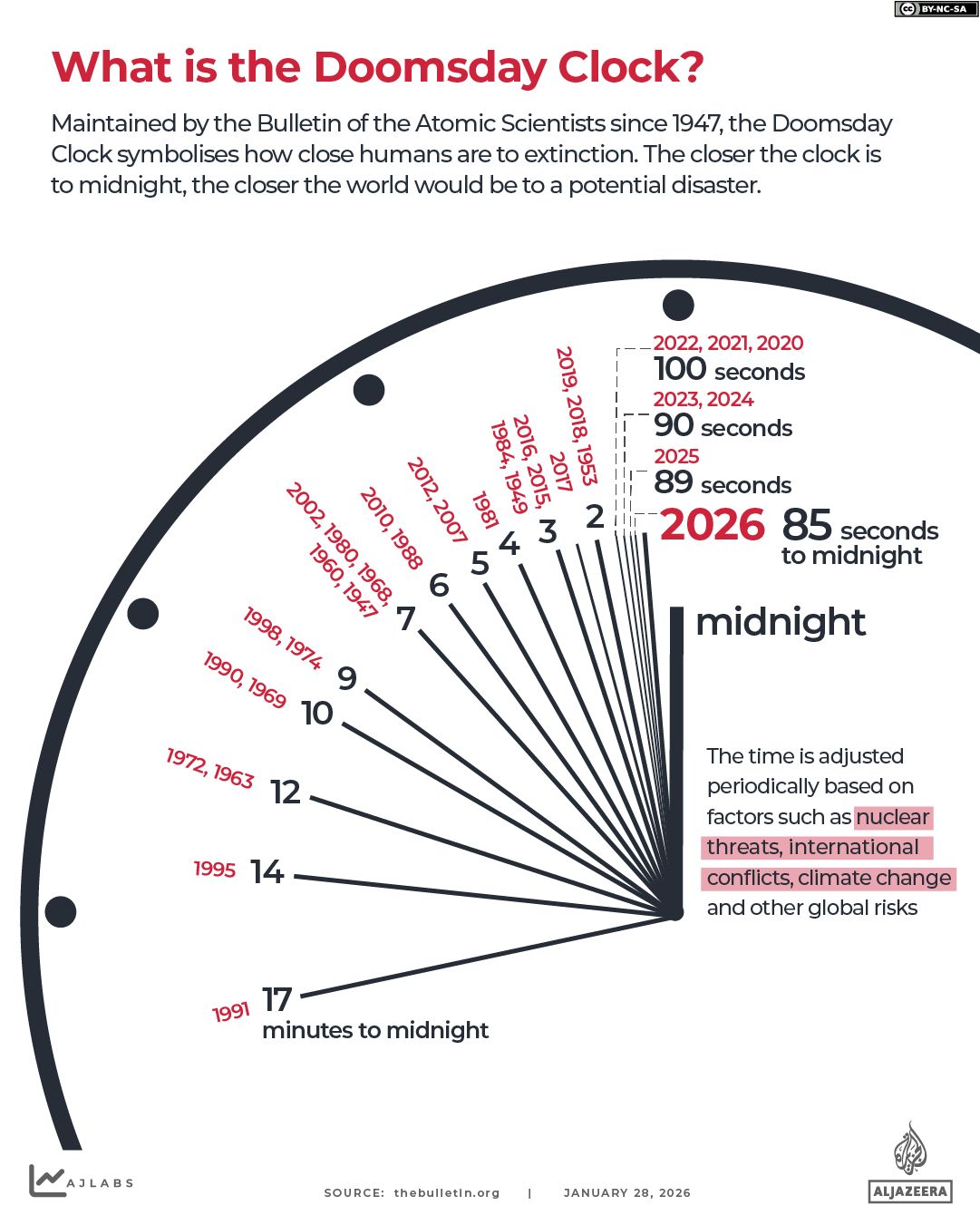
The world is closer than ever to destruction, scientists have said, as the Doomsday Clock was set at 85 seconds to midnight for 2026, the gloomiest assessment of humanity’s prospects since the beginning of the tradition in 1947.

The Bulletin of the Atomic Scientists, a not-for-profit organisation founded by Albert Einstein and other scientists, warned in its annual assessment on Tuesday that international cooperation is going backwards on nuclear weapons, climate change and biotechnology, while artificial intelligence poses new threats.

“The Doomsday Clock’s message cannot be clearer. Catastrophic risks are on the rise, cooperation is on the decline, and we are running out of time,” said Alexandra Bell, the president and CEO of the Bulletin of the Atomic Scientists.

Recommended Stories

list of 4 itemsend of list

“Change is both necessary and possible, but the global community must demand swift action from their leaders,” Bell said.

In a more detailed statement explaining the reasoning for moving the clock closer to midnight, the bulletin expressed concerns that countries including Russia, China, and the United States were becoming “increasingly aggressive, adversarial, and nationalistic”.

It said that “hard-won global understandings are collapsing”, while a “winner-takes-all great power competition” is emerging in its place.

The assessment cited conflicts in 2025, including Russia’s war on Ukraine, clashes between India and Pakistan that erupted in May, and the US and Israel’s attacks on Iran in June.

On the climate emergency, the bulletin said that national and international responses have ranged from “wholly insufficient to profoundly destructive”.

“None of the three most recent UN climate summits emphasised phasing out fossil fuels or monitoring carbon dioxide emissions,” it said, adding that US President Donald Trump has “essentially declared war on renewable energy and sensible climate policies, relentlessly gutting national efforts to combat climate change”.

At the same time, the Bulletin noted that renewable energy, especially wind and solar, saw record growth in both capacity and generation in 2024, and that “renewable and nuclear energy together surpassed 40 percent of global electricity generation for the first time”.

From Cold War to climate change

The clock is used to symbolise how close humans are to extinction. Since beginning the Doomsday countdown in 1947, the bulletin has varied its assessments between as far as 17 minutes from midnight up to this year’s assessment of 85 seconds.

The lowest ever risk was recorded in 1991, the year the Cold War officially ended and the United States and Russia began making significant cuts to their nuclear arsenals.

Just seven years earlier, in 1984, the clock had been at three minutes to midnight, one of its lowest points for the period, as it said dialogue between the Soviet Union and the US had virtually stopped.

In more recent times, the clock has ticked closer to midnight, as the Bulletin has increasingly assessed the lack of action on climate change as a significant threat alongside nuclear war and other global issues.

Speaking at a ceremony revealing the new assessment on Tuesday, Daniel Holz, professor of physics, astronomy & astrophysics at the University of Chicago and chair of the Bulletin of the Atomic Scientists, said that the rise of nationalistic autocracies was adding to a range of threats.

Swiatek’s career Grand Slam bid falls flat against Rybakina

On the evidence of what Iga Swiatek showed across the first four rounds, it never truly felt like she would complete the career Grand Slam at this year’s Australian Open.

Swiatek’s bid for the clean sweep was ended by Elena Rybakina in the Melbourne quarter-finals, with the Kazakh fifth seed triumphing 7-5 6-1.

Reigning Wimbledon champion Swiatek’s serve has been far from solid during the tournament, the Pole having won fewer games with the ball than any other quarter-finalist and being broken the most times alongside Coco Gauff.

Swiatek changed her service technique during the off-season, but the 24-year-old has historically struggled against aggressive opponents on the quicker Melbourne courts.

And former Wimbledon champion Rybakina, known for her powerful game from the baseline, ruthlessly took advantage.

    • 3 hours ago
    • 8 minutes ago

Swiatek can already be ranked among the greats, having won six major titles across the three different surfaces.

Mastering the Wimbledon grass last year – a surface considered her weakest – meant she arrived in Melbourne attempting to become only the sixth woman in the Open era to win all four Grand Slam singles titles.

Swiatek insisted she was blocking out the outside noise about what was at stake but perhaps she did not fully believe she could win in Australia, given the changes to her serve and the conditions.

That doubt played perfectly into Rybakina’s hands.

Rybakina could not initially find her rhythm on her serve, with an uncharacteristically low first-serve percentage of 41%, but she had enough pace and aggression in her groundstrokes to rush Swiatek.

That was demonstrated in the crucial 12th game. Rybakina fought back from 0-30 with depth from the baseline and explosive winners to take the opener.

Rybakina immediately took control of the second set, her groundstrokes flying through the court, and Swiatek could do little to halt her momentum.

Rybakina, runner-up in 2023, will face American sixth seed Jessica Pegula in Thursday’s semi-finals.

Related topics

  • Tennis

More on this story

  • Some tennis balls
    • 16 August 2025
    BBC Sport microphone and phone

Swiatek’s career Grand Slam attempt ended by Rybakina

Iga Swiatek’s bid to complete the career Grand Slam at this year’s Australian Open was ended by Kazakh fifth seed Elena Rybakina in the quarter-finals.

Reigning Wimbledon champion Swiatek lost 7-5 6-1 as Rybakina used her power to devastating effect.

Swiatek, 24, can already be ranked among the greats, having won six major titles across all three different surfaces.

Mastering the Wimbledon grass last year – a surface considered her weakest – opened the door to attempting in Melbourne to become only the sixth woman in the Open era to win all four Grand Slam events.

Before the tournament, Swiatek acknowledged the achievement would be a “dream come true” but insisted she was blocking out the outside noise about what was at stake.

    • 13 hours ago
    • 15 hours ago
    • 14 hours ago

Swiatek’s service game had not been rock solid, while the quicker courts at Melbourne Park have historically led to problems against aggressive opponents.

That always promised to be a bad combination against 2022 Wimbledon champion Rybakina, who ruthlessly took advantage in Wednesday’s contest.

Rybakina, 26, could not find rhythm with her serve in a first set which started with the pair exchanging breaks.

A low first-serve percentage of 41% was uncharacteristic, but she had enough pace and aggression in her groundstrokes to rush Swiatek.

That was demonstrated in the crucial 12th game. Rybakina fought back from 0-30 with deep returning – drawing loose sprays from Swiatek – and explosive winners to take the opener.

Momentum stayed with Rybakina as she immediately took control of the second set.

In perfect 22C sunny conditions following Tuesday’s heatwave, her groundstrokes continued to fly through the court and Swiatek was unable to solve the problem facing her.

Related topics

  • Tennis

More on this story

  • Some tennis balls
    • 16 August 2025
    BBC Sport microphone and phone

Minnesota Representative Ilhan Omar attacked during town hall meeting

BREAKING,

Minnesota Representative Ilhan Omar has been attacked by a man while hosting a town hall meeting in Minneapolis.

Omar was sprayed with an unknown substance by the man before he was tackled to the ground on Tuesday.

Recommended Stories

list of 4 itemsend of list

The Reuters news agency said that Omar was not injured in the attack, and authorities have not said what substance was sprayed or whether charges have been filed against the assailant.

The audience cheered as the man was pinned down and his arms were tied behind his back. In a video clip of the incident, someone in the crowd can be heard saying, “Oh my god, he sprayed something on her”, the Associated Press news agency reported.

Omar continued the town hall after the man was ushered out of the room.

Just before the attack, she had called for the abolishment of the US Immigration and Customs Enforcement (ICE) agency and for Department of Homeland Security Secretary Kristi Noem to resign.

“ICE cannot be reformed,” Omar said.

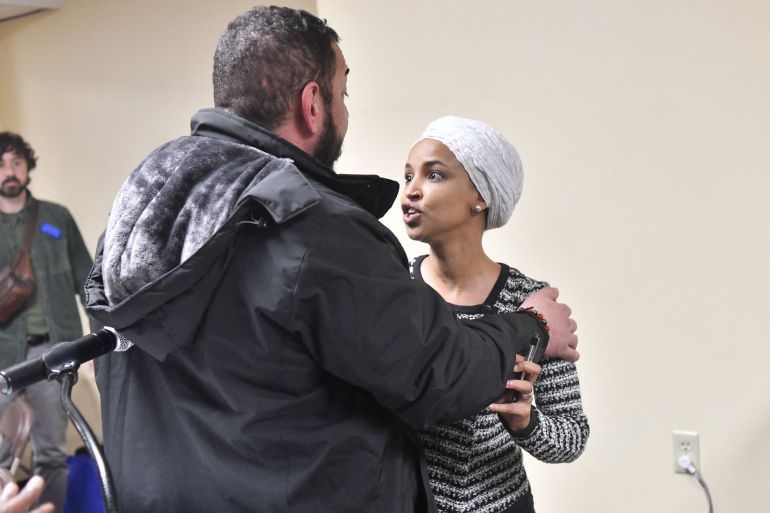
US Representative Ilhan Omar (D-MN) (R) reacts after being sprayed with an unknown substance by a man as she hosted a town hall in Minneapolis, Minnesota, on January 27, 2026. (Photo by Octavio JONES / AFP)
Ilhan Omar, right, reacts after being sprayed with an unknown substance by a man as she hosted a town hall in Minneapolis, Minnesota, on January 27, 2026 [Octavio Jones/AFP]

Minneapolis police did not immediately respond to requests for comment on the incident and whether anyone was arrested.

The White House did not immediately respond to a message from the AP seeking comment.