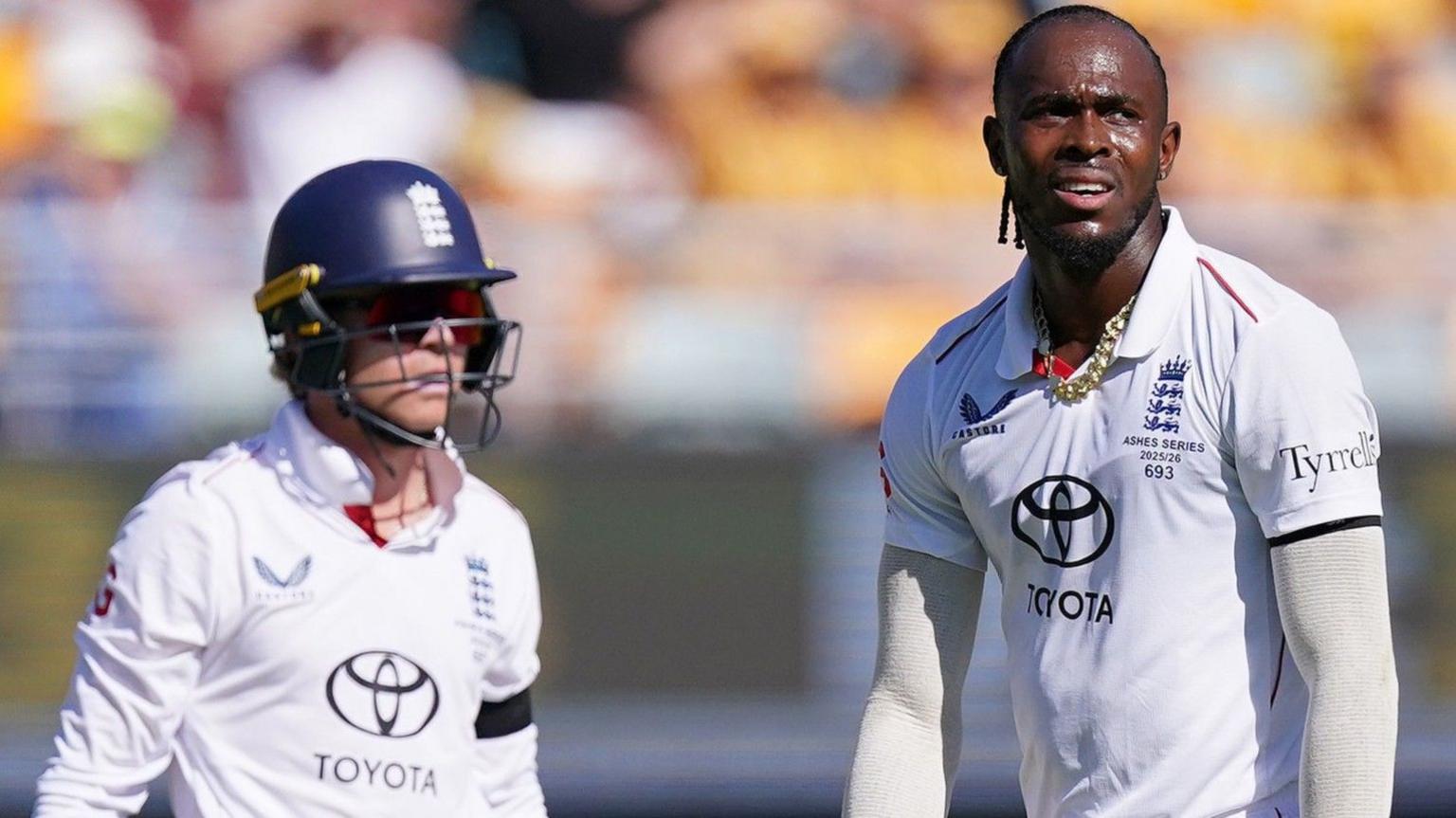
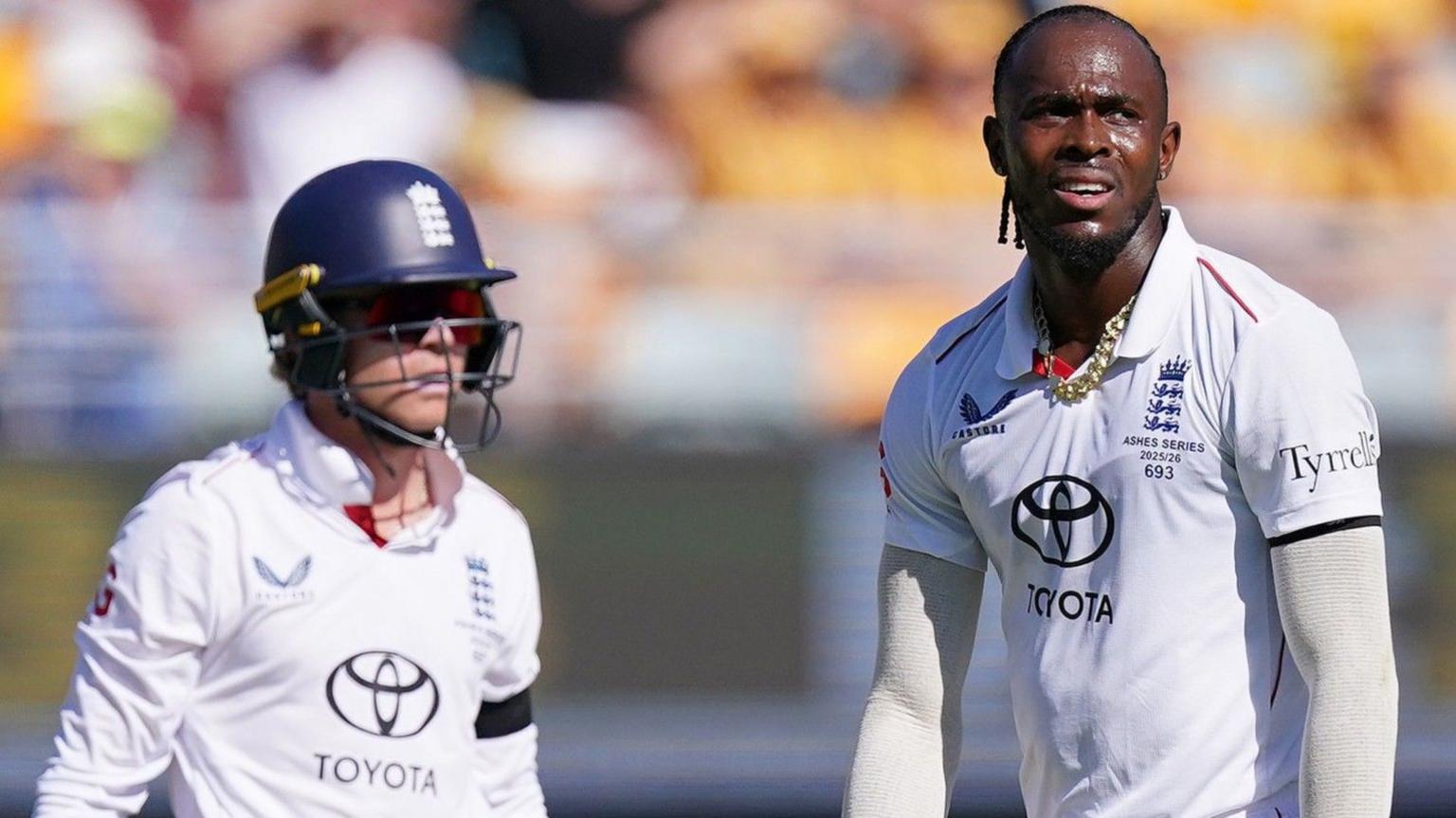
Jofra Archer has been criticised by former Australia opener Matthew Hayden for the “shocking look” of arriving for the third day of the second Ashes Test with a pillow.
With England needing four wickets to wrap up the Australia first innings in order to keep their Ashes hopes alive, fast bowler Archer was seen before play at the Gabba with a pillow tucked under his arm.
And the 30-year-old was made to wait for his rest as Australia frustrated England throughout the entire opening session.
Though the hosts lost two wickets, they moved to 450-8 by the interval, leading by 116 runs.
Only twice before have England overturned a first-innings deficit of more than 100 to win a Test in Australia. The last time was at the Sydney Cricket Ground in 1979.
“I’m sorry, but that’s a shocking look,” Hayden, who played 103 Tests, said on Channel 7.
“If I was a batsman, I tell you what I’d be doing, I’d be digging in. Forever.
“It would be exactly what you need as a batsman, I can tell you. You’d be looking over and thinking ‘you are never going to sleep on that’.
“Not any part of this day are you going to see that. Not even in the night are you going to see that.”
After Australia resumed on 378-6, England captain Ben Stokes had Michael Neser caught behind for 16.
England took the second new ball at 80 overs, with Gus Atkinson taking the edge of Alex Carey for 63.
Archer shared the new ball with Atkinson, bowling five wicketless overs and conceding 13 runs.
And England could not find a way to part ninth-wicket partnership Mitchell Starc and Scott Boland. The pair added 34 runs in 16 overs in the run-up to the break. Starc had moved to 46 and Boland seven.
The extra time spent batting in daylight is vital for Australia. It means England will be facing a newer ball when they bat under floodlights later on Saturday.
England’s deflating opening to the third day came after an error-strewn performance on Friday, when the tourists missed five chances in the field.
Former captain Michael Vaughan questioned their preparedness for this Ashes series, saying England looked “jaded”.
Archer returned to Test cricket in the home summer after a four-year lay-off because of a string of serious injuries.
The Sussex man had bowled 25 overs by the first interval on the third day in Brisbane, his second-most in a Test innings since 2019 – beaten by the 26.1 he bowled in the first innings of the fourth Test against India at Old Trafford, the second match of his comeback.
Jofra Archer has been criticised by former Australia opener Matthew Hayden for the “shocking look” of arriving for the third day of the second Ashes Test with a pillow.
With England needing four wickets to wrap up the Australia first innings in order to keep their Ashes hopes alive, fast bowler Archer was seen before play at the Gabba with a pillow tucked under his arm.
And the 30-year-old was made to wait for his rest as Australia frustrated England throughout the entire opening session.
Though the hosts lost two wickets, they moved to 450-8 by the interval, leading by 116 runs.
Only twice before have England overturned a first-innings deficit of more than 100 to win a Test in Australia. The last time was at the Sydney Cricket Ground in 1979.
“I’m sorry, but that’s a shocking look,” Hayden, who played 103 Tests, said on Channel 7.
“If I was a batsman, I tell you what I’d be doing, I’d be digging in. Forever.
“It would be exactly what you need as a batsman, I can tell you. You’d be looking over and thinking ‘you are never going to sleep on that’.
“Not any part of this day are you going to see that. Not even in the night are you going to see that.”
After Australia resumed on 378-6, England captain Ben Stokes had Michael Neser caught behind for 16.
England took the second new ball at 80 overs, with Gus Atkinson taking the edge of Alex Carey for 63.
Archer shared the new ball with Atkinson, bowling five wicketless overs and conceding 13 runs.
And England could not find a way to part ninth-wicket partnership Mitchell Starc and Scott Boland. The pair added 34 runs in 16 overs in the run-up to the break. Starc had moved to 46 and Boland seven.
The extra time spent batting in daylight is vital for Australia. It means England will be facing a newer ball when they bat under floodlights later on Saturday.
England’s deflating opening to the third day came after an error-strewn performance on Friday, when the tourists missed five chances in the field.
Former captain Michael Vaughan questioned their preparedness for this Ashes series, saying England looked “jaded”.
Archer returned to Test cricket in the home summer after a four-year lay-off because of a string of serious injuries.
The Sussex man had bowled 25 overs by the first interval on the third day in Brisbane, his second-most in a Test innings since 2019 – beaten by the 26.1 he bowled in the first innings of the fourth Test against India at Old Trafford, the second match of his comeback.
The Football Interview is a new series in which the biggest names in sport and entertainment join host Kelly Somers for bold and in-depth conversations about the nation’s favourite sport.
We’ll explore mindset and motivation, and talk about defining moments, career highs and personal reflections. The Football Interview brings you the person behind the player.
When Mauricio Pochettino first came to the Premier League as Southampton manager in 2013, he was not widely known.
But now, after spells with Tottenham, Paris St-Germain and Chelsea, he is one of the most recognisable names in the game.
Pochettino, 53, is preparing to coach at the World Cup for the first time, as manager of 2026 co-hosts United States.
Getty Images
Kelly Somers: Why did you want to be involved in football?
Mauricio Pochettino: When I was a child, it was a thing which began to grow in my body, my brain, my blood. Maybe because my dad, my family, always felt passion for football. But when I try to remember, I go back to my grandad’s farm when I was very little. I would have a ball in my hand and I would play.
Kelly: So you used to play football on a farm?
Mauricio: Yes, on my grandad’s farm. I started to play with my brother, my dad. That’s when I started to feel a passion for the game.
Kelly: Can you remember the first team you played for?
Mauricio: In my hometown of Murphy. I played there. But because my dad was a Racing Club fan, I grew up supporting them. Then I moved to Newell’s Young Boys, and grew my career there in the academy and first team.
Kelly: Can you remember a time in your young career that you thought, ‘I’ve got a chance of making it here… it could be my life’?
Getty Images
Kelly: Can you remember a time when you thought, ‘I want to be a manager’?
Mauricio: It started to grow little by little in my mind, when I was 27, 28. I moved from Espanyol to Paris St-Germain. I started to notice how the coaches dealt with situations. I started to challenge my coaches, to notice why they dealt with things. Then it is up to you – your character, your capacity to understand and make decisions. If you get asked to make a decision, and you say, ‘wait’… like people say now, ‘I’ll ask ChatGPT’ … no, you need to make decisions very quickly, store knowledge from different people, and believe in yourself.
Kelly: If you could relive one match from your career, what would it be?
Mauricio: Player or coach? Changing the result or reliving the experience?
Kelly: Whichever way you want to go with it.
Mauricio: One game I want to go back to and relive, as a coach, is the Champions League semi-final with Ajax [as Tottenham manager in 2019]. That was one of the best moments in my career, my life. The feeling was amazing. The emotion… it was one of the greatest moments. And the final in Madrid [which Spurs lost 2-0 to Liverpool], I will try to play again this game, for sure. I have no regrets, but if you gave me the opportunity, I would not like it to finish the same way.
Kelly: Describe to me a young Mauricio Pochettino. What were you like growing up?
Mauricio: I don’t know if you can be more happy than when you were a child. My first memories are very happy.
Kelly: Describe to me the home set-up… what it was like being in your household.
Getty Images
Kelly: We will all be watching the World Cup next summer. What can we expect out there?
Mauricio: It is going to be amazing. The USA is an amazing country, with amazing people and fans. I invite people to go and visit America, and share the excitement. It is a massive opportunity for the USA to show how football, soccer…
Kelly: Still football? Or are you trying to call it soccer?
Mauricio: No, it’s soccer! They push me to say soccer!
Kelly: It must be exciting to be spearheading that, and be part of that – coming from a football culture and instilling what you have learned in your career to them?
Mauricio: The motivation is massive. Sometimes you feel people don’t understand the culture of football… soccer. Sometimes you need to live with people who can help you. There are coaches out there who say you need to understand the culture of American players. I say, ‘no, the most important thing is the culture of soccer’. They need to know, and we need to translate that to the American players. After one year, we are making great progress, and building with people who are starting to realise the language of soccer is only one – it doesn’t matter if you are American, Brazilian, English… there is only one language of football. We are excited to build a team which is competitive to win in our own country, to try and get the result.
Kelly: Is there a part of you which misses the Premier League? Do you still watch it a lot?
Mauricio: Yeah, I watch a lot. The Premier League is the best in the world. Of course I miss it. I am so happy in the USA, but I am always thinking about returning one day. It is the most competitive league, and of course I would love to come back again.
Kelly: Tell me one thing about you, Mauricio, which would surprise me.
Mauricio: I am a very good chef, particularly barbecues.
Kelly: Then why do you live in England!
Mauricio: It is possible to do with umbrellas when it is raining! I barbecue steak, veggies, fish, chicken. I am very good, very confident. When I was a player, I did it with my team-mates, and as a coach.
Kelly: You’ve done barbecues for your players?
Mauricio: At Tottenham, every 10 days or two weeks, we prepared a barbecue. We had chefs and I would help.
Kelly: [Former chairman] Daniel Levy has left Tottenham now. You had a relationship with him when you were at the club. What did you make of the news of him leaving and the legacy he’s left?
Mauricio: I was very surprised. We still keep in touch. Our relationship was always good. His legacy is there. It’s amazing what he did for the club. We’re in contact and one day I’d like to share a coffee with him. He made it a possibility for me to manage a club like Tottenham – one of the best clubs in the world with an amazing fanbase. I’m very grateful to him and proud to be part of the family of Tottenham.
Kelly: If you could achieve only one more thing in your career, what would it be?
Mauricio: Talking about the Premier League, and we are in London… to win the Premier League and the Champions League. We were so close in Tottenham. I want to achieve this. I am still young, I have the energy, experience and motivation to try in the future. Outside, to make my family feel proud – my sons, my wife, my dog, my horses, my mum and dad, my granddaughter…
The Football Interview is a new series in which the biggest names in sport and entertainment join host Kelly Somers for bold and in-depth conversations about the nation’s favourite sport.
We’ll explore mindset and motivation, and talk about defining moments, career highs and personal reflections. The Football Interview brings you the person behind the player.
When Mauricio Pochettino first came to the Premier League as Southampton manager in 2013, he was not widely known.
But now, after spells with Tottenham, Paris St-Germain and Chelsea, he is one of the most recognisable names in the game.
Pochettino, 53, is preparing to coach at the World Cup for the first time, as manager of 2026 co-hosts United States.
Getty Images
Kelly Somers: Why did you want to be involved in football?
Mauricio Pochettino: When I was a child, it was a thing which began to grow in my body, my brain, my blood. Maybe because my dad, my family, always felt passion for football. But when I try to remember, I go back to my grandad’s farm when I was very little. I would have a ball in my hand and I would play.
Kelly: So you used to play football on a farm?
Mauricio: Yes, on my grandad’s farm. I started to play with my brother, my dad. That’s when I started to feel a passion for the game.
Kelly: Can you remember the first team you played for?
Mauricio: In my hometown of Murphy. I played there. But because my dad was a Racing Club fan, I grew up supporting them. Then I moved to Newell’s Young Boys, and grew my career there in the academy and first team.
Kelly: Can you remember a time in your young career that you thought, ‘I’ve got a chance of making it here… it could be my life’?
Getty Images
Kelly: Can you remember a time when you thought, ‘I want to be a manager’?
Mauricio: It started to grow little by little in my mind, when I was 27, 28. I moved from Espanyol to Paris St-Germain. I started to notice how the coaches dealt with situations. I started to challenge my coaches, to notice why they dealt with things. Then it is up to you – your character, your capacity to understand and make decisions. If you get asked to make a decision, and you say, ‘wait’… like people say now, ‘I’ll ask ChatGPT’ … no, you need to make decisions very quickly, store knowledge from different people, and believe in yourself.
Kelly: If you could relive one match from your career, what would it be?
Mauricio: Player or coach? Changing the result or reliving the experience?
Kelly: Whichever way you want to go with it.
Mauricio: One game I want to go back to and relive, as a coach, is the Champions League semi-final with Ajax [as Tottenham manager in 2019]. That was one of the best moments in my career, my life. The feeling was amazing. The emotion… it was one of the greatest moments. And the final in Madrid [which Spurs lost 2-0 to Liverpool], I will try to play again this game, for sure. I have no regrets, but if you gave me the opportunity, I would not like it to finish the same way.
Kelly: Describe to me a young Mauricio Pochettino. What were you like growing up?
Mauricio: I don’t know if you can be more happy than when you were a child. My first memories are very happy.
Kelly: Describe to me the home set-up… what it was like being in your household.
Getty Images
Kelly: We will all be watching the World Cup next summer. What can we expect out there?
Mauricio: It is going to be amazing. The USA is an amazing country, with amazing people and fans. I invite people to go and visit America, and share the excitement. It is a massive opportunity for the USA to show how football, soccer…
Kelly: Still football? Or are you trying to call it soccer?
Mauricio: No, it’s soccer! They push me to say soccer!
Kelly: It must be exciting to be spearheading that, and be part of that – coming from a football culture and instilling what you have learned in your career to them?
Mauricio: The motivation is massive. Sometimes you feel people don’t understand the culture of football… soccer. Sometimes you need to live with people who can help you. There are coaches out there who say you need to understand the culture of American players. I say, ‘no, the most important thing is the culture of soccer’. They need to know, and we need to translate that to the American players. After one year, we are making great progress, and building with people who are starting to realise the language of soccer is only one – it doesn’t matter if you are American, Brazilian, English… there is only one language of football. We are excited to build a team which is competitive to win in our own country, to try and get the result.
Kelly: Is there a part of you which misses the Premier League? Do you still watch it a lot?
Mauricio: Yeah, I watch a lot. The Premier League is the best in the world. Of course I miss it. I am so happy in the USA, but I am always thinking about returning one day. It is the most competitive league, and of course I would love to come back again.
Kelly: Tell me one thing about you, Mauricio, which would surprise me.
Mauricio: I am a very good chef, particularly barbecues.
Kelly: Then why do you live in England!
Mauricio: It is possible to do with umbrellas when it is raining! I barbecue steak, veggies, fish, chicken. I am very good, very confident. When I was a player, I did it with my team-mates, and as a coach.
Kelly: You’ve done barbecues for your players?
Mauricio: At Tottenham, every 10 days or two weeks, we prepared a barbecue. We had chefs and I would help.
Kelly: [Former chairman] Daniel Levy has left Tottenham now. You had a relationship with him when you were at the club. What did you make of the news of him leaving and the legacy he’s left?
Mauricio: I was very surprised. We still keep in touch. Our relationship was always good. His legacy is there. It’s amazing what he did for the club. We’re in contact and one day I’d like to share a coffee with him. He made it a possibility for me to manage a club like Tottenham – one of the best clubs in the world with an amazing fanbase. I’m very grateful to him and proud to be part of the family of Tottenham.
Kelly: If you could achieve only one more thing in your career, what would it be?
Mauricio: Talking about the Premier League, and we are in London… to win the Premier League and the Champions League. We were so close in Tottenham. I want to achieve this. I am still young, I have the energy, experience and motivation to try in the future. Outside, to make my family feel proud – my sons, my wife, my dog, my horses, my mum and dad, my granddaughter…
Palestinian groups have expressed “grave concerns” about the safety of jailed political figure Marwan Barghouti after his son reported receiving a call about Israeli guards allegedly torturing the popular leader in an Israeli prison.
Qassam Barghouti made the statement on Facebook on Friday, but later deleted the post, saying he was trying to obtain information about his father’s health from relevant agencies.
Recommended Stories
list of 4 itemsend of list
In the deleted post, Qassam said he had received a call from a person identifying themselves as a Palestinian prisoner and who said Israeli prison guards had beaten his father severely, leaving him “physically shattered”.
The person, who called from an Israeli number, said that the guards had broken Barghouti’s ribs, teeth and cut off a part of his father’s ear for “entertainment”, according to Qassam.
He added in a later post that he was trying to contact the caller but had not been able to do so.
A spokesperson for the Israel Prison Service said in a statement to The Times of Israel that the allegations were “another total lie” and “propaganda” against its prison staff.
The Palestinian Prisoner’s Society, meanwhile, condemned the “new act of intimidation targeting” Barghouti’s family, saying it had only further escalated their already “grave concerns” for the prisoner’s safety.
“This act is a direct continuation of the organised terrorism policy implemented by the occupation regime against the families of prisoners, in an attempt to break their will and psychologically blackmail them,” the society, which represents Palestinians imprisoned by Israel, said in a statement shared on Telegram on Friday.
‘Retaliatory measures’
Barghouti, who has been jailed since 2002, is a senior leader of President Mahmoud Abbas’s Fatah group and is viewed by many as Palestine’s Nelson Mandela.
Barghouti is serving five life sentences in Israeli prisons on alleged charges related to attacks during the second Intifada, which lasted from 2000 to 2005.
He has denied the charges.
Earlier this week, Barghouti’s family launched the global “Free Marwan” campaign calling for his release, saying that they feared he may die while in Israeli prison. Hundreds of people, including writer Margaret Atwood and actor Javier Bardem, have signed on to the campaign to free the 66-year-old leader.
Following Qassam Barghouti’s post, the Palestinian presidency also condemned what it called the “continuous attacks and retaliatory measures” against his father.
In a statement carried by the Wafa news agency, the presidency said on Friday that it held the Israeli government fully responsible for the Fatah leader’s safety and the safety of all Palestinian prisoners in Israeli prisons.
Meanwhile, Ofer Cassif, a member of Israel’s parliament from the left-wing, Arab-majority Hadash-Ta’al party, said he spoke to Barghouti’s family about the call and the reports that “Marwan’s teeth, ribs and fingers being broken and his ear being cut off”.
“The family very much hopes that this is just intimidation and that the information is not true. They are waiting to hear from his lawyer about his condition,” Cassif said in a social media post on Friday.
“I sincerely hope that this is indeed intimidation, diabolical to say the least, and nothing more. In any case: Free Marwan!” Cassif added.
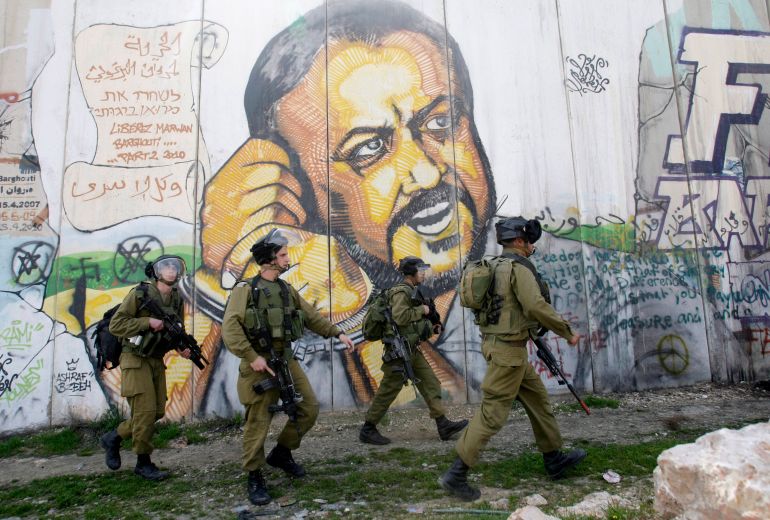
Israeli soldiers walk past a painting of Marwan Barghouti near the Qalandiya checkpoint between Jerusalem and the occupied West Bank city of Ramallah [File: Nasser Shiyoukhi/AP Photo]
‘Systematic killings’
Since Israel’s genocidal war on Gaza began in October 2023, Barghouti has been denied visits from his family and subjected to brutal assaults, according to his lawyer.
In August, he was also taunted in his cell at Ganot Prison in central Israel by far-right National Security Minister Itamar Ben-Gvir. A video broadcast by Israel’s Channel 12 at the time showed Ben-Gvir telling the captive, “You won’t win.”
It marked the first sighting of Barghouti in years, with relatives noting his “shocking” appearance caused by “exhaustion and hunger”.
Palestinians have called for Barghouti to be released as part of the recent ceasefire agreement between Israel and Hamas, but the Israeli government has rejected the call.
Barghouti is regarded as a likely key player in the creation of any Palestinian state because of his ability to unite various political factions.
As part of the truce deal, Israel released 250 Palestinians serving life sentences, several of whom were sent into exile abroad. About 1,700 Palestinians who were detained from Gaza and transferred to Israeli detention facilities during the war were also freed.
One of the released prisoners, Mohammad al-Ardah, told Al Jazeera that Israeli forces would carry out “barbaric” raids in the prisons each week, severely beating Palestinian detainees. “The latest reports we heard about the great leader Marwan Barghouti is that they broke three of his ribs,” al-Ardah said.
As of November 2025, more than 9,300 Palestinian prisoners are being held in Israeli prisons, including 3,368 held under administrative detention without charge or trial, according to Palestinian prisoners’ rights organisations.
According to Israeli and Palestinian rights groups, at least 94 Palestinian prisoners and detainees have died in Israeli prisons since October 2023.
Physicians for Human Rights Israel (PHRI), in a report in November, accused Israeli authorities of “systematic killings and coverups” and said fewer than 30 Palestinians had died in Israeli custody in the preceding years.
On Thursday, the Commission of Detainees and Ex-Detainees Affairs and the Palestinian Prisoner’s Society said that it had confirmed that three more prisoners from Gaza had died in Israeli detention.
The Palestinian prisoner rights organisations issued a joint statement identifying the men as Taysir Saeed al-Abd Sababa, 60, Khamis Shukri Mar’i Ashour, 44, and Khalil Ahmad Khalil Haniyeh, 35.
The organisations said Palestinian prisoners continue to die in detention due to torture, starvation, medical neglect, sexual assault and systematic violations of human rights.