Archive December 10, 2025

‘Give Alonso time’ – but Man City visit could be pivotal

Getty Images
  • Comments

Wednesday’s Champions League match between Real Madrid and Manchester City was supposed to be billed as a meeting of two of the most prolific strikers on the planet – instead it has seemingly turned into a make-or-break tie for under-fire home boss Xabi Alonso.

The Spaniard faced the media on Tuesday morning, following the weekend’s limp defeat by Celta Vigo, bearing the haunted look of a man weighed down by the intense scrutiny accompanying arguably the biggest job in world football.

In an often awkward pre-match news conference, Alonso managed to keep his composure when fielding questions about his possible replacements, on whether he felt lonely in the job and if he was disappointed in the players.

A pointed moment came when he was asked whether he felt supported by the team and he simply replied: “Yes.”

BBC Sport’s Guillem Balague says Alonso’s chances of survival are “slim” and there are suggestions the manager has lost the dressing room. Some reports suggest a defeat against City could spell the end of the ex-midfielder’s six-month reign.

But offering support for Alonso, former Real defender Jonathan Woodgate told BBC Sport: “I don’t agree with it [the criticism of Alonso]. Xabi is a fantastic coach and we saw what he achieved at Bayer Leverkusen.

“You have to stick with the manager. When I played here I had five managers in two seasons – it is not the way to do it. You have to give a manager time to implement what he wants to do. What is he supposed to do in half a season?”

Alonso will not be helped by mounting injury problems.

    • 20 hours ago
    • 1 day ago

Xabi knows what he has to do – Guardiola

Real’s performance in Sunday’s home defeat was met by loud jeers at half-time and left them trailing bitter rivals Barcelona by four points in La Liga, following a poor run of one victory in their past five league games.

That sequence of results could be classed as worrying at any top-flight club, but is deemed unacceptable at one the magnitude of Real.

City, though, present a stern test to a team in need of a change of form.

The engrossing rivalry between the sides is defining this particular era of the Champions League as they meet for the fifth consecutive campaign.

Real knocked City out at the play-off stage in February and staged an incredible comeback with two injury-time goals to leave their opponents stunned in May 2022.

Real have not had it all their own way though, thrashed 4-0 in the semi-final second leg a year later – a City performance which will go down as one of the greatest in manager Pep Guardiola’s tenure.

The two teams head into this contest with rather contrasting fortunes, City having won their past three Premier League fixtures.

“When you are the coach of Real Madrid you have to be ready to face these situations in a calm and relaxed way,” said a defiant Alonso. “I feel confident.

“We want to create excitement, we are trying to change the situation and in our mind all we have is Manchester City in the Champions League. This [situation] can change very quickly, we can change our vision.”

Guardiola expressed sympathy for Alonso’s position and said: “It’s a hypothesis. You’re asking me about his future? I only wish him the best. I love him.

“What would happen if you don’t win big games? You have more difficulties. Xabi knows what he has to do.”

No Mbappe ‘wouldn’t change much’

City, meanwhile, come to Madrid on the back of blowing the Premier League’s title race wide open following a buoyant victory over Sunderland, reducing Arsenal’s lead at the top to a mere two points.

But they too need to collect three points after suffering a shock home defeat by Bayer Leverkusen last time out in the competition, with Guardiola’s decision to make 10 changes backfiring spectacularly.

Another loss for City will deal a huge blow to their hopes of finishing in top-eight places, but they have been handed a huge boost by the possible absence of Mbappe.

The news of the France captain’s apparent injury means spectators may miss out on seeing a tantalising match-up between him and goal machine Erling Haaland.

Such has been talisman Mbappe’s impact this season, the 26-year-old has scored 57% of Real’s goals in all competitions, highlighting how important he is and how big a miss he would be.

Haaland’s ratio, meanwhile, has dropped to 40% following a run of one goal in his past four games – a rather barren sequence by his impeccable standards.

The deadly duo sit second and third among Europe’s top goalscorers, trailing leading marksman Harry Kane of Bayern Munich, who has found the net 28 times.

City captain Bernardo Silva said: “I wouldn’t say it changes much. Kylian is a very special player, if Madrid can count on him it is better for them, but I cannot say Madrid has some bad players – if he doesn’t play [Alonso] maybe plays Rodrygo.

Related topics

  • Manchester City
  • Real Madrid
  • UEFA Champions League
  • Football

‘Leaderless bowling is England’s other Ashes issue’

To play this video you need to enable JavaScript in your browser.

  • Comments

The fallout from England’s latest damaging Ashes defeat has, as ever, focused largely on their struggling batters.

Brainless. Unwilling to learn. Reckless. The withering analysis goes on.

But in the second Test there was another concerning failure as a fast bowling attack built for this very moment performed desperately.

Stuart Broad, an all-time great not long out of the dressing room, has labelled England’s first-innings effort with the ball in Brisbane their worst bowling performance since 2008. A wayward start and a bizarrely flat end allowed Australia to canter towards a par score and stroll well beyond it.

Broad is right – that innings was a startling extreme.

But the overall bowling average of Ben Stokes’ side in 2025 is also their worst for 23 years and their sixth worst calendar year in 140 years of Test cricket.

‘The worst performance since 2008’

Those 2025 numbers can, in part, be put down to who and where England have played.

Seven Tests in a row have come against India and Australia, with those India matches all lasting five days on some of the flattest pitches seen in the UK.

England’s only other Test this year was the four-day match against Zimbabwe, played on another slow surface at Trent Bridge, on which spinner Shoaib Bashir took nine wickets.

It is also undeniable an all-pace attack was both thrilling and threatening on first viewing in this Ashes series in bundling Australia out for 135 in Perth.

But that only makes the performances since, particularly the first innings in Brisbane with the game on the line and momentum with them, more disheartening.

“I have not seen a whole group get it wrong and bowl short and wide,” Broad told the Sky Cricket podcast.

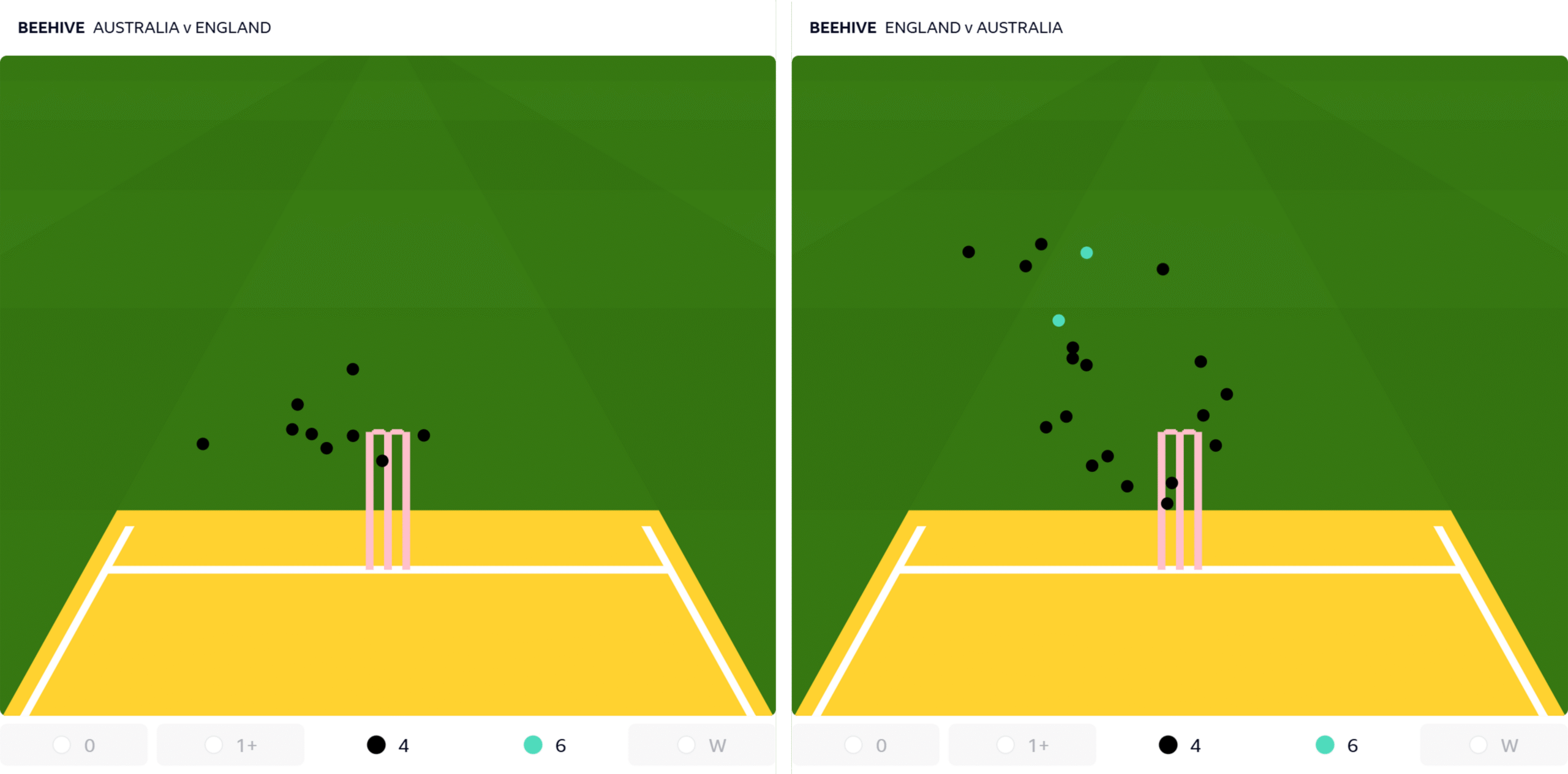
CricViz

The numbers were ugly.

Only once had Australia reached 100 quicker in a home Ashes Test while Brydon Carse conceded 95 runs in his first 12 overs. Stokes went for 64 in his first 11.

The number of balls on the ideal hard length (7-8m) dropped from 31% in the first 20 overs in the first innings in Perth to 17% at the Gabba and Australia scored 81 runs off the back foot – the most on record by any team in their first 20 overs of a match and the clearest sign England bowled short and wide.

Broad was not the only legend watching on for the first time in a generation.

“I was just thinking, ‘Pitch it up, just try and pitch it up a bit fuller’,” said James Anderson, whose Ashes contributions now come via the Tailenders podcast having been pushed aside in 2024 for these very bowlers.

Have England picked the wrong attack?

To play this video you need to enable JavaScript in your browser.

England cannot deny they began this tour with the exact attack they’d have scribbled down on a whiteboard two years ago, more in hope than expectation.

In Brisbane they picked three tall fast bowlers – Jofra Archer, Gus Atkinson and Carse – who thud the ball into the pitch at pace, plus a fully-fit Stokes.

This was their much-discussed plan – backing pace and steep bounce, while ignoring statistics that show bowlers operating below 85mph, who previously averaged eight runs per wicket worse than those reaching speeds above, have wiped out their inferiority in Australia in the past three years on livelier pitches and with the new Kookaburra ball.

Of course, there are caveats here too and, as ever, familiar criticism of the retiring of Anderson has resurfaced.

Chris Woakes’ shoulder injury in the fifth Test against India denied England the option of his nibblers while Essex seamer Sam Cook was overlooked after one underwhelming Test.

At his best, Anderson might have found more change from such surfaces but the 43-year-old played in less than half of Lancashire’s County Championship matches this summer amid injury struggles and averaged 85.40 with the ball against these Australians at home in 2023.

Are this crop simply England’s best Test bowlers, who happen to each be quick?

“They’re the right bowlers,” said former England bowler Steven Finn.

“I’m not sure anyone else in the country would have made a difference.”

Not a pace problem but one of leadership

Brydon Carse, Gus Atkinson, Jofra Archer and Ben Stokes (from left to right)Getty Images

Though six wickets for Michael Neser’s 82mph seam were an uncomfortable contrast at the Gabba, wickets are still falling more regularly to deliveries over 85mph than below in this series.

Archer has been England’s best bowler so far – the one capable of a match-winning spell – and he and Wood, England’s quickest two options before Wood’s series-ending injury, have the produced the highest percentage of false shots from Australian batters.

Despite taking only three wickets, Archer also comes out top of CricViz’s ‘Expected Average’ model across both sides while Mitchell Starc, Australia’s quickest bowler, is two Tests into an iconic Australian summer.

Broad, though, highlighted a deeper issue that could continue to thwart England’s plans.

“[Archer, Carse and Atkinson] don’t strike me as real tacticians of a game – thinkers of the craft,” said Broad on the For The Love of Cricket podcast.

“It struck me there were a lot of times Archer was at mid-on, Atkinson deep cover and Carse bowling. They would not say a word. You have got to work together.

“Stokes has to make all of the decisions along with other captaincy decisions. He is bowling, pouring with sweat and looks like he is taking so much on.

“It is first time he has captained without an experienced bowler.”

Suddenly the absence of Woakes and his 62 Tests of experience looks more significant, even with his history of struggling down under.

Remarkably, with Wood now to return home, 22-year-old Bashir’s 19 Test caps make him the most experienced of any of England’s frontline bowlers on tour.

Hopes Atkinson could grow from his quiet personality and be the attack leader were hit by injuries he suffered in the summer, which meant he only played one of the India Tests.

Archer is the most experienced quick with 17 caps, making his way back after four years out injured.

“That’s not me saying Anderson should be here or Woakes should be here,” added Broad.

“It is one of those things that happens.

“It struck me for the first time in two years that there is no-one helping Stokesy.”

Related topics

  • England Men’s Cricket Team
  • The Ashes
  • Cricket

More on this story

    • 16 August
    BBC Sport microphone and phone

‘Leaderless bowling is England’s other Ashes issue’

To play this video you need to enable JavaScript in your browser.

  • Comments

The fallout from England’s latest damaging Ashes defeat has, as ever, focused largely on their struggling batters.

Brainless. Unwilling to learn. Reckless. The withering analysis goes on.

But in the second Test there was another concerning failure as a fast bowling attack built for this very moment performed desperately.

Stuart Broad, an all-time great not long out of the dressing room, has labelled England’s first-innings effort with the ball in Brisbane their worst bowling performance since 2008. A wayward start and a bizarrely flat end allowed Australia to canter towards a par score and stroll well beyond it.

Broad is right – that innings was a startling extreme.

But the overall bowling average of Ben Stokes’ side in 2025 is also their worst for 23 years and their sixth worst calendar year in 140 years of Test cricket.

‘The worst performance since 2008’

Those 2025 numbers can, in part, be put down to who and where England have played.

Seven Tests in a row have come against India and Australia, with those India matches all lasting five days on some of the flattest pitches seen in the UK.

England’s only other Test this year was the four-day match against Zimbabwe, played on another slow surface at Trent Bridge, on which spinner Shoaib Bashir took nine wickets.

It is also undeniable an all-pace attack was both thrilling and threatening on first viewing in this Ashes series in bundling Australia out for 135 in Perth.

But that only makes the performances since, particularly the first innings in Brisbane with the game on the line and momentum with them, more disheartening.

“I have not seen a whole group get it wrong and bowl short and wide,” Broad told the Sky Cricket podcast.

CricViz

The numbers were ugly.

Only once had Australia reached 100 quicker in a home Ashes Test while Brydon Carse conceded 95 runs in his first 12 overs. Stokes went for 64 in his first 11.

The number of balls on the ideal hard length (7-8m) dropped from 31% in the first 20 overs in the first innings in Perth to 17% at the Gabba and Australia scored 81 runs off the back foot – the most on record by any team in their first 20 overs of a match and the clearest sign England bowled short and wide.

Broad was not the only legend watching on for the first time in a generation.

“I was just thinking, ‘Pitch it up, just try and pitch it up a bit fuller’,” said James Anderson, whose Ashes contributions now come via the Tailenders podcast having been pushed aside in 2024 for these very bowlers.

Have England picked the wrong attack?

To play this video you need to enable JavaScript in your browser.

England cannot deny they began this tour with the exact attack they’d have scribbled down on a whiteboard two years ago, more in hope than expectation.

In Brisbane they picked three tall fast bowlers – Jofra Archer, Gus Atkinson and Carse – who thud the ball into the pitch at pace, plus a fully-fit Stokes.

This was their much-discussed plan – backing pace and steep bounce, while ignoring statistics that show bowlers operating below 85mph, who previously averaged eight runs per wicket worse than those reaching speeds above, have wiped out their inferiority in Australia in the past three years on livelier pitches and with the new Kookaburra ball.

Of course, there are caveats here too and, as ever, familiar criticism of the retiring of Anderson has resurfaced.

Chris Woakes’ shoulder injury in the fifth Test against India denied England the option of his nibblers while Essex seamer Sam Cook was overlooked after one underwhelming Test.

At his best, Anderson might have found more change from such surfaces but the 43-year-old played in less than half of Lancashire’s County Championship matches this summer amid injury struggles and averaged 85.40 with the ball against these Australians at home in 2023.

Are this crop simply England’s best Test bowlers, who happen to each be quick?

“They’re the right bowlers,” said former England bowler Steven Finn.

“I’m not sure anyone else in the country would have made a difference.”

Not a pace problem but one of leadership

Brydon Carse, Gus Atkinson, Jofra Archer and Ben Stokes (from left to right)Getty Images

Though six wickets for Michael Neser’s 82mph seam were an uncomfortable contrast at the Gabba, wickets are still falling more regularly to deliveries over 85mph than below in this series.

Archer has been England’s best bowler so far – the one capable of a match-winning spell – and he and Wood, England’s quickest two options before Wood’s series-ending injury, have the produced the highest percentage of false shots from Australian batters.

Despite taking only three wickets, Archer also comes out top of CricViz’s ‘Expected Average’ model across both sides while Mitchell Starc, Australia’s quickest bowler, is two Tests into an iconic Australian summer.

Broad, though, highlighted a deeper issue that could continue to thwart England’s plans.

“[Archer, Carse and Atkinson] don’t strike me as real tacticians of a game – thinkers of the craft,” said Broad on the For The Love of Cricket podcast.

“It struck me there were a lot of times Archer was at mid-on, Atkinson deep cover and Carse bowling. They would not say a word. You have got to work together.

“Stokes has to make all of the decisions along with other captaincy decisions. He is bowling, pouring with sweat and looks like he is taking so much on.

“It is first time he has captained without an experienced bowler.”

Suddenly the absence of Woakes and his 62 Tests of experience looks more significant, even with his history of struggling down under.

Remarkably, with Wood now to return home, 22-year-old Bashir’s 19 Test caps make him the most experienced of any of England’s frontline bowlers on tour.

Hopes Atkinson could grow from his quiet personality and be the attack leader were hit by injuries he suffered in the summer, which meant he only played one of the India Tests.

Archer is the most experienced quick with 17 caps, making his way back after four years out injured.

“That’s not me saying Anderson should be here or Woakes should be here,” added Broad.

“It is one of those things that happens.

“It struck me for the first time in two years that there is no-one helping Stokesy.”

Related topics

  • England Men’s Cricket Team
  • The Ashes
  • Cricket

More on this story

    • 16 August
    BBC Sport microphone and phone

Where in the world are wealth and income most unequal?

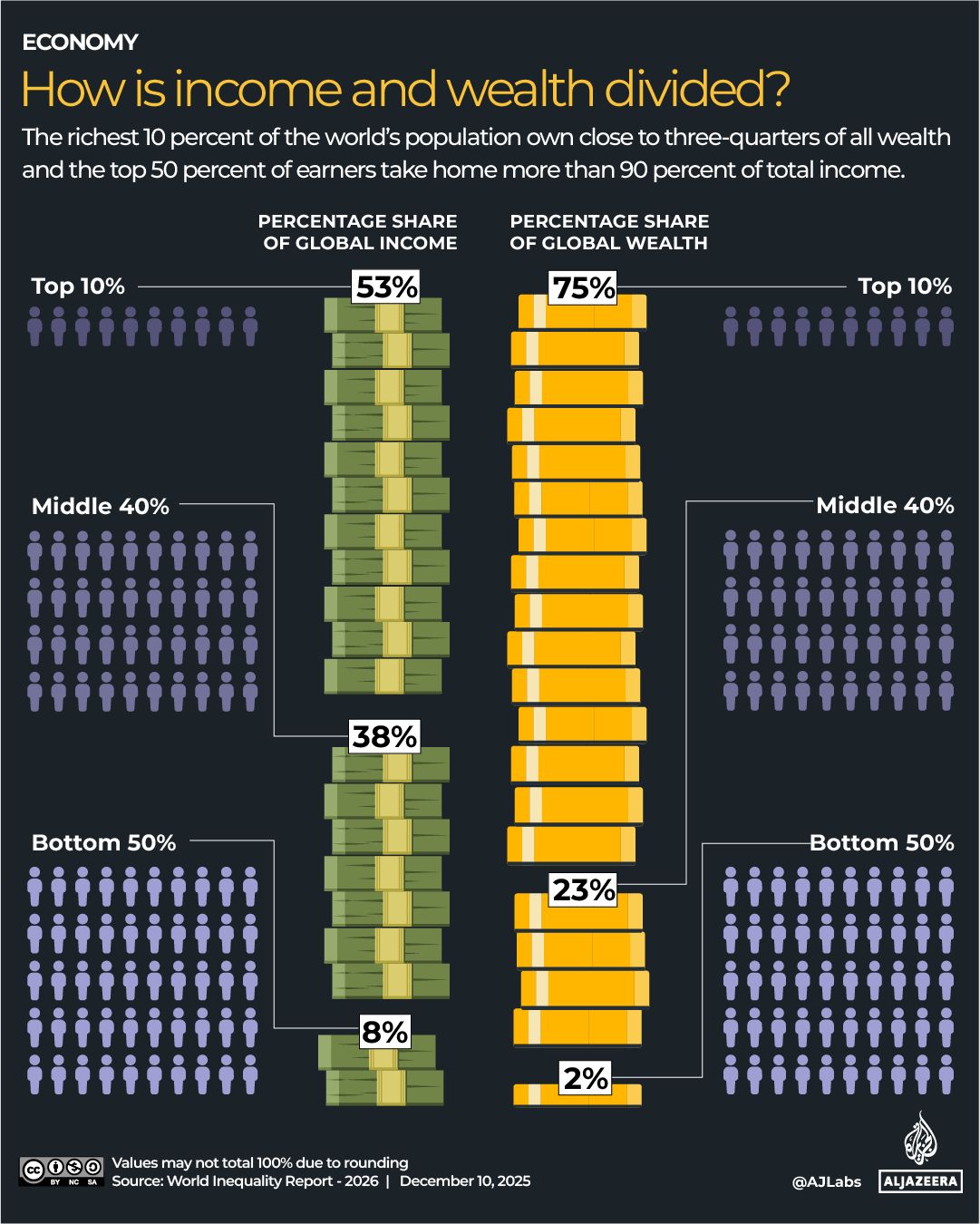
The richest 10 percent of the world’s population now owns three-quarters of all personal wealth, according to the newly released World Inequality Report 2026.

Income is not much different, where the top 50 percent of earners take home more than 90 percent, while the poorest half of the world receives less than 10 percent of total income.

The report, which has been published annually since 2018, notes that the 2026 edition arrives at a critical time. Worldwide, living standards are stagnating for many, while wealth and power are increasingly concentrated at the top.

(Al Jazeera)

The differences between wealth and income inequality

Wealth and income levels do not always go hand in hand. The wealthiest are not necessarily the highest earners, highlighting the persistent divide between what people earn and what they own.

Wealth includes the total value of a person’s assets-such as savings, investments or property, after subtracting their debts.

In 2025, the wealthiest 10 percent of the world’s population owned 75 percent of global wealth, the middle 40 percent held 23 percent, and the bottom half controlled only 2 percent.

Since the 1990s, the wealth of billionaires and centi-millionaires has grown by about 8 percent each year, almost twice the rate of the bottom half of the world’s population.

The wealthiest 0.001 percent – fewer than 60,000 multimillionaires – now control three times more wealth than half of humanity. Their share has climbed from almost 4 percent in 1995 to more than 6 percent today.

The poorest have made small gains, but these are overshadowed by the rapid accumulation at the very top, resulting in a world where a tiny minority holds extraordinary financial power, while billions still struggle for basic economic security.

Income is measured using pre-tax earnings, after accounting for pension and unemployment insurance contributions.

In 2025, the richest 10 percent of the world received 53 percent of global income, the middle 40 percent received 38 percent, and the bottom 50 percent earned just 8 percent.

For example, if the world comprised 10 people and total global income was $100, then the richest person would receive $53, the next four people would collectively earn $38, and the remaining five people would divide $8 among them.

How is wealth and income divided regionally?

Inequality looks very different around the world. A person’s birthplace remains one of the strongest factors in determining how much they earn and the wealth they can build. However, the regions also include poor and wealthy countries, and figures in the report are averages.

In 2025, the average wealth of people in North America and Oceania, which the report has grouped together, stood at 338 percent of the world’s average, making it the wealthiest region globally. Income share stood at 290 percent of the world’s average, also the highest in the world.

Europe and East Asia followed, remaining above the world average, while vast parts of sub-Saharan Africa, South Asia, Latin America and the Middle East remained far below the global average.

INTERACTIVE- Income and wealth inequality across regions-Dec9-2025-1765292712
(Al Jazeera)

Global inequality paints a stark picture, but the scale of wealth and income gaps can vary widely from one country to another. While some nations show slightly more balanced distributions, others reveal extreme concentration of wealth in the hands of a few.

Which countries have the highest income inequality?

South Africa has the highest levels of income inequality in the world. The top 10 percent earn 66 percent of total income, while the bottom half receives only 6 percent.

Latin American countries such as Brazil, Mexico, Chile and Colombia show a similar trend, where the richest 10 percent receive nearly 60 percent of earnings.

European countries offer a more balanced picture. In Sweden and Norway, the bottom 50 percent earn about 25 percent of total income, while the top 10 percent receive less than 30 percent.

Many developed economies, including Australia, Canada, Germany, Japan and the United Kingdom, fall in the middle. The top 10 percent earn roughly 33-47 percent of total income, while the bottom half takes 16-21 percent.

In Asia, income distribution is mixed. Countries like Bangladesh and China have a more balanced structure, whereas India, Thailand, and Turkiye remain top-heavy, with the richest 10 percent earning more than half of all income.

The table below shows where income is divided most unequally.

Which countries have the highest wealth inequality?

When it comes to wealth inequality, once again, South Africa tops the list. The top 10 percent control 85 percent of personal wealth, leaving the bottom 50 percent with negative shares – meaning their debt exceeds assets.

Russia, Mexico, Brazil and Colombia show a similar pattern, with the richest grabbing 70 percent or more, while the poorest receive barely 2–3 percent.

European countries such as Italy, Denmark, Norway and the Netherlands are relatively more balanced. Here, the middle 40 percent capture about 45 percent, and the bottom half takes a slightly larger share, though the top 10 percent still dominate. However, Sweden and Poland’s bottom 50 percent have negative shares in wealth.

Even wealthy nations like the United States, UK, Australia, and Japan are far from equal. The top 10 percent earn more than half of the total income, while the bottom half is left with just 1–5 percent.

Sledged on the beach – England’s break in Noosa

MixFM

England could not escape Australian sledging on their break from the Ashes series in the beach town of Noosa.

As the squad assembled on the beach on Wednesday morning, the players were approached by two local radio hosts – dressed in full whites – holding signs that read “For sale, moral victories” and “Bazballers anonymous, free counselling”.

Captain Ben Stokes was able to embrace the humour, posing for pictures.

Stokes’ reaction was in keeping with England’s relaxed approach to media attention on the tour.

The squad were made aware of their profile and the likely presence of cameras during their four-night stay on the Sunshine Coast.

Noosa is a small town, essentially with one street of bars, restaurants and shops. It is difficult for the England players to remain inconspicuous, and they have been happy to interact with locals and travelling supporters.

A number of players stand out in the crowd after collectively purchasing Akubra hats.

The squad arrived on Tuesday and will stay until Saturday, when they travel to Adelaide for the third Test.

They will train at the Adelaide Oval from Sunday, with three sessions planned before the Test begins on 17 December (23:30 GMT, 16 December).

On Wednesday all England players and staff gathered on the beach to play ‘pig’ – the football game they often play in the warm-up for training and matchdays. They then moved into the town centre for a fish-and-chip lunch.

The break is Noosa was planned before the Ashes series began and was arranged in conjunction with Cricket Australia.

One alternative to this trip would have been arriving in Adelaide well ahead of the third Test.

The three days of training before the third Test is in keeping with England’s usual preparation for a Test. The tourists had five days of training before the defeat in Brisbane, which McCullum said left them “overprepared”.

During the last Ashes in the UK in 2023, Australia’s players took a break in the middle of the series, with some travelling to various cities across Europe.

Australia wicketkeeper Alex Carey, who spent his downtime in Edinburgh during the 2023 series, said it is “not new” for a team on tour to move away from cricket between Tests.

“It’s a pretty big series – there is a lot of time in between games,” he said. “For the Australian cricket team, we get to go home for a few days and be with the families.

“For touring parties, you’ve got to find time to fill in those little windows, and Noosa’s not too far from Brisbane.

“The Ashes is a very hotly contested contest and you don’t want to be thinking cricket every single day of the tour. If you do have a little break, it’s probably not a bad time to refresh the batteries.

“Our boys played a bit of golf. I’m probably watching Netflix or taking the fishing rod away if I can.

    • 1 hour ago
    • 15 minutes ago
    • 19 hours ago

England’s off-field activities have been under constant scrutiny from the Australian press during the tour.

In Perth they were pictured on golf courses and at an aquarium, then in Brisbane they were front-page news for not wearing helmets when riding e-scooters.

Their training plans have also come under fire. They were criticised for playing only one warm-up match before the series – against England Lions – and again for not sending any of the players who played in the first Test to join the Lions in their game against a Prime Minister’s XI in Canberra.

Now, former England captain Nasser Hussain has said he “can’t understand” their schedule between the second and third Tests, while ex-coach David Lloyd said they should be having “naughty boy nets”.

But former batter Dawid Malan, who was part of England’s previous two Ashes tours, told BBC Radio 5 Live: “Sometimes you can lose the fact these guys are human beings.

“Anyone who has a normal job is able to go to the pub on their day off. It’s the same with these guys.

“They need to get away from cricket and they have to have a break. They have to clear their minds.”

Malan pointed to England’s previous tour of Australia in 2021-22, when strict Covid protocols restricted their movements outside of playing and training.

“It’s all in moderation,” he said. “It might not be a good look to be sat on a beach or having beers on an off day, but they are human beings and they should be allowed to enjoy their off days.

To play this video you need to enable JavaScript in your browser.

Related topics

  • England Men’s Cricket Team
  • The Ashes
  • Cricket

Sledged on the beach – England’s break in Noosa

MixFM

England could not escape Australian sledging on their break from the Ashes series in the beach town of Noosa.

As the squad assembled on the beach on Wednesday morning, the players were approached by two local radio hosts – dressed in full whites – holding signs that read “For sale, moral victories” and “Bazballers anonymous, free counselling”.

Captain Ben Stokes was able to embrace the humour, posing for pictures.

Stokes’ reaction was in keeping with England’s relaxed approach to media attention on the tour.

The squad were made aware of their profile and the likely presence of cameras during their four-night stay on the Sunshine Coast.

Noosa is a small town, essentially with one street of bars, restaurants and shops. It is difficult for the England players to remain inconspicuous, and they have been happy to interact with locals and travelling supporters.

A number of players stand out in the crowd after collectively purchasing Akubra hats.

The squad arrived on Tuesday and will stay until Saturday, when they travel to Adelaide for the third Test.

They will train at the Adelaide Oval from Sunday, with three sessions planned before the Test begins on 17 December (23:30 GMT, 16 December).

On Wednesday all England players and staff gathered on the beach to play ‘pig’ – the football game they often play in the warm-up for training and matchdays. They then moved into the town centre for a fish-and-chip lunch.

The break is Noosa was planned before the Ashes series began and was arranged in conjunction with Cricket Australia.

One alternative to this trip would have been arriving in Adelaide well ahead of the third Test.

The three days of training before the third Test is in keeping with England’s usual preparation for a Test. The tourists had five days of training before the defeat in Brisbane, which McCullum said left them “overprepared”.

During the last Ashes in the UK in 2023, Australia’s players took a break in the middle of the series, with some travelling to various cities across Europe.

Australia wicketkeeper Alex Carey, who spent his downtime in Edinburgh during the 2023 series, said it is “not new” for a team on tour to move away from cricket between Tests.

“It’s a pretty big series – there is a lot of time in between games,” he said. “For the Australian cricket team, we get to go home for a few days and be with the families.

“For touring parties, you’ve got to find time to fill in those little windows, and Noosa’s not too far from Brisbane.

“The Ashes is a very hotly contested contest and you don’t want to be thinking cricket every single day of the tour. If you do have a little break, it’s probably not a bad time to refresh the batteries.

“Our boys played a bit of golf. I’m probably watching Netflix or taking the fishing rod away if I can.

    • 1 hour ago
    • 15 minutes ago
    • 19 hours ago

England’s off-field activities have been under constant scrutiny from the Australian press during the tour.

In Perth they were pictured on golf courses and at an aquarium, then in Brisbane they were front-page news for not wearing helmets when riding e-scooters.

Their training plans have also come under fire. They were criticised for playing only one warm-up match before the series – against England Lions – and again for not sending any of the players who played in the first Test to join the Lions in their game against a Prime Minister’s XI in Canberra.

Now, former England captain Nasser Hussain has said he “can’t understand” their schedule between the second and third Tests, while ex-coach David Lloyd said they should be having “naughty boy nets”.

But former batter Dawid Malan, who was part of England’s previous two Ashes tours, told BBC Radio 5 Live: “Sometimes you can lose the fact these guys are human beings.

“Anyone who has a normal job is able to go to the pub on their day off. It’s the same with these guys.

“They need to get away from cricket and they have to have a break. They have to clear their minds.”

Malan pointed to England’s previous tour of Australia in 2021-22, when strict Covid protocols restricted their movements outside of playing and training.

“It’s all in moderation,” he said. “It might not be a good look to be sat on a beach or having beers on an off day, but they are human beings and they should be allowed to enjoy their off days.

To play this video you need to enable JavaScript in your browser.

Related topics

  • England Men’s Cricket Team
  • The Ashes
  • Cricket