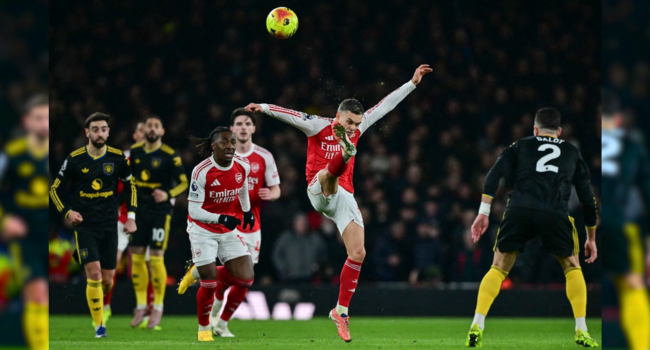
Manchester United’s problems mounted as the managerless Red Devils crashed out of the FA Cup after a 2-1 defeat against Brighton on Sunday.
Brajan Gruda put Brighton ahead in the first half at Old Trafford, and former United striker Danny Welbeck netted after the break.
Benjamin Sesko’s reply came too late to save his side from a third-round exit as United teenager Shea Lacey was sent off in the final moments.
English referee Simon Hooper shows a red card to Manchester United’s English midfielder #61 Shea Lacey during the English FA Cup third round football match between Manchester United and Brighton and Hove Albion at Old Trafford Stadium in Manchester, north west England, on January 11, 2026. (Photo by PETER POWELL / AFP)
United were barraged by jeers from furious fans following the latest miserable result in another troubled season.
Caretaker boss Darren Fletcher has failed to stop the rot following Ruben Amorim’s shock sacking on Monday, with United looking to appoint an interim manager until the end of the season
Former United boss Ole Gunnar Solskjaer and Michael Carrick, a decorated ex-United midfielder, have both been linked with the temporary role.
But regardless of United’s past pedigree, the chaos enveloping Old Trafford hardly makes it an appealing job for any manager of stature these days.
Manchester United’s Slovenian striker #30 Benjamin Sesko reacts during the English FA Cup third round football match between Manchester United and Brighton and Hove Albion at Old Trafford Stadium in Manchester, north west England, on January 11, 2026. (Photo by PETER POWELL / AFP)
Welbeck, 35, was at United when they won their most recent Premier League title in 2013 under Alex Ferguson, who watched the Brighton debacle from the directors’ box as the current generation showed how far they have fallen from the Scot’s golden era.
United, currently a disappointing seventh in the Premier League, are without a win in four games and have managed only one victory in their last seven matches.
That wretched form is unlikely to improve anytime soon with United hosting Manchester City next weekend before travelling to Premier League leaders Arsenal on January 25.
After a humiliating League Cup loss at fourth-tier Grimsby in August, United have exited both domestic cups at the first hurdle for the first time since 1981-82.
Avenging their 2023 FA Cup semi-final loss to United, Brighton have now won on four of their last five visits to Old Trafford.
READ ALSO: Martinelli’s Hat-Trick Fires Arsenal Past Portsmouth In FA Cup
United in disarray
Manchester United’s Slovenian striker #30 Benjamin Sesko reacts during the English FA Cup third round football match between Manchester United and Brighton and Hove Albion at Old Trafford Stadium in Manchester, north west England, on January 11, 2026. (Photo by PETER POWELL / AFP)
United midfielder Kobbie Mainoo started for only the second time this season as Fletcher left Casemiro on the bench in one of three changes from the midweek 2-2 draw at lowly Burnley.
Albion keeper Jason Steele made fine saves to deny Diogo Dalot and Bruno Fernandes in the early stages.
But Brighton made the most of those escapes to take the lead in the 12th minute.
Welbeck was the catalyst with an incisive run and cross to Georginio Rutter, whose header was cleared off the line by Lisandro Martinez before Gruda slammed past Senne Lammens from close-range.
United were in disarray, and chants against co-owners Jim Ratcliffe and the Glazer family rang around Old Trafford.
Fernandes sent a free-kick wide, and Matheus Cunha was narrowly off-target as United trudged off with boos ringing in their ears at half-time.
Mainoo was hauled off in the second half after a lacklustre display that did little to rebuke Amorim’s decision to ignore him for much of this season.
United’s problems are far wider than just Mainoo, and Brighton punished their shambolic defending to double the lead in the 64th minute.
Manchester United’s Dutch forward #11 Joshua Zirkzee (L) comes on for Manchester United’s English midfielder #37 Kobbie Mainoo (R) during the English FA Cup third round football match between Manchester United and Brighton and Hove Albion at Old Trafford Stadium in Manchester, north west England, on January 11, 2026. (Photo by PETER POWELL / AFP)
Gruda was given time and space to pick out Welbeck inside the area, and he lashed an exquisite strike past Lammens as the atmosphere turned even more toxic.
Sesko set up a frenetic finale after heading home from Fernandes’ 85th-minute corner.
But United couldn’t muster a late escape as Lacey, already on a booking, brought a fitting end to a painful defeat when he was sent off for throwing the ball away in frustration.
Nigeria secured a well-deserved 2-0 victory over Algeria in their Africa Cup of Nations (AFCON) quarterfinal, with second-half goals from Victor Osimhen and Akor Adams, setting up a semi-final clash against hosts Morocco.
The Super Eagles delivered an impressive performance, especially considering they had missed out on World Cup qualification just two months prior.
READ ALSO: [AFCON] Tinubu Hails Super Eagles Over Quarter-Final Win
From the beginning of the match at the Grand Stade de Marrakesh, they overwhelmed their opponents with determination, speed, and strength in challenges. Remarkably, they denied their rivals any scoring opportunities throughout the game.
Eric Chelle’s men will now look forward to what many will call their toughest test yet, against the hosts, Morocco, on Wednesday
Takeaways from Nigeria vs Algeria Match
But before that game, here are six takeaways from the Nigeria vs Algeria match
Nigeria Dominated Overall Play
Nigeria’s forward #22 Akor Adams controls the ball during the Africa Cup of Nations (CAN) quarter-final football match between Algeria and Nigeria at the Grand stadium in Marrakesh on January 10, 2026. (Photo by SEBASTIEN BOZON / AFP)
Nigeria’s dominance over Algeria was reflected not just in the scoreline but in the overall control of the match. From the opening exchanges, Nigeria imposed a higher tempo and physical intensity, pressing Algeria aggressively in midfield and forcing turnovers that disrupted the North Africans’ rhythm.
The Super Eagles were quicker to second balls, more decisive in transitions, and consistently pushed Algeria back into their defensive shape. This approach limited Algeria’s ability to build sustained possession or play through the middle, where Nigeria’s midfield screen stayed compact and disciplined.
Tactical Awareness, Collectiveness Was Key
Nigeria’s goalkeeper #23 Stanley Nwabali celebrates after Nigeria scored their first goal during the Africa Cup of Nations (CAN) quarter-final football match between Algeria and Nigeria at the Grand stadium in Marrakesh on January 10, 2026. (Photo by Paul ELLIS / AFP)
Yet again, the Super Eagles delivered a disciplined, well-coordinated performance that reflected clear planning and strong in-game understanding across all departments.
At the back, Nigeria’s defenders maintained a compact shape, ensuring minimal space between the lines. The centre-back pairing of Calvin Bassey and Semi Ajayi stayed disciplined rather than stepping out recklessly, while the fullbacks timed their forward runs intelligently.
This balance allowed Nigeria to defend solidly without sacrificing attacking width. Algeria were frequently forced wide or backward, unable to play through Nigeria’s defensive block.
In midfield, Nigeria’s work rate and positional awareness stood out. The midfielders provided constant cover for the defence while also acting as the link between the defence and the attack.
When Nigeria were out of possession, they pressed in coordinated units rather than individually, cutting off passing lanes and slowing Algeria’s build-up. In possession, they moved the ball quickly and efficiently, allowing Nigeria to transition smoothly from defence into attack.
The use of the flanks was a key tactical feature. Nigeria’s fullbacks pushed high at the right moments, stretching Algeria’s defensive line and creating overloads out wide. This width forced Algeria’s defenders to shift laterally, opening spaces centrally for the forwards.
Crosses and cut-backs from wide areas repeatedly put Algeria under pressure, even when clear chances did not immediately materialise.
Nigeria’s Attack Looked More Balanced
Nigeria’s forward #22 Akor Adams celebrates scoring his team’s second goal during the Africa Cup of Nations (CAN) quarter-final football match between Algeria and Nigeria at the Grand stadium in Marrakesh on January 10, 2026. (Photo by Paul ELLIS / AFP)
For years, Nigeria’s attacking identity has often revolved around Osimhen as the primary source of goals and intensity. While his presence remains central, the emergence of Akor Adams as a genuine scoring option altered the dynamics.
Algeria could no longer afford to focus all their defensive attention on shutting down Osimhen, as doing so created spaces elsewhere, spaces Akor was quick to exploit.
Akor’s willingness to make intelligent off-ball runs complemented Osimhen’s direct, physical style. While the 27-year-old occupied centre-backs with his pressing, aerial duels, and hold-up play, the Sevilla forward found gaps between defenders and timed his movements into the box effectively.
This dual threat made Nigeria’s attack less predictable and more difficult to contain.
The shared scoring responsibility also had a psychological impact. Osimhen was able to play with greater freedom, dropping deeper to link play or drifting wide without the constant burden of being the sole match-winner.
In turn, this improved Nigeria’s fluidity in the final third, as attacks were built through combinations rather than rushed, individual actions.
Iwobi Still Instrumental In Decisive Moments
Nigeria’s forward #17 Alex Iwobi celebrates with his team after winning the Africa Cup of Nations (CAN) quarter-final football match between Algeria and Nigeria at the Grand stadium in Marrakesh on January 10, 2026. (Photo by Paul ELLIS / AFP)
One person who has been key to Nigeria’s outing at the AFCON is Alex Iwobi. It would be an understatement to say he is enjoying the tournament. The Fulham man has been a ”revelation” to say the least.
In attacking phases, Iwobi provided creative connectivity rather than flashiness. He helped shift play wide, supported overlapping runs, and timed his forward movements to keep Algeria’s midfield occupied.
Even when not directly involved in goals, his movement and passing helped open spaces for forwards like Osimhen and Akor to exploit, particularly as Nigeria increased their dominance in the second half.
Defensively, Iwobi’s work rate stood out. He tracked runners, pressed intelligently rather than recklessly, and contributed to Nigeria’s compact shape when protecting the lead.
Algeria Struggled To Generate Offensive Chances
Algeria’s defender #21 Ramy Bensebaini reacts during the Africa Cup of Nations (CAN) quarter-final football match between Algeria and Nigeria at the Grand stadium in Marrakesh on January 10, 2026. (Photo by SEBASTIEN BOZON / AFP)
Meanwhile, Algeria’s difficulty in generating offensive chances was one of the defining features of the match and a direct reflection of Nigeria’s tactical control.
Throughout the game, the Desert Foxes found it hard to progress the ball cleanly into dangerous areas. Nigeria’s midfield of Wilfred Ndidi, Iwobi, and Frank Onyeka pressed aggressively and cut off passing lanes, forcing Algeria to circulate possession sideways or backwards rather than play through the centre.
Whenever Algeria attempted to build from deep, they were quickly met by coordinated pressure that disrupted their timing and limited forward momentum.
In the final third, the North Africans lacked penetration and clarity. Their attacking players were often isolated, with little support arriving from midfield, which made it easy for Nigeria’s defenders to contain one-on-one situations.
The Final Whistle Did Little To End Tensions
Nigeria’s midfielder #18 Raphael Onyedika, Algeria’s goalkeeper #23 Luca Zidane and players argue during the Africa Cup of Nations (CAN) quarter-final football match between Algeria and Nigeria at the Grand stadium in Marrakesh on January 10, 2026. (Photo by Paul ELLIS / AFP)
Players from both sides converged near the centre of the pitch, with heated exchanges, pushing, and confrontations involving not only players but also members of the technical benches.
Match officials were forced to intervene quickly to prevent the situation from escalating further.
The tension appeared to stem from a mix of frustration and high stakes. For Algeria, the defeat marked an abrupt end to a promising AFCON campaign, and some of their players visibly reacted to decisions made late in the game, including fouls and stoppages that disrupted their attempts to mount a comeback.
Nigeria’s players, meanwhile, were seen defending teammates and responding to perceived provocation as celebrations began.
Security personnel and coaching staff played a key role in restoring order, shepherding players away from flashpoints and toward the dressing rooms.
While the situation eventually de-escalated, the scenes underlined just how emotionally charged knockout football at AFCON can be, especially between two traditional continental heavyweights.
World number one Aryna Sabalenka warmed up for a tilt at a third Australian Open title in four years in ominous fashion by winning her second successive Brisbane International crown on Sunday.
Sabalenka scored a dominant 6-4, 6-3 win over Marta Kostyuk in just 78 minutes.
“Every day you go out there and prove your level, and I think this week I did it really well,” said Sabalenka after a tournament in which she powered to the title without dropping a set.
Looking ahead to the Australian Open, which begins next Sunday, Sabalenka said: “The only thing I know is that I’ll be there, I’ll be fighting.”
Salablenka lost in the Melbourne Park final last year to Madison Keys, having been the Australian Open champion in 2023 and 2024.
“I’ll do my best to go as far as possible,” said Sabalenka. “And do a little bit better than last year. That’s my focus.”
Kostyuk, the world number 26, had enjoyed a spectacular week, beating three top 10 players on the way to the final.
But she had no answer to the power of Sabalenka and the Ukrainian’s serve, so reliable in the early rounds, also went off the boil.
Sabalenka was rarely troubled on her own delivery and faced only three break points.
The 27-year-old Belarusian said she had tried to introduce new elements to her game so she wasn’t relying just on power, and that had paid off this week.
READ ALSO: High-Flying Super Eagles Defeat Algeria’s Desert Foxes To Reach AFCON Semi-Final
Ukraine spotlight
Marta Kostyuk of Ukraine reacts during the women’s singles final against Aryna Sabalenka of Belarus at the Brisbane International tennis tournament in Brisbane on January 11, 2026. (Photo by William WEST / AFP)
“I finally found the touch game,” she said.
“I figured something and I kind of changed my game style — now I’m not only the aggressive player, I can play at the net, I can be in defence, I can use my slice, I have a good touch.
“I’m super happy to see that things are clicking together.”
There has been animosity between the two players in the past.
Like many Ukrainian players, Kostyuk refuses to shake hands with Russians or Belarusians because of the war in her homeland.
There was no handshake at the end of the Brisbane final, and in her speech at the trophy presentation, Kostyuk brought up the situation in Ukraine.
“I play every day with a pain in my heart, and there are thousands of people who are without light and warm water right now,” she said.
“It’s minus 20 degrees outside, and it’s very painful to live this reality every day.”
Sabalenka said she wasn’t concerned by Kostyuk’s attitude towards her.
“It’s their position, what can I do?” she asked.
“When I go out there, I think about my tennis and the things I have to do to get the win.
“It doesn’t matter if it’s Marta Kostyuk or Jessica Pegula there. I have nothing to prove. I go there, and I just compete as an athlete.”
Kostyuk told reporters she was determined to keep what is happening in Ukraine in the public eye.
“I think it’s important for me to use my platform in the right way, and my platform is Ukraine, because I represent Ukraine,” she said.
“So I think it’s really important to talk about that.”
Liverpool right-back Conor Bradley is set to undergo surgery on a serious knee injury, which will rule him out for the rest of the season.
The Northern Ireland international suffered the injury in the closing stages of Thursday’s 0-0 draw at Arsenal.
Gunners’ forward Gabriel Martinelli apologised after the match for attempting to push Bradley off the field in the mistaken belief he was time-wasting.
“Liverpool FC can confirm Conor Bradley has sustained a significant knee injury,” the English champions said in a statement.
“Bradley will undergo surgery in the coming days and then begin a period of rehabilitation.”
READ ALSO: Martinelli’s Hat-Trick Fires Arsenal Past Portsmouth In FA Cup
The BBC reported that the injury is not an anterior cruciate ligament tear but does involve damage to the bone and ligament.
Bradley is also a major doubt for the World Cup should Northern Ireland navigate two play-off matches in March, starting with a trip to Italy.
His absence is a major blow to both club and country.
The 22-year-old was seen as the natural heir to Trent Alexander-Arnold at Anfield when he departed for Real Madrid.
But injuries have limited Bradley’s impact this season with Arne Slot often having to turn to midfielder Dominik Szoboszlai to deputise at right-back.
Liverpool are still involved in three competitions and begin their FA Cup campaign at home to Barnsley on Monday.
Slot’s side sit fourth in the Premier League and are also on course to qualify for the knockout stages of the Champions League.
Gabriel Martinelli shrugged off the backlash to his clash with stricken Liverpool defender Conor Bradley to send Arsenal into the fourth round of the FA Cup with a 4-1 win at Portsmouth on Sunday.
The Championship side were dreaming of an upset against the Premier League leaders when they went in front after just three minutes through Colby Bishop.
Arsenal boss Mikel Arteta had made 10 changes from the side that drew 0-0 with Liverpool on Thursday.
Martinelli drew stinging criticism for trying to push Bradley off the pitch in the closing stages after the Northern Irishman hit the ground with a serious knee injury.
Liverpool confirmed on Sunday that the right-back will require surgery and will miss the remainder of the season.
READ ALSO: High-Flying Super Eagles Defeat Algeria’s Desert Foxes To Reach AFCON Semi-Final
Arsenal’s Brazilian forward #11 Gabriel Martinelli (2R) celebrates scoring the team’s third goal during the English FA Cup third round football match between Portsmouth and Arsenal at Fratton Park in Portsmouth, southern England, on January 11, 2026. (Photo by Glyn KIRK / AFP)
The Brazilian apologised to Bradley after the game and did not seem affected by the furore at Fratton Park.
Arsenal could rely on their threat from set-pieces to turn the tie around.
The Pompey lead lasted only two minutes as Christian Norgaard bundled in from close range before Martinelli flicked in the first of his three goals.
Noni Madueke missed the chance to make it 3-1 from the penalty spot when the England international fired wide.
Martinelli killed the tie off early in the second period from Gabriel Jesus’ cross before completing his hat-trick from another Arsenal corner.
Arsenal’s Brazilian forward #11 Gabriel Martinelli celebrates scoring the team’s fourth goal, his hat-trick, during the English FA Cup third round football match between Portsmouth and Arsenal at Fratton Park in Portsmouth, southern England on January 11, 2026. (Photo by Glyn KIRK / AFP) /
Darren Fletcher is looking to further his case to remain in charge of Manchester United beyond Sunday with victory over Brighton later to keep alive the Red Devils’ hopes of silverware this season.
Leeds needed a second-half fightback to beat Derby County 3-1 and book their place in the fourth round.
The Premier League side have lost just once in their last nine games to pull clear of the relegation zone.
But they were headed for defeat at half-time to second-tier Derby after Chilean international Ben Brereton Diaz drilled a strike into the bottom corner.
Joel Piroe had seen a penalty saved by Jacob Zetterstrom before Leeds fell behind, but the Dutch striker redeemed himself by playing a part in the comeback.
Jaka Bijol played the ball into the area, and Piroe’s neat step-over allowed Willy Gnonto to smash home a 55th-minute equaliser.
Just four minutes later, Piroe’s low shot was parried by Zetterstrom, and Ao Tanaka slotted in the rebound.
The visitors made sure of victory in stoppage time when James Justin rounded off a slick counter-attack.
Mohamed Salah scored as Egypt won 3-2 to dump defending champions Ivory Coast out of the Africa Cup of Nations in a thrilling quarter-final on Saturday.
Omar Marmoush and Ramy Rabia netted for Egypt, then Ahmed Aboul-Fetouh conceded an own goal before half-time.
Salah then edged closer to a first Africa Cup of Nations winners’ medal by doubling the lead soon after the break before Guela Doue pulled a goal back for Ivory Coast.
Egypt’s forward #10 Mohamed Salah congratulates Egypt’s defender #5 Ramy Rabia after he scored a goal during the Africa Cup of Nations (CAN) quarter-final football match between Egypt and Ivory Coast at the Grand stadium in Agadir on January 10, 2026. (Photo by FRANCK FIFE / AFP)
Egypt will face Senegal on Wednesday in Tangiers, with the winners meeting hosts Morocco or Nigeria four days later in the final.
The triumph in Agadir confirmed the AFCON dominance of Egypt over the Ivory Coast since they first met 56 years ago. The Pharaohs have won 11 times and the Elephants just once.
READ ALSO: High-Flying Super Eagles Defeat Algeria’s Desert Foxes To Reach AFCON Semi-Final
Ivory Coast’s midfielder #08 Franck Kessie and Egypt’s midfielder #14 Hamdy Fathy vie during the Africa Cup of Nations (CAN) quarter-final football match between Egypt and Ivory Coast at the Grand stadium in Agadir on January 10, 2026. (Photo by FRANCK FIFE / AFP)
Ivory Coast became the eighth consecutive titleholders unable to successfully defend the title since Egypt achieved the feat in 2010.
Salah has helped Liverpool win the Premier League, FA Cup, League Cup, Champions League and Club World Cup, in its previous format, but the most prized African medal has eluded him.
The 33-year-old has twice been a runner-up after losses in the AFCON final to Cameroon in 2017 and Senegal five years later. He was also in Egyptian teams that twice made unexpected last-16 exits.
Ivory Coast’s forward #26 Yan Diomande celebrates his team first goal during the Africa Cup of Nations (CAN) quarter-final football match between Egypt and Ivory Coast at the Grand stadium in Agadir on January 10, 2026. (Photo by FRANCK FIFE / AFP)
Now he is two matches away from realising his long-time dream of helping Egypt win the AFCON a record-extending eighth time.
Salah arrived in Morocco for the premier African sporting event amid uncertainty over his future at Liverpool after a post-match outburst following a draw at Leeds United.
The Egyptian, demoted to the substitutes’ bench after a run of poor results by the Anfield outfit, claimed he had been “thrown under the bus”.
Clinical Best
But he has been back to his predatory best at the AFCON, scoring the match-winner against Zimbabwe and South Africa at the group stage, then the goal that sealed a last-16 victory over Benin.
On Saturday, Egypt took the lead just 182 seconds after the kick-off through Manchester City striker Marmoush.
Ivory Coast lost possession, Emam Ashour delivered a superb pass and Marmoush took advantage of Odilon Kossounou slipping to beat goalkeeper Yahia Fofana.
Egypt increased their lead on 32 minutes when centre-back Rabia soared above Ibrahim Sangare at the far post to meet a Salah corner, and his looping header beat Fofana.
Egypt’s forward #22 Omar Marmoush celebrates his goal with Egypt’s forward #10 Mohamed Salah during the Africa Cup of Nations (CAN) quarter-final football match between Egypt and Ivory Coast at the Grand stadium in Agadir on January 10, 2026. (Photo by FRANCK FIFE / AFP)
The defending champions were rattled and needed to score. It came after 40 minutes when Egyptian Aboul-Fetouh conceded an own goal.
Yan Diomande, the 19-year-old RB Leipzig striker, floated a free kick into the heart of the six-yard box, Kossounou nodded the ball goalwards, and it entered the net off the midriff of Aboul-Fetouh.
Salah restored Egypt’s two-goal lead just seven minutes into the second half, and once again, Ashour from African club giants Al Ahly was the creator.
The midfielder gained possession on the left wing, and his low, curved cross was perfectly weighted for Salah to push the ball into the net despite being under pressure from Ghislain Konan.
Ivory Coast’s defender #17 Guela Doue celebrates his goal during the Africa Cup of Nations (CAN) quarter-final football match between Egypt and Ivory Coast at the Grand stadium in Agadir on January 10, 2026. (Photo by FRANCK FIFE / AFP)
Ivory Coast, which overcame a two-goal deficit to beat Gabon in a group match, once again halved the deficit after 73 minutes.