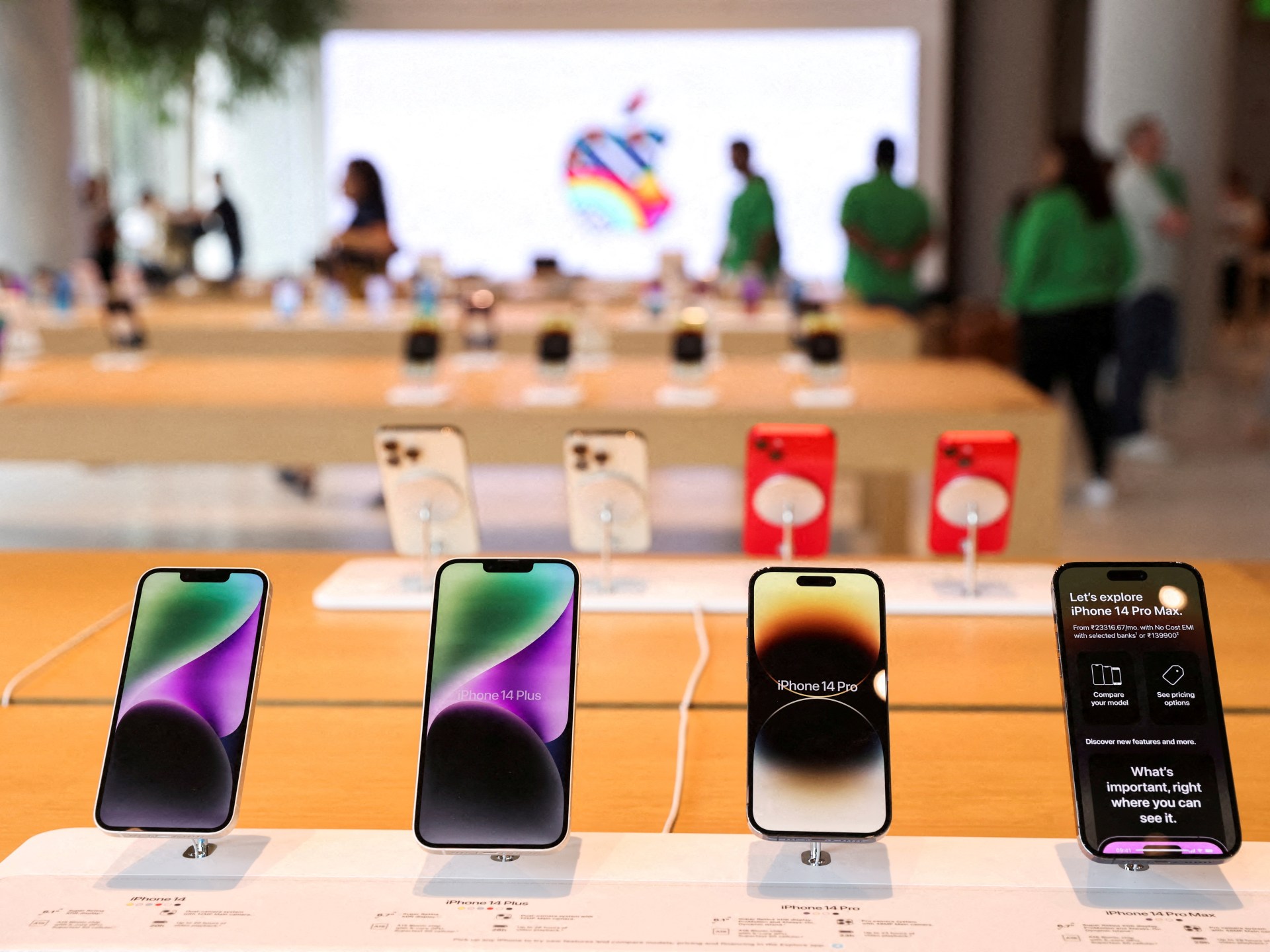
Following a significant backlash resulting from concerns about digital rights, India has suspended a command to smartphone manufacturers to install a government-owned cybersecurity application on all new mobile devices.
All leading smartphone manufacturers, including Apple and Samsung, were given 90 days to add the government’s Sanchar Saathi application to all newly produced devices, according to an official notification released by the Department of Telecommunications on November 28.
Recommended Stories
list of 3 itemsend of list
The Bharatiya Janata Party (BJP)-led government claimed the decree was a step in a campaign to combat mobile phone fraud and abuse.
However, both tech companies and advocates for digital privacy were against the order. Previously, a number of privacy- and security-related issues reportedly caused Apple, headquartered in the United States, to say it would not comply with the order.
What we know is as follows.
What was stated in the order?
Manufacturers were instructed to ensure that Sanchar Saathi was “pre-installed on all mobile handsets manufactured or imported for use in India” within 90 days in accordance with the directive issued by India’s Department of Telecommunications.
Manufacturers were informed that the app’s features were “not disabled or restricted,” and that it was “readily visible and accessible to the end users at the time of first use or device setup.”
Manufacturers and importers were instructed to “make an effort to push the App through software updates” for devices already in stock, according to the order.
Companies were also required to submit compliance reports to the telecom ministry within 120 days of the directive.
More than 85 percent of Indian households are smartphone owners, according to a survey conducted by the Ministry of Statistics and Programme Implementation (MoSPI) in May.
It’s obvious that Sanchar Saathi is a snooping app, but it’s ridiculous. The right to privacy is a right of citizens. Without the government’s supervision, everyone must have the right to privacy when communicating with friends and family.
It’s more than just phone snooping. They’re… pic. twitter.com/omw2XlD5pq
Why was this ordered by the Indian government?
The government supported the decree, stating that Sanchar Saathi would enable “stakeholders to report International Mobile Equipment Identity (IMEI) – related suspicious misuse and also verify the authenticity of IMEIs used in mobile devices.” Sanchar Saathi added that the country’s Telecom Cyber Security Rules empower it to establish “necessary to identify and report acts that may endanger telecom cyber security.”
A unique 15-digit IMEI is used to identify a particular mobile device.
What was the response of smartphone manufacturers?
According to a source with knowledge of Apple’s concerns about the app, the tech giant would tell the Indian government that it would not abide by any such laws anywhere in the world.
Samsung, a South Korean-based tech company, was reportedly reviewing the order, a source inside the industry told Reuters, but it had not provided any information regarding how it planned to proceed.
What were the order’s criticisms?
Its “deeply worrying expansion of executive control over personal digital devices” was described by the Indian Internet Freedom Foundation (IFF).
On the surface, the stated goal of halting IMEI fraud and improving telecom security appears to be a legitimate state goal. However, the methods chosen are “disproportionately” legal fragile, “economically hostile” to user privacy and autonomy,” it said in a statement.
Priyanka Gandhi, a leader of the Congress and Lok Sabha member, described Sanchar Saathi as “ridiculous” and “snooping.”
The Delhi-based Software Freedom Law Center claimed that the directive was yet another attempt to “destroy user autonomy, make a mockery of consent, and have a 24-hour State in My Home measure.”
“This is the beginning of a function creep slope.” The extensive integration of state software on private devices results in an increase in surveillance capabilities without the need for fresh public debate whenever new changes are made, according to the statement.
“Government has no business being in our devices that are more meaningful to us than our loved ones,” he said.
The Indian government’s COVID-19 contact tracing app, Aarogya Setu, was the subject of a similar controversy in 2020, when it was deemed a “privacy minefield” by critics.
When was the order removed by India?
The government announced early on Wednesday that it would be willing to change the order “based on the feedback we receive.” The order was voided a few hours later.
The Indian Communications Ministry stated in a press release that the government has decided not to require pre-installation for mobile manufacturers.
The app is secure, according to the statement, and is only intended to protect users from “bad actors in the cyber world.”
Government mandates no pre-installation of Sanchar Saathi apps.
The government mandated the pre-installation of the Sanchar Saathi app on all smartphones with the intention of allowing all citizens to gain access to cyber security. The app is secure, and it’s only intended to assist citizens… twitter.com/u4AgSuLrkh
The IFF claimed that the full legal order governing the revocation was still a “welcome development” even though it was still in its entirety.
Statement
The PIB just announced in a statement at 3:00 PM on December 3, 2025 that the government won’t require mobile manufacturers to install the Sanchar Saathi app prior to December 3. Although we are still waiting for the legal order’s full text, we are pleased that this has been made. twitter.com/VQV4t8YNfK
Do other nations have similar orders?
Russia released Max earlier this year, an app designed to stop stolen phones from being used in fraud schemes and expand access to state-backed digital services.
Max is allegedly more secure than apps provided by foreign competitors by Russian authorities.
Max, a product of the state-controlled tech company VK, is integrated with government platforms and is required on all new cell phones and tablets sold as a result of the government’s requirement since September 1.
Moscow claimed that the move would create a “digital ecosystem” that was “smarter”. The app is likely to be used for surveillance, claim Moscow has refuted, though, according to critics.
Source: Aljazeera

Leave a Reply