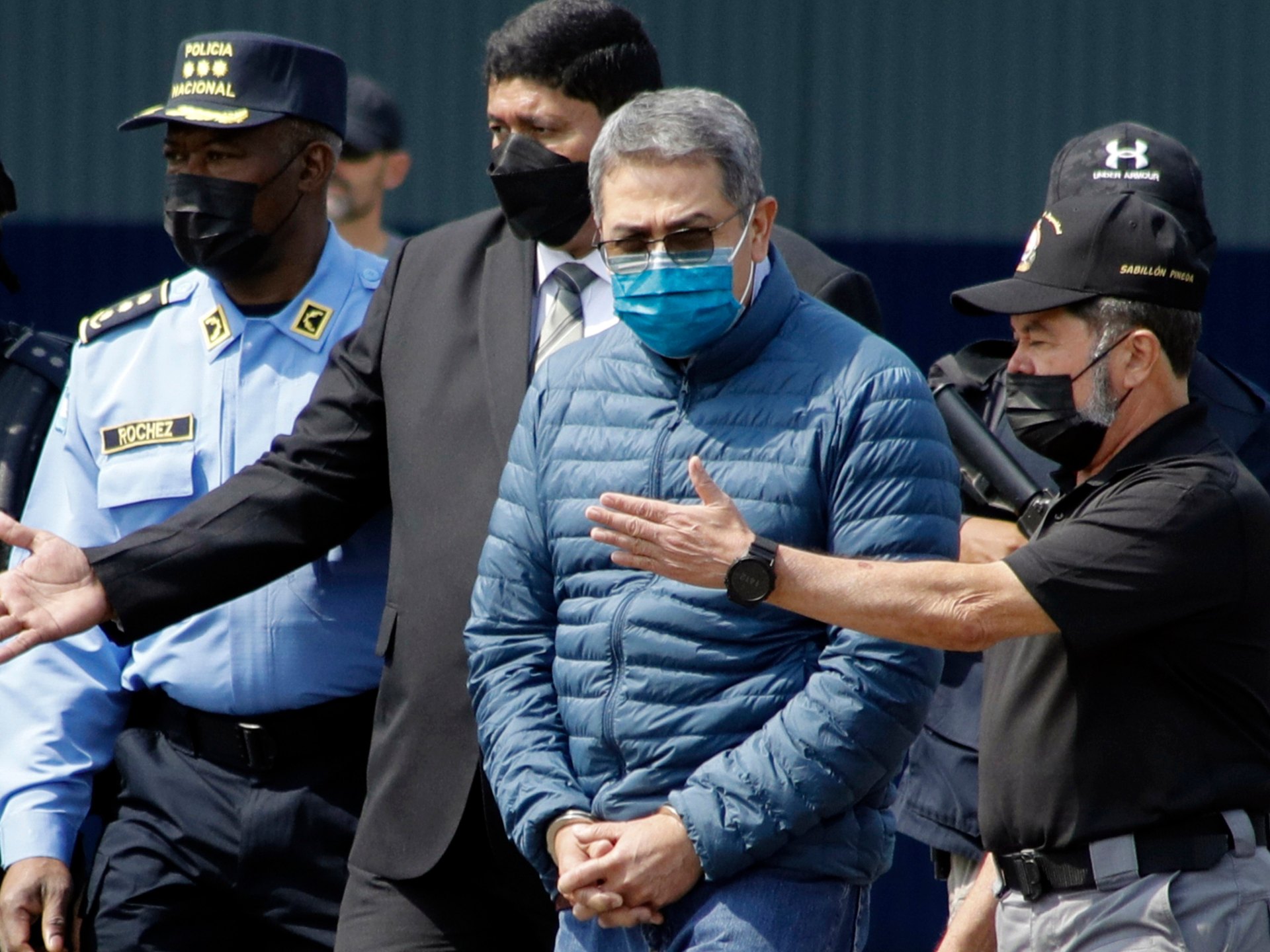
President Donald Trump announced he would pardon a former Honduran president infamous for his involvement in the US drug trade as the United States continued its military campaign against what the Trump administration refers to as “narco-terrorists” in the Caribbean.
Juan Orlando Hernandez, who had been found guilty of conspiring to import more than 400 tonnes of cocaine into the US, was given a 45-year prison sentence in 2024.
Recommended Stories
list of 3 itemsend of list
Trump claimed that Joe Biden’s administration had “set up” Hernandez during an interview with reporters on Air Force One on Sunday. Trump said, “If someone sells drugs in that country, you don’t arrest the president and imprison him for the rest of his life,” without providing any proof of the alleged “set-up.”
Trump made an inaccurate statement about the nature of the former Honduran president’s arrest and conviction: Hernandez was deeply involved in the flow of illegal drugs into the US after he was elected president, not because he sold drugs there.
Although the circumstance is uncommon, it has some similarities.
Trump’s planned pardon was seen by the White House as a step toward correcting a flawed system of justice. White House press secretary Karoline Leavitt criticized Hernandez’ three-week jury trial for having weak evidence at a press briefing on December 1.
A judge denied Hernandez’ request for a new trial after his conviction.
What crimes did Hernandez commit?
Hernandez declared his intent to combat drug trafficking during his presidency, which extended from January 2014 to January 2022. Trump praised his 2019 accomplishments.
Hernandez was charged with drug- and weapons-trafficking and extradited to the US in April 2022. For importing cocaine and other prohibited weapons, District Judge P. Kevin Castel sentenced him to 540 months in prison and 60 months of supervised release on June 26, 2024.
Hernandez used his presidential authority to bring hundreds of tonnes of cocaine into the US, according to the US Justice Department, and used drug trafficking proceeds to finance his political career.
Hernandez once said that he wanted to “stuff the drugs right up the noses of the gringos,” according to the department.
Witnesses, some of whom were former traffickers, gave testimony for the prosecution. According to documents obtained in the case, Hernandez worked with coconspirators who were armed with assault rifles, machineguns, and grenade launchers to facilitate the importation of more than 400 tonnes of cocaine into the US.
Witnesses to Hernandez’ trial claimed that the Honduran military and police issued orders from criminal organizations.
According to US prosecutors, Hernandez ended up receiving millions of dollars in drug proceeds from some of the world’s largest and most violent drug-trafficking organizations. According to the prosecution, he then used those bribes to fuel his rise in Honduran politics, enabling him to defend his conspirators.
Under Hernandez’s leadership, Juan Antonio Hernandez Alvarado, a former member of the Honduran National Congress, was protected by the government. According to the prosecution, Hernandez also received millions of dollars from former Sinaloa Cartel leader Joaquin “El Chapo” Guzman.
How did the US successfully prosecute a foreign leader?
Trump claimed Hernandez was given the honor of serving as Honduran president. A foreign president’s prosecution is unusual but not unprecedented.
A sitting head of state or head of government is protected by “complete immunity” from prosecution in international court, according to Anthony Clark Arend, a Georgetown University professor of government and foreign service with a focus on international law.
Former heads of state are less repressive, though. Hernandez’ US extradition took place weeks away from his office.
If a former head of state or government is accused of acting in their place of power, Arend said, they are not subject to legal action in another country. However, because drug trafficking has historically not been regarded as an “official” duty, the US was able to prosecute Hernandez.
According to Arend, there would be no impediment in the international law to try him, a former president, for those charges because he was facing drug-trafficking charges.
According to Daniel Sabet, a visiting fellow at the Johns Hopkins University’s SNF Agora Institute who studies Central America, Hernandez’s prosecution “seemed to have legitimacy both in the US and in Honduras.” The arrest was viewed as legitimate, according to “his main supporters.”
Particularly notable is Manuel Noriega of Panama’s case, which is uncommon but not unprecedented.
Following Noriega’s indictment by a US grand jury on drug-related charges, President George H. W. Bush ordered US forces to seize the nation’s leader in Panama in 1989. (Noriega’s position as the country’s head of state was contested at the time, and the US did not recognize it.)
On eight counts of drug trafficking, money laundering, and racketeering, Noriega was tried and found guilty after turning himself in and being taken to the US state of Florida. He received a 40-year prison sentence. A three-judge appeals court panel in 1997 upheld Noriega’s claim that his position as head of state should have preempted his prosecution.
Additionally, Sabet cited the arrest of former Ukrainian Prime Minister Pavel Lazarenko in the United States in 1999 on suspicion of 53 counts of money laundering. He was found guilty and given a three-year prison term.
Source: Aljazeera

Leave a Reply