A young Maqbool Fida Husain, who was barely in his 20s, made his way to Bombay, the Indian financial capital, in the 1930s, from Indore city, which was 600 kilometers (370 miles) away.
His dream was to make films. He started painting billboards for the burgeoning Bollywood film industry after finding it difficult to survive in the city.
Recommended Stories
list of 4 itemsend of list
A decade later, as newly independent India was finding its footing, Husain became a part of a group of artists who laid the foundations of modern art in the country. He later became one of the most well-known and renowned Indian modern artists of the 20th century, frequently referred to as “India’s Picasso.”
But despite the global renown and the numerous awards – internationally and at home in India – Husain found himself the target of a concerted hate campaign by a rising Hindu majoritarian movement starting in the 1990s, forcing him to flee.
Famous works by Husain have found permanent homes in Doha, Qatar’s capital, since the artist was granted citizenship in 2010, nearly 20 years after he fled into exile and 14 years after his death in London.
Lawh Wa Qalam: MF Husain Museum inaugurated
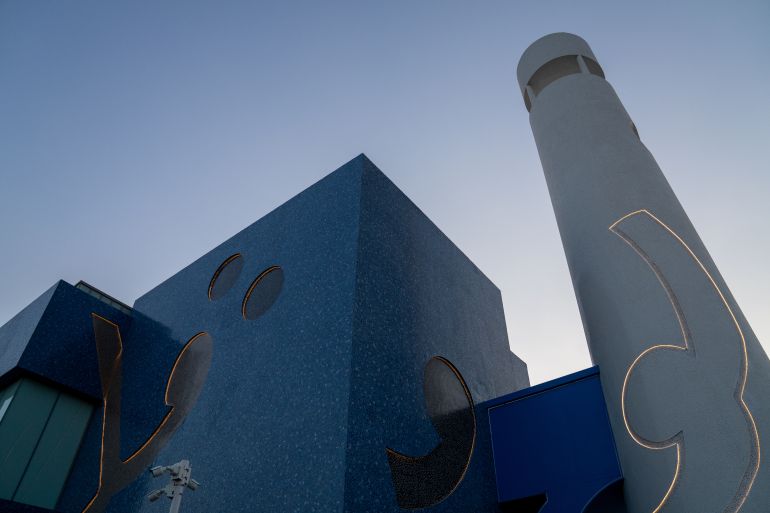
The board and the pen, or Lawh Wa Qalam, was inaugurated by Qatar last month, which honors Husain’s life and work that spanned more than six decades.
“Maqbool Fida Husain is a legendary artist – a true master whose artistic works transcend borders and connect cultures, histories, and identities”, Sheikha Moza bint Nasser, the chair of Qatar Foundation, said during the museum’s inauguration.
The celebrated artist’s final works, along with his other works, including photography, films, and poetry, are displayed in the new museum, which is located in Doha’s sprawling Education City.
At least 35 paintings, which were completed as part of his Arab Civilisation series before Husain died in 2011, are on display in the building.
Husain incorporated Arabic script and calligraphy into his bold modern style to illustrate the significance of the early Islamic military victory in The Battle of Badr. Arab Astronomy, another painting, honours scholars who mapped the heavens.

Seeroo fi al ardh (meaning “travel through the earth”, in Arabic), a multimedia art installation that opened in 2019, now forms part of the museum. Through the lens of the Arab region, the installation examines the evolution of human civilization.
“From the outset, one of the biggest questions for us was how to represent the range of Husain’s practice without reducing it to a simple linear story at Lawh Wa Qalam”, Noof Mohammed, museum curator, told Al Jazeera.
One of his most ambitious career stages was the one that we wanted to concentrate on presenting in Doha, which we wanted to do primarily. Projects like Seeroo fi al ardh and the Arab Civilisation series show him working on a scale and clarity that deserve to be seen together, and that shaped how we approached the narrative”.
The museum, which is spread over 290 square meters (3, 000 square feet), also houses his personal belongings, including Indian passport books, which he gave up in 2010.
“We were lucky that Husain made Qatar his home, where he was able to produce a lot of artwork that is part of the collection in the museum”, Kholoud Al-Ali, executive director of community engagement and programming at Qatar Foundation, said.
The Education City of the Qatar Foundation is home to some of the best educational institutions, including Georgetown University, Northwestern University, and Weill Cornell Medicine, as well as a hub for contemporary Arab art. The campus boasts more than 100 public art installations, including those by Damien Hirst and Faraj Daham.
Al-Ali told Al Jazeera, “This museum is going to be an addition to the Education City ecosystem, a place where students, researchers, and anyone interested in art can find essentially what they’re looking for.”

confined to his home
By the time Husain had moved to Doha, he had long secured his place as one of the world’s biggest figures – and as a lightning rod for criticism from the Hindu far-right in India.
His paintings, which were exhibited at international fairs like the Sao Paulo Biennial in Brazil alongside the renowned Spanish painter Pablo Picasso, broke auction records throughout the 20th century.
Husain was a versatile artist working across multiple mediums: Films, photography, tapestry and poetry.
In 1967, he directed the experimental film Through the Eyes of a Painter, which won the Golden Bear at the Berlin International Film Festival. He also directed Meenaxi: A Tale of Three Cities and Gaj Gamini, starring his muse, Bollywood star Madhuri Dixit.
Husain had a cult following and was adored by the press for decades. He developed a celebrity-like reputation by walking barefoot. The Calcutta Club, an elite British-era social club based in the Indian city of Kolkata, once came in for heavy criticism when it refused Husain entry for not wearing shoes.
Hindu right at attack
But by the mid-1990s, Husain’s portrayal of nude Hindu deities, some of them drawn in the 1970s, stirred controversy. He was accused of insulting Hindu sentiments and making up.
Multiple criminal police complaints were filed against the artist after a magazine, Vichar Mimansa, published his painting depicting Hindu deity Saraswati in the nude in 1996. A new wave of lawsuits resulted from a painting of Bharat Mata (Mother India) as a naked woman eight years later. He apologised, but that did not deter the torrent of hate and legal cases.
His Mumbai home was ransacked in 1998, and hundreds of police complaints were made all over the country. His exhibitions were vandalised in India and abroad, forcing Husain, in his 80s, to leave India in 2006 for safety.
The Supreme Court of India ruled that Husain’s Bharat Mata painting was a work of art in 2008, and the case was quashed. India has a tradition of graphic sexual iconography in temples, the top court reminded petitioners.
Husain felt uneasy about returning to India, where anti-Muslim rants were becoming more common. He died in 2011 in London at the age of 95.
Husain’s attacks weren’t isolated. The right to freedom of speech and expression in India has been declining since the rise of the Hindu right in the 1990s.
Numerous filmmakers, authors, and artists have been the target of increasing anti-Hindu nationalist attacks. Bollywood star Aamir Khan faced boycott calls from Hindu groups over his work and past media interviews, during which he expressed concerns about rising religious intolerance.

Since the Bharatiya Janata Party (BJP), which is led by Prime Minister Narendra Modi, came to power ten years ago, hundreds of Muslims have been lynched by Hindu vigilantes, hundreds of houses have been destroyed in violation of ‘bulldozer justice’ without the proper process, and a number of legal and institutional measures have been put in place, negatively affecting the minority community.
In January this year, a Delhi court ordered the seizure of “offensive” paintings by Husain. Hindu organizations threatened to obstruct the late painter’s Mumbai auction. The event eventually went ahead without incident under tight security.
His departure from India is tragic, and it is a sign of the kind of censorship and repression of speech and expression that has become much more prevalent, according to Sonal Khullar, an art historian from the University of Pennsylvania.
Khullar, who featured Husain in her 2015 book Worldly Affiliations: Artistic Practice, National Identity and Modernism in India, 1930-1990, said the attack on Husain was due to both his Muslim heritage and the secular ethos that informed his work.
“I think it really came down to what this artist was able to represent in India, whether you understood him to represent Muslim peoples, societies, or whether you understood him to represent a secular ethos,” he said. And I think that’s what came under an attack”, she told Al Jazeera.
The architecture of the museum
The architecture of the museum was inspired by Husain’s sketch dubbed Lawh wa Qalam. The multiple influences that inspired Husain are reflected in the building design.
“For instance, the blue tile used in the building has its origins in Central Asia, and it has become an important part of the architectural language”, said Martand Khosla, the architect of the museum.
Given Husain’s impact on the Indian cultural landscape, Khosla claims the project was extremely personal.
“We grew up seeing his work … at airports, at convention centres and inside people’s homes”, he recalled. He continues to be significant. So in that sense, it was a real privilege to be able to come and build a museum for him”.

Husain’s work
Husain was one of the most well-known contemporary Indian artists, with between 30 000 and 40 000 pieces of art.
His paintings portrayed Indian icons such as Mahatma Gandhi, leader of India’s independence struggle, to mythologies such as the Mahabharata with motifs of rural and urban life.
According to Khullar, the art historian, “Many of his early paintings seemed to make references to both wall paintings from the country of India, the ones you would find in the caves of Ajanta and those you would see in village homes.”
Painter Akhilesh Singh, who wrote Husain’s biography, Maqbool, said the turning point of his career was Between the Spider and the Lamp, which portrays five women figures standing with a lamp and a spider coming down from the roof.
It is considered to be the most significant piece of contemporary Indian art, according to Singh. It was modernist yet rooted in the folk tradition of India, he told Al Jazeera, adding that it defined Husain’s style.

Husain’s artwork was a break from the revivalist nationalism of the past that had triggered the creation of Hindu-majority India and Muslim-majority Pakistan.
Secular ethos was the language of his writing, which incorporated elements of Western modernism with elements of Indian culture, history, and folk traditions.
His first solo art exhibition was held in Zurich five years after India’s independence. His work was showcased across Western cities over the following decades, earning him acclaim worldwide.
Singh, the biographer, said Husain’s peers moved abroad, but he stayed in India.
Singh told Al Jazeera, “He helped to establish the entire contemporary art scene of the nation,” adding that he occasionally donated his own paintings to start galleries.
His contribution to Indian art was recognised by the government. In 1991, he was honored with the second-highest civilian honor, the Padma Vibhushan, among other things. He was also nominated to the upper house of parliament in 1986.

Early life and the future
In the state of Maharashtra in western India, Husain was born into a Sulaymani Bohra Muslim family in 1915. But early in his life, he was drawn towards art while studying calligraphy at a madrasa in Vadodara, located in present-day Gujarat state.
He relocated to Indore, in central India, where his father worked in a textile mill after his mother passed away.
In Indore, he was introduced to the images of Hindu deities and other figures from Indian mythology by an art teacher at the Indore School of Art, which he attended, said Singh, his biographer.
Husain departed Indore for Mumbai in 1933, according to Singh, while India was still under British colonial rule.
“He went to Bombay to pursue filmmaking. He believed that film offered more opportunities for expression. But he couldn’t find any entry. He then began to paint movie banners, according to Singh, an internationally renowned painter who resides in Bhopal, India.
Husain had to juggle jobs, also working in a toy factory, to earn additional income before he got a start in the art world. His first painting was sold for 10 rupees in 1934, which is still only 11 cents, according to the current exchange rates.
By the late 1940s, he had established himself as an avant garde artist known for his bold and bright colour on canvas. In 1947, Husain and Francis Newton Souza and Sayed Haider Raza co-founded the Bombay Progressive Artists’ Group.

In addition to his provocative art with erotic and unconventional themes, Souza, who later worked in New York and London, was well-known.
But to those who knew him well, Husain was more than just an artist. The legendary artist and Singh’s father were close friends. “He treated me like his son”, Singh told Al Jazeera. Early in the morning, he brought a Jalebi (Indian sweet) to our Indore home, according to him.
Singh recalled how, in the early 2000s, Husain once invited him to London. Husain drove Singh around London in his Rolls-Royce while making breakfast there. “He enjoyed every moment of his life”, Singh said of Husain.
Husain continued to love his motherland despite giving up his Indian passport. “This is just a piece of paper. He said after giving his Indian passport in 2010, “India is my motherland, and I simply cannot leave that country.”
Singh said that while in exile, Husain wanted to visit three Indian cities – Varanasi, Mumbai, and Hyderabad. “‘ He told me from exile, “I will come any time,” Singh said. “But he died before he could undertake his journey back to his homeland”.

That Husain was forced to spend his final years in exile remains a blot on India, said Khullar, the art scholar.
One could say that for a certain segment of society, in general, for India itself, is a loss due to a figure like Husain, who was a figure of the Indian art world, which he founded in 1947.
“It’s a dark time, and people are afraid”, she said.
Husain himself, however, never let the attacks deter him from pursuing his art. He spent time in exile working on art projects in Dubai and Qatar.
“He laughed off the controversies. He never touched on the past. He was a man of the future and always looked forward”, Singh said.
The museum serves as a tribute to the board and the pen, an outlet for current and upcoming generations to admire Husain’s wizardry, and a place for that ethos as well.

Source: Aljazeera

Leave a Reply