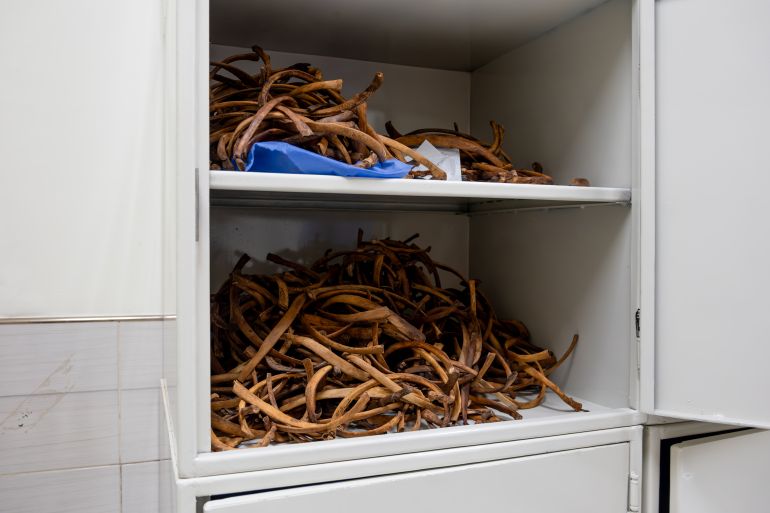
Damascus, Syria – In the basement of a nondescript building in Damascus is the Syrian Identification Centre’s forensic laboratory with storage units full of human bones.
One cabinet is entirely dedicated to ribs. Another contains skulls.
Recommended Stories
list of 3 itemsend of list
These are only some of Syria’s missing; their disappearances remain an unresolved legacy of the dictatorship under Bashar al-Assad.
A year on from the fall of the regime in December 2024, the Identification Centre’s head, Dr Anas Hourani, has examined the only mass grave that has been fully exhumed so far.
It could take his team up to four years to identify victims from that site alone, he said.
A long, painstaking process
It’s a daunting timeline. Across Syria, there may be as many as 66 mass graves, according to the International Commission on Missing Persons.
“These missing people may be our relatives, our neighbours, our families,” Hourani said. “We must hold accountable the person who did these things.”
Forced disappearances were a hallmark of the al-Assad regime, which operated a vast prison network where detainees were tortured, killed, and many were buried in mass graves.
When the regime collapsed, many Syrians were relieved, hoping to finally get answers about their disappeared loved ones.
![Dr Anas Al Hourani is a forensic odontologist - meaning he studies teeth to help identify a person's remains. [Harriet Tatham/Al Jazeera]](https://i0.wp.com/www.aljazeera.com/wp-content/uploads/2025/12/DrAlHourani-1765187120.jpg?w=696&ssl=1)
Prisons were swiftly opened, and about 30,000 detainees were freed.
But for people who didn’t see their loved ones emerge, a devastating realisation set in: They’re most likely dead.
Mohammad Reda Jalkhi, the head of the National Commission on Missing Persons, believes the figure may be as high as 300,000, while the UN estimates it at about 100,000.
“According to some documents, noting that they vary in authenticity, the number is between 120,000 missing persons and 300,000,” he said.
“However, I expect that in reality the number is much higher, and the number of people affected by this loss exceeds millions of Syrians.”

Waiting for a DNA lab
As a forensic odontologist, Dr Hourani studies teeth to help identify victims.
“The teeth are one of the universal indicators,” he said.
He also looks at a victim’s bone structure and the clothes they were buried in to ascertain as much information about when and how a person died.
A winter jacket, for example, suggests the person was killed in the winter.
While these techniques can narrow down clues, real forensic work is hamstrung until Syria has a DNA centre with a functioning DNA bank.

“We hope to open several centres for DNA analysis, which will help us identify individuals,” Dr Hourani said, adding that they struggle to find specialised staff.
Jalkhi acknowledges these shortcomings.
“We are trying to do everything we can regarding this file,” he told Al Jazeera.
But dealing properly with crimes of this scale “does not happen overnight”, he said.
“If we look at Bosnia and Herzegovina, after more than 30 years – and up until now – they are still looking for missing people, and the same goes for Mexico and Argentina,” Jalkhi said.
Despite this, he says he is committed to delivering results.
“Failure in the file of missing people,” he said, “means failure to maintain civil peace and therefore disaster. We do not want to return to disaster again in Syria.”
![It’s believed this victim died from a gunshot to the head. [Harriet Tatham/Al Jazeera]](https://i0.wp.com/www.aljazeera.com/wp-content/uploads/2025/12/SkullGunshot-1765187511.jpg?w=696&ssl=1)
Source: Aljazeera

Leave a Reply