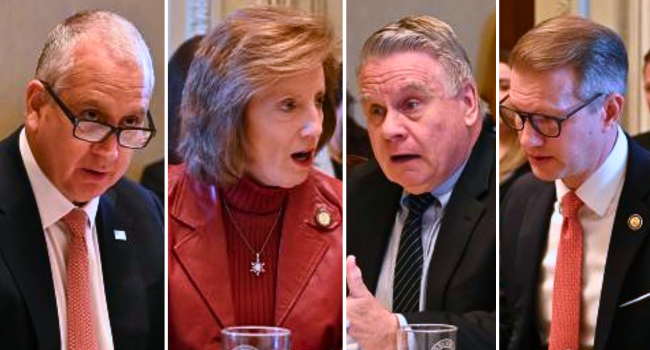

The Nigerian government is accused by US lawmakers of not doing enough to combat the country’s growing insecurity and murders.  ,
The lawmakers addressed the alleged persecution of Christians in Nigeria during a joint congressional briefing of the US House Appropriations Committee on Tuesday.
Following President Donald Trump’s designation of Nigeria as a country of particular concern and his threat of military action, the lawmakers took turns speaking at the event.
The Nigerian government is required to protect its citizens under the terms of the Constitution, but the perpetrators of this persecutors operate completely impunity, according to Congressman Chris Smith.
The US will demand accountability for the killings, according to the chairman of the House Foreign Affairs Africa Subcommittee.
We cannot allow this to happen because the Nigerian government is trying to run out the clock. He remarked that we must act quickly and decisively to save more lives.
RELATED
No One Should Live In Fear Due To Their Religion: Full Report/Statement Of The US Joint Hearing On Nigeria
Our Senators Play Politics In The US Congress, Says Bakare, It’s Shameful
Obadare Tells US Congress that the only way to stability is to end Boko Haram.
US Congress Demands Nigerian Governors Disband Hisbah Commissions and Incite Law Enforcement to Declare Sharia Law to be Unconstitutional.
Rep. Brian Mast backed President Donald Trump’s choice to designate Nigeria as a country of particular concern, echoing previous sentiments.
He claimed that the US “must demand that the Nigerian government disarm these militias, return displaced families to their homes, and prosecute the perpetrators.”
Riley Moore, the s Vice Chair of the House Appropriations Legislative Branch Subcommittee, and a leading advocate for religious liberty, rebuffed his claim that Christians were being persecuted in Nigeria.
The Congressman claimed that “the world will no longer ignore the persecution of Christians in Nigeria.”
The briefing included not just lawmakers. Vicky Hartzler, the head of the U.S. Commission on International Religious Freedom, claimed that Nigerian authorities don’t do much to stop attacks despite early warnings.
Hartzler urged Nigeria to increase its role in the fight against insecurity while also urging that resources be invested in early warning systems to reduce community violence.
Local villagers “too often” learn about an imminent attack and offer their support only to hear their pleas for help when they are put to death. Worse yet, there are instances of law enforcement intervening in an attack but receiving no assistance. This is unacceptable.
Ebenezer Obadare, a Douglas Dillon Senior Fellow for Africa Studies at the Council on Foreign Relations, claimed Boko Haram, one of the root causes of Nigeria’s insecurity.
He claimed that Trump’s action has put more pressure on the Nigerian government, citing among other things calls for the creation of a national security emergency and the recruitment of more security personnel.
Washington must continue to exert pressure. First, work with the Nigerian military to stop Boko Haram, according to Obadiahi. The policy goal should be twofold.
Second, the United States should press President Tinubu to: (1) repeal Sharia law in the twelve northern states where it has been implemented since 2000; and (2) dissolve the various Hisbah organizations that seek to impose Islamic law on all citizens, regardless of their religious affiliation.
A US Congressional hearing on the escalating violence in Nigeria and Trump’s declaration of the country as a CPC took place on November 20.
In 2020, Trump first designated Nigeria as a CPC, but his successor, President Joe Biden, removed it.
However, the US president designated Nigeria as a CPC on October 31 for violations of religious freedom.
Source: Channels TV

Leave a Reply