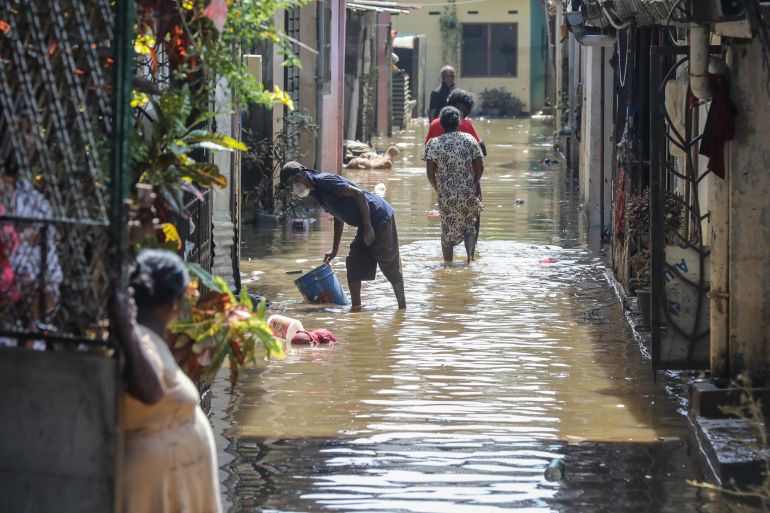
Rescue teams and volunteers have been struggling to assist millions of people affected by floods and landslides in parts of Asia, as the official death toll from the ongoing climate-fuelled disaster has climbed to more than 1,750 people in the worst-affected countries of Indonesia, Sri Lanka and Thailand.
In Indonesia, at least 867 people were confirmed dead and 521 were still missing, according to the latest data on Saturday from the island of Sumatra in Aceh province, where more than 800,000 people have also been displaced.
Recommended Stories
list of 4 itemsend of list
In Sri Lanka, the government has confirmed 607 deaths, with another 214 people missing and feared dead, in what President Anura Kumara Dissanayake has called the country’s most challenging natural disaster.
The floods also caused at least 276 deaths in Thailand, while two people were killed in Malaysia and two people died in Vietnam after heavy rains triggered more than a dozen landslides, according to state media.
On Indonesia’s Sumatra, many survivors were still struggling to recover from the flash floods and landslides that hit last week as Indonesia’s meteorological agency warned Aceh could see “very heavy rain” through Saturday, with North and West Sumatra also at risk.
Aceh Governor Muzakir Manaf said response teams were still searching for bodies in “waist-deep” mud.
However, starvation was one of the gravest threats now hanging over remote and inaccessible villages, he said.
“Many people need basic necessities. Many areas remain untouched in the remote areas of Aceh,” he told reporters.
“People are not dying from the flood, but from starvation. That’s how it is.”
Entire villages had been washed away in the rainforest-cloaked Aceh Tamiang region, Muzakir said.
“The Aceh Tamiang region is completely destroyed from the top to the bottom, down to the roads and down to the sea.
“Many villages and sub-districts are now just names,” he said.
In Sri Lanka, where more than two million people – nearly 10 percent of the population- have been affected, officials warned on Friday of continuing heavy rains causing new landslide risks.
Sri Lanka’s Disaster Management Centre (DMC) said more than 71,000 homes were damaged, including nearly 5,000 that were destroyed by last week’s floods and landslides.
The DMC said on Friday that more rain was expected in many parts of the country, including the worst-affected central region, triggering fears of more landslides, hampering cleanup operations.
Climate change, logging contribute to disasters
Last week’s flood came as two typhoons and a cyclone swept through the region at the same time, causing heavy rains, which experts told Al Jazeera are becoming more likely due to climate change.
Illegal logging, often linked to the global demand for palm oil, also contributed to the severity of the disaster in Sumatra, where photographs of the aftermath showed many tree logs washed downstream.
Indonesia is among the countries with the largest annual forest loss due to mining, plantations and fires, and has seen the clearance of large tracts of its lush rainforest in recent decades.
Indonesia’s Forestry Minister Raja Juli Antoni said on Friday that his office was revoking the logging licences of 20 companies, covering an area of 750,000 hectares (1.8m acres), including in flood-affected areas in Sumatra, Indonesia’s Antara news agency reported.
Environment Minister Hanif Faisol Nurofiq also “immediately” halted the activities of palm oil, mining, and power plant companies operating upstream of the disaster-hit areas in northern Sumatra on Saturday, according to Antara.
The Batang Toru and Garoga watersheds are strategic areas with ecological and social functions that must not be compromised,” Hanif said.
Febi Dwirahmadi, Indonesian programme coordinator for the Centre for Environment and Population Health at Griffith University in Australia, told Al Jazeera that rainforest cover “acts like a sponge” absorbing water during heavy rainfall.
Following deforestation, which is also contributing to making climate change worse, there is nothing to slow down the heavy rainfall as it enters waterways, Dwirahmadi said.

Source: Aljazeera

Leave a Reply