
Israel’s settler outposts choke Palestinian life in West Bank’s villages

On a sweltering summer day, the insides of villagers’ homes in Ras Ein al-Auja smelled of rot. The villagers said that the day before, settlers had – not for the first time – severed the power lines between their homes and the off-grid electricity networks the community had built up with help from humanitarian organisations, causing the food in their refrigerators to spoil.

Israeli authorities have long denied access to basic services such as water, electricity and sanitation to this Palestinian community and others in Area C, and almost all of these communities face demolition orders. Israel typically accuses Palestinians of building without permits to justify the orders, but it makes it near impossible to acquire the permits.

The Israeli military did not respond to Al Jazeera’s request for comment for this article.

According to Ghawanmeh, Israeli settlers from the three surrounding outposts – all established in the past two years – cut the off-grid electricity systems “five or six times a week”.

Last year, settlers prohibited the Bedouins from accessing the al-Auja spring, which locals depend on for both their herds’ and their own water needs. The Palestinian villagers and local reports indicate that Israeli military forces allowed the settlers to block access to the spring.

Now, all of the land where the Palestinian locals had grazed their herds is off-limits, forcing them to keep their livestock penned up.

Ibrahim Kaabneh, 35, has only 40 sheep and goats left. He once had 250, but he said he sold most of his herd after he and a relative were attacked by settlers last year and the settlers stole his relatives’ herd.

“I needed to get money to feed the rest of the herd before they would die or be stolen by the settlers,” he said inside his sparse family home with his children looking on quietly in the summer heat.

With settlers attacking them if they bring out their herds to graze and no longer able to access the water spring as well as being denied access to the nearby water pipes connected to Israeli settlements, Kaabneh now must spend about 200 shekels ($60) a day on fodder for his animals while paying for water tanks every two days.

“Even the livestock that we still have, we feel like they’re not ours,” Kaabneh said. “Any moment, they can be stolen. Any moment, they can be attacked.”

Kaabneh lives about 200 metres (220 yards) away from a second Israeli outpost that was established a year ago. The outpost, containing a corrugated iron pen allegedly stolen from an already-expelled Bedouin community nearby, is a preview of what the newest outpost will look like as it expands, according to locals.

The outpost established in August is even closer to the Bedouins living here. This has added to the fears among community members who feel “suffocated” by encroaching settlers. Since the war in Gaza started, settlers have burned homes in the community and are alleged to have assaulted community members, including Kaabneh’s uncle, who was struck by a bulldozer. Settlers also come to the village inappropriately dressed or drunk, the Palestinians say.

Kaabneh says he has trouble sleeping, and he is wary of leaving his home even to get groceries because he fears for his family. Women and children avoid leaving their homes for more than an hour or two at a time.

An access road to the community – built with funding from the United States Agency for International Development, as a billboard attests – now has at its entrance a series of concrete blocks painted with Israeli flags, and community members face constant harassment to run the most basic of errands.

“Once we step outside of the house, it seems like we’re doing something wrong or we’re doing something illegal,” Ghawanmeh explained. “Children, the women and everyone here is in constant fear and in constant danger whenever they leave the house for whatever necessary reason.”

French no-confidence vote: What’s next if the government collapses?

The French government looks set to collapse in a vote of no confidence and tip the eurozone’s second biggest economy into a political crisis. Prime Minister Francois Bayrou is expected to be ousted, casting doubt over President Emmanuel Macron’s future.

Monday’s vote hinges on Bayrou’s unpopular budget proposal for 2026, designed to slash France’s fiscal deficit. The 74-year-old political veteran, who called the vote himself in a bid to pressure lawmakers to back his plans, has been in office for only nine months.

France has had four prime ministers in less than two years, and a fifth probably won’t be enough to break the country’s political deadlock. The paralysis is reminiscent of the instability last observed in 1958 when the Fifth Republic was established.

Ahead of the no-confidence vote, Bayrou spoke on Monday afternoon in the National Assembly, France’s lower house of parliament, where he told lawmakers that the economy faced serious risks because of its deep indebtedness. He is expected to field questions from parliamentarians.

The vote itself will take place in the evening with the result expected between 8pm and 9pm (18:00 and 19:00 GMT).

Here’s what you need to know:

What could happen next?

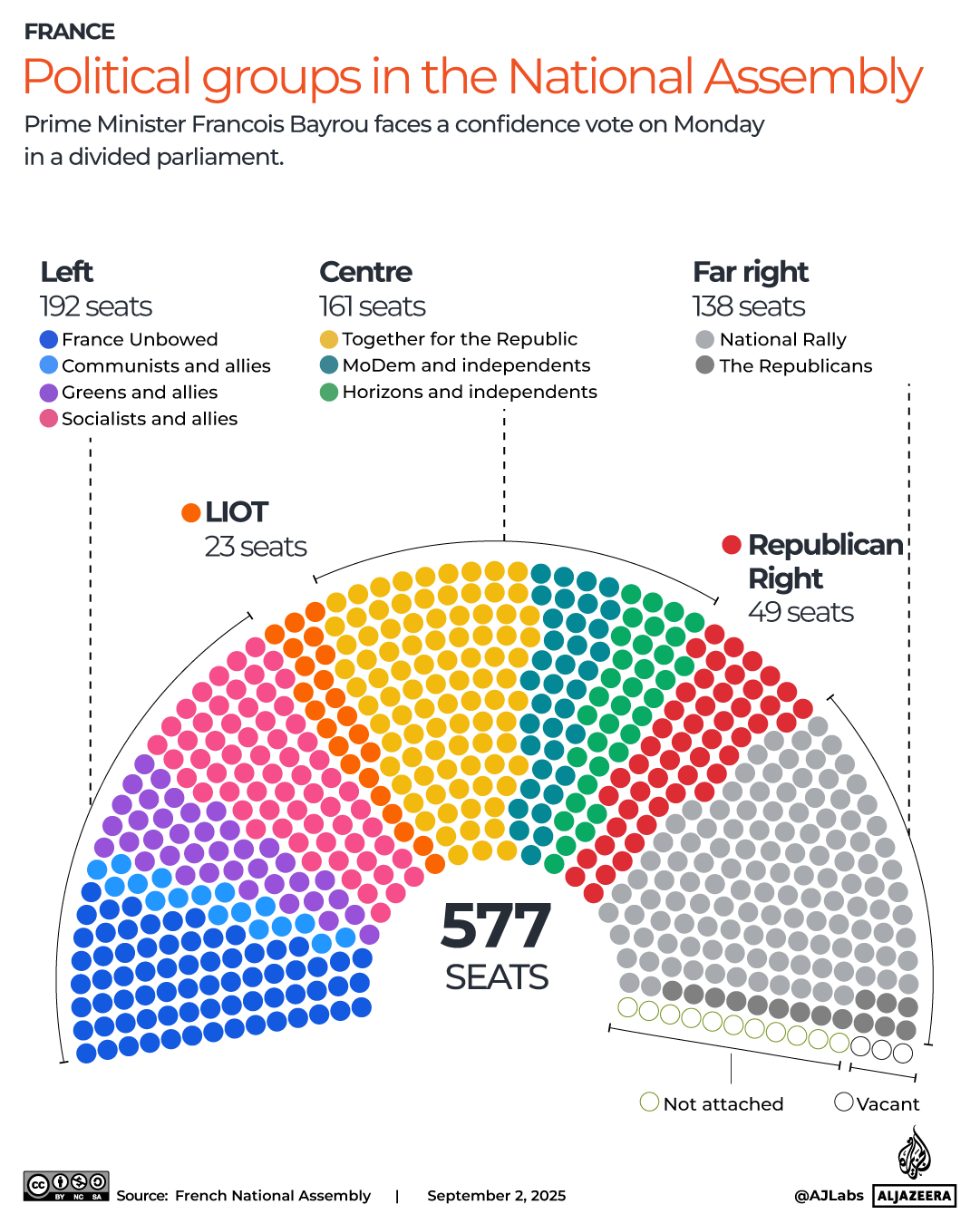
For several weeks, lawmakers have made it clear they will vote against Bayrou’s state-slashing budget. Opposition parties from the far left to the far right hold 330 seats in the 577-seat National Assembly – more than enough to oust him.

If Bayrou loses Monday’s vote and the government falls, he would stay in office until President Emmanuel Macron decides what to do next. Unfortunately for the president, France lacks a consensus figure to replace Bayrou.

Macron is faced with uniquely hard choices – appoint another prime minister in the hope he or she can pass an unpopular budget, call new elections to try to re-establish a parliamentary majority or stand down himself, something he has refused to do before his term ends in 2027.

Most experts expected Bayrou to lose the vote, which would force Macron to find a replacement. But with the arithmetic in parliament unchanged, that risks simply repeating the events from last year when Bayrou succeeded Michel Barnier.

A fiscal conservative, Macron is unlikely to appoint a premier who advocates for higher state spending. But after the government recently tried to cut deals on the right of the political spectrum, some wonder if Macron might try something new.

According to Stefano Palombarini, assistant professor of economics at the University of Paris VIII, “the two previous appointments, Barnier and Bayrou, both failed. He [Macron] lost a lot of credibility in that process, and if he tries a similarly centrist approach, he’d lose even more.”

Palombarini told Al Jazeera that “in this context, it would make the scenario of a relative opening towards the left possible. Some Macronist, Socialist and Green politicians say they’re ready for compromises to form a government that lasts until 2027.”

Does this mean there is a clear political path?

Not really.

According to an opinion poll this month for Le Figaro Magazine by the Verian Group, just 15 percent of the electorate has confidence in Macron, down 6 percentage points since July. However, the president has consistently ruled out resigning from office.

Separate surveys by Ifop, Elabe and Toluna Harris Interactive indicated that 56 to 69 percent of French people want snap parliamentary elections, indicating growing dissatisfaction with current party politics in a country run by minority cabinets since 2022.

For Palombarini, “there’s general political malaise [in France] and also dissatisfaction specifically with Macron. So overall, opinion polls are actually quite stable.” Indeed, the latest polls show no material change in voting intentions over the past year.

This means there is no certainty that a new prime minister would be safe from a similar fate as Bayrou.

What are the origins of this crisis?

At the heart of France’s political paralysis is Macron’s risky decision to call snap parliamentary elections last year. That came after he was re-elected in 2022.

Macron’s gamble in June 2024 was an effort to shore up support for the political centre. But French voters edged towards the extremes, leaving Macron with a weakened minority government and limiting his ability to pass legislation.

The vote resulted in a hung parliament split between three groups. A left alliance won the most seats but fell far short of a majority. The far-right National Rally won the most votes but also doesn’t have a majority. Macron’s centrist coalition lost seats but still forms a significant third bloc.

This parliamentary shake-up has made France hard to govern. Divisions have shown up most clearly around spending.

How does the budget fit into it?

The immediate reason for Bayrou’s fall is his budget proposal for next year. His unpopular 44-billion-euro ($51bn) deficit-reduction plan, including freezing most welfare spending and scrapping two public holidays, has been widely rejected by parliamentarians.

On August 25, Jordan Bardella, head of the National Rally, said his party would “never vote in favour of a government whose decisions are making the French suffer”. Bayrou in effect has announced “the end of his government”, Bardella said.

The French budget deficit is now nearly 169 billion euros ($196bn), or 5.8 percent of its gross domestic product (GDP), well above the 3 percent limit set by the European Union for countries using the euro.

Bayrou is trying to lower the government’s borrowing to 4.6 percent of GDP in 2026 and to 2.8 percent by 2029. In turn, that would lower the overall debt-to-GDP ratio to 117.2 percent in 2029, compared with 125.3 percent if no changes are made.

Bayrou recently said young people will be saddled with years of debt payments “for the sake of the comfort of boomers” if France fails to tackle its fiscal pressures. Born in 1951, Bayrou himself qualifies as a baby boomer, the generation born in the years soon after World War II.

But any attempt to curtail social benefits is politically difficult in France, as made clear by conflicts in 2023 over Macron’s decision to raise the retirement age to 64 from 62.

Still, investors worry that France’s persistent deficits will cause ever higher debt ratios and undermine its credit score.

Is more gridlock expected?

A series of street demonstrations known as “Block Everything” is expected this week, followed by union-led hospital and rail strikes in the second half of September.

In 2018 and 2023, France witnessed what became known as the “gilets jaunes”, or yellow vest. antigovernment protests against various domestic policies overseen by Macron, who will want to avoid a repeat this time, analysts said.

4,000 COVID-19 Survivors to Donate Plasma for Research on Cure

According to Shincheonji Church of Jesus, a South Korea-based religious group, over 4,000 members of the church who recovered from COVID-19 are willing to donate plasma for developing a new treatment.

Mr. Man Hee Lee, founder of the Shincheonji Church, said that members of the church are advised to donate plasma voluntarily. “As Jesus sacrificed himself with his blood for life, we hope that the blood of people can bring positive effects on overcoming the current situation,” said Mr. Lee.

Read More