‘Quite cute’ and ‘in sync’ – the father-son duo in non-league dugout

Football is littered with fathers and sons who have pulled on the same shirts for the same clubs during their playing careers, or sons who have played under their manager fathers professionally.

But how many father-son duos can claim to have managed a team together?

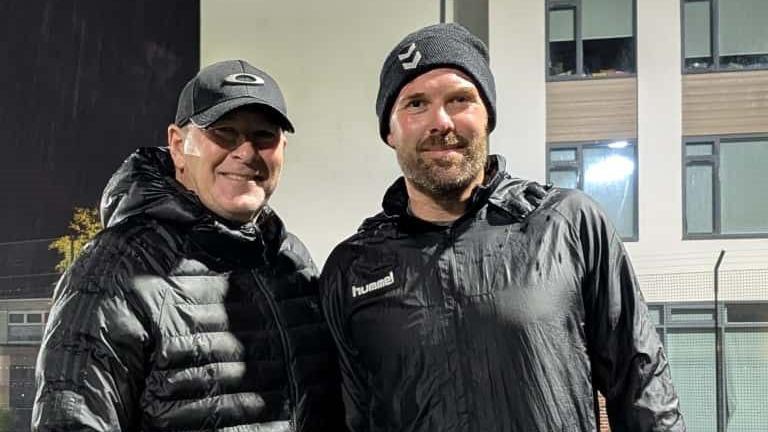
It is what helps make Craig and his son Scott Laird, co-managers of ninth-tier outfit Street FC, unique.

The pair were appointed last month by the Western League Premier Division side following the departure of former manager Ben Watson.

“For Scott and I to be able to do this is fantastic, it’s a dream come true”, Craig told BBC Radio Somerset.

Former Preston and Stevenage left-back Scott has been at the club for the past 18 months as a player and assistant manager under Watson.

And when Watson left earlier in the autumn, Scott knew just the person to bring in to work alongside him in the dugout.

“We wanted someone to come in who believed]in] what we were doing, understood how we wanted to play, the same philosophy, the same mindset and this man]his father] was the only guy who could offer what we wanted”, Scott, 37, said.

Scott Laird running on the pitch with the ball at his feet while playing for Preston in 2015Shutterstock

Football is very much in the Laird family.

Craig began his career working at Plymouth Argyle and has managed non-league clubs including Weston-super-Mare and Bridgwater Town.

Scott, one of four brothers, had a prolific career across the EFL, most notably with Preston, who he won promotion to the Championship with in 2015.

His brothers Callum and Jamie have played at non-league level, while another brother, also called Craig, has played at university level in the United States.

Craig Sr and Scott are early into their managerial tenure together – with one win, one draw and one loss from the past three league games – but they are working in “sync”.

“I’m sure we’ll have some disagreements”, Scott said. “At the moment, we do see the game the same way, we try to recruit the same players we believe in – we’re having to do it at the moment to bring a few players in.

For Craig, the position offers a chance for his son to learn as well as a role reversal.

According to Craig, “Scott probably listened to me growing up, how I felt football should be played, and that’s probably embedded in him.”

He left and had other experiences that he now brings with him, which I can take away as well.

Scott is aware of the poignancy of starting his football management career alongside his father.

It’s a nice full circle moment to come round, Scott said, “He was]there at the beginning of my career, and now I’m at the end of my playing career and beginning my coaching career.”

related subjects

  • Football
  • National League

‘Quite cute’ and ‘in sync’ – the father-son duo in non-league dugout

Football is littered with fathers and sons who have pulled on the same shirts for the same clubs during their playing careers, or sons who have played under their manager fathers professionally.

But how many father-son duos can claim to have managed a team together?

It is what helps make Craig and his son Scott Laird, co-managers of ninth-tier outfit Street FC, unique.

The pair were appointed last month by the Western League Premier Division side following the departure of former manager Ben Watson.

“For Scott and I to be able to do this is fantastic, it’s a dream come true,” Craig told BBC Radio Somerset.

Former Preston and Stevenage left-back Scott has been at the club for the past 18 months as a player and assistant manager under Watson.

And when Watson left earlier in the autumn, Scott knew just the person to bring in to work alongside him in the dugout.

“We wanted someone to come in who believed [in] what we were doing, understood how we wanted to play, the same philosophy, the same mindset and this man [his father] was the only guy who could offer what we wanted,” Scott, 37, said.

Scott Laird running on the pitch with the ball at his feet while playing for Preston in 2015Shutterstock

Football is very much in the Laird family.

Craig began his career working at Plymouth Argyle and has managed non-league clubs including Weston-super-Mare and Bridgwater Town.

Scott, one of four brothers, had a prolific career across the EFL, most notably with Preston, who he won promotion to the Championship with in 2015.

His brothers Callum and Jamie have played at non-league level, while another brother, also called Craig, has played at university level in the United States.

Craig Sr and Scott are early into their managerial tenure together – with one win, one draw and one loss from the past three league games – but they are working in “sync”.

“I’m sure we’ll have some disagreements,” Scott said. “At the moment, we do see the game the same way, we try to recruit the same players we believe in – we’re having to do it at the moment to bring a few players in.

For Craig, the job is a chance for a role reversal to learn from his son as well.

“Probably growing up Scott listened to me, how I felt football should be played and that’s probably embedded itself in him,” Craig said.

“He’s gone off and had other experiences which he now brings and I can learn from as well.”

As for Scott, the poignancy of starting his journey into football management alongside his father is not lost on him.

“He was [there] at the start of my career, now at the end of my playing career and start of my coaching career – it’s a nice full circle moment to come round,” Scott said.

Related topics

  • Football
  • National League

Piers Morgan opens up on ‘unbelievably painful’ loss after sudden health issue

ITV’s former Good Morning Britain presenter Piers Morgan revealed what the sudden death of a close friend taught him, following his 60th birthday earlier this year

Former Good Morning Britain host Piers Morgan has opened up about a devastating loss that has changed his outlook on life. Last November, the 60-year-old said goodbye to one of his closest friends, Miles, who died 15 months after being diagnosed with brain cancer.

Reflecting on his milestone birthday earlier this year, Piers said Miles’ death made him realise “that you only get one go at this”.

“One of my best mates suddenly out of nowhere got brain cancer aged 57 and died within 15 months,” he shared in a new interview with Best Magazine. “He was a brilliant guy, and I’d known him since I was 12 years old.

“We played cricket together for 20 years, and it was unbelievably painful and sad, but he never complained.

“He had the worst thing you could possibly have – incurable brain cancer and he never once issued any sense of self-pity,” he added.

“The worst I ever heard him say was, ‘It’s not great’. He had incredible spirit. It reminded me that you only get one go at this, and you never know what curveball is round the corner.”

Piers paid tribute shortly after his friend’s death, posting a heartfelt message on Instagram.

Alongside his lengthy caption, he shared multiple photos of the pair together and reflected on their decades of memories – from school days and cricket matches to being ushers at each other’s weddings and travelling the world.

“He was one of the funniest, kindest, most popular people imaginable, beloved by his family and friends,” he added.

“For his many friends, we will all miss him so much. He was the greatest mate you could ever wish to have. RIP Caldy,” Piers concluded.

Speaking previously about turning 60, Piers admitted he “may have calmed down a bit” with age.

“You mellow also with experience and wisdom, and also with the fact that I now own my own business, I’m my own boss, I’m not answerable to anybody else,” he claimed. “I think that brings with it a certain calmness.”

In an interview with Saga Magazine, the father-of-four also said he is taking “more care of myself than I did 30 years ago”.

He explained: “I watch what I eat and exercise more – I’ve even taken up boxing, and, no, it’s not because I keep getting into fights.

“The only person who ever landed a fist on me was Jeremy Clarkson at the 2004 Press Awards.”

Discussing the same incident in his chat with Best, Piers said the pair have since reconciled.

Article continues below

Pollock nominated for breakthrough star award

Getty Images
  • 125 Comments

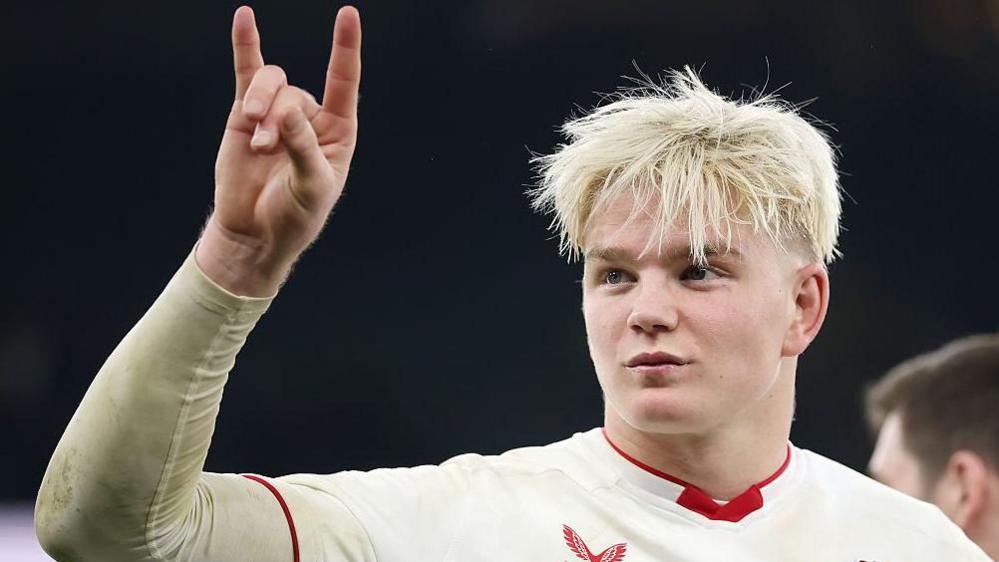
England flanker Henry Pollock has been nominated for World Rugby’s Breakthrough Player of the Year.

The 20-year-old’s sensational rise includes two tries on his England debut against Wales in March, before selection for the British and Irish Lions’ tour of Australia.

Although he did not feature in a Lions Test, he has continued to shine for England, scoring a vital try against Australia at the start of November.

Northampton’s Pollock is known for his high energy, speed and immense work-rate, which has been used to good affect off the bench this autumn.

New Zealand’s Dutch-born lock Fabian Holland, South Africa wing Ethan Hooker and Australia’s cross-code star Joseph-Aukuso Suaalii are the other nominees.

France winger Louis Bielle-Biarrey, who was named the 2025 Six Nations Player of the Tournament, is nominated for World Rugby Player of the Year.

The 22-year-old scored eight tries – a record in a single championship – as France lifted the title for a 19th time.

Last year’s winner Pieter-Steph du Toit, who won the award in 2019 as well, is again nominated after helping South Africa win back-to-back Rugby Championships.

Fellow Springboks Malcolm Marx and Ox Nche are also up for the award, with Rassie Erasmus’ side topping the world rankings after an impressive year.

The winners of both awards, and the men’s international try of the year, will be announced on Saturday.

Related topics

  • England Rugby Union
  • Rugby Union

More on this story

    • 27 September
    John Mitchell holds up the World Cup

Pollock nominated for breakthrough star award

Getty Images
  • 124 Comments

England flanker Henry Pollock has been nominated for World Rugby’s Breakthrough Player of the Year.

The 20-year-old’s sensational rise includes two tries on his England debut against Wales in March, before selection for the British and Irish Lions’ tour of Australia.

Although he did not feature in a Lions Test, he has continued to shine for England, scoring a vital try against Australia at the start of November.

Northampton’s Pollock is known for his high energy, speed and immense work-rate, which has been used to good affect off the bench this autumn.

New Zealand’s Dutch-born lock Fabian Holland, South Africa wing Ethan Hooker and Australia’s cross-code star Joseph-Aukuso Suaalii are the other nominees.

France winger Louis Bielle-Biarrey, who was named the 2025 Six Nations Player of the Tournament, is nominated for World Rugby Player of the Year.

The 22-year-old scored eight tries – a record in a single championship – as France lifted the title for a 19th time.

Last year’s winner Pieter-Steph du Toit, who won the award in 2019 as well, is again nominated after helping South Africa win back-to-back Rugby Championships.

Fellow Springboks Malcolm Marx and Ox Nche are also up for the award, with Rassie Erasmus’ side topping the world rankings after an impressive year.

The winners of both awards, and the men’s international try of the year, will be announced on Saturday.

Related topics

  • England Rugby Union
  • Rugby Union

More on this story

    • 27 September
    John Mitchell holds up the World Cup

‘Scotland must shake shackles of past to grasp World Cup dream’

PA

World Cup qualifying Group C: Scotland v Denmark

Venue: Hampden Park, Glasgow Date: Tuesday, 18 November Kick-off: 19:45 GMT

The burden of history is everywhere you look.

Hampden Park, Glasgow. A footballing mausoleum of memories and moments, both awe-inspiring and harrowing.

The walls of the place carry the spirit of the greats. Sir Kenny Dalglish dancing elegantly through defences. Denis Law with arms raised in trademark fashion. An image of James McFadden with the ball hanging in the Parisian air and a bamboozled Mickael Landreau somewhere in the distance.

Take a walk deeper inside and the broad bowl of the national stadium opens up. Once it was a concrete cathedral that held the hopes of teams and fans setting off with dreams of actually trying to win a World Cup.

Now, lying thick and still under the cover of plastic seats, the cavernous emptiness of the place mirrors the void left since it is modern reincarnation in the late 1990s.

Not since Hampden’s redevelopment have Scotland earned the right to go to a World Cup. The last time it was achieved, a lap of honour took place around a partially built Celtic Park.

History. That’s what Scotland have when it comes to the greatest stage of all.

    • 19 hours ago
    • 22 hours ago

To the uninitiated, signs of stars aligning are there in the crisp Glaswegian sky.

Scotland have tripped, stumbled and stuttered their way through this campaign with all the poise of a sumo wrestler on Strictly Come Dancing, but have managed to carve out positive results.

They survived a first-half onslaught in Copenhagen to earn a valuable point. Battered at home by Greece? Somehow Steve Clarke’s side claimed victory. They made hard work of it, but Belarus were beaten twice, too.

Even in chaotic defeat in Athens on Saturday, Scotland were rescued as Denmark inexplicably were held by Belarus, meaning a home win on Tuesday evening and immortality – a place in the World Cup – is theirs.

Yet, this Scotland team is masters of the dark arts of unpredictability. For most of the time, you’re just not sure what you’re going to get.

For a support who adore their football team, there is no room for sentiment here.

Romance has been eroded away for the Tartan Army. Nothing is written in the stars for Scotland.

Through the history of the nation’s football team, there have been moments where you’d think the footballing gods would say “they’ve suffered enough, let’s give them a break”.

Going out of the 1974 World Cup without losing a game. Exiting Euro ’96 in the most cruel fashion. Losing to Brazil by a hapless own goal and then, after raising hopes by drawing with Norway, being demolished by Morocco. Beating England at Wembley, but not by enough, in a European Championship play-off the following year.

Then there are recent examples of trauma after actually getting to two European Championships. A dispiriting choke in the first game being followed by a credible draw in the second to keep hopes alive, only to then go out with a whimper in the final group match.

Clarke hauls Scotland into the spotlight

Scotland head coach Steve ClarkeSNS

That in itself is a compliment of sorts to Clarke, who has hauled Scotland out of the international wilderness to be within touching distance of going to USA, Canada and Mexico next summer.

Since the late and magnificent Craig Brown trudged off the park in St Etienne in the summer of 1998, six different Scotland managers tried and failed to get the nation to a major tournament.

Play-offs came and went. So too did the international careers of many players who deserved more.

Then came Clarke in 2019. The man who had thrived at Kilmarnock in his native Ayrshire after a successful career on and off the pitch in England took the national team from losing in Kazakhstan to back-to-back Euros.

He did so with a blend of Brown’s hard-to-beat mantra, an emerging crop of talent and a dollop of landmark results.

Spain beaten at Hampden. Norway turned over in their own backyard. Serbia outdone on penalties five years ago. Croatia upstaged in Glasgow.

Scott McTominay, John McGinn, Billy Gilmour, Andy Robertson. Some old and some new, but players with reputations and pedigrees to match, who have helped haul Scotland from the shadows of irrelevance into the spotlight.

That ascension has brought scrutiny. Some of it harsh, some of it deserved.

In the 2022 play-off semi-final against Ukraine, Clarke’s team disintegrated on an occasion, just like this one, that meant so much.

Two Euros have drifted by without a glove being laid on any of their opponents. Just three goals were scored across six games.

These examples stand as warnings from the past, but they should be used as motivators for the here and now. As if any were needed.

The moral of all of this is that Scotland have so often failed to grasp the opportunity that they have clawed out for themselves. The moment has slipped away.

On Tuesday, this group has the chance to reach a World Cup. No strings, no what ifs.

Denmark have been at five of the past seven World Cups but, just like their hosts, vulnerability is lurking.

There is a weakness that was exposed by Belarus and which must be ruthlessly pounced upon. Conversely, signs of an intensity in Scotland’s second-half display in Greece surely must be replicated from the start in Glasgow.

There is an overwhelming sense that Scotland’s fate on Tuesday does not depend on what the handy Danes do, but what Clarke’s team can conjure up and rouse from within themselves.

The quality is there. The incentive is there. The opportunity is there.

Related topics

  • Football
  • Scotland Men’s Football Team