Live updatesLive updates,
LIVE: Israel vows to destroy all Hamas tunnels in Gaza as attacks continue
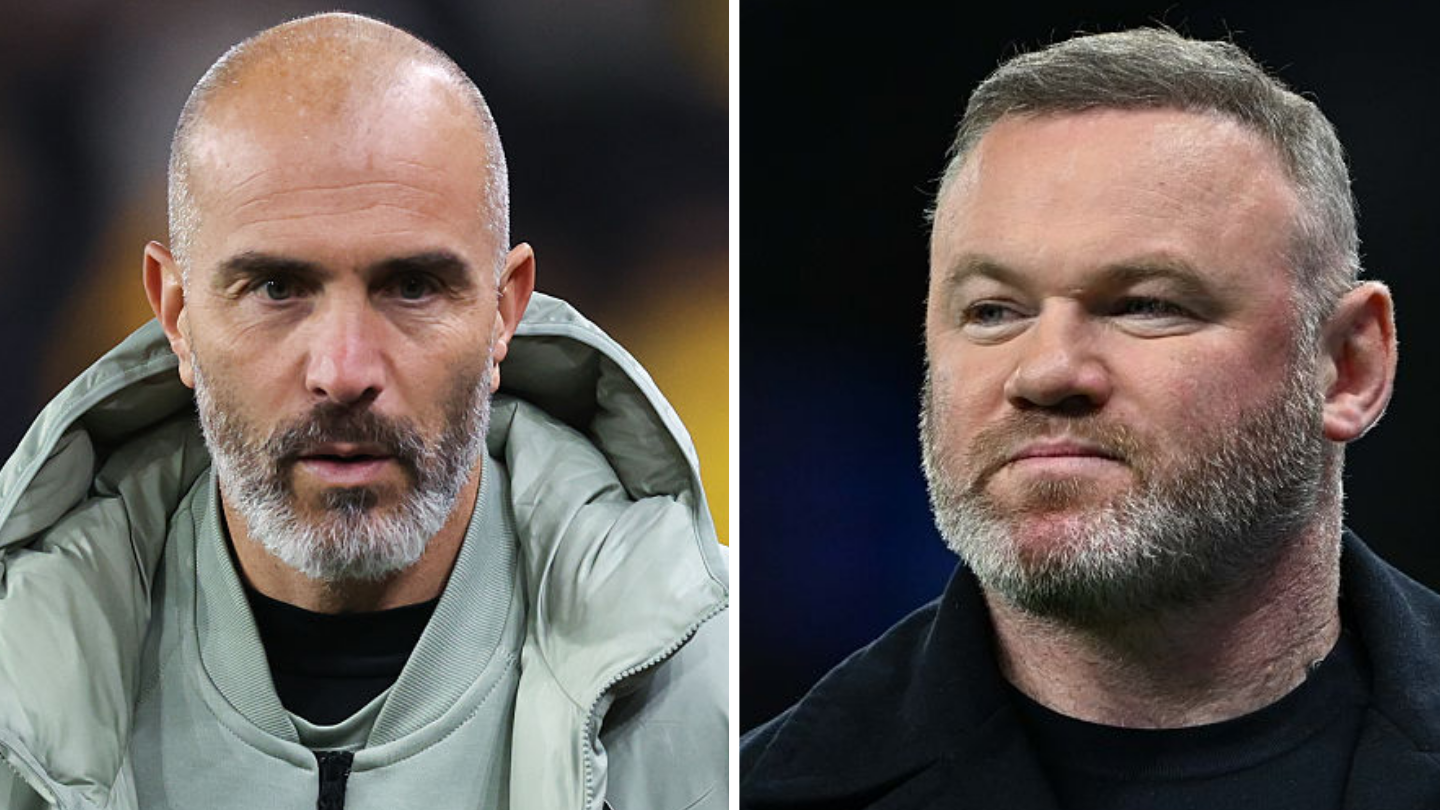
Former Manchester United captain Wayne Rooney says Chelsea’s senior players should “question” Enzo Maresca’s team selections.
The Italian made seven changes to his starting XI for the 2-2 draw against Qarabag in the Champions League on Wednesday.
It was the fifth consecutive match across all competitions that Maresca has made at least seven changes to his starting XI.
“The players want to play, they want to build relationships,” the former England captain said on the Wayne Rooney Show.
“When you keep chopping and changing then the players won’t be happy. I think that will come back to bite them.
“If they are getting results all the time then you can’t question it but if they’re not, there has to be questions asked.”
Rooney believes it is up to captain Reece James and other experienced players in the Chelsea squad to address the issue with Maresca.
“I think most clubs now have a leadership group and as a group you have to go and question the manager,” he added.
“You hear people talk about ‘player power’ but this isn’t player power.
“I’d be concerned if the team kept changing. If i was in that [leadership] group I’d be speaking to my team-mates saying ‘Look, i’m not happy with this’.”
Chelsea have made 85 changes in 16 matches this season – by far the most of any Premier League team.
But, speaking after the draw in Azerbaijan, Maresca defended his rotation policy.
“The [selection] is always because we think the plan with the players is the correct one,” said Maresca.
“The intention was to rest Moises [Caicedo], Enzo [Fernandez], Malo [Gusto] and more players.
Earlier on the podcast, Rooney said he was perhaps a “bit harsh” for suggesting Liverpool captain Virgil van Dijk had “downed tools” after signing a new deal with the club.
Rooney said in October that Van Dijk’s body language was a “big concern” and that he had failed to lead the team this season.
The Dutchman, who signed a new deal with the club towards the end of last season, described the criticism as “lazy”.
Following Liverpool’s Champions League win against Real Madrid on Tuesday, Van Dijk was interviewed on Amazon Prime, who had Rooney as a pundit.
“I think the comment that I signed my new deal and then it was like ‘that is it’ and I let it slide, I think that was a bit… but that’s my personal opinion and we move on,” said Van Dijk.
“Maybe I was a bit unfair with that comment,” said Rooney.
“Maybe I was a bit unfair because I don’t know him that well as a person.”
However, Rooney says he stands by his comments about the level of Van Dijk’s displays this term.
“From a performance point of view I think I was speaking what I felt and what I was seeing and I felt I was right,” said Rooney.


Nouadhibou, Mauritania – When Omar*, a 29-year-old bricklayer from rural Gambia, crossed the border into Mauritania in March, he came in search of the better pay he’d heard he could find.
He settled in Nouadhibou, Mauritania’s second-largest city, where he shared a one-room shack with four friends, and found work as a casual labourer on construction sites, earning two to three times more than he had back home.
list of 3 itemsend of list
The oldest of nine children and the son of a rice farmer, Omar was able to save enough to support his family in The Gambia and pay his younger siblings’ school fees.
Then, in August, the National Guard’s armed pick-up trucks arrived in the city, and the police began rounding up migrants to detain and deport.
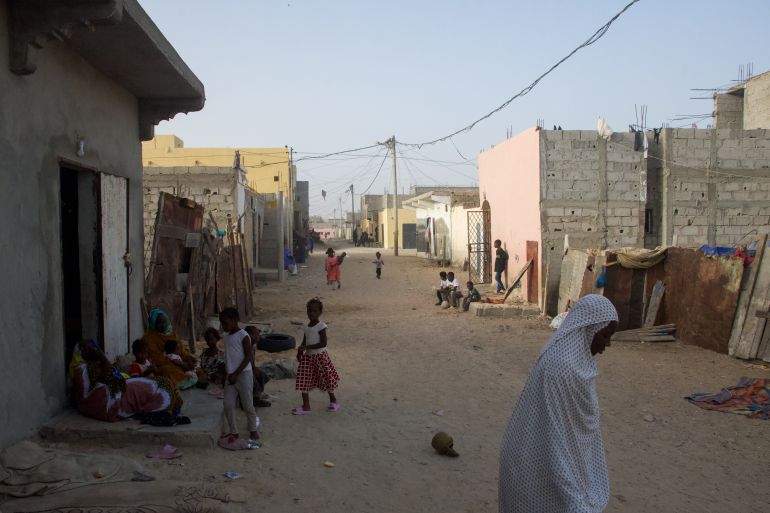
Nouadhibou’s construction sites became early targets, so, to avoid capture, Omar – who did not have a residence permit – stopped working. He limited his movements to his housing compound in a dusty alleyway in Ghiran, a neighbourhood with a large migrant population, and the adjacent corner store.
But soon, the police began targeting homes. They came day and night – breaking down doors if those inside did not respond immediately.
One evening, police swept through Omar’s compound. He and his friends escaped by fleeing over the rooftops, but with nowhere else to go, they returned later that night.
Still unable to work, Omar and his housemates ran critically short of money, sharing just one small bowl of rice a day, and occasional fish caught by a friend who would sneak through the backstreets to a nearby estuary in the dead of night.
“All the emotions I go through in one day are hard to explain,” Omar told Al Jazeera in early September.
Al Jazeera spoke to migrants caught up in the government crackdown in Nouadhibou, the capital Nouakchott, and in both Rosso, Mauritania, and Rosso, Senegal – twin cities on opposite sides of the Senegal River, which marks the border between the two countries. Many of those we spoke to have since been pushed out of Mauritania, often to a third country.
The Mauritanian Association for Human Rights (AMDH) estimated that in March alone, 1,200 people were deported. Of those, about 700 had residence permits allowing them to legally work in Mauritania.
The Mauritanian authorities have not released deportation figures, but according to a statement by government spokesman Houssein Ould Medou, 130,000 migrants entered the country of 5 million in 2022, while only 7,000 people renewed their residence permits that year.
The government has not publicly detailed the scope and aims of its deportation campaign. But in May, Interior Minister Mohamad Ahmed Ould Mohamed Lemine told parliament that Mauritania was fully within its rights to control the movement of foreigners on its territory, stressing that authorities acted “with respect for human dignity”. The deportees were to be given sufficient food and water, access to medical services, and were allowed to keep their personal possessions, he added.
Earlier, in March, government spokesman Medou insisted that “reports of recent deportations were exaggerated,” referring to accounts circulating on social media sites.
After the mass deportations started this year, some experts noted that similar campaigns had also taken place in Mauritania in 2009 and 2012, albeit at a smaller scale. However, other observers pointed out that this time, the crackdown came not long after Ursula von der Leyen, President of the European Commission, announced a 210 million euro ($248m) migration partnership deal between the European Union and Mauritania in February 2024.
The financial package supports security and “migration management” as well as other investments in “green energy, employment and skills, entrepreneurship … and strengthening access to socioeconomic services for refugees, asylum seekers and host communities”, a European Commission (EC) spokesperson told Al Jazeera in a written statement.

However, experts note that in pursuing a policy of “border externalisation”, the EU has in recent years made deals with countries including Morocco, Algeria, Tunisia, Libya, and Niger to stem irregular migration from major departure points in Africa.
Mauritania is of particular interest because of its proximity to Spain’s Canary Islands. A 2025 report from Spain’s National Security Department stated that in 2024, 25,081 people departed from Mauritania’s shores for the archipelago – more than half of the islands’ 46,843 total irregular arrivals that year. A few people Al Jazeera spoke to said they might have considered travelling by boat to Europe, but that it was now too expensive and difficult. Most wanted to stay in Mauritania to work and send money home to their families.
In October 2024, an amendment to Mauritania’s 1965 immigration law came into force. The amendment legislated that any foreign national convicted of not abiding by immigration regulations, particularly those entering or residing in the country illegally, would be “automatically expelled” and banned from re-entry for a period of one to 10 years.
A few months later, in a speech to parliament, Prime Minister Mokhtar Ould Djay described “the fight against illegal immigration” as one of the government’s priorities.
The Mauritanian government did not respond to Al Jazeera’s requests for comment. But in response to questions about the EU, the EC spokesperson said the bloc has “scaled up its support to Mauritania” on “migration management”, while stressing that protection for those in need and respect for the human rights of migrants were “fundamental principles”.
The spokesperson added that the EU is “in a constant dialogue with Mauritania” to ensure the partnership is respectful of human rights.
However, rights groups, opposition politicians and migrants paint a different picture of what is happening.
“What people see every day is fear,” said Kadiata Malik Diallo, a Mauritanian opposition MP who has been a vocal critic of the government campaign. “Mass expulsions carried out under cruel and degrading conditions.”

Nouadhibou, a windswept port city located on the tip of a narrow, 65km (40-mile) peninsula, has long drawn migrants from West and Central Africa. Many of them find work in construction, fishing, or other sectors of the city’s informal economy. They are a visible part of city life – in markets, ports, and streets – and while up-to-date numbers are hard to come by, in 2020, the International Organization for Migration (IOM) estimated the city’s migrant population at 32,000, about a fifth of the total.
For Nouadhibou’s migrants, the arrests have created fear and confusion.
An Ivorian construction worker in his mid-20s told Al Jazeera that he had been arrested three times in less than a week.
The worker, who did not have valid documents and asked to use only his surname, Traore*, said the first time police raided his compound, 11 people were handcuffed but released when they managed to pool the equivalent of $200 in bribes to the police.
Two days later, he said, the police reappeared, breaking down doors and arresting 14 people. They were taken to a local police station before being released when their boss at the construction site paid a bribe.
The third time, he was on a large construction site near Nouadhibou airport when it was raided by police, who arrested more than 60 men without documents. Some of those were able to pay bribes ranging from $11 to $33, but Traore had no money left and was only released after his boss intervened on his behalf.
Traore’s Ivorian colleague, Ibrahim*, said that when his compound was raided, he showed the police officers his recent entry stamp, which permitted him to stay in the country for the following three months. One of the police officers concluded that Ibrahim’s documents were in order, but another officer ignored the stamp and arrested him.
After spending five days in prison, Ibrahim was approached by a police officer, who he said told him, “Now we will do business. How much can you pay?” Ibrahim paid a $100 bribe.
The constant threat of extortion and harassment has dealt a major blow to the livelihoods of Nouadhibou’s migrant workers. “We don’t know what to do,” said Obi*, an electrician from the Ivory Coast. After narrowly escaping three arrests, he now only goes to work on days when he has heard that there will not be raids. He now feels trapped in Mauritania – unable to earn a living, but also unable to afford to return home.

Two weeks after the first raid on Omar’s compound, the police turned up again. This time, they found him sleeping. Physically and mentally exhausted after weeks of worry, Omar said he submitted without resistance.
But for others, arrest was a more traumatic experience.
Yunisa*, a 28-year-old Sierra Leonean forklift operator at a Chinese fish-processing plant, was apprehended on his way to work. When he tried to call his boss for help, he said his phone was slapped out of his hand, shattering the screen.
“I have to go to work,” he protested as he was handcuffed. He said the officer told him, “You can go exploit your own country’s riches now.”
Yunisa said he was not allowed to retrieve his belongings from his home before he was deported to Rosso, Senegal.
Even those who were arrested in their homes describe not being permitted to take their possessions with them.
Youssouf*, a 22-year-old Guinean working in a sardine factory, said he asked for a moment to get his birth certificate and school diploma when police broke down the door of his shack, but was told, “We don’t have time for that.” When he tried to insist, he said he was slapped. He was taken without shoes to a nearby school, where he said he was searched, and police confiscated $3 they found in his pockets.
Once in Nouadhibou’s migrant detention facility, Youssouf said he was fed only once a day, typically a piece of bread with sardines, or sometimes just plain bread. For water, he was forced to rely on a small tap in the common toilet, accessible only during infrequent toilet breaks.
Omar said he was given no food during his three-day detention, but that police would offer to bring food from shops at extortionate prices. “If the price is 50 [Ouguiya], they bring it to you for 100. If you have money, you can survive,” he said.
The same principle applied when he wanted to make a phone call to the Gambian embassy in Nouakchott. The 11 Gambians he was in detention with were able to pool $13 to use a guard’s phone. The call failed, but they were forced to pay regardless and were not allowed to try again.
Migrants who have been detained say access to toilets was limited or non-existent. In the three days Omar was held in detention, he was forced to urinate into a large bucket with 50 other men in the same room where they slept. Yunisa said he and his fellow inmates were told to urinate into empty water bottles.

While the deportation campaign has largely targeted men, women and children have also been swept up in police raids.
Mariam*, a 31-year-old mother of two from Sierra Leone, who had lived in Nouakchott for five years, selling ice-cream on the street, was approached by police on the way to a pharmacy, where she intended to buy medicine for her one-year-old daughter, who was sick with severe diarrhoea.
When she protested that her two daughters were at home – one in urgent need of medicine – she said she was told, “This isn’t the time for your baby. This is the time for documents.” She was then taken to a holding facility, which she described as a “cattle shed”.
After pleading with guards at the detention facility, she was allowed to make a phone call to a neighbour, who brought her children to the facility. For the next two days, they were held together. Guards would enter the room to eat in front of them, she said. On the second day, a guard gave her daughters an ice cream to share. It was the only thing they ate during their detention.
After two days, Mariam’s husband’s boss paid a bribe, and she and her children were released. That same day, she left voluntarily for Senegal to reunite with her husband, who had been deported some months earlier.
Others remain separated from their children. Oumar*, a 22-year-old Guinean migrant, now in Senegal, was arrested with his wife as they went to buy food, while their four-year-old daughter stayed at home.
“I explained everything, I cried, but the police didn’t listen,” he told Al Jazeera from his temporary accommodation in Rosso.
Unable to travel back to Mauritania and strapped for cash, Oumar and his wife do not know how they will be reunited with their daughter, who is being cared for by a neighbour.

From Nouadhibou, migrants are typically transported south in buses to detention facilities in Nouakchott, from where they are subsequently sent either to Gogui, Mauritania’s border crossing with Mali, or Rosso.
Detainees told Al Jazeera they are often chained to one another during the journey.
Amadou*, a 19-year-old Guinean now in Senegal, described how a policeman, intending to chain him to another detainee, pulled him forcefully by the collar. “My brother, don’t pull me like that, don’t pull me like I’m a sheep,” he protested. He said the officer slapped him so hard that a week later, he was still unable to hear properly.
Once in Rosso, detainees have their fingerprints taken at Mauritania’s border post, before they are released into the port area. There, they wait for a ferry to take them to the Senegalese border post on the other side of the River Senegal, just over 500 metres (550 yards) away. Once there, some of those with documents that enable them to enter Senegal visa-free are fortunate enough to cross the border. But many others remain stranded.
Omar, though still in possession of his Gambian ID card, which should have given him visa-free access to Senegal, was refused entry. “Have you been deported?” the border guards on the Senegalese side of the river asked. When Omar and his friends acknowledged that they had been, they were told to return to Mauritania.
Stuck at the Senegalese border post, they waited until the dead of night, when they instead paid for a pirogue to smuggle them to a remote drop-off point in the bush on the Senegalese side of the river.
Those lacking valid documents – often left in their Mauritanian homes because police did not allow for their collection – recounted similar experiences.
Youssouf was trapped at the Mauritanian border post until his friends pooled about $9 to help him pay for the pirogue to Senegal. Under the cover of darkness, the pirogue took him to a remote marshland a few kilometres downstream of the border post across the river. From there, he waded through knee-deep water until he reached dry land on the outskirts of Rosso.
Unable to afford the journey back to Guinea, Youssouf joined large groups of deportees sleeping on the streets of Rosso.

A day after Youssouf and his friends spoke to Al Jazeera, they were arrested by Senegalese police and sent back to the no-man’s land on the Mauritanian side of the river. There, they were once again forced to pool money to pay for a pirogue to take them back across the river.
Stepping off the pirogue and onto Senegalese soil, Omar and his friends circumvented Rosso through remote bush roads, entering the highway after the last police checkpoint outside the city. From there, they took a series of shared taxis towards The Gambia.
Al Jazeera reached out to the responsible government bodies in Mauritania to ask about the migrant deportation campaign, including the deportees’ allegations of widespread violations and misconduct by police. We contacted the government spokesman, the Gendarmerie, and the Ministry of the Interior, Decentralisation and Local Development, which is responsible for the campaign and in charge of the police forces conducting the operation. As of the time of publication, they had not responded.
Speaking to Al Jazeera in late September, a week after his return to The Gambia, Omar expressed mixed emotions.
“There’s no policeman chasing us here. You don’t have to look over your shoulder,” he said, adding, “There’s no place like home.”
But with the rainy season not yet over in The Gambia, demand for labourers is low, and Omar has been unable to find work.
“The schools are opening, and my family is asking, ‘Where is the bag of rice?’” he said. “There is no cash and they don’t like it.”
Despite his ordeal, Omar remains nostalgic about his early days in Nouadhibou, when the work was regular and the wages good.
For now, he intends to keep a close eye on the climate in Mauritania. “If they stop deporting people, I’ll go back to Nouadhibou,” he said.
*All interviewees requested that only one of their names be used for safety reasons.

Typhoon Kalmaegi has killed at least five people in Vietnam after slamming into its central and highland provinces, according to Vietnamese state media.
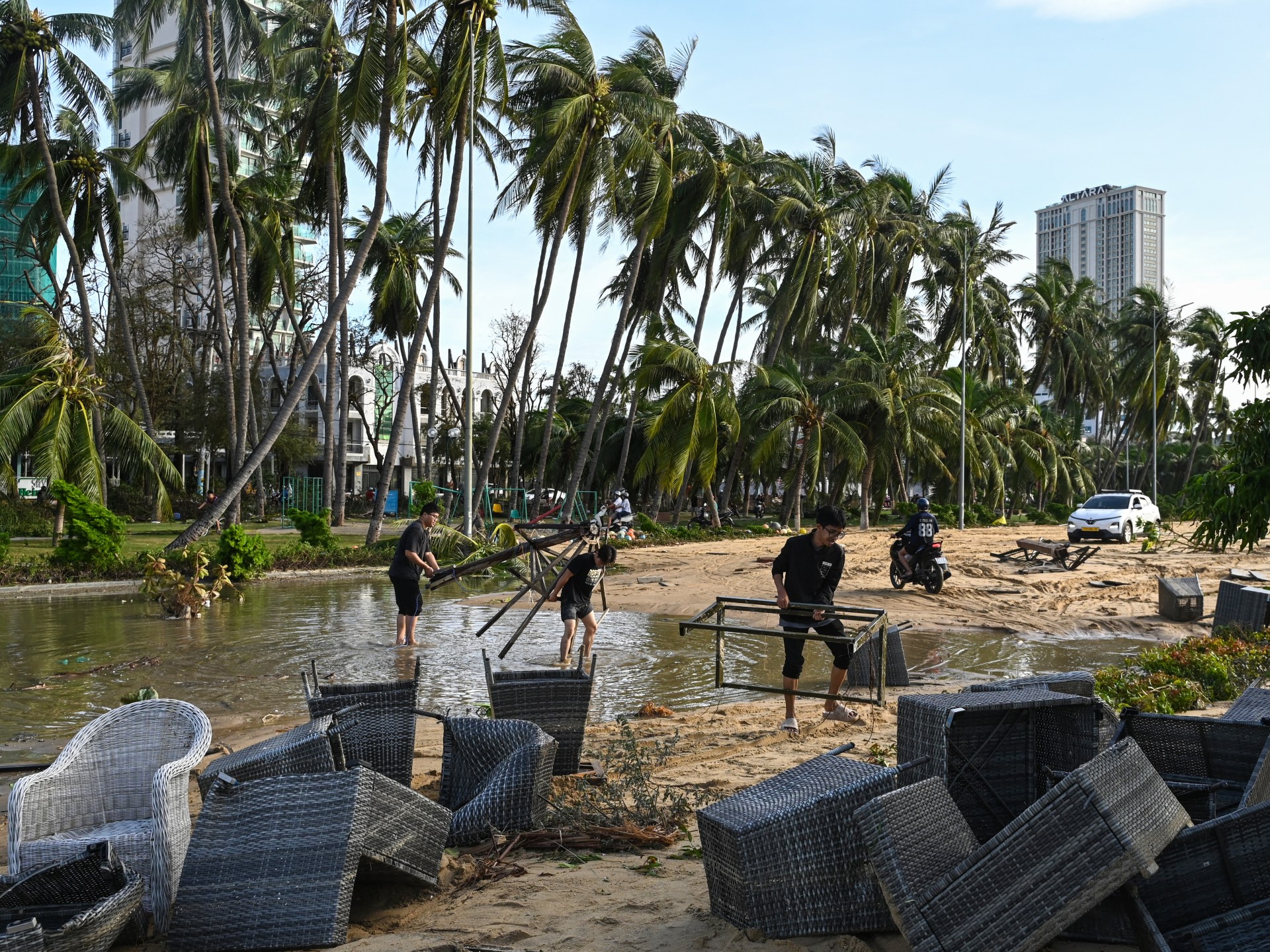
Kalmaegi made landfall in central Vietnam on Thursday evening, bringing heavy wind and rain that damaged thousands of buildings across the region, the state-run Vietnam News reports.
list of 4 itemsend of list
The storm led to the collapse of nearly 57 houses and ripped the roofs off an estimated 3,000 more, the news outlet said, while also causing 11 boats to sink and downing power lines across the country.
Vietnam’s Dak Lak, Quang Ngai, and Gia Lai provinces were some of the hardest hit, Vietnam News said, with the government reporting five deaths and seven injuries as of midday on Friday local time.
More than 8,000 people have been evacuated from storm-hit areas while 1.28 million households remain without power, according to Vietnam News.
The government said it had mobilised more than 268,000 soldiers for search-and-rescue operations while the US embassy in Hanoi issued a travel advisory, warning that coastal Vietnam could see waves of between 4-8 metres (13-26ft) high and winds of up to 135km (84 miles) per hour in some parts of the country.
Kalmaegi – the 13th typhoon to form in the South China Sea this year – has now weakened to a tropical storm, according to Vietnam’s weather forecaster, as it moves on to nearby Cambodia and Laos.
Earlier this week, Kalmaegi tore through the central Philippines, killing at least 188 people in one of the worst disasters of the year, according to its Office of Civil Defense.
According to Philippine authorities, the death toll may continue to rise, as 135 people are still missing following heavy rains and flooding from Kalmaegi.
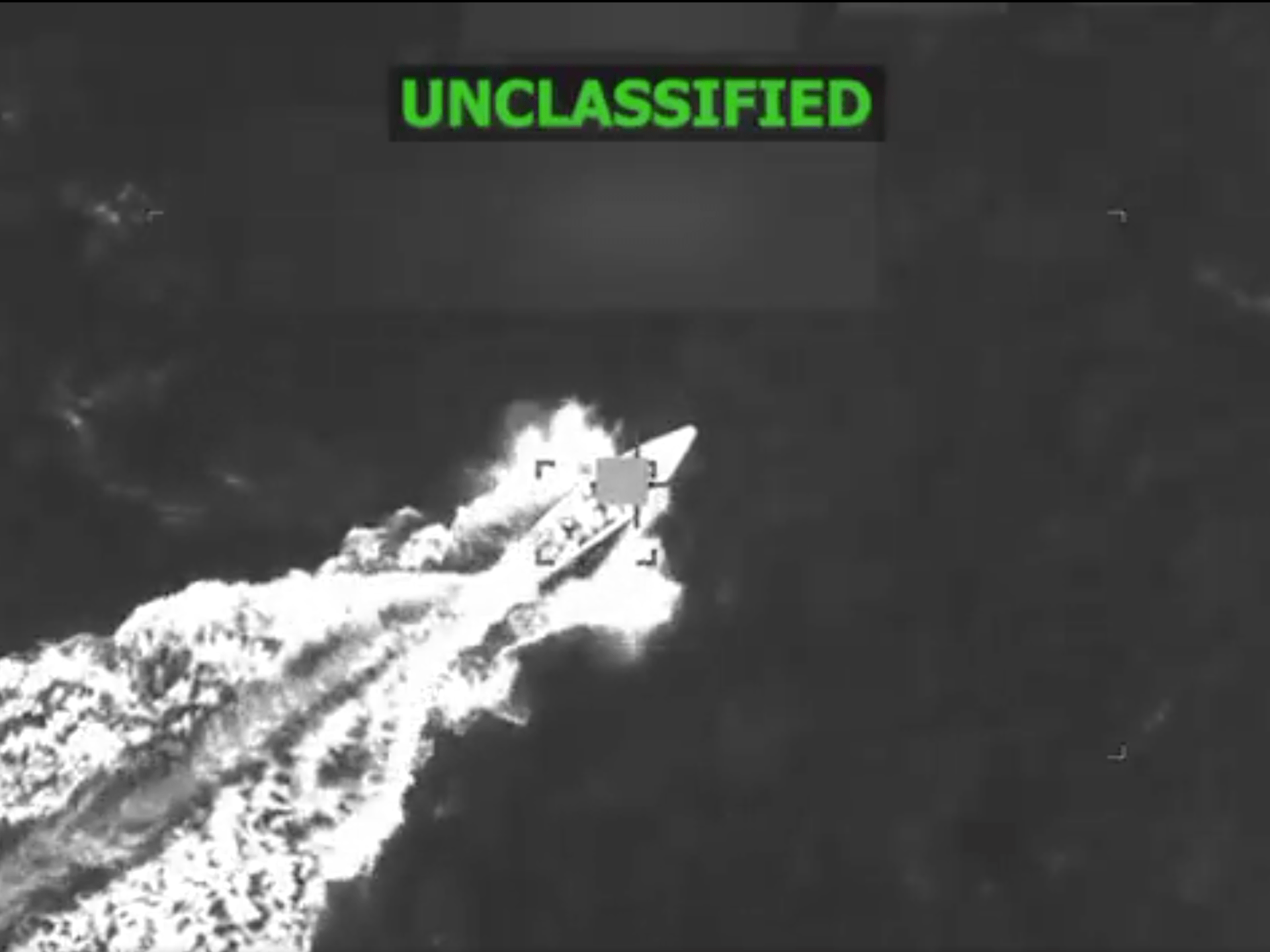
The United States military has carried out another lethal strike on a vessel in the Caribbean Sea, Secretary of Defense Pete Hegseth has said.
Three men were killed in the attack, Hegseth wrote in a post on X late on Thursday, which he said was carried out at the direction of US President Donald Trump and struck a “vessel operated by a Designated Terrorist Organization”.
list of 3 itemsend of list
Hegseth, who said the vessel was attacked in international waters, posted a 20-second video clip, marked unclassified, of the boat being struck by a munition and exploding as it sped through the water.
Though providing no evidence that the vessel was involved in drug smuggling, Hegseth said such attacks would continue until “narco-terrorists” stopped their “poisoning of the American people”.
“To all narco-terrorists who threaten our homeland: If you want to stay alive, stop trafficking drugs. If you keep trafficking deadly drugs – we will kill you,” he said.
Since early September, more than 60 people have been killed in US attacks on at least 18 vessels – 17 boats and a semi-submersible – in the Caribbean Sea and the eastern Pacific Ocean.
United Nations human rights chief Volker Turk has condemned the strikes as “extrajudicial killing”, while US lawmakers – mostly Democrat, but also several senior Republicans – have demanded clarity from the Trump administration on the legal basis for carrying out deadly attacks in international waters.
The Trump administration has yet to publicly provide any substantial evidence proving its claims that the vessels are being operated by drug traffickers.
Venezuelan President Nicolas Maduro has accused Trump of seeking to destabilise his government through the attacks, as well as through a major military build-up of US naval forces in the region over recent months.
Maduro, who Trump accuses of being involved in drug trafficking, said Washington’s “war on drugs” was merely a pretext to topple him from power.
Trump has threatened to carry out direct strikes on Venezuelan territory. He has also publicly stated that he has authorised covert CIA operations to take place in the South American country to counter drug cartels.
On Thursday, Senate Republicans rejected legislation that would have put a check on Trump’s ability to launch an attack against Venezuela without congressional authorisation.
Democratic Senator Adam Schiff – who pushed the resolution, which was voted down 51-49 – said it is an “open secret” that the build-up of US troops in the Caribbean was “much more about potential regime change” in Venezuela than stopping drug trafficking.
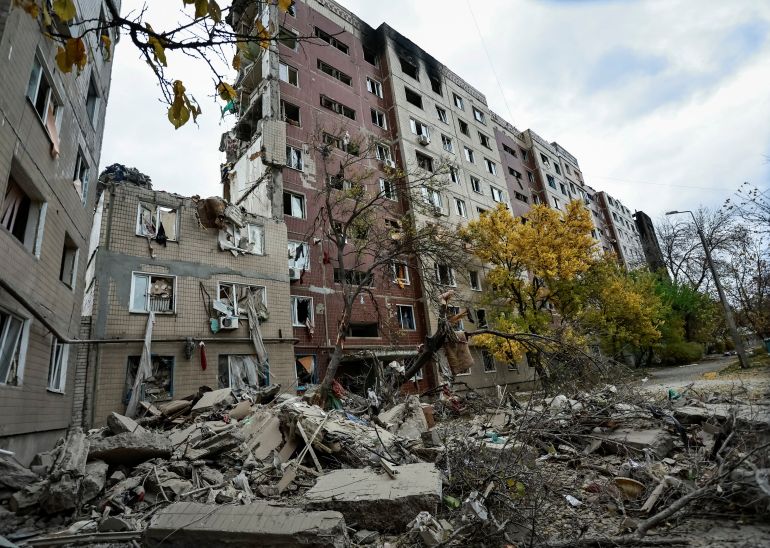
A court run by Moscow-installed authorities in Ukraine’s occupied Donetsk region has sentenced two Colombian nationals to 13 years in prison each for fighting on behalf of Kyiv.
The ruling, announced on Thursday, is the latest in a series of lengthy sentences handed to foreign fighters accused by Moscow-backed prosecutors of being “mercenaries”.
list of 4 itemsend of list
“For participating in hostilities on the side of the Armed Forces of Ukraine” – Alexander Ante, 48, and Jose Aron Medina Aranda, 37 – “were each sentenced to 13 years in prison”, the prosecutor’s office said on the Telegram messaging app.
According to reports, the pair fought for Ukraine in 2023 and 2024 before disappearing in July while transiting through Venezuela, a close ally of Russia, on their way home to Colombia after serving in the war.
Colombian newspaper El Tiempo reported in July 2024 that the men were detained in the Venezuelan capital Caracas while still wearing Ukrainian military uniforms.
A month later, Russian authorities said they had taken custody of the two, who both hail from the western Colombian city of Popayan.
Footage released by Russia’s FSB security service showed the men handcuffed and dressed in prison uniforms as masked officers escorted them through a court building.
News of the pair’s sentencing on Thursday was widely covered in Colombian media.
“I don’t know if we will see them again one day. That’s the sad reality,” said Medina’s wife, Cielo Paz, in an interview with the AFP news agency, adding that she had not heard from her husband since his arrest.
#Colombia 🇨🇴🇷🇺 Alexander Ante y José Medina fueron condenados por participar como “mercenarios” en las hostilidades del lado de las Fuerzas Armadas de Ucrania.
👉Lee la nota completa en: https://t.co/UrlDjv6Tnp pic.twitter.com/1kiEl1rlU2
Translation: Alexander Ante and Jose Medina were convicted for participating as “mercenaries” in the hostilities on the side of the Armed Forces of Ukraine.
In June, Russian state news agency TASS reported that Pablo Puentes Borges, another Colombian national, was handed a 28-year prison term by a Russian military court on charges of terrorism and mercenary activity for fighting alongside Ukrainian forces.
Earlier, in April, Miguel Angel Cardenas Montilla, also from Colombia, received a nine-year sentence for fighting with Ukrainian forces.
While Russian investigators have labelled foreigners who fight alongside Ukrainian forces as “mercenaries”, the Kyiv Post notes that most foreign fighters serving in Ukraine’s armed forces are formally enlisted and receive the same pay and status as Ukrainian soldiers.
That formalisation of their status in the Ukrainian army means they do not meet the legal definition of a mercenary under international law, the media outlet reported.
But Moscow continues to prosecute captured foreign fighters as “mercenaries” – a charge that carries up to 15 years in prison – rather than recognising them as prisoners of war who are protected under the Geneva Conventions.
Colombia’s government says dozens of its citizens have been killed fighting in Ukraine since the war began in February 2022.