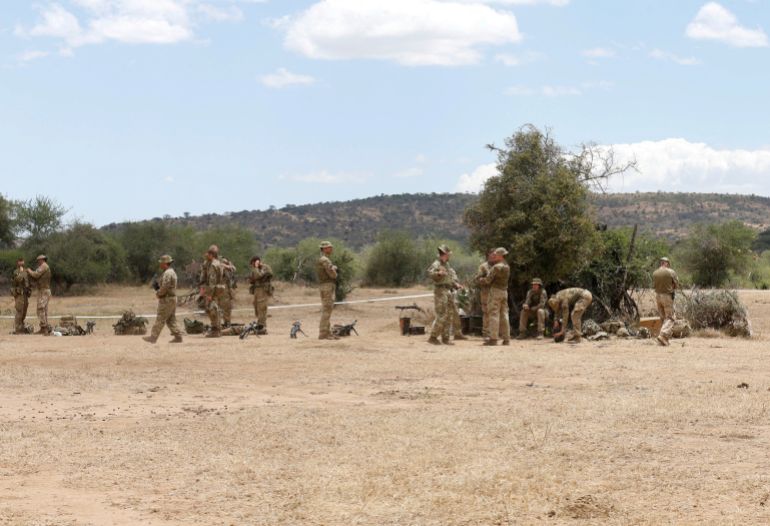
Following years of accumulating complaints from local communities, a Kenyan parliamentary report has accused British troops who are training there of widespread killings, sexual abuse, human rights abuses, and environmental abuses.
The report, published on Wednesday, found that serious misconduct by British soldiers caused them to be viewed as something of an “occupying force” by local people.
Recommended Stories
list of 4 itemsend of list
British soldiers have been regularly trained in the East African nation’s British Army Training Unit (BATUK), which is known for its mild weather and realistic combat scenarios. However, they have attracted rising numbers of accusations of gross violations, ranging from killings to neglectful disposal of military grade chemicals. The murder of Kenyan woman Agnes Wanjiru, 21, was the most well-known case, which attracted international media attention.
Community activists who have for years sought redress in Kenyan courts told Al Jazeera the report’s publication represented an “enormous victory” not just for Kenya, but for other African countries which host foreign military bases on their territory, but are wary of regulating them.
The Kenyan parliament has shown that the British Army is not above the law, according to James Mwangi, the founder of the grassroots advocacy group Africa Centre for Corrective and Preventive Action (ACCPA), which has been a key player in the prosecution of community complaints and served as counsel to lawmakers during their investigation.
“The impunity that has been perpetrated by these forces has been appalling. Kenya has become the first country in Africa to implement measures to combat injustices committed by African parliaments, he added.
Here’s what we know about the report, the most serious allegations against the British troops, and what will happen next:
What is BATUK?
A permanent training facility for the British Army Training Unit in Kenya is based in Nanyuki, central Kenya. It has been stationed there since Kenyan independence from the UK in 1963 and has about 100 permanent staff and some 280 rotating short-term troops from the United Kingdom.
According to the UK-Kenya Defence Cooperation Agreement, which allows both armies to share intelligence and training, the unit trains British troops and provides anti-terrorism training to Kenyan troops fighting the al-Shabab armed group.
In 2022, the UK government reported that BATUK had contributed more than 5.8 billion Kenyan shillings ($45m) to the local economies in which its garrisons are based, and that it employed more than 550 local staff. According to the report, local businesses that are close to BATUK training facilities also gain from the unit’s presence.
However, there have been numerous complaints from local people about the conduct of the troops. They claim that Kenyan women in the area have been harmed by improper handling of dangerous training materials and left-over, defused bombs.
Many Kenyan women say they have been left to care for children alone after British soldiers they began relationships with left the country at the end of their training.
There is no mechanism in place to hold British soldiers accountable under BATUK in the UK or Kenyan justice systems. On that basis, the UK government initially pushed back against Kenyan authorities ‘ attempts to investigate the troops ‘ behaviour.
Therefore, the Kenyan parliament approved a change to the UK-UK defense agreement that would allow for local prosecutions of British soldiers in April 2024.
What does the new report say?
Following a one-and-a-half-year investigation led by the Kenyan parliament’s defence, intelligence, and foreign relations committee, the 94-page inquiry into the conduct of BATUK troops was made public.
The report examined complaints from residents in Laikipia and Samburu counties in central Kenya, close to where the BATUK camp is. In June of this year, law enforcement started holding public hearings to hear evidence, with victims revealing gruesome tales of BATUK soldiers’ mistreatment. BATUK did not cooperate with the parliamentary investigation, the committee noted.
According to the report, BATUK soldiers displayed a “disturbing trend” of sexual misconduct, including rape, assault, and neglect of children by their parents.
It found that an internal inquiry by BATUK in 2003 had mishandled evidence and failed to provide justice for women who brought complaints.
BATUK, according to the report, has also caused significant environmental damage by not conducting environmental impact assessments for its field exercises. In at least one case, a major fire killed livestock and destroyed 4, 900 hectares (12, 000 acres) of vegetation. According to the report, BATUK also openly dumped military waste and toxic materials, violating Kenyan environmental laws.
Additionally, the Kenyan parliament said British troops showed “gross negligence” in the way they handled unexploded ordnance during their training and that their neglect had led to multiple deaths and injuries.
Communities were frequently unaware of loud training exercises, which in turn could have caused shock, injury, or even trauma.
Kenyan workers hired to clean up ammunition debris were not provided with protective gear in line with Kenyan labour laws, the report added.
According to the report, BATUK’s injured claimants received unfair compensation.

What other crimes is BATUK accused of?
Thousands of serious allegations against BATUK members have been made by locals. The mother of a young woman testified in June 2024 at the public hearings that the BATUK truck driver had caused her daughter to be in a wheelchair. BATUK paid for the daughter’s hospital bills for two years, but did not compensate the family beyond that, she said.
Another mother narrated how she had been abandoned by a British soldier, with whom she had been having a consensual relationship when he discovered she was pregnant, at a hearing held by her five-year-old daughter. The soldier is believed to have since left Kenya. The woman claimed that she needed child support.
Survivors of a huge March 2021 wildfire, which started at the privately-owned Lolldaiga Conservancy nature reserve in Laikipia, where BATUK carries out trainings, also brought complaints. Elephants, buffalo, lions, and the endangered Grevy zebra are among the wildlife at the nature reserve.
The blaze, which raged for four days, is believed to have started after BATUK used white phosphorus, a lethal chemical, during a training exercise. 4, 900 hectares (12, 000 acres) of the fire that caused it to burn through the nature reserve’s grounds. It killed livestock and pushed fleeing wild animals to swaths of farm land further afield. The smoke, according to community members, lasted for days before coming out of the eyes and breathing problems.
One man named Linus Murangiri was crushed by a moving vehicle as he rushed to help put out the fire, the BBC reported.
A camp stove that had been knocked over during an exercise was most likely the cause, according to the UK Ministry of Defence in 2022.
In August 2025, the UK agreed to pay what it called a “generous” settlement to the 7, 723 claimants who sued BATUK over the incident with the help of organisations like ACCPA. Just 2.9 million pounds ($3.9 million) was reported by the BBC as compensation.
The British government has also supported the restoration of burned areas on the conservancy where BATUK exercises continue to be held.
Agnes Wanjiru’s fate, what happened to her?
Agnes Wanjiru’s killing in March 2012, allegedly by a British soldier, was the most high-profile BATUK case.
After last seen with British soldiers at the Lion Court Hotel bar in Nanyuki, Wanjiru, the mother of a five-month-old girl, vanished on March 31. Her naked body was found two months later in a septic tank on the hotel grounds, close to the room where the BATUK soldiers had been staying. By the time her body was discovered, the group of soldiers had already left Kenya.
A post-mortem determined Wanjiru had been stabbed in the chest and abdomen, had a collapsed lung, and had suffered from blunt force injury to her chest. She was allegedly assaulted, but it was believed that she was still alive when she was taken into the tank. It was not clear whether she had been sexually assaulted.
The British Royal Military Police reportedly questioned nine soldiers in June 2012, but the Kenyan police claim they received no response. Wanjiru’s family attempted to sue BATUK in Kenya, but the UK government argued the Kenyan court had no jurisdiction over UK troops.
After a Sunday Times investigation revealed that a British soldier had murdered her, and that BATUK bosses had been aware of the soldier’s involvement in her murder but had attempted to conceal it, Wanjiru’s murder case came to light again in October 2021.
One soldier who went to top officials after hearing a colleague, identified at the time as Soldier X, confess to the killings was told to “shut up”. Soldier X showed Wanjiru’s body to the soldier who claimed Soldier X had taken him to the septic tank. Soldier X, who was not among the nine soldiers the Kenyan police initially identified, also poked fun at the murdered woman in Facebook posts, the Times reported.
Following the revelation, UK government officials again agreed to assist with a new investigation.
In September 2025, a Kenyan court ordered the arrest and extradition of a British national, and in November, the UK government arrested a 38-year-old suspect, Robert Purkiss. According to the UK’s Guardian newspaper, the case may be the first in which a former or current British soldier will be deported to a foreign country to stand trial.
Purkiss served as a medic in the Duke of Lancaster’s Regiment, an Infantry Regiment based in the northwest of England, and was in Kenya for a six-week training exercise at the time of Wanjiru’s death.
The Guardian reported that he made an appearance in a Westminster court on November 7 where a prosecutor claimed that Purkiss and other local women had been “drinking heavily” the night of Wanjiru’s murder.
Friends of Wanjiru, a hairdresser, reported that she had told them she was going out to “hustle” (earn extra money) for her daughter, prosecutors told the UK court.
Additionally, Purkiss admitted to killing Wanjiru to a coworker for “sex that went wrong.”
Purkiss denied the allegations. His upcoming hearing is scheduled for December 9.

What response did the UK government give to the report?
The British High Commission in Kenya responded in a statement on Wednesday, claiming that BATUK had not been sufficiently represented during the parliamentary hearings.
The commission stated that it would investigate new allegations against BATUK “once evidence is provided” and that it had written statements that were not taken into account in the report.
“While we deeply regret the challenges which have arisen in relation to our defence presence in Kenya, we are disappointed our submission to the Committee was not incorporated into the report’s conclusions”, the statement said.
What will follow?
The parliamentary report recommended that Kenya’s Attorney General should immediately work with the UK government to extradite Purkiss to Kenya for the ongoing trial of Wanjiru’s murder. Additionally, it mandated inquiries into other local deaths that might have involved BATUK soldiers.
Negotiations should begin with the UK within three months to hold ex-BATUK soldiers who have neglected their children to account, the report said, and compensation and psychosocial support should be provided to victims of sexual offences committed by BATUK soldiers.
In addition, the parliamentary report suggested that developing a code of conduct that emphasizes zero tolerance for gender-based violence and environmental degradation should be given more direct control over government agencies operating overseas.
Kenya similarly hosts two US military bases with fluctuating numbers of personnel. Along with a number of other African nations, the nation frequently holds US-Africa military exercises.
Mwangi of ACCPA told Al Jazeera that the parliament’s move was a step forward for communities which have to deal with foreign militaries in Kenya and elsewhere. He claimed that BATUK’s crimes against local communities date back to Kenya’s colonial past and the UK, but officials have always been cautious when questioning soldiers because they fear the impact of any development aid from the UK government might be affected.
Source: Aljazeera

Leave a Reply