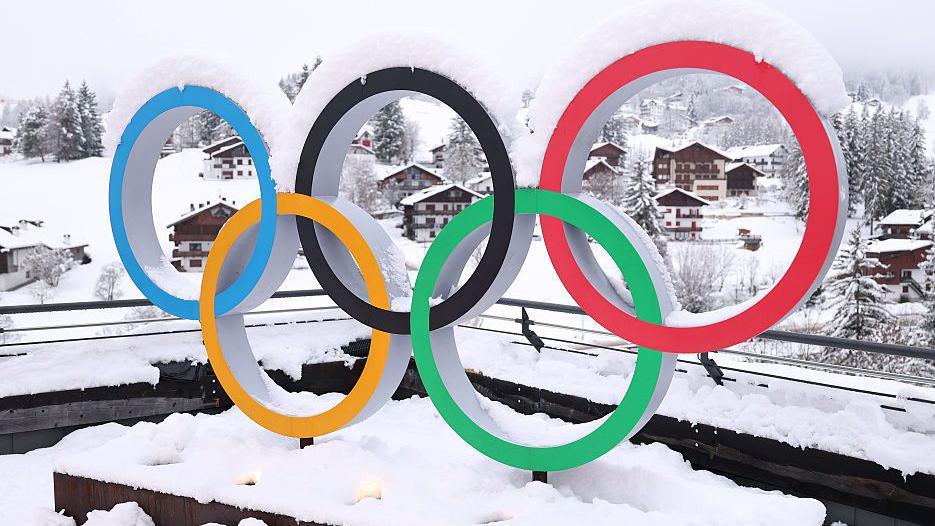
The 25th Winter Olympics is almost here – it’s back in Europe and will feature a record 116 medal events, three of which will be in the new sport of ski mountaineering.
It could be Britain’s most successful Winter Olympics
Great Britain have never won more than five medals – or more than one gold – at a single Winter Olympics, but that could change in 2026.
Medal ‘targets’ have become medal ‘ranges’ at recent Olympics, and for Milan-Cortina the funding body UK Sport is hoping GB athletes will win between four and eight medals, while Team GB chef de mission Eve Muirhead says there is an “opportunity to get the most we ever have”.
British athletes won nine medals at the most recent World Championships in Winter Olympic sports – across bobsleigh, curling, figure skating, freestyle skiing, skeleton and snowboard.
And that does not include the likes of snowboarder Mia Brookes and freestyle skier Kirsty Muir who have won World Cup events this season and are considered genuine medal hopes.
The most gender-equal Winter Olympics ever
The Winter Olympics have come a long way since their 1924 debut, which featured 11 female athletes – and roughly 25 times more men.
According to the International Olympic Committee (IOC), about 1,300 female athletes will be at Milan-Cortina. Of the 116 medal events, 50 will be in women’s competition (the most ever) and 12 will be mixed. The upshot is that women will compete in a Winter Games-record 53.4% of all medal events.
Twelve of the 16 disciplines will be fully gender-balanced in athlete numbers – another Games record. Among the new women’s events are luge doubles and the ski jumping individual large hill, while there is also a mixed skeleton relay.
There is another sign of the progress made with equality: these Games are the first to be overseen by new IOC president Kirsty Coventry, the first woman to be elected to the organisation’s most powerful position.
The NHL stars are back
Ice hockey is one of the biggest draws of the Winter Olympics, and the return of NHL stars after an absence of 12 years has only heightened the anticipation.
NHL-contracted players were denied a chance to compete at the 2018 Games while Covid put paid to their 2022 participation – and even 2026 has been touch and go after major issues with the readiness of the main rink and the condition of the ice.
The return of NHL players has also reignited the USA’s hopes of a first Olympic men’s ice hockey title since the 1980 ‘Miracle on Ice’ gold – further boosted by the fact that Russia are banned from competing.
Milan-Cortina 2026 will be very different from Cortina 1956
Cortina d’Ampezzo will become the fourth location to host the Winter Olympics twice, following St Moritz (1928 & 1948), Innsbruck (1964 & 1976) and Lake Placid (1932 & 1980).
The growth of the Winter Olympics from 1956 to 2026 – five times as many events and almost four times as many athletes – means it would be impossible today for a ski resort like Cortina to stage the Olympics single-handedly. The 2026 Games will be the most geographically widespread, with events in multiple regions and cities, including Milan, which is Italy’s second biggest city.
The IOC also prizes sustainability, and spreading events around – something president Kirsty Coventry says will be “the new normal” – meaning less new infrastructure is required.
Golden era of record-breaking athletes
Not since 2018 has there been a new name at the top of the list of most Winter Olympic golds, but 2026 could change that.
German lugers Tobias Wendl and Tobias Arlt are aiming to win their seventh and eighth golds in Milan-Cortina, which would move them level with the Norwegian trio of biathlete Ole Einar Bjorndalen and cross country skiers Bjorn Daehlie and Marit Bjorgen.
It would arguably be a greater achievement as biathlon and cross country skiing offer more medal opportunities than luge. Daehlie, Bjorgen and Bjorndalen won gold in 53%, 33% and 30% respectively of the Olympic events they competed in. The ‘Two Tobis’ have won all six of theirs (100%).
How will hosts Italy perform?
Hosting an Olympics usually results in a boost in medals – but it’s not always the case, as Italy discovered the last time they hosted the Winter Olympics in 2006.
They had won 13 medals in 2002 in Salt Lake City but only managed 11 in Turin – although they did win five golds as opposed to four in the USA four years previously.
The Italian Olympic Committee has set a minimum target of 19 medals, which is one short of their biggest haul of 20. That was achieved in 1994 – including a record seven golds – when their team included the likes of skiing greats Alberto Tomba, Deborah Compagnoni and Stefania Belmondo.
Italy’s 2026 hopes have already suffered a few setbacks, with flagbearer Federica Brignone and freestyle skier Flora Tabanelli both fighting fitness battles while another alpine hope, Marta Bassino, has already been ruled out.
But there are others with golden credentials, including speed skater Davide Ghiotto, snowboarder Maurizio Bormolini and curling pair Amos Mosaner and Stefania Constantini.
Related topics
- Winter Sports
- 20 January

- 4 days ago

- 3 days ago


Leave a Reply