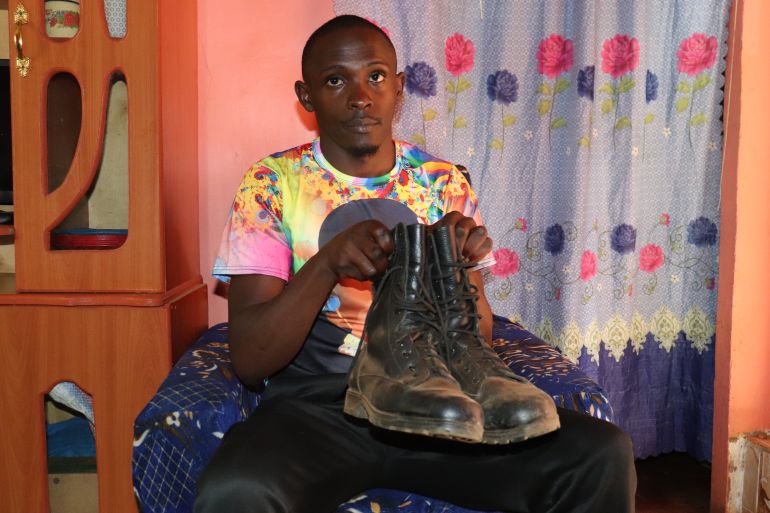
Kimende, Kenya – Several weeks after Dancan Chege left his home in Kimende town in Kenya’s Kiambu County for Russia, having been promised a job as a truck driver, he instead found himself on the front lines of the war in Ukraine.
With no combat experience, it was not something he had signed up for. But the trainer readying Chege and other fighters told him: “This is the Russian military, and once you are in, you either fight or die,” he said.
Recommended Stories
list of 3 itemsend of list
Last week, Kenya’s National Intelligence Service (NIS) unveiled a report which said more than 1,000 Kenyans have been recruited “to fight in the Russia-Ukraine war”, with 89 currently on the front line, 39 hospitalised and 28 missing in action.
Chege, a 30-year-old father of one, is one of the few who made a narrow escape, but dozens of families are demanding that the government take action to ensure their loved ones’ safe return home.
Many of the returnees and families of those still abroad say they were lured or tricked into joining the war on Russia’s side.
Chege, who used to work as a truck driver, delivering fresh vegetables from his town to the coastal city of Mombasa, was fraudulently recruited last year after he lost his job and decided to look for other opportunities.
He asked a friend who worked as a driver in the Gulf for advice. “He connected me with an agent in Nairobi who had taken him there,” Chege recounted, sitting in his living room in Kimende. “After we spoke, she [the agent] told me that jobs in Dubai, where I wanted to go to work as a driver, would take long and that she would get back to me when she had a good offer.”
Two weeks later, the agent called back, saying she had a good offer for him to work in Russia as a truck driver delivering supplies to military barracks.
He accepted, and within three days in October, Chege had a visa and an air ticket. “A Russian agent asked me whether I was ready to travel … He had called me at 6am and by 11am I already had a plane ticket for 3am the next morning,” he said.
Chege’s family took him to the airport, where he left on a connecting flight via Istanbul, Turkiye, before landing in Moscow, the Russian capital.
In Russia, he was sent for a week of ballistics training before being transferred to a Russian base in Ukraine, where he says he was given a full combat uniform, and his civilian clothes were burned.
“On the way, some Chinese and Russians asked me through a translator why I was there, and I insisted that I was going to drive the military trucks. They were surprised but told me that they were specifically there to ‘fight and kill the Ukrainians’,” Chege recounted.
“When I asked some Ugandans and Kenyans that I met later, and seeing what training we were being given, we realised that we had been fooled and we were going to the war front.”

‘I saw thousands of dead bodies’
In recent months, reports have surfaced from South Africa, Zimbabwe and elsewhere in Africa about young men fraudulently recruited for work abroad, only to end up on the front lines in the Russia-Ukraine war.
All in all, nationals from 36 African countries are known to be fighting for Russia in the four-year war, Ukraine’s foreign minister said in November.
At the base he was sent to in Ukraine, Chege went through a one-month training and was sent to what he called the “yellow zone” before eventually going to the “red zone”.
“Our trainer there told us that it was going to get tough. He prepared us for the worst and told us that we should be courageous enough to see dead bodies.”
Soon after, Chege witnessed this firsthand. “I saw thousands of dead bodies that were piled into something like a wall.” That’s when he knew he had to find a way out.
“I tried to call my agent and went to the commander, asking to leave,” he said, but was told he was in it until the end.
A week into fighting, Chege thought he would not survive. He called his wife and told her that if he went offline, his family would know that he had died.
“Three of my friends from the six of us had been killed by a drone,” he lamented.
With no other options, Chege decided to feign a mental breakdown.
“I decided to discharge my firearm aimlessly into the woods, and after all 12 magazines were spent, I pretended to be mad, collecting cartridges from the ground and eating them while talking to myself, unbothered by my two friends who rushed to check on me.”
The other soldiers were ordered to take him back to base, which was “a relief”, he said, as he was afraid they would kill him then and there.
He was later taken to a military hospital for mental health treatment, where, with the help of a Russian soldier who was a patient, he got access to a phone to contact his family. He asked them to send fake car accident photos from his mother’s phone, explaining that his wife and three children had been killed and he was needed back in Kenya.
“That made the doctor give me permission to go to the commander,” he said, “and that is how I went to the Kenyan embassy and flew back home.”

Fighting ‘shoulder to shoulder’
Chege returned to Kenya last month at a time when more reports were surfacing of Africans trapped or killed on the front lines of the Ukraine war.
On February 10, Kenya’s Prime Cabinet Secretary (PCS) Musalia Mudavadi announced that the government had repatriated more than two dozen Kenyans from the war zone and that Moscow’s use of its citizens in combat was unacceptable.
“We have facilitated 27 Kenyans to come back home away from the front line and from what they thought were different jobs but ended up being lured into battle,” he said.
The PCS also said he would put the issue of fraudulent recruitment of Kenyan civilians into war on the agenda at a planned meeting in Russia.
“We have seen loss of lives, and I am planning to make a visit to Moscow so that we can emphasise that this is something that needs to be arrested,” he said in a statement to the media.
In its report last week, the NIS said that to facilitate Kenyans’ travel to the front lines, recruitment agencies had colluded with rogue airport staff and immigration officials of the country, as well as with staff at the Russian embassy in Nairobi and at the Kenyan embassy in Moscow.
The Russian embassy in Kenya denied wrongdoing, calling the claims a “dangerous and misleading propaganda campaign”.
“The embassy refutes such allegations in the strongest possible terms,” it said in a statement on X, adding that the Russian government had “never engaged in illegal recruitment of Kenyan citizens in the Armed Forces”.
However, it added that Moscow does not preclude citizens of foreign countries from “voluntarily enlisting in the armed forces” and fighting “shoulder to shoulder” with Russian servicemen.

‘Deceptive recruitment’
Andrew Franklin, a Nairobi-based security analyst and former United States marine, says the Russian military has been recruiting all kinds of people into its army, including from the country’s own prisons and labour camps.
“What the Russian military is looking for are bodies, just bodies to fill holes in the ranks and keep the war going,” he said, explaining that Ukraine does not have the military power to overcome the Russians, so extending the ground war works in Moscow’s favour.
According to Franklin, Africa has a huge youth population, which is a selling point for such recruitment efforts, especially in Anglophone Africa. The level of education in East Africa and people’s ability to operate in the English language are helpful for issuing orders on the battlefield, he said.
Rights groups have condemned the fraudulent recruitment of civilians into Russia’s war.
“The deceptive recruitment of Kenyan youth into foreign conflicts is a grave violation of their rights and dignity,” said Irungu Houghton, Amnesty International executive director in Kenya.
“It is deeply concerning that recruitment agents have been openly operating within our borders without legal consequences to date. We encourage Kenyan youth to thoroughly research opportunities abroad and remain vigilant against fraudulent recruitment,” he said.

‘My son is gone’
A day after the NIS released its report, dozens of families protested in Nairobi, demanding the government take action against the network of officials and syndicates tricking locals into joining the war.
Many are still awaiting news about their loved ones’ whereabouts and when they might return. Meanwhile, other families are grieving the deaths of their sons and brothers.
In Nairobi’s Kamulu estate, Bibiana Wangari and her family are recovering from the loss of her son, who was fraudulently recruited into the Russian army with a promise of a plant operator job.
Charles Waithaka, like Chege, ended up joining the fight in Ukraine, where he was killed.
His mother remembers his last moments in Kenya before he left.
While packing his bags, she told him to be careful not to inadvertently transport things like drugs for someone else, something she now wishes he had done.
“I wish he had drugs in his bags because he would be arrested at the airport and jailed here locally. I would be seeing him in jail here, but alive,” Wangari said through sobs.
After Waithaka left, Wangari heard on a local radio station that young Kenyan men were being lured by rogue agents to travel for well-paying jobs in the Gulf and, on getting there, they were flown to Moscow instead.
“That got my attention because Charles told me they first landed and spent the night in Sharjah, before flying to Moscow,” she said.
Wangari lost communication with Waithaka after that. Later, at the end of January, she was informed by her son’s friend that he had been killed.

“His friend told me that he had been killed [on December 27] alongside five of his troop members after he stepped on a landmine, with only one surviving after losing his hand,” she said.
The family conducted a burial ceremony without Waithaka’s body in their village of Mukurweini in Nyeri County on February 6.
“My son is gone, and I will never see him,” Wangari said. But her wish now is that the government “should close down the borders and try to bring back the few [Kenyans] that are left … in any condition they are in.”
Chege, now at home with his family in Kimende, says he knows many other Kenyans who died on the battlefield, lamenting that their bodies cannot be retrieved.
For escapees such as himself – many of whom are still in need of jobs – he says he hopes the government will find ways to put their new skills to use locally.

Leave a Reply