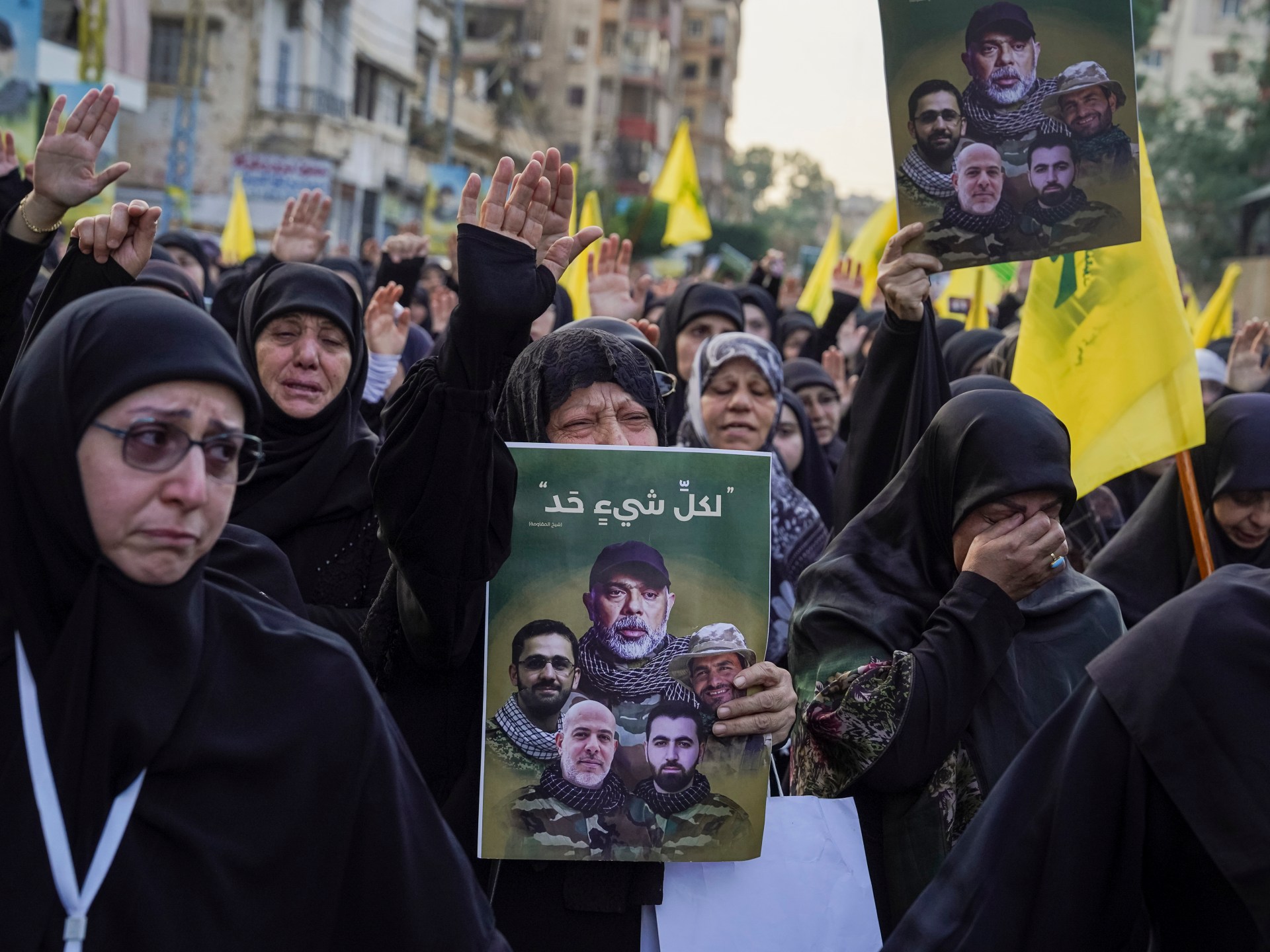
Beirut, Lebanon – The Lebanese group Hezbollah has launched only one attack in the 14 months since a ceasefire with Israel began – despite more than 11,000 Israeli violations.
The Israeli attacks continue to devastate parts of southern Lebanon and the Bekaa Valley and are keeping approximately 64,000 Lebanese displaced.
Recommended Stories
list of 3 itemsend of list
Hezbollah has not been in a position to respond after being weakened during the 2024 war, in which most of its military leadership was killed, including longtime Hezbollah chief Hassan Nasrallah, analysts say.
But the group hasn’t ruled out a response – especially as Hezbollah is increasingly under pressure to disarm.
“No one can predict when Hezbollah will respond,” Qassem Kassir, a journalist close to Hezbollah, told Al Jazeera. “It’s linked to the escalating Israeli aggression, [a Hezbollah response will happen] if a suitable opportunity presents itself, and in the event that diplomatic efforts fail.”
‘Hezbollah committed to the ceasefire’
When the ceasefire was announced between Hezbollah and Israel on November 27, 2024, the Lebanese group was badly weakened militarily and politically. The fall of its ally in Syria, the al-Assad regime, less than two weeks later, cut off a crucial land supply route used to transport financing and weapons from Iran.
The ceasefire stipulated that both Hezbollah and Israel would cease their attacks, Hezbollah would pull back its forces from south of the Litani River that runs across south Lebanon, and Israel would withdraw its forces from its northern neighbour.
But Israel has not stopped attacking Lebanon, and it continues to occupy five points in southern Lebanon. Other issues that are of importance to Hezbollah and the Lebanese state include the fate of Lebanese prisoners in Israeli jails and reconstruction, which Israel has prevented through the repeated targeting of construction equipment.
Still, Hezbollah has only attacked Israel once since November 2024. The lone strike was in December 2024, when Hezbollah responded to repeated Israeli attacks by firing at an Israeli military post. No one was harmed, but Israel responded to that attack by killing 11 people in Lebanon.
In the months since, Israel has killed more than 330 people in Lebanon, including at least 127 civilians, and a top Hezbollah commander, Haytham Ali Tabatabai.
“Hezbollah committed to the ceasefire in order to give the Lebanese state, government, and army the opportunity to implement the ceasefire and achieve demands through diplomatic means, as promised by the President of the Republic [Joseph Aoun],” Kassir said. “Furthermore, it wants to take the time to rebuild and allow people to return to their villages and homes.”
‘No position to respond’
For years, Hezbollah’s military capacity acted as a deterrent to Israeli aggression. But that changed after the last war.
Analysts said that should Hezbollah respond, it would likely incur the wrath of Israel’s military, bringing back a scale of violence that displaced more than 1.2 million people and killed thousands.
“Hezbollah is simply in no position today to respond to Israel,” Lebanese political analyst Karim Emile Bitar told Al Jazeera. “Any retaliation from Lebanon would provoke an uproar in the domestic political arena, and it is also likely to be highly ineffective from a military standpoint. The party is simply too weak to enter into such an endeavour.”
“Israel has changed the rules of engagement through deep intelligence penetration, cyber-enabled targeting, AI-assisted surveillance, and precision strikes that degrade command, logistics, and leadership,” Imad Salamey, a political scientist at the Lebanese American University, told Al Jazeera.
There is, however, one scenario that might force Hezbollah’s hand, analysts said. An attack on Iran, Hezbollah’s longtime benefactor, could kick the group into action.
On January 26, Hezbollah’s leader Naim Qassem delivered a televised speech addressing his party’s position on US threats to attack Iran.
“We are determined to defend ourselves,” Qassem said. “We will choose in due course how to act.”
Hezbollah is a notoriously secretive group. And following a war where the group felt exposed by Israeli intelligence, their secretiveness has likely intensified. Still, reports in local media and some analysts have spoken about a potential divide in the group over its position vis-a-vis Iran, and how disarmament should proceed, if at all.
Iran’s survival
With that in mind, some members of Hezbollah may view the survival of the Iranian government as existential and push them to attack the US’s most fervent regional ally, Israel.
“The only scenario in which [Hezbollah may attack Israel] is if there is a genuine, clear and present existential danger to the very survival of the Iranian regime and if the Iranian regime orders all its regional proxies to go all in,” Bitar said. “Otherwise, I think Hezbollah is most likely to stay out of it.”
Salamey said that only a “dramatic external shock” like a regional war including Iran would draw in the group. Otherwise, any response “would likely require a clear crossing of red lines that directly threaten Hezbollah’s core survival, not symbolic or tactical losses.”

Leave a Reply