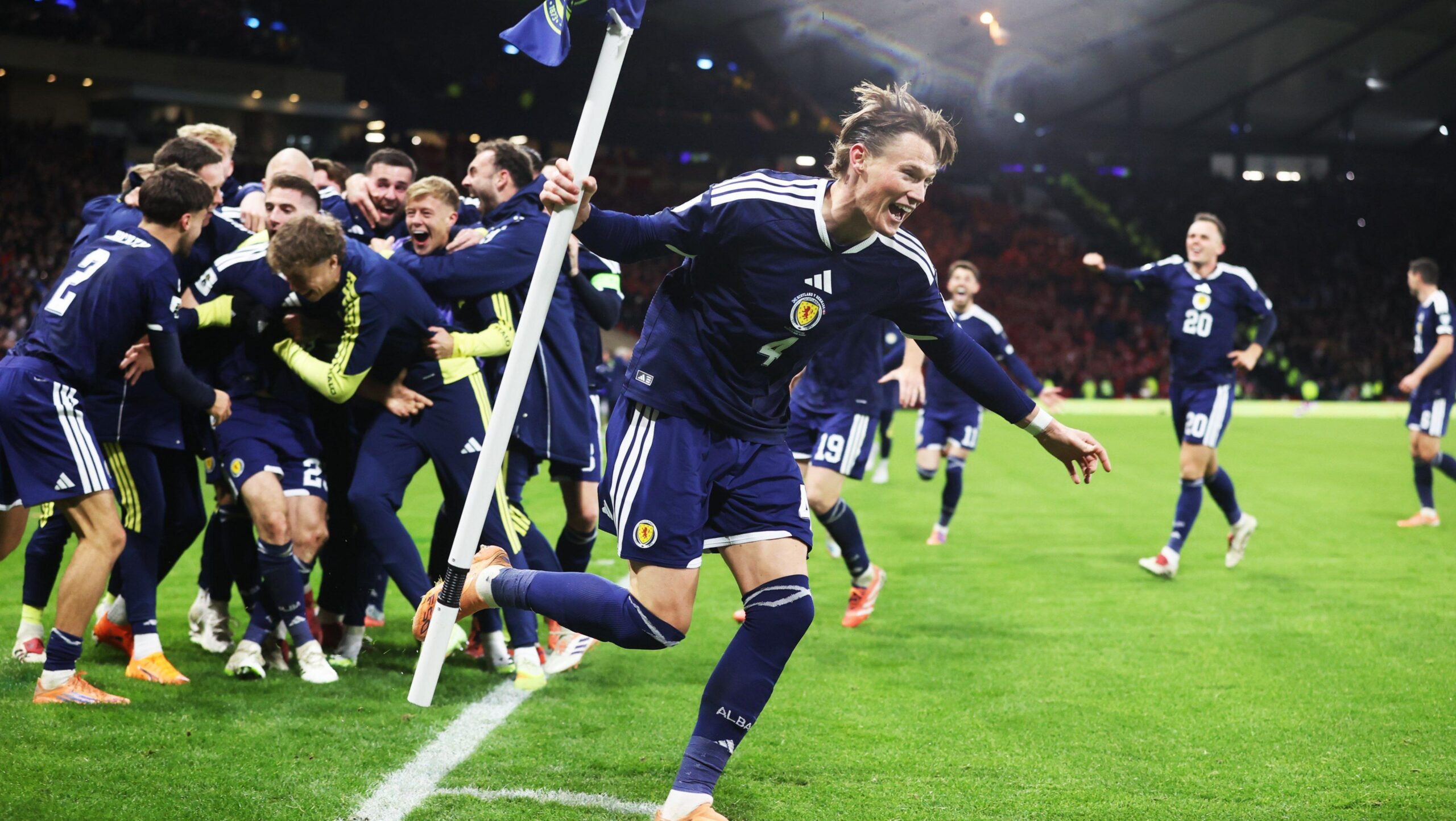
Who needs the Nations League? Now Steve Clarke has ended decades of heartache and taken Scotland to the World Cup, does anything else matter?
Understandably, ever since December’s gala draw for the summer’s finals in North America, every Scotland fan has been consumed with thoughts of facing Haiti, Morocco and Brazil.
The prospect of partying at the finals for the first time since 1998 has given long-suffering supporters plenty to savour and there’s been no need to look beyond, nor anything definite to anticipate.
That changes at the Nations League draw in Belgium on Thursday evening, when Scotland’s opponents for matches in the second half of 2027 are confirmed.
- 1 day ago
- 7 hours ago
How does the Nations League work?
 Getty Images
Since being introduced in 2018 in an attempt to add more structure to the international calendar and phase out meaningless friendlies, the competition has followed a familiar format.
National teams are split into four tiers based on promotion and relegation from the last edition, theoretically putting sides of the same level together.
Each of these tiers are split into groups of four and there’s promotion and relegation through the divisions. The best teams in League A then go on into a knock-out finals tournament the following summer with the champions crowned at the end. Simple.
Scotland played in the top flight in the last edition back in 2024 but finished in third place in their group behind eventual champions Portugal and Croatia. That put the national team in a play-off to fight for survival and defeat by Greece meant relegation to League B.
Who could Scotland draw?
 Getty Images
Scotland are in Pot 1 of the League B draw, but a quick look at the possible opposition puts paid to any ideas that it means an easy draw.
Hungary, Poland and Israel are the only sides Scotland cannot face, but with the likes of Switzerland, Republic of Ireland and Sweden as a potential group of opponents, fans won’t be taking success for granted. Though do we ever?
Pot 1: Scotland, Hungary, Poland, Israel
Pot 2: Switzerland, Bosnia and Herzegovina, Austria, Ukraine
Pot 3: Slovenia, Georgia, Republic of Ireland, Romania
Pot 4: Sweden, North Macedonia, Northern Ireland, Kosovo
Scotland will play each opponent home and away, with the fixtures grouped into three double-headers in September, October and November.
Why is it important for Scotland?
Even eight years after its introduction, the competition does not have the allure of its counterparts, but it is still an important part of the international calendar, especially for Scotland.
Head coach Clarke has spoken repeatedly about how his players need to face strong opposition to keep improving.
This time around, they will not be playing Europe’s elite, but competitive games against sides of a similar level present a good test and strong preparation for the next set of European Championship qualifiers.
Promotion brings prestige, glamour games next time around and prize money, but arguably the real prizes come in how a successful campaign sets Scotland up for the future.
The seeding for qualification campaigns and finals is always a complicated affair, but there is one simple truth that applies to them all. Winning games pushes a team up the rankings and into a better position – and winning competitive games is more valuable than victory in friendlies.
There is also the importance of a good Nations League as a lifeline to reach major finals. Four teams who failed to qualify for the World Cup directly have been given a second chance through the play-offs due to their Nations League record.
And let us not forget that Scotland’s long exodus from a major finals was ended because of a Nations League lifeline – the emotion of the play-off victory in Serbia that sealed a place at Euro 2020 was only possible because of a strong campaign.
It should not be the case that the national team needs a similar chance to reach Euro 2028, but a horrible set of circumstances could arise that make Nations League success essential.
As co-hosts of the tournament, the idea of Scotland not making the finals and seeing fans of other nations celebrating at Hampden in unthinkable.
However, with four nations hosting the finals, Scotland, England, Wales and Republic of Ireland all have to go through the qualification campaign.
In an ideal world, the national team succeeds there and books a place, with three group games at Hampden guaranteed.
Uefa has set aside two places for host nations who fail to qualify in an attempt to make sure all four are in the tournament proper.
However, if more than two of the four fail to qualify automatically, it comes down to qualifying ranking and Scotland could conceivably miss out altogether.
A new face in the dugout?
 SNS
SNSThere’s one other intriguing footnote to the draw: it could set up the opposition for the next Scotland head coach’s first game in charge. Steve Clarke’s contract expires after the World Cup and there’s no indication if he’ll carry on in the job, regardless of what happens at the finals.
How can you watch the draw?
Related topics
- Scottish Football
- Football
- Scotland Men’s Football Team

Leave a Reply