- 45 Comments
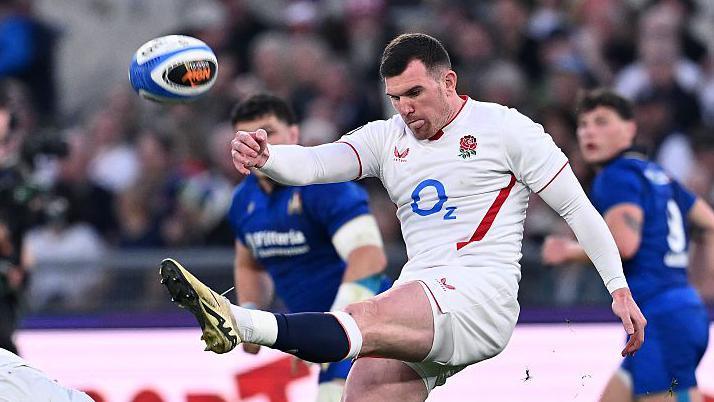
‘Kick’ has become a four-letter word to England fans once more.
The team’s instinct to chase down high balls as a way of winning territory was tolerated while they were in the midst of a 12-match winning streak.
At times, the panic it induced in opposition defences – who were still getting to grips with 2024 law tweaks outlawing deliberate blocking of chasers – was even relished.
But now, after three straight defeats, England’s pragmatic style has become problematic.
Complaints about the team’s tactics featured prominently in fans’ discussions after their latest setback against Italy last weekend.
England have indeed kicked more than other teams in this Six Nations. But not by much.
They average 30.75 kicks per match. That is only one more than Italy, Ireland and France.
So why have England become so synonymous with the boot?
Head coach Steve Borthwick’s Leicester tactics, where he peppered back threes en route to the Premiership title, was also the starting point for his England stint as he attempted to quickly get up to speed.
Even now, when England do kick, they do so at a volume few others match.
After markedly less kick-heavy performances against Scotland and Ireland, Italy was one of those occasions. Against the Azzurri, England kicked 38 times in open play.
Added to which, lots of those kicks were the same sort. Starting scrum-half Ben Spencer put up 14 box-kicks, the most of any player in last weekend’s round of games.
Jack van Poortvliet managed to put up another five after replacing Spencer in the 57th minute.
That lack of variety, combined with the time taken to set up a box-kick, makes them stick in the mind.
What can be more difficult to recall is that the tactic often worked.
England were the best team at regaining kicks, both as an absolute number and a percentage, in the fourth round.
Inside the first three minutes, Spencer put up two box kicks for Cadan Murley to chase. The England wing took the first cleanly and tapped the second back to Joe Heyes. England advanced up half the pitch with easy yardage wins.
Of 12 box-kicks put up outside the England 22m, eight were successful, giving England territory, momentum or a set-piece.
The first of England’s tries came from a similarly smart aerial play, Fin Smith hitting a pin-point crossfield bomb to Tom Roebuck.
That said, there were also errors and wasted opportunities.
Fin Smith was fortunate that Lorenzo Cannone’s charge-down of his 13th-minute kick did not result in a try for Italy. In the 71st minute, off quick ball, with excellent field position and Murley lurking wide, Seb Atkinson similarly dawdled too long and had his kick blocked.
Shortly after, as the clock ticked, Smith clumped an ugly flat kick out on the full as he looked for Roebuck on a low-percentage play.
All were ploys with more moving parts and increased risk of going wrong.
Italy got several such attacks right, most notably when Paolo Garbisi found wing Monty Ioane with a lateral nudge to help set up Leonardo Marin’s decisive late try.
From the static base of a box-kick and chase though, England were well in profit.
What is more worrying than their kicking, is how England have struggled to make inroads into defences via other routes.
Against Scotland, they had 53% of possession, but made fewer than half as many line breaks – six to Scotland’s 14 – and beat fewer defenders [15 to 23].
Against Ireland, England had 52% possession, did almost half as much kicking as their opponents -18 in open play to Ireland’s 31 – but were burgled at the breakdown repeatedly, conceding 14 turnovers.
Their inability to convert field position into points has been a recurring theme through the championship. Only Italy have averaged fewer points per entry into the opposition 22m.
Whether it is because opposition are better prepared to snuff out England in the often chaotic aftermath of a contestable kick or if England themselves have lost the cut and thrust required to land a follow-up blow in broken field, the tries of 2025 have dried up.
Complaints about kicking imagine England would do something more incisive and effective if they kept the ball in hand. There has been little sign of that so far.
Perhaps depressingly for England fans, the one part of the team’s game that they dislike most is one of the more successful.
Borthwick denied that there was any need for a “major overhaul” in his tactical plan this week.
Related topics
- England Rugby Union
- Rugby Union

Leave a Reply