To play this video you need to enable JavaScript in your browser.
- 84 Comments
No ice track, and yet the most successful nation in Olympic skeleton history.
Make it make sense.
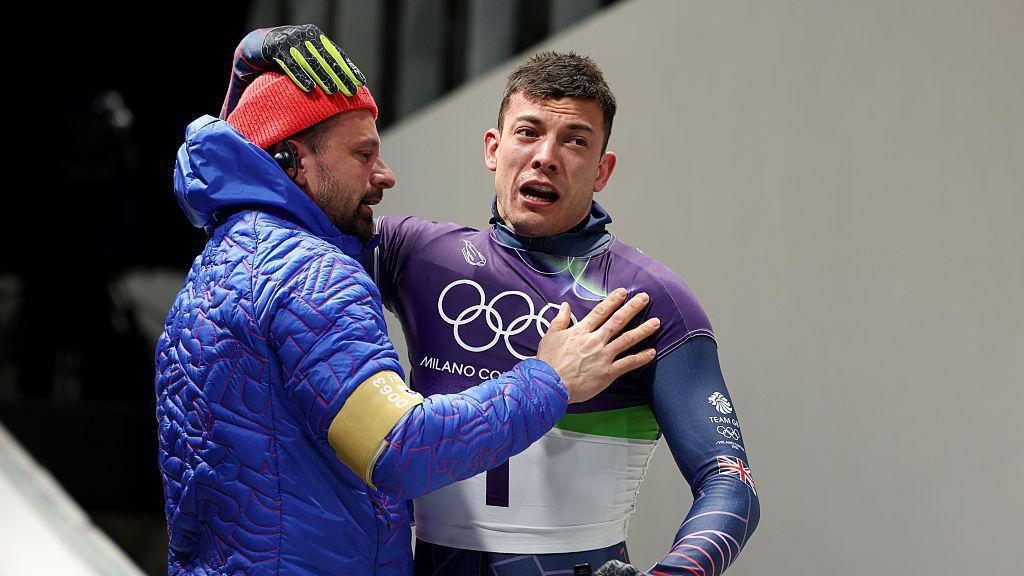
But as Matt Weston won his historic gold on Friday, he joined a long line of British skeleton athletes to have taken his place on a Winter Olympics podium.
After Amy Williams and Lizzy Yarnold – twice – he is the first man to stand on the top step, and brings the sport’s total medal haul to 10 with chances for that number to grow still at these Milan-Cortina Olympics.
Weston – also a two-time world champion – thinks the fact Britain has achieved such success with no track is probably “quite infuriating” for other nations. For Yarnold, it’s Team GB’s “superpower”.
“What the Brits are really good at is that when we turn up a track, you have six practice runs before the race, so six minutes of practice,” she told BBC Sport.
“You go in there with purpose, with clarity, with commitment in every single run, and everyone is tuned into that particular performance advantage that you’re focusing on.
A small wooden hut in the grounds of the University of Bath campus doesn’t look like a superpower, however.
It is here that Olympic champions have been made, the start of the UK’s only push track and the home of the skeleton and bobsleigh teams.
They spend their summers on this 140m stretch, finessing their starts and building their bodies in the gym for the winters ahead.
The technology in other parts of the sport is more advanced.
It was back in 1990s that a PhD student named Kristan Bromley – who later became known as ‘Dr Ice’ – was asked to create a sled for the British military, who took part in the sport for recreation.
No soldier would test his creation, and so he did so himself. He later went on to become a four-time Olympian, and designed the sleds on which many of Britain’s early skeleton medallists achieved their Olympic success.
In the years since, the likes of McLaren and British Aerospace have also been involved in the engineering of the sleds, while the creation of special ‘drag-resistant’ skin suits raised eyebrows at the 2018 Games.
Before these 2026 Games, the team have utilised a wind tunnel in a bid to improve performance.
“Research and innovation are really important in a sport like skeleton where it’s the human and the machine,” said Yarnold.
“I’m often asked the question, how often is it the human? How often is it the machine? It’s a combination of everything coming together.”
Sometimes, it hasn’t done so. At these Games, Team GB were banned from using new helmets that the Court of Arbitration for Sport (Cas) said had clearly been designed to specifically enhance aerodynamic performance.
Team GB had won a skeleton medal at every Winter Olympics since the sport was reinstated to the programme in 2002 but 20 years later, that run had come to an end, with Weston’s 15th-place finish the highest of the four British athletes competing.
In the aftermath, the skeleton programme had a drop in UK Sport funding – from the £6.5m it received for the 2022 cycle, to an initial £4.8m for 2026 – though this later rose to £5.8m.
Historically, alongside the ski and snowboard programme and that of curling, it has been one of Great Britain’s highest-funded winter sports.
But how does it attract athletes in the first place? After all, no British child grows up dreaming of one day being a skeleton champion.
Before skeleton, Weston was an England taekwondo international and played rugby union, but was introduced to sliding through Discover Your Gold, a UK Sport talent identification scheme.
Such UK Sport schemes – which search for raw talent in potential athletes and direct them into suitable sports – also brought two-time Olympic champion Lizzy Yarnold, and 2018 bronze medallist Laura Deas into skeleton.
“That’s how they’re drawing very capable athletes in, and you pair that with phenomenal coaching and great funding,” said Yarnold, a former heptathlete who wanted to take up modern pentathlon.
“Because we’re not a winter sport nation and we don’t have young athletes trying out these sports on Wednesday afternoons like they do in other countries, we lean into the fact that we’re capturing athletes who are incredible physical athletes already, and who are interested in trying a different sport.
Star coach ‘the icing on the cake’
With such a history of success, it is also an enticing proposition for the very best coaches in the world.
Latvian Martins Dukurs – widely regarded as the greatest slider to ever take to the ice – became Great Britain’s new coach in 2022.
A six-time world champion with more than 60 World Cup victories to his name, Dukurs retired after the Beijing Games and his capture as a coach – alongside that of his own coach and sled designer Matthias Guggenberger – by the British team was a major coup.
“This is just a massive bonus to a good package that we already had, this is the icing on the cake,” Weston told BBC Sport in 2025.
“Martins is the best ever at what he’s done. His experience is invaluable.”
Dukurs’ father Dainis manages the track in Sigulda, meaning Dukurs had constant access to the ice. Joining a set-up with no ice track, then, was a challenge.
“I was sliding 23 December, 24 December, 31 December, 1 January, and any time I needed I was jumping on a sled, I was testing equipment, and unfortunately they don’t have such opportunity,” he told BBC Radio 5 Live.
So what do the British athletes put it down to? The answer is each other, their team camaraderie.
“We only get to slide down an ice track about 120-150 times a year. Each run is less than a minute, so you’re looking at less than two hours actually doing the sport every year,” Marcus Wyatt – who finished ninth in Cortina – told BBC Sport last year.
“But if you talk to other athletes, learn from their experiences and share what you’re doing, suddenly you’ve doubled, tripled, quadrupled your knowledge.
“In the last couple of years especially, me and Matt have bounced off each other, we’re sharing ideas.
“The day before a race, I might be struggling on a corner, so I ask Matt, what are you doing on corner four? He tells me, I try that, it works for me, and lo and behold when the race comes, I might beat him.
“That’s fine, because he knows that next week when he’s struggling somewhere else, I’ll help him out and he might beat me.
“It’s this team ethos, working together, to get the best out of everyone.”
Weston adds: “I think that’s why we’re so good.
“On the track, he’s the first person I want to beat, I’m the first person he wants to beat.
- 13 hours ago
Winter Olympics 2026
6-22 February
Related topics
- Winter Sports
- Skeleton
- Winter Olympics

Leave a Reply