The biggest defence companies in the United States have agreed to “quadruple production” of what President Donald Trump describes as “exquisite class” weaponry after a meeting at the White House.
The meeting on Friday was attended by the chief executives of RTX (formerly Raytheon), Lockheed Martin, Boeing, Northrop Grumman, BAE Systems, L3Harris Missile Solutions and Honeywell Aerospace, all of which are sitting on billions of dollars of order backlogs, some of which dwarf the gross domestic products (GDPs) of several nations.
The US is already the world’s largest military spender at nearly $1 trillion in 2025, exceeding the combined total of the next nine countries. Trump aims to increase this amount to $1.5 trillion by 2027.
Billions of dollars have already been spent by the US on weapons in the war with Iran, making war a highly profitable business for defence contractors.
Last week, stock prices for major arms-producing companies in the US have all risen, including for Northrop Grumman (up 5 percent), RTX (up 4.5 percent) and Lockheed Martin (up 3 percent).
So which weapons are being used in the war in Iran and which defence contractors are benefitting from this rapidly intensifying conflict?
Which weapons is the US using against Iran?
According to the US military’s Central Command (CENTCOM), Operation Epic Fury has drawn on more than 20 distinct weapons systems across air, sea, land and missile defence forces.
Missiles, munitions and missile systems
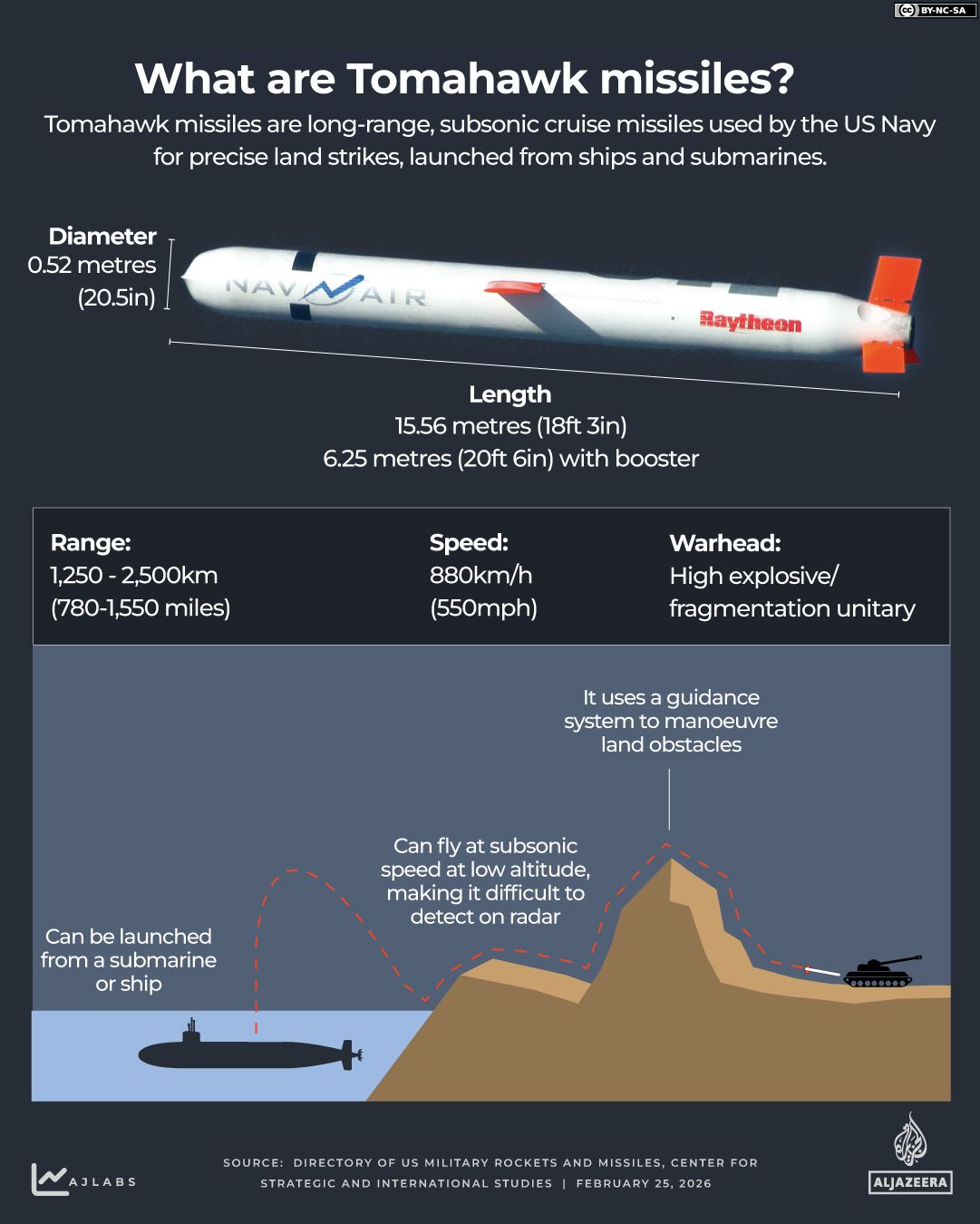
The Tomahawk missile has been the Pentagon’s long-range strike weapon of choice for three decades. The missiles travel at subsonic speeds, hugging the terrain at low altitude to avoid radar detection. They have been fired from Arleigh Burke-class destroyers in the Arabian Sea, with each destroyer capable of carrying more than 90 Tomahawks.
The US has also launched the Precision Strike Missile (PrSM) for the first time against Iranian targets from M-142 HIMARS systems in desert terrain. The short-range ballistic missile is capable of hitting targets 4002km (250 miles) away.
On the defensive side, Patriot missile batteries and Terminal High Altitude Area Defense (THAAD) systems have been positioned to intercept Iran’s retaliatory strikes with Patriots handling shorter-range cruise missiles and low-altitude threats while THAAD intercepts ballistic missiles at higher altitudes in the final phase of their descent.

Drones
The assault on Iran has also seen the debut of the Low-Cost Uncrewed Combat Attack System (LUCAS), a one-way attack drone built by SpekreWorks and modelled on Iran’s own Shahed drone. At $35,000 per unit, LUCAS represents a deliberate pivot towards cheaper, more expendable munitions. It costs far less than the MQ-9 Reaper drone, which has also been deployed and costs up to $40m per aircraft to manufacture. Iran’s Islamic Revolutionary Guard Corps said it shot down a Reaper on March 1.
Strike performance
The US is using B-1 bombers, B-2 stealth bombers, F-15 fighter jets, F-22 Raptor jets and F-35 Lightning II stealth fighters to strike Iranian ballistic missile facilities and underground bunkers using 900kg (2,000lb) bombs to destroy Tehran’s stockpiles.

Reconnaissance
According to local news sources, EA-18G Growler electronic warfare jets were spotted on board the USS Abraham Lincoln aircraft carrier, which is positioned in the Arabian Sea. The aircraft are used to jam enemy radar, communications and missile guidance systems. The P-8A Poseidon plane is also being deployed to carry out surveillance and reconnaissance across sea and land and has been detected circling around the Strait of Hormuz, according to flight path data.
Last month, the US Air Force also deployed E-3 Sentry AWACS radar aircraft to the Middle East, which provide real-time battlefield awareness. US Air Force RC-135 spy planes, such as the Cobra Ball and Rivet Joint variants have also been flying intelligence-gathering missions out of bases in Qatar and the United Arab Emirates, monitoring Iranian missile launches, radar systems and communications.
Naval assets
The USS Abraham Lincoln and USS Gerald R Ford aircraft carriers have anchored US naval presence in the Arabian Sea and Mediterranean, respectively, while a fleet of Arleigh Burke-class guided-missile destroyers are providing both offensive firepower and missile defence with their Aegis systems.

Who makes the weapons being used against Iran?
- Boeing makes the B-1 bomber, F-15s, EA-18G Growlers, P-8A Poseidon and the RC-135 with modifications provided by L3Harris Technologies.
- Northrop Grumman makes the B-2 stealth bombers and provides radar technology to E-3 Sentry AWACS.
- Lockheed Martin makes F-35 Lightning II stealth fighters, F-22 Raptor jets, THAAD systems, M142 HIMARS, MGM-140 ATACMS missiles and the PrSM.
- The Raytheon division of RTX Corporation makes Tomahawk missiles and MIM-104 Patriot missile systems.
- SpektreWorks produces LUCAS one-way attack drones.
- General Atomics Aeronautical produces the MQ-9 Reaper drones.
- Huntington Ingalls Industries built the USS Abraham Lincoln and USS Gerald R Ford.

What are the biggest military companies in the world?
In 2024, the top 100 defence companies in the world made more than $679bn of revenue, according to the Stockholm International Peace Research Institute (SIPRI).
US firms dominate with almost half ($334bn) of the revenues, followed by China ($88bn), the United Kingdom ($52bn), Russia ($31bn) and France ($26bn).

European heavyweights, such as the UK’s BAE Systems, Italy’s Leonardo, the trans-European Airbus, France’s Thales and Germany’s Rheinmetall, all occupy positions within the top 20 companies with many growing off the back of the Russia-Ukraine conflict.
The table below breaks down the top 100 arms-producing companies around the world.
What are the biggest defence contractors in the US?
According to SIPRI’s report, 39 US contractors are on its list of the top 100 defence companies, dwarfing China’s eight groups, which have the second most contractors featured in the top 100.
The top five US defence companies are:
- Lockheed Martin: The world’s largest defence contractor was formed in 1995 through a merger of Lockheed and Martin Marietta. In 2024, it generated $68.4bn in revenue. It has contracts with the US government to manufacture aircraft, such as the F-35, missiles and space systems. Its Department of Defense contracts are worth tens of billions of dollars. This year, the company signed an agreement with the US government to accelerate the production of the PAC-3 Missile Segment Enhancement for air defence missiles.
- RTX: It was formed in 2020 after a merger between Raytheon and United Technologies. The three main segments of the business are focused on producing missile systems, jet engines and avionics for the US military and commercial airlines. In 2024, $43.6bn of the company’s revenue came from defence.
- Northrop Grumman: The contractor was formed in 1994 after Northrop’s acquisition of Grumman. The company generates revenue from the manufacture of stealth aircraft, such as the B-21 Raider, space systems and nuclear modernisation programmes for the US Air Force and government. In 2024, $37.9bn of its revenue came from defence.
- General Dynamics: It develops nuclear submarines, battle tanks, armoured vehicles and the Gulfstream business jet. In 2024, $33.6bn of its revenues came from defence.
- The Boeing Company: The aircraft maker was founded in 1916. Most of its revenue comes from the production of commercial aircraft, defence programmes and space systems such as its F/A-18E/F Super Hornet, AH-64 Apache and Chinook helicopters and the P-8 Poseidon. In 2024, $30.6bn of its revenue came from defence.

What are Israel’s biggest defence contractors?
According to SIPRI’s report, three Israeli contractors are on its list of the top 100 defence companies. The Israeli defence industry is experiencing a surge in exports with highly advanced military technology taking the helm.
- Elbit Systems: Israel’s largest defence company specialises in drones, surveillance systems, battlefield electronics and military optics. In 2024, $6.3bn of its revenue came from defence.
- Israel Aerospace Industries: The state-owned defence and aerospace company specialises in missile defence systems, satellites, combat drones and radar technology. In 2024, $5.2bn of its revenue came from defence.
- Rafael: The company is also state-owned and is behind Israel’s much-lauded Iron Dome missile defence system. It also provides precision-guided munitions. In 2024, $4.7bn of its revenue came from defence.

US defence stocks have surged in recent years
According to SIPRI, global defence spending jumped 9.4 percent in 2024 to $2.7 trillion. In addition, NATO members have pledged to increase their annual defence budgets from 2 percent to 5 percent of their GDPs by 2035, adding hundreds of billions of dollars in annual spending.
To replenish rapidly depleting stockpiles of munitions being used in the wars in Ukraine and the Middle East, major weapons contractors are investing billions in new orders, responding to increased demand and driving up their stock prices.

Leave a Reply