To play this video you need to enable JavaScript in your browser.
- 198 Comments
Before the Six Nations started, England head coach Steve Borthwick talked about facing France in Paris on 14 March being a possible title decider.
“We want to be in a position in that game to get what we all want to achieve. We want English fans flooding across the channel to get there and watch that game,” he said.
A repeat of the 2016 Grand Slam in Paris was the goal, with a first title since 2020 also a reasonable outcome.
Instead, two heavy back-to-back defeats, with two games left, makes that trip to Paris now very daunting.
Losing to Scotland and Ireland is perhaps not a shock, but the manner of those defeats puts pressure on Borthwick.
England’s 12-game winning streak went up in smoke with a disappointing 31-20 defeat at Murrayfield, before their nine-match winning home run was emphatically ended with Saturday’s dismal 42-21 defeat by Ireland.
“Two weeks ago after 12 wins on the bounce people were saying we were the best team in the world, and now we are all sorts of things. Neither of these are true,” Borthwick told BBC Sport.
“We are on a journey of development that has a lot of growth in it. That England team from today will be a lot better in two weeks’ time.”
It was a nightmare performance at Allianz Stadium, with five tries conceded in one of the worst performances of Borthwick’s tenure, on what was captain Maro Itoje’s 100th cap.
To play this video you need to enable JavaScript in your browser.
‘No-one knows what the answer is’
After seven dynamic caps off the bench, 21-year-old back rower Henry Pollock finally gained a first Test start.
The idea was his energy would help avoid a repeat of last week when England went 17-0 down in 15 minutes at Murrayfield.
However, Ireland scored 22 points inside the first 30 minutes – the fourth-most first-half points conceded by England at home.
“What do you do? Two weeks in a row conceding so many points in the first 15 minutes,” prop forward Ellis Genge told BBC Sport.
“Everyone has to take a look at themselves. No-one knows what the answer is right now or we would have sorted it out.
“It opened up scar tissue from last week – we have to be better at managing that period and stop turning the ball over.
“It’s brutal, professional sport because if you get 5% wrong it’s gone. We probably believed the hype from the first week too much. We can’t let the noise in now.”
Meanwhile, England found themselves deep in Ireland’s 22 on multiple occasions but lacked any clinical edge, making 14 handling errors in the game.
George Ford also missed touch with a penalty that could have put the hosts in a scoring position.
“As players, senior players and the leadership team we have to take responsibility for not starting the game right,” said Itoje.
To play this video you need to enable JavaScript in your browser.
Defensive errors & discipline
Ireland took advantage of England’s poor one-on-one tackling to make 12 line breaks.
Stuart McCloskey’s clean break came after replacement Jack van Poortvliet, who had long arrived on the field in place of the injured Alex Mitchell, overshot the read, with Ollie Lawrence then fended off.
That error resulted in Ireland’s second try, while Fraser Dingwall was beaten on the outside by Robert Baloucoune, who dummied Tommy Freeman and then escaped Lawrence, for Tommy O’Brien’s score.
Ireland captain Caelan Doris then broke through Genge to sprint clear and help set up Dan Sheehan’s bonus-point try early in the second half.
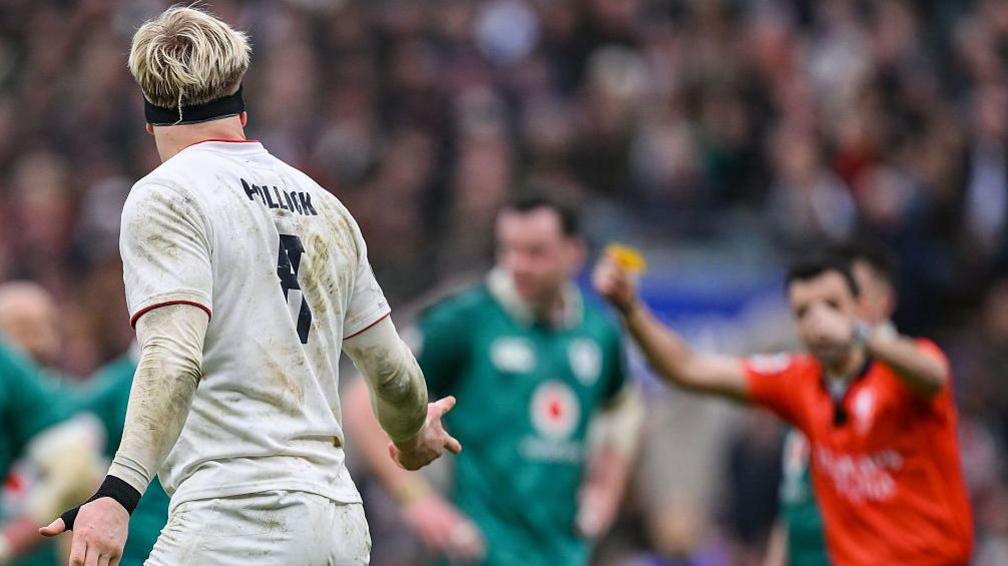
Baloucoune and Sheehan’s tries both resulted in yellow cards from scrambling defence by Freddie Steward and Pollock, which further added to England’s problems.
“Sorry to the fans – you have been outstanding. We have let everyone down,” Genge added.
Mentality and leadership
Like in Edinburgh, England captain Maro Itoje was again replaced before the final quarter of the game.
Itoje missed the start of the Six Nations training camp in Girona to attend his mother Florence’s funeral in Nigeria, before coming off the bench in the opening win over Wales.
Having only started two games since November before the tournament because of injury, England’s talisman is still getting up to speed.
Itoje is a leader by example, but is struggling to be at his impactful best.
Vice-captains Ford and Genge, who both made errors in the game, are examples of other players who could step up, but new leaders from England’s younger generation will also need to emerge.
England lose aerial battle
England’s kick-heavy strategy was key in their 12-game winning run, but against Scotland they failed to win the aerial battle.
Freeman’s switch back from outside centre to the right wing was with the view of improving in that area.
The 24-year-old had a mixed day in the air against Ireland, but still managed to compete when called upon.
Given Ireland lost James Lowe early to injury, utilising Freeman against O’Brien early could have brought some change.
Instead, Leinster’s O’Brien managed to regather a kick that eventually led to Baloucoune’s try.
Ireland simply won the aerial battle, also taking advantage of the height difference between the 6ft 4in Baloucoune and Henry Arundell, who is four inches shorter.
Arundell, 23, was backed to respond from his red card against Scotland and failed to enforce himself.
Immanuel Feyi-Waboso’s championship-ending injury is proving a vital moment in England’s campaign.
 Getty Images
- 4 hours ago
Most points conceded by England at home
Related topics
- England Rugby Union
- Rugby Union

Leave a Reply