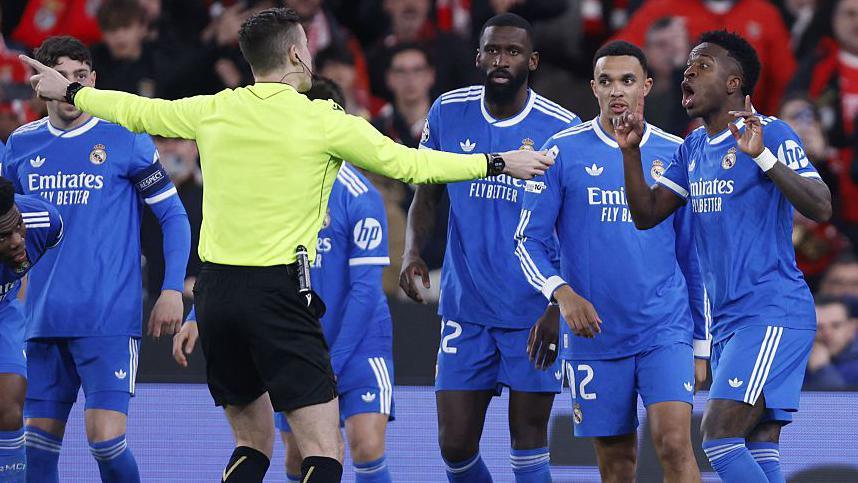
As Vinicius Jr sat on his own in the dugout at the Estadio da Luz, arguments raged on around him between coaches and players while the Real Madrid forward sipped on his water.
The Brazilian had told referee Francois Letexier he had been racially abused by Benfica midfielder Gianluca Prestianni – an allegation the Argentina international has denied.
Letexier acted immediately to stop the match, raising his arm in a crossed gesture to indicate there had been an allegation of racist abuse.
Moments earlier, the 25-year-old Vinicius had scored a world-class goal which would give Real Madrid a 1-0 win in the first leg of their Champions League knockout play-off round tie.
Rather than player welfare, the focus turned to protocol and process. Vinicius seemed to be left ostracised and the match restarted 10 minutes later.
The French official will file his report to Uefa, which will now complete its own investigation into the events in Lisbon.
But could it be handled any better?
“It is the least bad of a set of terrible options,” Kick It Out chair Sanjay Bhandari told BBC Sport.
“I don’t think anyone feels really happy with it, and I think everyone feels dissatisfied with it.
- 1 hour ago
A three-step process and 10-match ban
 Getty Images
Uefa introduced its three-step racism procedure in 2009 and gave referees the power to halt games.
This is how the protocol works; If a player reports alleged racism, a referee has no further powers if they have not heard what was said. The game is stopped and details given to the fourth official.
On Tuesday, Vinicius took himself off the pitch. It was then a case of diplomacy between the teams to get the game back on.
Had there been racist abuse from supporters, as is more usually the case, an announcement would be made.
If the racism continues, by players or fans, the game could be suspended for a longer period and another warning issued over the public address system.
If it still goes on, the game could then be abandoned.
Bhandari said the three-step protocol has “not been invoked a huge number of times” but when it has, it has provided a “quite healthy debate”.
It was used in the Premier League in the first match of this season at Liverpool by referee Anthony Taylor when Antoine Semenyo said he had been racially abused by a fan in the crowd during Bournemouth’s game at Anfield.
In 2013, Uefa drew up its “European football united against racism” policy.
It was driven by Gianni Infantino who, at the time, was the general secretary of the governing body.
The document created 11 resolutions which set out the responsibilities of players, coaches, clubs and supporters.
Infantino successfully pushed for a suspension of “at least 10 matches” for players found guilty.
In 2021, Slavia Prague’s Ondrej Kudela was banned for 10 matches after racially abusing Rangers midfielder Glen Kamara.
The crossing of arms to display an “X” is not part of the Uefa protocol.
- 10 hours ago
- 3 hours ago
‘Abandoning the match is the last resort’
A referee can only take action if they have heard the alleged racist abuse, in which case the player would be sent off.
If not, the only option available is the three-step protocol adopted across the game.
Former Fifa and Uefa assistant referee Darren Cann told BBC Sport the referee’s role is to “assure the offended player that the allegation is taken very seriously”.
“All referees are highly trained and very familiar with the three-step approach to follow, should they be made aware of any racist incidents,” he said.
“Usually the player will continue but the referee cannot force him to if he doesn’t want to.
“The player could be substituted. Abandoning the match is the last resort.”
Bhandari said this “prioritises getting the game played”, but he accepted officials have limited options.
The issue will always be that “players are not stupid enough to say anything within earshot of the referee”.
But Bhandari added Kick It Out would back any team that decided to walk off the pitch in support of their team-mate.
“If we went to the theatre and someone racially abused an actor, we would not expect the actor to stay on stage,” he added.
“It would take something like that for people to have another debate about the protocol.
- 16 August 2025
Watch highlights of every Champions League game from 22:00 on Wednesday on BBC iPlayer and the BBC Sport website and app.
Related topics
- Real Madrid
- UEFA Champions League
- Football

Leave a Reply