To play this video you need to enable JavaScript in your browser.
Up front? Behind the number nine?
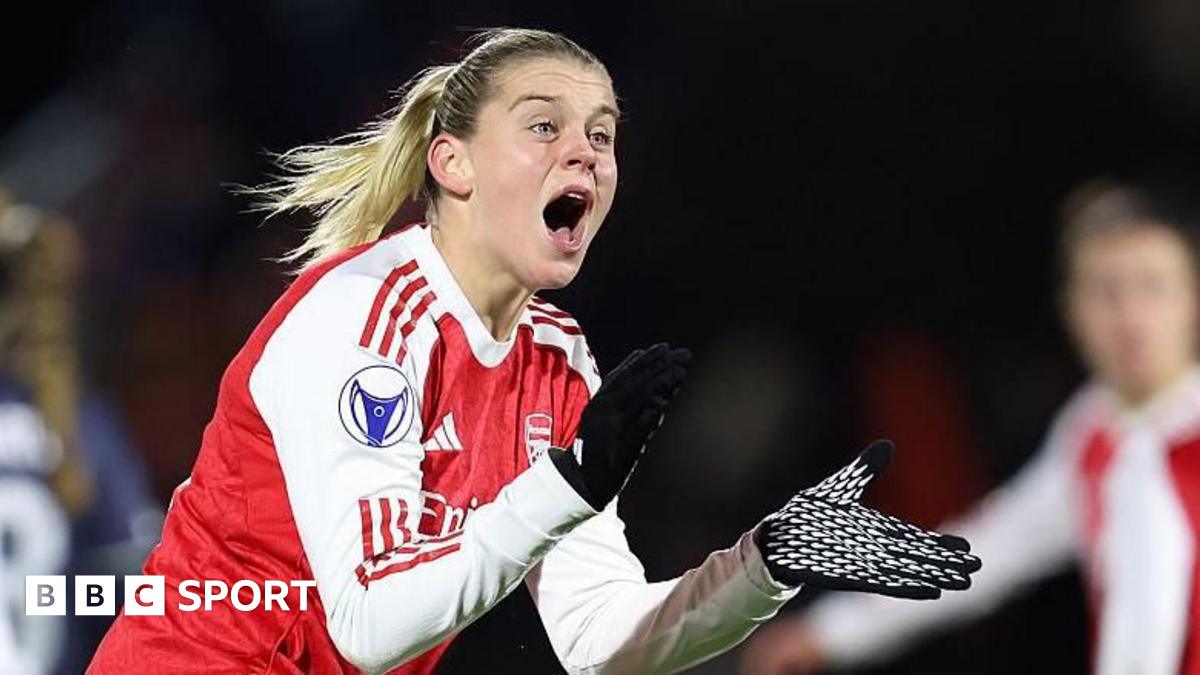
Where exactly is Arsenal’s Alessia Russo most effective?
When she won the Champions League last season, she did so playing as a central striker in Renee Slegers’ 4-2-3-1 formation.
Nine weeks later she scored the equaliser for England in the European Championship final against Spain with a predatory header from seven yards.
Leading the line is something she has done with great success in Europe this season, but it has been a different story in the Women’s Super League.
On many occasions domestically, Arsenal’s number nine has drifted back to become a number 10 – a different emphasis but with a similarly devastating impact.
Play her as an out-and-out striker
Objectively, Russo’s record in the main forward role is excellent.
Lethal in front of goal, she is two clear of Europe’s best in the Champions League, with her expert finishing highlighted by how she has over-performed her expected goals (xG), scoring seven from an xG of 3.49.
All her goals have come from inside the box and usually from a central position. Effectively, put her in the right place and she will find the back of the net.
It is the type of profile that would not look unfamiliar for the players she admires.
Boasting two assists in her eight Champions League matches, Russo has a goal contribution per game figure of 1.13, behind only Klara Buhl of Bayern Munich (1.5) and Barcelona’s double Ballon d’Or winner Alexia Putellas (1.17), who have both played fewer games.
Russo believes she has benefited from extra space in the revamped Champions League this season as she reckons teams are more willing to attack.
“You’re playing against champions of other countries and they are playing with less fear,” she said. “Teams give it a really good go.”
Perhaps this is why she has been able to clean up in Europe – and why she has spent 97% of her minutes operating in that central role.
For England, boss Sarina Wiegman is clear on how to deploy Russo.
“She can play both, and it’s nice to have options, but for us in the way we set up, her best position is as a number nine,” Wiegman said before the 2-0 win over Iceland this month.
For England at the Euros last summer, Russo’s role was even more centralised. She spent 14% of her time in the opposition box, sniffing out chances and occupying centre-backs.
Two goals and three assists came in that tournament, behind only Putellas for total goal contributions.
“As a nine, you’re obviously playing higher up, in and around the box, and reacting off instincts and small margins around the area,” Russo said.
Deploy her deeper behind the striker
That out-of-possession angle is an interesting one.
In the WSL this season Russo has dropped off into the number 10 position for more than a third of her minutes.
That has not translated into winning possession particularly often. For instance, fellow forwards Olivia Smith and Beth Mead have made more tackles than her.
It is a role that diminishes her goalscoring impact too – Russo has six in 16 games – and she has underperformed her xG by 1.1 this season.
However, it has amplified her threat as a creator. Her average per 90 minutes this season is more than one and a half chances created, and her total of 26 puts her joint fifth in the division.
Has that been a positive, though?
Last season Arsenal’s 62 goals in 22 WSL matches was the most in the division, but their 33 in 16 this time around is almost one full goal per game fewer.
Either defences are getting better or Arsenal’s attacking output has dropped off this season. In fairness, the 5-0 thrashing of West Ham on Saturday, with Russo pulling the strings from the number 10 position, was full of the flair Slegers demands from her team.
When Russo does play in the attacking midfield role behind a striker, she can serve those ahead of her, and she acknowledges the qualities of her fellow forwards in making her job easier.
“There are so many different talents in our forward positions – Stina [Blackstenius], Chloe [Kelly], Liv [Smith] and Beth,” she said. “I try to learn off them as much as I can.
“As a number 10, you are freer to join attacks late and attack the space rather than pushing the line as much. In build-up, you can drop a lot deeper and get involved earlier.”
What information do we collect from this quiz?
Russo puts Arsenal in ‘really good position’
As far as Slegers is concerned, the answer is simple.
“Alessia is fantastic to work with,” she told BBC Sport. “She can be really good as the nine and really good as the 10. We’re in a really good position where we have so many players that we can make a decision.
“If I only had 11 players and Alessia in my squad, she would constantly be in the nine, but this is part of our strength.
“Whatever position she starts in, she’s very effective for us.”
Therein lies the challenge for Chelsea, who know Russo extremely well having shipped five goals to her in 10 appearances since 2021-22.
Wherever she is deployed, she will be a constant menace to a backline that has been decimated by injury.
Slegers has her challenge at centre-back too, with captain Leah Williamson ruled out of the first leg through injury.
Arsenal v Chelsea
Women’s Champions League quarter-final first leg
Related topics
- Football
- Women’s Super League
- Women’s Football

Leave a Reply