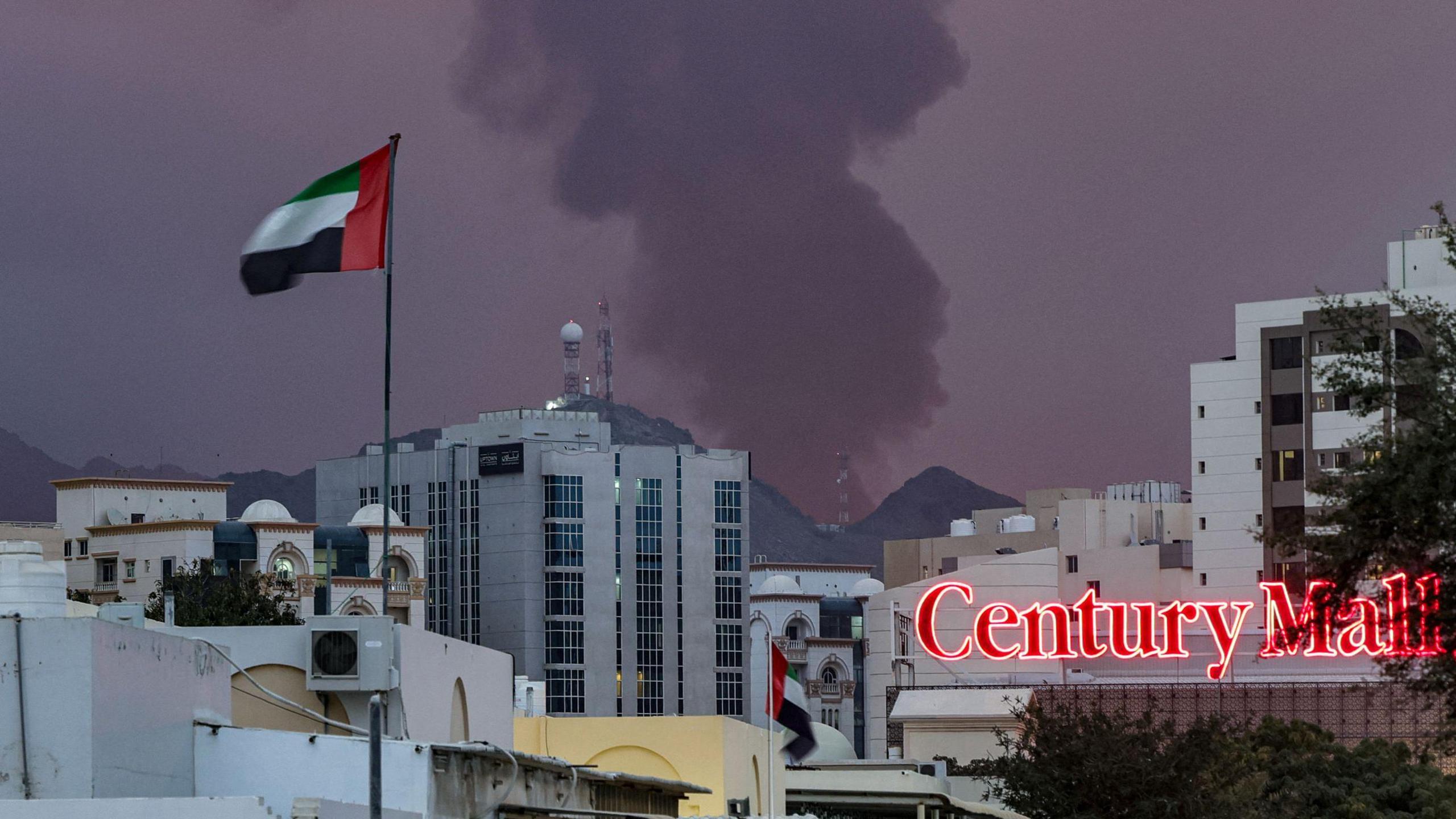
Explosions could be heard outside of the Dubai hotel.
With the United Arab Emirates coming under attack by Iranian missiles, the players who were there for an ATP Challenger tournament in nearby Fujairah did not expect to take to the court.
To their surprise, they were told it was safe to play in the port city about an hour’s drive east of Dubai, home to a key global oil storage and bunkering hub.
“We expected to stay in shelter because that’s what the governments were advising,” Australian player James McCabe, who was practising on court when he heard explosions and fighter jets overhead, told BBC Sport.
The UAE has come under attack after US-Israeli strikes on Iran, which began last Saturday, prompted retaliatory strikes across the region.
The ATP decided on Monday to proceed as planned with the tournament after holding discussions with the local government about its viability.
On Tuesday, players ran from the courts when a nearby oil terminal was set ablaze by debris from a drone attack.
The rest of the tournament was eventually cancelled, along with a second tournament at the same venue next week, leading to worried players desperately asking for support and scrambling for flights.
Two players – Russia’s Marat Sharipov and Uzbekistan’s Sergey Fomin – remain stranded in the UAE, along with their coaches. Everyone else has found a way to leave.
 ATP
ATP“A lot of the players didn’t want to play in Fujairah. But the ATP made the decision that it was safe to go.
“After the oil refinery was hit, it was still in the air that we could be going back on the court the next day – that was the scary part.
“It took them 10 hours to cancel the tournament. If the tournament had continued, I would have pulled out.”
The men’s governing body concluded it was safe to play following discussions with local government officials about the risk, with extra security measures put in place and the event being held behind closed doors.
All the players had already arrived in the UAE – meaning the draw was not affected by any travel disruptions – and that was highlighted as another factor in the decision.
But the knock-on effect has led to huge stress for the players, who are mainly ranked outside of the top 200 and far from financially secure as they try to make ends meet in their pursuit of reaching the main ATP Tour.
Costly demands & cancelled plans – how players tried to flee
Anger among the players reached boiling point when an ATP representative sent an email informing them that a chartered flight out of the Middle East was being arranged – but would cost them $5,000 (£3,750) each.
Prize money for winning the Fujairah tournament would have been almost $9,500 (£7,100). Losing in the first-round would have been $600 (£470).
After players made the situation public, the ATP said it would cover the cost of the chartered flight, which went to Milan via a stop in Egypt.
Sharipov was not able to fly to Italy because he does not have a European visa.
Disembarking in Egypt was an option, but meant leaving his luggage – including the racquets, kit and equipment which are his livelihood – with no guarantee when he would be reunited with it.
The 23-year-old felt he had no option but to stay in the UAE and search for alternatives.
“The ATP knew I could not travel to Europe so I think they should have said ‘we will sort something out for you’,” Sharipov told BBC Sport.
“They did not do this. They just said ‘there is a flight that you cannot make’. That’s really bad in my view.”
McCabe was able to leave on Tuesday, managing to book on to the first flight back to Sydney.
“It was a bit of a shock that the ATP didn’t support us with the flights getting out of there. We were left to our own devices,” said 22-year-old McCabe.
“As soon as we heard we needed to pay five grand everyone was pulling their hair out.”
The pair say those who arranged their own flights will not be reimbursed by the ATP. They have also been told players will receive no compensation in the absence of prize money.
 Marat Sharipov
McCabe said he was grateful to the Professional Tennis Players’ Association (PTPA) for offering $2,500 in support and also praised the UAE government for covering hotel costs for as long as players such as Sharipov need them.
Sharipov says he has spent $7,000 on four cancelled flights – on various routes from the region to Russia – because some airspace is still closed.
He continues to play the waiting game. He has a ticket booked to Armenia on Friday morning, but fears that will be cancelled too as many flights from Dubai continue to be grounded.
For the world’s best players, it was very different. Sharipov’s compatriots Daniil Medvedev, Andrey Rublev and Karen Khachanov were among a group also stuck in Dubai following the ATP 500 tournament there.
They were able to drive to Oman for a flight to Istanbul, then make the onward journey to California in time for the prestigious ATP 1000 tournament in Indian Wells.
“It’s not about the money in times like this,” said Sharipov, who was also entered the doubles with Fomin.
“But I think the ATP should help the players on the lower circuits like Challenger Tour more – because we don’t have that much.
Related topics
- Tennis

- 16 August 2025


Leave a Reply