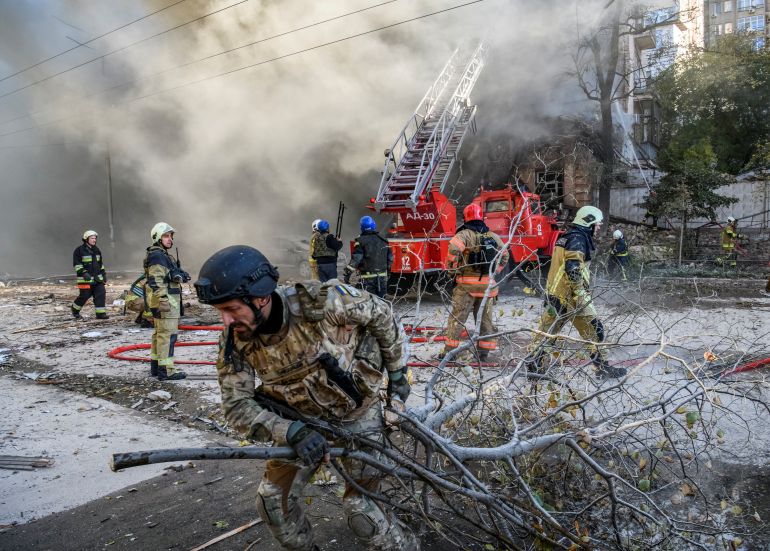
Kyiv, Ukraine – Experts estimate that Iran has tens of thousands of Shahed drones.
Recently released footage from Iranian media appears to show vast supplies stored in underground production facilities, signalling that Iran could deploy the weapons long into the foreseeable future.
Recommended Stories
list of 4 itemsend of list
Drones have been deployed in several Middle East countries this week.
Tehran claims to be attacking United States assets in the region in retaliation, after the US and Israel launched a war on it that has so far killed more than 1,000 people and seen its supreme leader assassinated.
In Ukraine, drone technology has been used on battlefields since Russia’s full-scale invasion began four years ago.
Now, Ukrainians are sure that they have the answers for how to combat them.
In a muddy field, young men test a weapon they hope they never have to use. A high-pitched whizzing sound fills the air as a cylindrical shape, no bigger than a kettle, thrusts towards the sky.
Al Jazeera is unable to disclose the location of the field due to security reasons.
It is a scene that shows how, despite hopes for a ceasefire, Ukraine is preparing to defend itself for a protracted war against Russia.
But battlefield lessons are no longer confined to Ukraine, as a new, wider war engulfs the Middle East.

As Iranian-designed drones appear across the skies in the expanding conflict involving the US, Israel, and Iran, Kyiv is emerging as an unlikely source of solutions.
At the centre of that shift is cost.
Recent attacks across the Gulf have seen million-dollar air-defence missiles used to destroy drones worth no more than $50,000.
Ukraine’s answer is a system born out of necessity, using interceptor drones designed to collide midair with incoming threats at a fraction of the cost.
On Saturday, the Iran war began as Ukraine and Russia were meant to meet for another round of peace talks in Abu Dhabi.
In the days that followed, Iranian-designed Shahed-136 drones struck countries including Saudi Arabia, Bahrain, Qatar, and the United Arab Emirates.
More than 1,000 drones launched towards Gulf nations
According to defence ministries in the Gulf, as of March 5, 1,072 drones had been detected over the UAE, with 1,001 intercepted. Qatar reported 39 drones detected and 24 intercepted, while Bahrain said it had destroyed 123 drones. Kuwait reported monitoring and intercepting 384 drones.
It is here that Ukraine is positioning its battlefield experience and interceptor drones as part of the solution.
According to a spokesperson for Skyfall, one of the private Ukrainian manufacturers producing the drones, the interceptor system was first deployed about four months ago.
He spoke to Al Jazeera from their testing ground in Ukraine.
The weapons function as kamikaze drones, armed with a warhead and programmed to crash into a Shahed or any fixed-wing drone. The P1-SUN, Skyfall’s version of the interceptor drone, travels up to 310 km/hour (190 miles per hour).
The entire body, the antenna, head, wings, and payload compartment are 3D printed, making these weapons cheap and easy to produce at scale.
When it comes to repelling Shahed drones, the spokesman says Ukraine is uniquely suited to the task.
“We’ve been dealing with this problem for more than four years already. We know all the types of Shaheds that Russia deploys.”

That expertise comes from experience.
Iran-made drones have caused extensive damage across Ukraine. Over recent years, Ukraine has focused on intercepting them.
Over the winter alone, Russia launched more than 19,000 attack drones at Ukraine, according to Ukrainian officials. In 2025, Moscow deployed 54,000 Shahed-type drones, renamed Geran-3, against the country.
Now Kyiv is offering that hard-earned experience abroad.
Since Monday, Ukraine has offered assistance to partners seeking cost-effective air defence technologies.
On Thursday, US President Donald Trump told the Reuters news agency he would accept assistance from any country when asked about Ukraine’s offer to help defend against Iranian drones.
That same day, Ukrainian President Volodymyr Zelenskyy said Kyiv had received a specific request from the US for help in dealing with drones in the Middle East.
“I gave instructions to provide the necessary means and ensure the presence of Ukrainian specialists who can guarantee the required security,” he said on X.
Back at the testing ground, the Skyfall spokesman offers his advice to the world bluntly.

Leave a Reply