- 302 Comments
The opening race of Formula 1’s new era in Australia left all the drivers, even race winner George Russell, with mixed feelings about what the sport had become.
People in F1 went to Melbourne nervous about what the first race of the season would throw up.
There was concern about the new driving styles required with the new engines, with their 50-50 split between internal combustion and electrical power.
There was anxiety about the potential for danger at the start, with cars getting away at wildly different speeds, about the risk of huge speed differentials in the race when one car was deploying all its electrical energy and another had gone into recovery mode.
What would it all look like? Would the audience like it? Would it look real? Had F1 shot itself in the foot? How big a change might be needed in the regulations to return the sport to something closer to its essence?
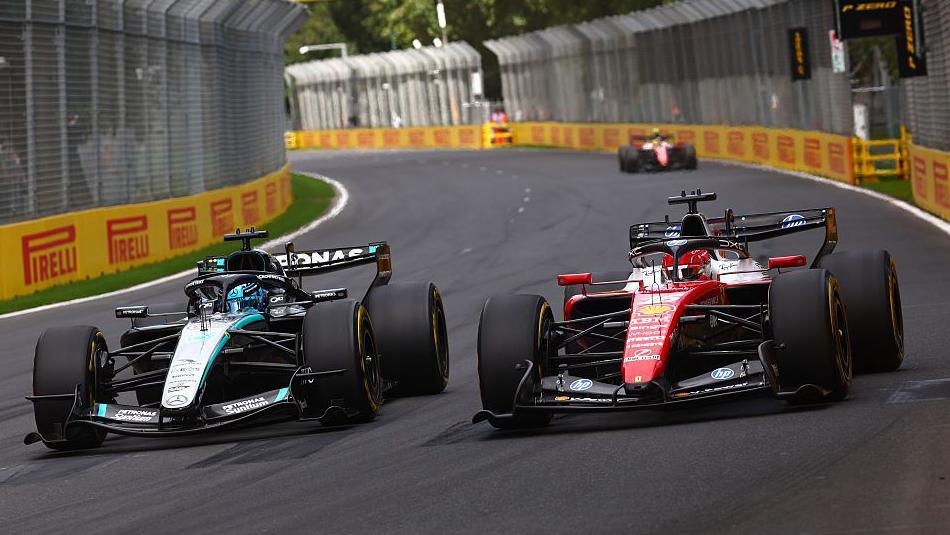
In the end, the race largely looked like a race. Russell and Charles Leclerc provided great entertainment as they swapped and re-swapped the lead over the opening 10 laps, each using their “boost” and “overtake” modes to pass.
This is a version of F1 that provided 125 overtaking manoeuvres in a race in which there were 45 last year, according to F1’s own official statistics.
But more overtaking is not necessarily an entirely good thing – it depends on what makes the overtakes happen.
To play this video you need to enable JavaScript in your browser.
‘F1 waiting for something to go horribly wrong’
Russell said the new style of F1 had made his early battle with Leclerc “dicey”.
Leclerc, who finished third behind Russell and his Mercedes team-mate Kimi Antonelli, said the new requirement to constantly charge and deploy 350kw (470bhp) of electrical power “will definitely change the way we go about racing and overtaking”.
Lewis Hamilton, fourth behind Ferrari team-mate Leclerc, said he “loved it, the race was really fun to drive”.
World champion Lando Norris, who finished fifth, predicted that F1 was “just waiting for something to go horribly wrong” given the speed differentials involved.
And four-time champion Max Verstappen said he loved racing but not like this. “I do want it to be better than this,” he said.
Of the battle for the lead for the first 10 laps, Ferrari team principal Frederic Vasseur said: “I’m not sure that I saw something like this the last 10 years.”
But the misgivings remain, and team bosses retain open minds about the potential that the rules might need to be tweaked after three races this year – a point at which all have agreed to take a pause and reflect.
The battle between Russell and Leclerc was a function of the new technology.
One would use the overtake or boost mode to pass. But this not only left them vulnerable to being overtaken again, as the cars swapped around who had the most electrical energy, but also made it difficult for them to break away from each other, and the rest of the field.
In fact, their battle compromised them heavily, allowing Hamilton and Antonelli to catch up and briefly make it a four-way scrap for the lead before a virtual safety car led to split strategies and an ultimately comfortable victory for Russell and a one-two for Mercedes. They look formidably strong heading to the second race in China this coming weekend.
There was enough evidence in the race that the concerns expressed by the drivers were real, too.
The speed differentials at the start were startling. There was one very near miss between Liam Lawson of Racing Bulls and Franco Colapinto’s Alpine, and Norris and Russell both expressed concerns about them in racing on track, too.
Norris was the most outspoken.
“It’s chaos,” he said. “You’re going to have a big accident, which is a shame. You’re kind of driving and we’re the ones just waiting for something to happen and something to go quite horribly wrong, and that’s not a nice position to be in.
“Just depending on what people do, you can have a 30, 40, 50 km/h speed (differential), and when someone hits someone at that speed, you’re going to fly and you’re going to go over the fence and you’re going to do a lot of damage to yourself and maybe to others. And that’s a pretty horrible thing to think about.”
Equally, is racing by pressing a button for more electrical energy really racing? McLaren team principal Andrea Stella described it as “a little bit artificial”.
- 6 hours ago
- 3 hours ago
- 1 hour ago
‘We should just give it a chance’
This issue at the centre of this is the way the engines behave. With their virtually equal split between internal combustion and electrical power, they are energy starved, and the battery is being charged and recharged several times a lap.
When they go into recharge mode, they lose as much as 470bhp. When they are at full power, they have 1,000bhp. But the need to optimise that balance leads to unconventional driving techniques and car behaviour.
At the end of long straights, the energy tails off and the speed drops, long before the driver brakes for the corner. “Overtake” and “boost” mode provide more power, but drain the battery faster, leaving a driver vulnerable to being re-passed on the next straight.
There are further “weirdnesses”, as some have called them, in qualifying, where drivers are “lifting and coasting” on straights, and not accelerating at full power until some way along the start-finish straight, for example.
It’s all this stuff that Verstappen hates, because it takes away from the purity of driving flat out – braking as late as possible, accelerating as soon as possible, to generate lap time.
“I don’t really find the right words for it,” Verstappen said. “What they should worry about is the rules, focus on that. They ask questions and I give my opinion, on what I think is better for the sport.
“I hope even this year we can come up with some different solutions so it becomes more enjoyable for everyone.
“I love racing, but you can only take so much. They are willing to listen, FIA and F1, I just hope there is some action. It is not that I’m the only one saying it, a lot of people are. If it’s drivers, fans, we are not critical just to be critical, we are critical for a reason.
“We want it to be F1, proper F1 on steroids. Today of course again that was not the case.”
On Saturday after qualifying, Norris had even gone as far as to say that F1 had gone “from the best cars to the worst ones”.
But that was not true. The drivers did not like the last generation of cars – and Norris was one of the ones to say so at the time.
Yes, they were fast in the high-speed corners, and the engines were definitely more “racey” than the current ones. But the rock-hard suspensions of the ground-effect cars were not popular at all, and the chassis side of the new rules, most would agree, has been a step in the right direction.
As Russell said about Norris’ comments: “If he was winning, I don’t think he’d be saying the same. We weren’t happy with how stiff the cars were last year and the porpoising, and everyone had a bad back and drivers were complaining about that.
What information do we collect from this quiz?
The Briton wants those in the sport to take more time before coming to a definitive judgement of the new rules.
“Everyone’s very quick to criticise things,” he said. “You need to give it a shot, you know. We’re 22 drivers. When we’ve had the best cars and the least tyre degradation and when we’ve been happiest, everyone moans the racing’s rubbish. Now drivers aren’t perfectly happy and everyone said it was an amazing race. So, you can’t have it all, and I think we should just give it a chance and see after a few more races.”
Russell’s boss, Toto Wolff, said: “I didn’t hear any one of the drivers speaking particularly good of the last cars and saying it was the best car. So we tend to be very nostalgic and looking at past events.
“But clearly we are all stakeholders of the sport. We need to have a great spectacle, the best cars in the world and the best drivers and being exciting for the fans. And that’s why we just need to look at the product.
“One perspective is the view of the drivers, which is an important perspective.
Your views to BBC F1 live text page
Edward: Overall a promising start to these new regs. A little concerned about cars sometimes blasting past others, but that opening stint was chaotic.
Dougie: Not true Formula 1 racing. Not testing the skills to become the ultimate driver. Won’t take long to get boring.
Stu: Great first race of the season, the new regs have enabled the cars to follow for longer and to be able to overtake. The first 10-15 laps was non-stop action… more of that please for China and the rest of the season.
Jake: The most exciting first 10 laps I can remember.
Richard: This is like traction control and active suspension era. It’s anti-F1 racing with too much reliance on power deployment and boost rather than driver skills. It’s ripped the excitement out and I just wanted to stop watching.
Mikey: Plenty more overtakes, looks like we’re on for a more exciting season.
Andrew: The early laps reminded me of close battles in Formula Ford, but with more power and grip. That’s commendable!
Related topics
- Formula 1
- 3 hours ago

- 1 day ago

- 4 days ago


Leave a Reply