The US-Israel war on Iran has rattled global energy markets, as countries scramble to secure fuel, conserve supplies and rethink exports.
Tehran has effectively halted most traffic through the Strait of Hormuz, a key shipping lane between the Gulf – also known as the Arabian Gulf and the Persian Gulf – and the Gulf of Oman, which supplies one-fifth of the world’s oil, in retaliation for the US-Israeli attacks, which started on February 28.
Recommended Stories
list of 3 itemsend of list
With tanker traffic severely reduced and crude oil prices surging past $100, major oil-importing nations such as Bangladesh and Thailand are looking for workarounds to avert a crisis at home, including diversifying crude suppliers and rationing fuel.
Nevertheless, analysts doubt that any alternative can ensure long-term energy stability as the Middle East remains the world’s main oil and gas supplier.
Here are four strategies countries are enacting to ease the impact of the war on their fuel needs:
Turning to Russia, other suppliers
India has resumed buying Russian oil after halting imports from its old ally following US sanctions against Moscow’s biggest oil producers.
This, after the US temporarily exempted India from sanctions on buying Russian oil shipments currently stranded at sea, aiming to prevent disruptions to global supply and curb further spikes in energy prices. The 30-day waiver would end in early April, but it can be extended by the Trump administration.
“Russian oil can help cushion a short-term supply shock, but its usefulness depends on two uncertain conditions: that Russian barrels remain available and that the discount remains meaningful,” energy expert Tatiana Mitrova, a fellow at Columbia University’s Center on Global Energy Policy, told Al Jazeera.

In theory, the estimated 120-140 million barrels of Russian oil reported to be “on the water” could cover weeks of India’s imports, Mitrova said. However, she warned that, in practice, only a fraction can be redirected quickly due to logistical and refinery constraints.
The “discount” Mitrova referred to is a subsidised rate at which Russia sold oil to India from 2022 until late 2025, when Europe and other traditional buyers shunned Russian crude amid the Ukraine war. Desperate to sell its oil, Russia was offering India discounts. However, with Russian oil now in high demand because of the war in Iran and the choke on transit through the Strait of Hormuz, it is unclear whether Russia continues to offer India crude at subsidised rates.
At the same time, China, another major buyer, could compete for the same barrels, narrowing discounts and pushing prices closer to global benchmarks if disruptions continue, Mitrova said.
“Russian oil is a useful tactical buffer, but not a durable shield,” she added.
Analyst Abhi Rajendran said the current disruption is much larger than past shocks, and the volume of oil and gas flowing from the Middle East that has now been blocked cannot be quickly replaced.
Rajendran, a non-resident fellow at the Center for Energy Studies at Rice University, said other major oil and gas exporters, such as the US and Norway, would need months to ramp up their production, and only inventory releases can partially bridge the gap.
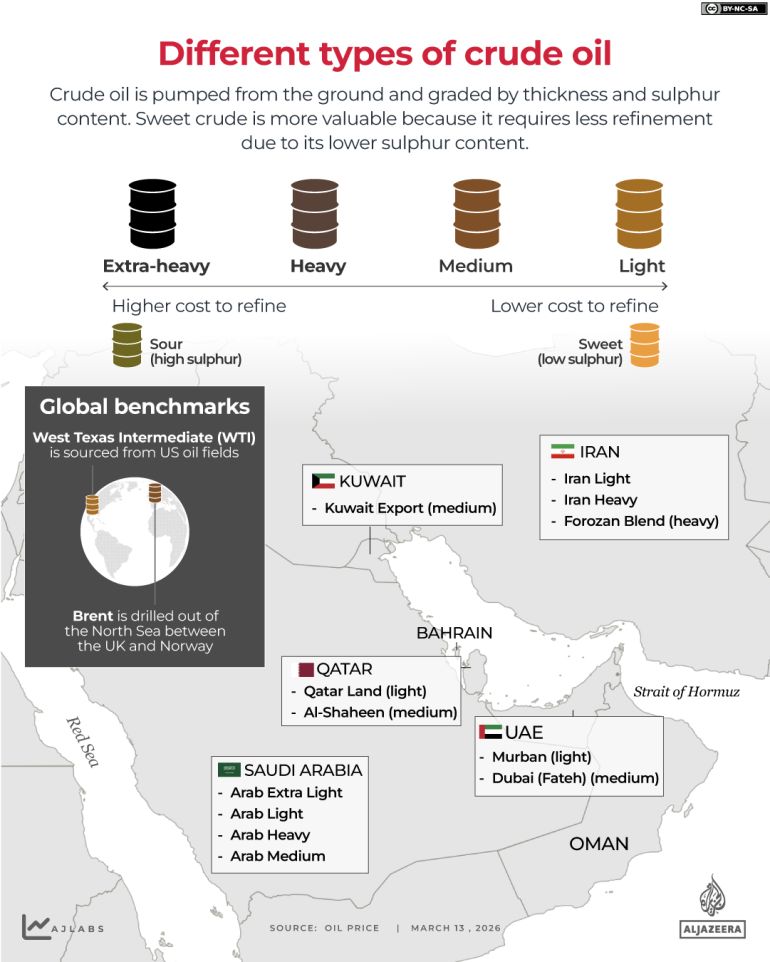
He also pointed out that crude produced by different countries varies in quality, and refineries in different countries are configured for different grades. Oil produced in one country is not an automatic replacement for crude exported from another nation.
Fuel rationing
Many governments are resorting to fuel rationing to deal with the situation. Sri Lanka, for example, has introduced a QR code-based fuel authorisation system to regulate petrol and diesel distribution amid supply pressures. The scheme, launched on March 15, requires vehicle owners to present a unique QR code obtained after registering their vehicles online before buying fuel.
At fuel stations, attendants scan the QR code to verify the vehicle and track its weekly fuel quota. Limits vary by vehicle type; for example, cars can receive up to 15 litres a week, while it is capped at 5 litres for motorcycles, authorities said.
Bangladesh imposed similar restrictions on March 6, introducing daily limits on fuel sales following reports of stockpiling and panic buying.
However, authorities in Dhaka said on Sunday the limits would be suspended, citing sufficient reserves and the need to meet higher demand during the upcoming Eid holidays.
Alternative shipping routes
Iraq, a major oil exporter, is exploring alternative routes to transport its crude.
Ministry of Oil spokesperson Saheb Bazoun said last week Iraq had several shipments stuck at sea and that crude sales, which provide about 90 percent of state revenues, had sharply declined.
To ease the pressure, Baghdad has proposed exporting at least 200,000-250,000 barrels per day of crude from Kirkuk via the pipeline to Ceyhan in Turkiye, which crosses the northern Kurdish region. However, talks with Kurdish authorities have stalled, the Reuters and AFP news agencies have reported.
Remote working, austerity measures
Bangladesh, Pakistan, Vietnam and Thailand have announced their work-from-home policies for government employees while recommending similar steps for private employees.
Pakistan has introduced a four-day working week for government employees, with 50 percent of the staff working from home on rotation.
Vietnam has called on businesses to allow people to work from home to reduce the need for transport.
In addition to mandating remote work, the Thai government has asked its employees to take stairs to reduce the use of lifts and encouraged online meetings to help conserve fuel. It has also asked government employees to wear short sleeves and avoid suits to minimise cooling costs in offices.
Academic Fengqi You said remote work can cut oil demand – mainly by reducing commuting – but its national impact is limited. “Work-from-home is useful for short-term crises and long-term energy planning,” You, a professor of energy systems engineering at Cornell University, told Al Jazeera.

Leave a Reply