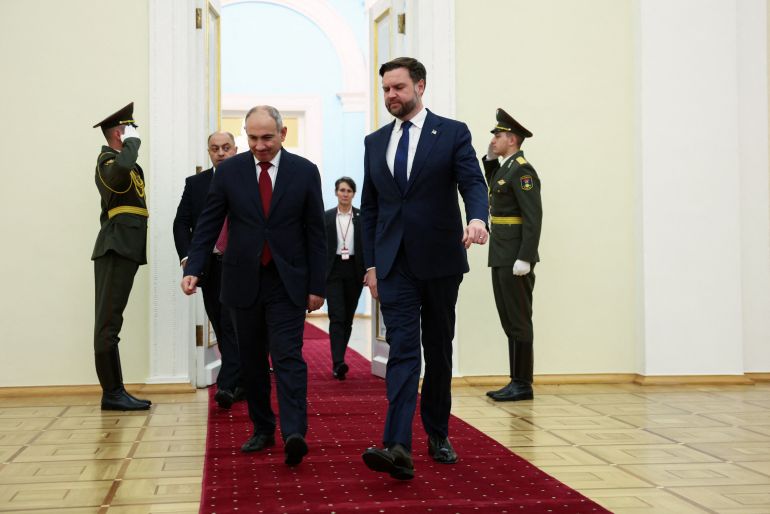
The United States and Armenia have struck an agreement on civil nuclear cooperation, amid a push by Washington to strengthen ties with the West Asian country that was once a close ally of Moscow.
Armenian Prime Minister Nikol Pashinyan and US Vice President JD Vance, who is on a two-day visit to the country, signed the multibillion-dollar nuclear energy deal on Monday.
Recommended Stories
list of 4 itemsend of list
The deal, known as a 123 Agreement, sees the US entering a sector previously dominated by Russia, which had supplied the technology for the only nuclear power plant in the republic.
“This agreement will open a new chapter in the deepening energy partnership between Armenia and the United States,” Pashinyan said at a joint news conference with Vance.
Vance said the agreement, which allows the US to legally license nuclear technology and equipment to other countries, would enable up to $5bn in initial US exports to Armenia, plus an additional $4bn in longer-term fuel and maintenance contracts.
The deal related to small modular reactors, he said, adding that Washington had enough confidence in Armenia to supply it with this new technology.
Vance’s visit – the first to Armenia by a sitting US president or vice president – comes six months after the Armenian and Azerbaijani leaders signed an agreement at the White House, seen as the first step towards peace after decades of war.
Armenia seeking to diversify partners
Yerevan, which has relied on Moscow and Tehran to meet its energy needs, has been reviewing proposals from US, Russian, Chinese, French and South Korean companies to construct a new nuclear reactor.
The facility would replace its ageing Russian-built nuclear power plant in Metsamor.
The agreement with Washington clears the way for a US plant to be chosen – a development that would deal a blow to Russia, which has viewed the South Caucasus as its sphere of influence.
Narek Sukiasyan, a political scientist in Yerevan, told the Reuters news agency that given Armenia’s multiple dependencies on Russia, it was a “political priority to diversify partners when it comes to nuclear cooperation”.
“The United States seems to be the preference now,” he said.
Russian Deputy Foreign Minister Mikhail Galuzin told media outlet Izvestia that a Russian proposal for a new nuclear plant was the best option for Armenia, and that Russia’s state nuclear corporation Rosatom was ready to proceed “very quickly” with the project.
“There are no real alternatives in terms of the availability of reliable, proven technologies, as well as the attractiveness of financial parameters,” he said.
During his trip, Vance is also seeking to advance plans for the so-called Trump Route for International Peace and Prosperity (TRIPP), a proposed 43km (27-mile) corridor that would run across southern Armenia and give Azerbaijan a direct route to its exclave of Nakhchivan and on to its close ally, Turkiye.
The land corridor is part of the deal signed between Armenia and Azerbaijan in August in Washington, DC.

The route would better connect Asia to Europe, while bypassing Russia and Iran at a time when Western nations are seeking to diversify energy and trade routes away from Russia amid Moscow’s war on Ukraine.
The corridor, which is intended to include new or modernised rail infrastructure, oil and gas pipelines and fibre optic cables, is being billed as a transformative megaproject for the closed and conflict-riven South Caucasus.
“We’re not just making peace for Armenia,” Vance said. “We’re also creating real prosperity for Armenia and the United States together.”

Leave a Reply