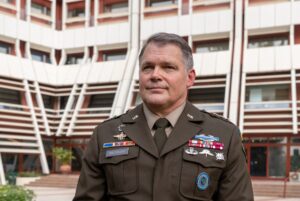
As part of a wider American push to collaborate with African militaries to fight Islamic State-linked militants, the US military is increasing its supply of weapons and intelligence with Nigeria, according to Africom’s deputy commander.
According to Lieutenant General John Brennan, the Pentagon has maintained communication with military bases in Burkinabe, Niger, and Mali, which are under the junta.
The US military is becoming “more aggressive” in pursuing IS-linked targets on the continent as a result of Washington’s diplomatic pressure on Nigeria over jihadist violence there.

We’ve gotten a lot more aggressive and are working with partners to target, primarily ISIS, according to Brennan, who spoke on the heels of a US-Nigeria security meeting last week in the country’s capital.
The problem set is linked from Somalia to Nigeria, according to the statement. So we’re attempting to disassemble it before giving partners the information they require,” he continued.
More enabling partners have been involved, and less restrictions have been placed on them, making it easier for them to gain more success.
About a month after the US announced surprise strikes on IS-linked targets in northwest Nigeria, the US-Nigeria Joint Working Group met last week.
diplomatic conflict
After the joint strikes, both militaries appear eager to work together again, but Washington’s diplomatic pressure is weighing in on the matter, which Trump claims led to a number of Christians being killed in Nigeria.
Abuja and independent analysts refute the long-standing religious right in the US to frame Nigeria’s numerous, intertwining conflicts.
At the Joint Working Group meeting in Abuja, Allison Hooker, the State Department’s number three, pressed the Nigerian government to “protect Christians” in a speech that neglected to mention the Muslim victims of armed groups.
The north of Africa’s most populous nation is roughly evenly divided between a predominantly Muslim and largely Christian south. Religious and ethnic identity are still a hot topic in a nation that has experienced sectarian violence throughout its history, despite the fact that millions of people live peacefully alongside one another.
According to Brennan, US intelligence would not only be used to defend Christians.
He added that, in the wake of the US’s recent airstrikes in northwestern Sokoto state, American support will continue to be focused on sharing intelligence to support Nigerian airstrikes there and the northeast, where a jihadist insurgency led by Boko Haram and rival breakaway ISWAP have raged since 2009.
He called ISWAP, or Islamic State West Africa, “our most alarming group.”
In recent months, some have questioned whether air support alone can stop armed groups that thrive in rural poverty and state collapse. However, analysts have been tracking US intelligence flights over the country.
Read more: Police Surveillance Truck Bringing Suspect Explosives to Oyo
Still work with AES militia members?
According to Brennan, continuing US-Nigerian cooperation will entail “the entire gamut of Intel sharing, sharing… tactics, techniques, and procedures,” as well as enabling them to acquire more equipment.
According to Brennan, the initial strikes targeted militants who were typically active in neighboring Niger and affiliated with the Islamic State Sahel Province.
Analysts worry that ISSP will spread to coastal West African nations like Nigeria as it is a result of the Sahel’s influence.
Local and international journalists were unable to confirm the casualties of those strikes, which has so far been undetermined.
Nigerian information minister Mohammed Idris questioned their effectiveness last week, saying that work was still being done.
In the Sahel, Brennan said more broadly that “we still work” with the junta-led Burkinabe, Mali, and Niger, which have largely rejected the West and distanced themselves from their neighbors.
Since coups that threw civilian governments in the three countries between 2020 and 2023, security cooperation has been hampered.
He claimed that we have actually shared information with some of them to attack important terrorist targets. Even though it’s not a formal agreement, we still communicate with our military partners throughout the Sahelian states.
After the ruling junta forced its troops out of Niger, Brennan added, the US is not attempting to replace its bases there.
He cited the abandoned US drone operations in Agadez as saying, “We’re not in the market to build a drone base anywhere.”
We are much more focused on arriving in the right place at the right time than departing. None of the Western African nations are willing to host us for a long-term base.
Source: Channels TV
Leave a Reply