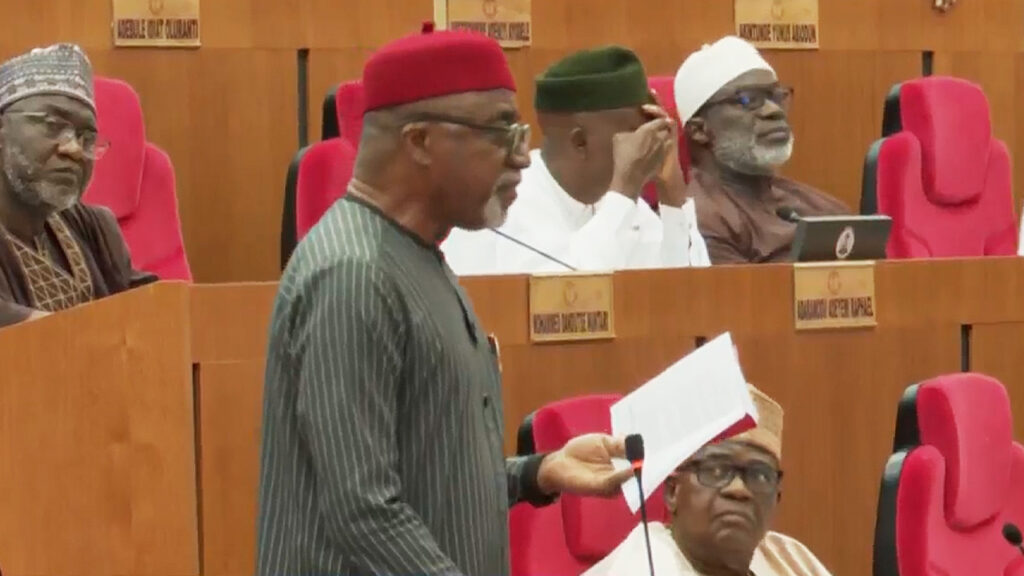
The Senate has held an emergency plenary session amid backlash over amendments to the Electoral Act, particularly provisions relating to the electronic transmission of election results.
Here were some of the key developments from the session, which started around 12:30 pm on Tuesday.
13: 34 pm: The Senate President has expanded the membership of the Senate Conference Committee to 12 and directed members to commence sittings immediately, as legislative work on the bill enters its final stage.
Addressing the committee, the Senate President urged members to expedite their deliberations, noting that the outcome would be transmitted promptly to the Presidency for assent within February.
He expressed optimism that President Bola Tinubu, in the next week, would sign the bill into law as an act of Parliament.
The number of lawmakers from the Senate was increased to 12 from a previous 9 to align with that of the House of Representatives. The total number of lawmakers from both chambers now stands at 24.
1:14 pm: The Senate President, Akpabio, continues with the votes and proceedings
1:10 pm: Abaribe withdraws his call for individual votes
1:02 pm: Sen. Abaribe calls for a vote on the matter, which is met with immediate uproar among lawmakers.

12:55 pm: The Senate President, Godswill Akpabio, has aligned with a motion sponsored by Senator Tahir Mungono calling for the electronic transmission of election results by presiding officers at polling units.
Under the proposal, electronic transmission would serve as the primary method of uploading results. However, in the event of technical challenges such as network failures, the motion provides for a fallback option allowing the manual transmission of results using Form EC8A, duly signed and stamped by the presiding officer.
The proposal, however, sparked concerns among lawmakers, particularly over the reliance on Form EC8A as the primary source of election results, where disputes arise.
The differing views led to sharp divisions on the floor of the Senate, prompting Senator Enyinnaya Abaribe to call for an individual vote on the matter to clearly determine the position of each lawmaker.
12:50 p.m.: The Senate now takes the motion by Senator Tahir Munguno that the decision on Clause 60 (3) be rescinded and recommitted to the committee of the whole.
Background
The emergency sitting was announced in a notice issued on Sunday by the Clerk of the Senate, Emmanuel Odo, following the directive of Senate President Godswill Akpabio.
“I am directed by His Excellency, the President of the Senate, Distinguished Senator Godswill Obot Akpabio, GCON, to inform all Distinguished Senators of the Federal Republic of Nigeria that an Emergency Sitting of the Senate has been scheduled to hold as follows: Date: Tuesday, 10th February, 2026. Time: 12:00 noon. Venue: Senate Chamber,” the notice read.
Although no official reason was given for the emergency sitting, the development comes amid widespread public debate and protests following the Senate’s passage of the Electoral Act 2022 (Repeal and Re-enactment) Amendment Bill 2026 through a third reading last week.
READ ALSO: Occupy National Assembly Protest Begins In Abuja Over E-Transmission Of Election Results
The controversy centres on Clause 60, Subsection 3, of the bill, which relates to the electronic transmission of election results.
The Senate declined to approve a proposed amendment that would have made real-time electronic transmission of results mandatory, instead retaining the existing provision in the 2022 Electoral Act.
The retained clause states that “the presiding officer shall transfer the results, including the total number of accredited voters and the results of the ballot, in a manner as prescribed by the Commission.”
The rejected amendment would have required presiding officers of the Independent National Electoral Commission (INEC) to electronically transmit polling unit results to the IREV portal in real time after the relevant result forms had been duly signed and stamped.
The Senate also rejected proposals seeking to introduce a 10-year ban on vote-buyers, opting instead to retain existing penalties of fines and jail terms.
Protest

Public discontent over the Senate’s decision spilled onto the streets on Monday, as members of civil society groups and opposition political parties converged on the entrance of the National Assembly in Abuja under the banner of the “Occupy National Assembly” protest.
The demonstration, which was directed against the Senate’s position on electronic transmission of results, attracted a heavy security presence, with personnel deployed from the Nigeria Police Force, the Nigerian Army and the Nigeria Security and Civil Defence Corps.
The entrance to the National Assembly was barricaded by security operatives, but some of the protesters told Channels Television that they did not intend to force entry into the National Assembly, noting that the demonstration was planned to take place solely at the gate.
The protesters marched from the Federal Secretariat towards the National Assembly complex.

Meanwhile, the 2023 presidential candidate of the Labour Party, Peter Obi, who is now a member of the ADC, also joined the protest.
Obi said the Senate must act to prevent a recurrence of the technical failures reported by INEC during the 2023 general elections.
According to him, lawmakers should make real-time electronic transmission of election results mandatory to strengthen the credibility of the electoral process.
Clarification
In response to the backlash, Senate President Godswill Akpabio clarified that the Senate did not reject electronic transmission of election results but merely retained the provision as contained in the 2022 Electoral Act.
Speaking at a book launch over the weekend, Akpabio explained that the phrase “real time” was removed to avoid potential legal complications arising from network failures.
“All we said during the discussion was that we should remove the word ‘real-time’ because if you say real-time, then there is a network or grid failure, and the network is not working. When you go to court, somebody will say it ought to have been real-time. That was all we said,” he said.

Akpabio added that the decision was intended to give INEC the flexibility to determine the most appropriate method of transmitting results, taking into account technological and security challenges.
‘Allow INEC decide’
Former Senate President David Mark responded to Akpabio in on the issue, stating that the National Assembly should allow INEC to decide whether or not to transmit election results electronically.

Despite the criticism, some senators have defended the bill, insisting that it enjoyed overwhelming support in the Red Chamber.
“Over 85 per cent of senators agreed to electronic transmission. It was common ground. Even the ad hoc committee of the Senate agreed to it,” the Senator representing Anambra Central, Victor Umeh, told Channels Television.
Umeh said the only change agreed during the Senate’s executive session was the removal of the phrase “in real time”, attributing the decision to concerns about network coverage in some parts of the country.
“It was only ‘real time’ that was expunged because of network issues. Transmission itself was never in dispute,” he said.
According to him, confusion arose during plenary when a motion was reportedly introduced to replace the word “transmission” with “transfer” without debate.
“There was no debate on it. If debate had been allowed, it would have taken us back to the executive session where the issue had already been exhaustively discussed and resolved,” Umeh added.
You can watch the Senate proceedings today on all our platforms.

Leave a Reply