Kyiv, Ukraine – The Russia-Ukraine war’s harshest winter has brought ceaseless pressure from Moscow along the front line and significant aerial attacks that have left millions of Ukrainians without power and heat.
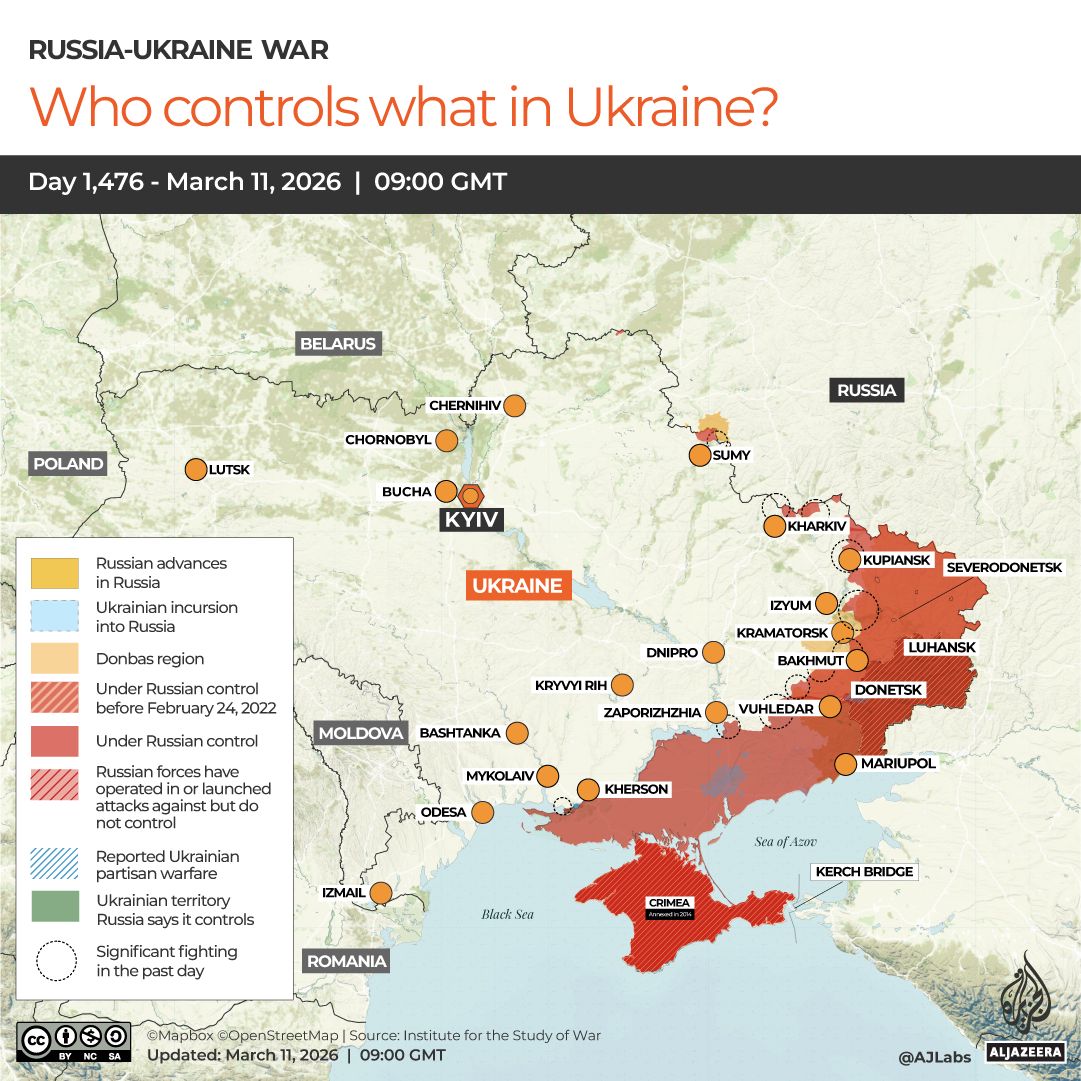
Even though Russia keeps pushing towards Ukrainian strongholds in the southeastern region of Donetsk and plans a spring-summer offensive, for the first time in almost three years, Kyiv began regaining some territory.
Recommended Stories
list of 4 itemsend of list
The gains amounted to 460sq km (117.6sq miles), or about 10 percent of what Kyiv lost to Moscow in 2025, according to Ukrainian President Volodymyr Zelenskyy.
Moscow’s inability to replenish its front-line losses is the main factor, he said.
“Russia is losing a lot of people, up to 35,000 a month,” he told Corriere Della Sera, an Italian daily, on March 3.
Because of the losses inflicted by Ukraine, Russia’s army “stopped growing. Losses equal the number of newly mobilised soldiers. They are close to a crisis,” he was quoted as saying.
The Institute for the Study of War (ISW), a US think tank, said the gains were more modest – 257sq km (100sq miles) – but admitted that the porous front line and multiple grey areas complicate a better calculation.
Almost all of Dnipropetrovsk liberated, Ukraine says
Ukrainian counterattacks were especially successful in the eastern region of Dnipropetrovsk, where the presence of Russian troops had been insignificant and is now reduced to only three towns.
“Almost the entire territory of Dnipropetrovsk has been liberated,” Major General Oleksandr Komarenko, Ukraine’s chief strategist, said in televised remarks.
In the neighbouring Zaporizhia region, where Moscow had occupied almost three-quarters of the total area and advanced towards the eponymous administrative capital, Ukrainian forces have regained nine towns since January.
“These counterattacks are generating tactical, operational and strategic effects that may disrupt Russia’s Spring-Summer 2026 offensive campaign plan,” the ISW said.
According to Lieutenant General Ihor Romanenko, former deputy head of the Ukrainian military’s General Staff, the gains are “tactical but very meaningful”.
But he told Al Jazeera that while Ukraine “amassed some reserves” to advance in Dnipropetrovsk and Zaporizhia, Russians keep pushing forward in key areas in Donetsk towards the towns of Sloviansk, Liman, Siversk and Kostiantynivka.
To Romanenko, lower recruitment numbers throughout Russia are key to Moscow’s losses.
“For three months, they’ve had nothing to create their reserves with,” he said.
In 2025, Moscow’s aggressive recruitment fuelled by a persuasive campaign and hefty signing bonuses of tens of thousands of dollars replenished the losses, and the monthly number of newly mobilised servicemen sometimes approached 60,000, he said.
But this year, Russia’s recruitment spree seems to be hobbled by financial problems caused by Western sanctions as the people needed to feed the front line seem exhausted.
Putin’s dilemma
Russian President Vladimir Putin appears wary of a public outcry that would stem from a full-scale mobilisation.
“Putin is afraid of conducting a full mobilisation. He’s looking for other ways,” Romanenko said.
One of them is the forced enlistment of university students, especially ones with low grades, as drone operators.
Several Russian universities from St Petersburg, Russia’s second largest city and Putin’s hometown, to Khabarovsk near the Chinese border, force male students to undergo drone flying training, the Movement of Conscientious Objectors, a Moscow-based rights group, said this month
Sometimes, the universities offer payments of 100,000 rubles ($1,260) a month on top of the Ministry of Defence’s salary if the newly trained operators enlist.

“They’re scaling up the process to form drone units. They pressure students into becoming drone operators,” Romanenko said.
Kyiv’s advances have so far not turned the table on the war, but they have definitely irked Moscow.
“The Kremlin is utterly displeased from the morale standpoint because their conception, their confidence that they are pushing along the entire front line is falling apart,” Kyiv-based analyst Igar Tyshkevych told Al Jazeera.
Black Sea developments
Meanwhile, Washington’s and Israel’s strikes on Iran have postponed the resumption of United States-brokered peace talks between Kyiv and Moscow.
Other observers are sceptical about the significance of Kyiv’s territorial gains.
They “can hardly be called significant even considering the Russian army’s very modest success”, Nikolay Mitrokhin of Germany’s Bremen University told Al Jazeera.
By using amassed reserves in vulnerable front-line spots, Ukraine “manages in some cases to get back some territory”, he said.
The spots are mostly “politically sensitive” areas in the northern region of Kharkiv and Dnipropetrovsk that Russia declared annexed after “referendums” held in 2022, he said.
The liberation of Dnipropetrovsk was part of a larger counteroffensive that also unfolded on the border with Zaporizhia, but it failed, he said.
Another less-publicised development is taking place in the Black Sea.
In February, Ukraine began a “systemic expulsion” of Russia’s Black Sea Fleet from its main harbour, the southern port of Novorossiysk, Mitrokhin said.
On March 1, drone strikes damaged five Russian warships, including one capable of launching Kalibr cruise missiles.
The fleet was evacuated to Novorossiysk from the port of Sevastopol in annexed Crimea in 2023 after Ukrainian aerial and sea drones and missiles destroyed its largest ships.
The attacks on Novorossiysk followed last year’s destruction of air defence systems in Crimea and of Russian aircraft that monitored sea drones, he said.
“Ukraine has enough drones, keeps producing new ones, but Russia has about two-thirds of its warships on the Black Sea,” Mitrokhin said. “Most importantly, they have nothing to flee to.”
The smaller vessels could be evacuated up the Volga-Don Canal but not to the Caspian Sea, where Ukrainian drones can easily reach them, but towards the upper Volga or the Moskva Rivers, where Moscow’s air defence systems can protect them.

Leave a Reply