- 12 Comments
Roll up, roll up.
It may be just 19 months since India lifted the T20 World Cup in Barabdos but the latest edition begins in Colombo on Saturday.
As ever, the tournament in India and Sri Lanka will likely be one of sixes and runs.
Will this be the tournament of the retired out?
The option for a team to call in a batter who is struggling and chewing up too many balls has always been there.
2025 was the year retiring batters out hit the mainstream.
There were 26 instances of that ‘dismissal’ in international and domestic T20s last year – almost 50% of the total number in the history of the format.
It has also happened twice more since the turn of the year in the Big Bash, while Northern Districts retired out two batters in the same innings in New Zealand’s Super Smash in January.
A batter has retired out in a T20 World Cup before – in a match involving England no less – when Namibia batter Nikolaas Davin walked off to allow David Wiese to come to the middle in the 2024 group stage.
Spinners backed to bowl at the death
Not since 2013 have spinners bowled as much at the death in T20s as they did in 2025.
For a long while, the death overs – regarded as the last five in an innings for this data – have been left largely to seamers and their mix of yorkers, slower balls and hard lengths. That is changing.
In 2025, 24% of balls bowled at the death in T20s between full member nations were delivered by spinners – and with some success.
Spinners’ economy rate at the death has dropped around 1.5 runs per over in the past two years to 7.68 runs per over. Last year, spinners had a better economy at the finish than seamers.
Afghanistan, unsurprisingly given the quality of their options, have used spin regularly at the death. More than half of their deliveries in the final five overs were bowled by spinners.
India were the next most frequent users of the tactic, followed by Sri Lanka and, interestingly, England.
While England captain and when leading Northern Superchargers in The Hundred since 2024, Harry Brook has had spinners bowling 42.2 % of his deliveries at the death.
Scoring rates break another landmark
This may be less of a surprise, given fast scoring and six-hitting has been on an upward trajectory since T20’s inception.
Last year was a big jump, however, with batting strike-rates for all players in all men’s T20s tipping over 130 for the first time. The increase from 2024 was more than eight runs per 100 balls.
The introduction of the Indian Premier League’s player impact rule has boosted scoring rates there – teams effectively can field an extra batter when needed – but the rise is reflected in internationals too.
A six was also hit every 17.4 deliveries across all T20s last year – the figure was at 23.1 as recently as 2021.
Defying the match-ups
We are all familiar with the term match-up these days.
It has become commonplace in T20 – and increasingly in Test cricket – and describes how some batters are suited to styles of bowling and vice-versa.
When it comes to batting against spin, the logic goes that batters are more vulnerable when facing a bowler who turns the ball away from them – a leg-spinner to right-handers and off-spinner to left-handers.
What is interesting, however, is how all of those at the top of the T20 batting rankings, bar Australia’s openers Mitchell Marsh and Travis Head as shown below, all have strong records against their perceived negative spin match-up.
India’s left-handed opener Abhishek Sharma, the world’s leading T20 batter, averages 43.3 and strikes at 183.1 runs per 100 balls against off-spin in internationals since the start of 2024.
England right-handers Phil Salt and Buttler have strike-rates of 148.4 and 136.8 respectively against left-arm spin alongside solid averages.
The trend is reflected by the leading spin bowlers too. India’s Varun Chakravarthy, Rashid Khan and Adil Rashid all have similar records against right and left-handers.
Gambhir’s favourite tactic
Another thing on the rise is the prevalence of left-handed batters.
In T20s between full member nations, lefties have never faced a higher percentages of deliveries than the 35% they did in 2025.
The spike is a sign of some teams switching on to the benefits of right-hand-left-hand batting combinations.
It makes shorter boundaries harder to defend, messes with bowlers’ lengths and negates the threat of those spinning match-ups.
And no team uses this more than co-hosts and overwhelming favourites India. It has been a cornerstone of Gautam Gambhir’s time as coach.
Since the start of 2024, left-handers have faced 51% of India’s deliveries in T20s against full members – a jump from 31% under Rahul Dravid in the run up to the 2024 World Cup.
England, in comparison, twice picked a team with only one left-hander in their XI during the tour of India last year.
How England build their powerplay
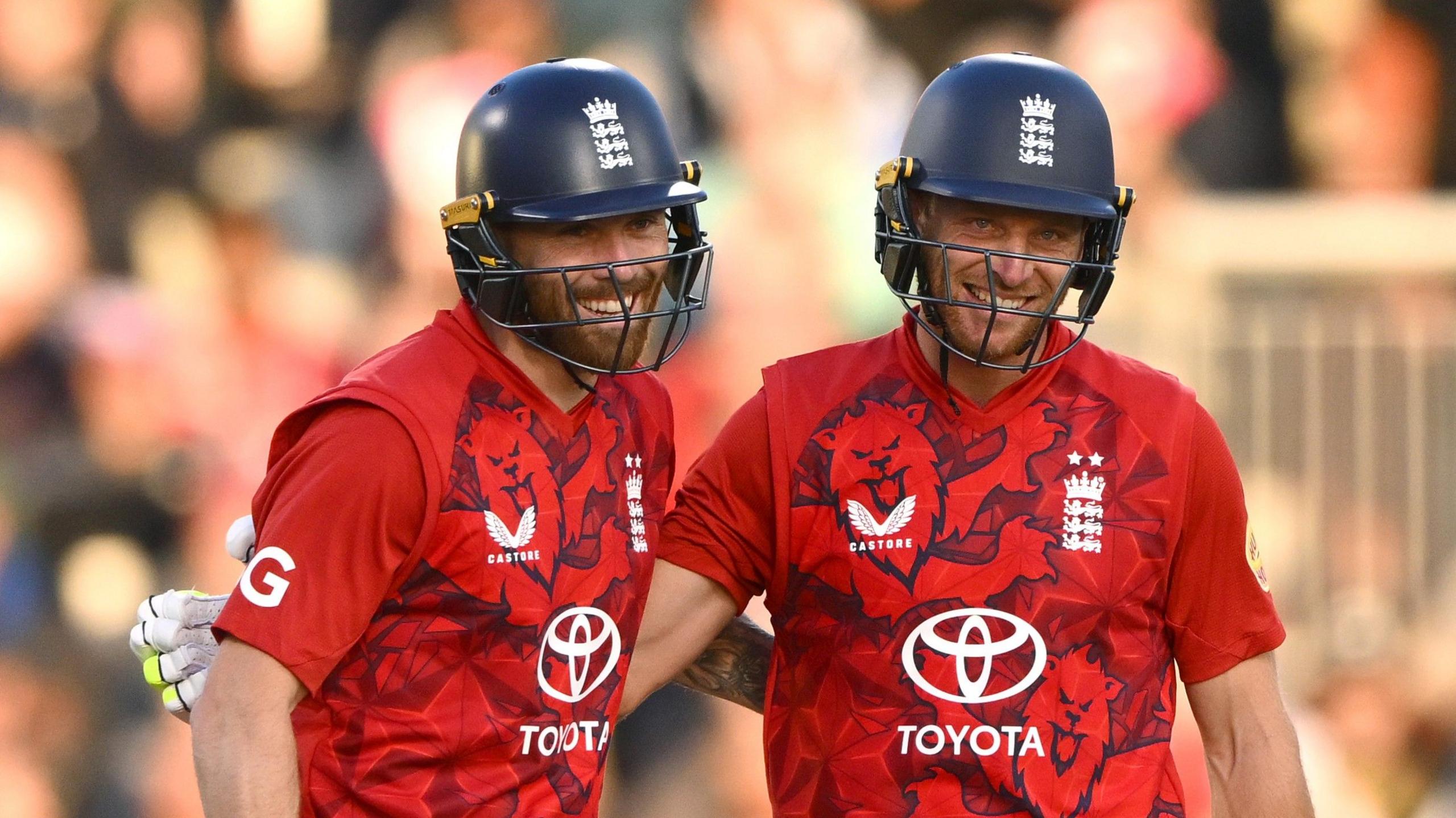
But if England are to have any chance in India and Sri Lanka, it feels like Salt and Buttler, their two leading batters, will have to hit form.
After Buttler’s period at number three, the pair were reunited as openers at the end of last summer and, despite a quiet run for Salt in Sri Lanka, have returned impressive results.
Salt hit scores of 141 not out, 85 and 89 against South Africa and Ireland. Buttler also made 83 against South Africa when an opening stand of 126 sent England on their way to a record 304-2.
Salt, a notoriously aggressive starter, cuts loose from the start, striking at 149.7 in the first two overs of T20s since the start of 2024 – the third best of any opener at this World Cup.
Buttler, in comparison, has a strike-rate of just 105 in that time. He sits back and watches Salt do his thing.
But by the final two overs of the powerplay Buttler is often flying.
The former captain, having taken a bit of time to get in, has been striking at 172.9 in the fifth and sixth overs, even outdoing Salt’s healthy strike-rate of 163.7.
Men’s ICC T20 World Cup 2026
Related topics
- England Men’s Cricket Team
- India
- Cricket
- 16 August 2025


Leave a Reply