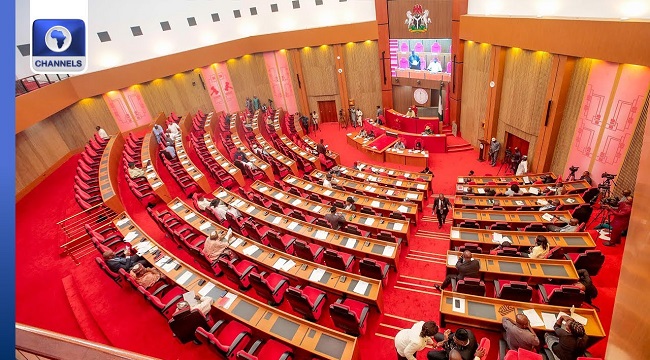
The senator representing Anambra Central, Victor Umeh, has described President Bola Tinubu’s decision to sign the Electoral Act (Amendment) Bill 2026 into law as expected, saying the legislative process clearly pointed to that outcome.
Umeh, who spoke on Channels Television’s Sunrise Daily programme on Thursday, said the political and legislative dynamics surrounding the bill made the President’s assent inevitable.
“There is no surprise that it will be so. Anybody who was expecting the president not to assent to the bill is perhaps not honest to himself or herself. The whole process was predicted to end this way, and that’s what we have seen.
“Seeing what played out in both chambers of the National Assembly, one will be expecting that at the end, the president will veto the National Assembly or say that he doesn’t want to assent to the bill…because everything was tailored to meet a certain end,” he said.
Umeh traced the controversy to the debate over electronic transmission of election results, particularly the provision now captured in Section 63 of the amended law.
READ ALSO: Tinubu Signs Electoral Act 2026 Into Law, Says ‘We Need To Avoid Glitches, Unnecessary Hacking’
He explained that the repealed Electoral Act 2022, then Section 65, only provided for the transfer of results in a manner prescribed by the electoral commission, without expressly mandating electronic transmission.
According to him, the commission’s guidelines for the 2023 general election required electronic transmission, but the law itself did not explicitly state it.
He said disputes arising from the 2023 process, especially claims of glitches affecting the presidential poll, triggered litigation that eventually reached the Supreme Court of Nigeria.
Umeh noted that the court held that electronic transmission “was not expressly recognised by the Act,” even though the Independent National Electoral Commission had the power to prescribe the mode of result transfer.
He said the amendment was therefore aimed at giving clear statutory backing to electronic transmission to avoid similar disputes.
Inside NASS Deliberations
Reflecting on the legislative process within the National Assembly of Nigeria, Umeh said the Senate initially passed a version similar to the 2022 provision, while the House of Representatives adopted mandatory electronic transmission based on recommendations from joint committees.
He disclosed that disagreements emerged within the Senate when the mandatory transmission clause was removed and replaced with a broader “transfer of results” wording, prompting protests from some lawmakers.
“When that mandatory transmission was expunged and returned to ‘transfer’ as contained in Section 65 of the Act, we made noise. We went public. We said that wasn’t what we agreed to in the Senate executive session,” he said.
READ ALSO: Electoral Act: We’ve Met Aspiration Of Nigerians, Not Few People Who Make Noise — Akpabio

Following public backlash, he said the Senate revisited the clause and reinstated electronic transmission but inserted a proviso allowing exceptions in cases of communication failure, a move that triggered fresh controversy.
Umeh argued the proviso could weaken the intent of the reform.
“If you make a law and say, ‘provided that there will be no communication failure,’ you’re already proposing that there will be a communication failure.
“Once you say if this happens, you can jettison electronic transmission, you have opened the door back to anybody who will claim that there was no internet or communication availability,” he said.
Passage, Presidential Assent

The Electoral Act generated public debate. Key proposals in the amendment included electronic transmission of results, digital voter identification using QR codes, compulsory National Identification Number linkage for voter registration, and voting rights for inmates.
Civil society groups under the “Occupy NASS” campaign demanded real-time transmission to curb manipulation, while opposition figures such as Peter Obi and Rotimi Amaechi pushed for the same cause.

Lawmakers were divided over whether electronic transmission should be compulsory or conditional, with some arguing that Nigeria’s infrastructure gaps necessitated retaining manual collation as a backup.
The bill was passed on Tuesday, February 17, after a tense session marked by disagreements across party lines, with the Senate adopting a conditional approach that allows manual collation where technological failures occur.
President Tinubu signed the legislation into law on Wednesday, February 18, citing concerns about broadband limitations, potential technical glitches and cybersecurity risks.
He maintained that election outcomes are ultimately determined by human officials, not technology alone.

Leave a Reply